By evaluating the person’s understanding of the will, their assets, and potential beneficiaries, often through a medical or psychiatric assessment.
What Is Testamentary Capacity


Testamentary capacity means the legal ability to make a valid will. In simple words, it’s the mental soundness needed to decide how to transfer your assets after death. The law expects that the person (called the testator) fully understands the effect of making a will. They should know what they own and whom they want to give it to. A testamentary capacity assessment confirms that the testator’s mental state is fit for creating a legal will.
Why Is It Important
If someone lacks testamentary capacity, their will can be thrown out by a court. That means their plan for passing on their assets may not count. A bad will can cause conflicts among family and add extra stress at a hard time. A clear will backed by proof of capacity helps keep peace.
When Is Testamentary Capacity Assessment Needed
Certain situations warrant a formal capacity assessment. Such as:
Mental Health Concerns
Some people may have mental illnesses. In such cases, a testamentary capacity assessment becomes very important. This process helps experts see if a person can make clear decisions.
Key Situations That Need It
- If the testator is elderly, check that age has not clouded their judgment.
- If they have dementia, bipolar disorder, or schizophrenia, confirm they still grasp what they’re doing.
- If families are in conflict or past wills were contested, gather clear proof the testator was of sound mind.
Role of Testamentary Capacity in Psychiatry
Psychiatrists often help in assessing testamentary capacity. They use tests and interviews to see if a person is fit to make a will.
Key Psychiatric Tests Involved:
- Memory and logic checks.
- Questions about assets and family.
- Observation for signs of delusion or confusion.
Purpose of These Tests:
The psychiatrist will check if the person:
- Understands what a will is.
- Knows their assets.
- Knows the people who may expect to receive something.
- Is free from conditions that affect decision-making.
Learn the difference between psychiatrist and psychologist.
How to Prove Testamentary Capacity
There are several methods available to demonstrate a testator’s mental fitness. You can use following ways to prove capacity:
Use Expert Help
To prove capacity, you can get expert help. A doctor or psychiatrist writes a formal paper called a medico-legal report. This report explains why the person can or cannot make a will. Lawyers can use it in court if the will is questioned.
Legal Benchmark: Banks v Goodfellow Case
In the UK, the famous case of Banks v Goodfellow sets the rule. Which states that:
“A testator shall understand the nature of the act and its effects; shall understand the extent of the property of which he is disposing; shall be able to comprehend and appreciate the claims to which he ought to give effect.”
Chief Justice Cockburn, Banks v Goodfellow (1870) LR 5 QB 549
In Banks v Goodfellow, John Banks, who had suffered delusions, left his estate to his niece. His heir argued he lacked mental fitness. The court found Banks understood he was making a will. He grasped his assets and who might inherit. He was not influenced by irrational beliefs. He knew the effect of giving away his property. This ruling defined today’s capacity test.
Common Mental Conditions That Affect Capacity
Below are the mental conditions that can affect your capacity:
Dementia
People with dementia often forget key facts. They may not recall their own children’s names. They can lose track of what they own. A detailed check helps spot these gaps. It also guides support for their daily needs.
Currently, more than 55 million people around the globe have dementia. In the future it is expected to reach 139 million by 2050. This makes assessing capacity vital, specifically in older adults.
Depression
People having depression or long term stress develop forgetfulness. Due to which they can skip naming close friends or family in their will. They might also rush the will without thinking it through. A focused test can spot these hidden issues.
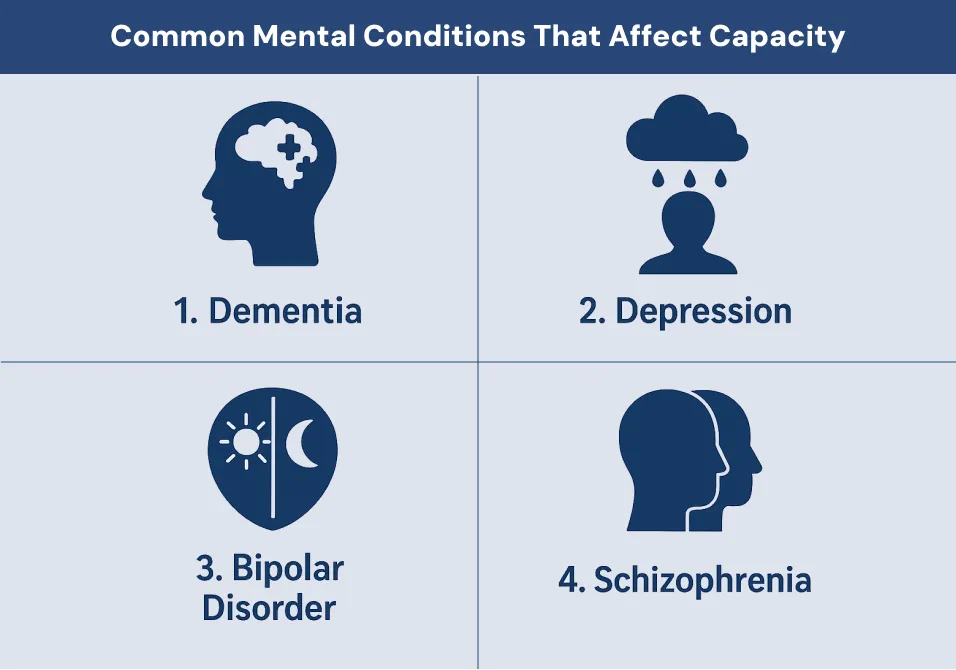
Bipolar Disorder
People with bipolar disorder can have very high and very low moods. In a manic phase, they might impulsively sign away assets. In a depressive phase, they may be too withdrawn to make any choices. Regular mental checks help ensure they are in a steady state before making a will.
Schizophrenia
In this state, delusions and strange voices can cloud real life. A person may believe odd things that don’t match facts. This can skew their choices about their state. Thorough assessments make sure their mind is clear before any decisions.
Signs That a Person Needs a Capacity Check
These clues can help you know when to request a capacity check:
- Sudden change in behaviour and so in the content of will. If plans shift fast or ideas change overnight, get a check. This can catch hidden mental trouble early.
- Family disputes around the will. If loved ones start to fight over shares, a check can end doubts. It shows the person really chose their plan.
- A history of mental health issues. Past struggles with mood or cognitive health may recur, regular capacity checks help track mental health and plan support.
- Confused or odd statements during will-writing. If the person says strange things or misnames people, pause the will-writing and test capacity first. It ensures the mind is clear or not.
Who Can Carry Out a Capacity Assessment?
Following experts can conduct capacity assessment:
- Psychiatrist experts with legal training.
- Clinical psychologists
- Doctors trained in cognitive testing.
They follow rules from The British Medical Association (BMA) and The Law Society of England and Wales.
Tips for Assessing Capacity
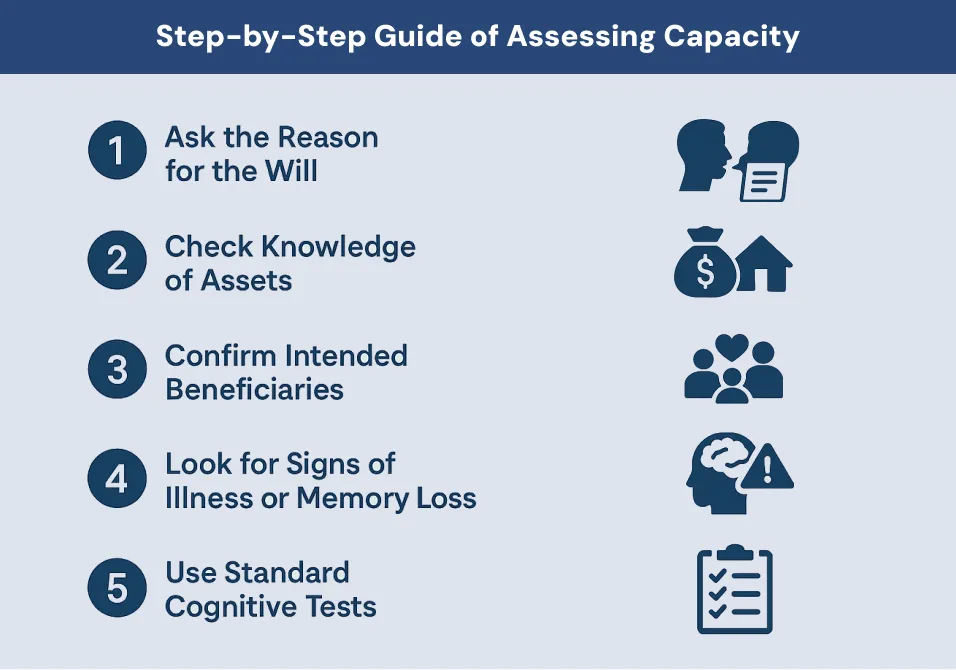
Follow the given steps for capacity assessment:
- Ask the person why they are writing a will. This shows if they grasp the purpose. It also reveals their main goals and wishes.
- Check if they know what they own. Ask them to list key assets like houses or bank accounts. See if they can name items and their financial values.
- Check if they know who should receive things. Ask them to name heirs or friends clearly. Watch if they pause or seem unsure.
- Watch for signs of illness or memory loss. Note any blank looks, wrong dates, or odd stories. These can flag deeper needs.
- Use standard tools like MMSE or ACE-R. These simple tests score memory and thinking skills. They give a clear number to track change.
Use Professional Help Early
It is smart to ask a doctor when in doubt. A strong report now can stop big problems later. It also gives the person more confidence in their choices.
Legal Advice and Precautions
These simple precautions help keep your will valid:
Include a Medical Report
- A clear medical report helps prove testamentary capacity.
- Ask the doctor to be detailed about tests and results.
Have a Lawyer Present
Make sure the lawyer checks the person’s understanding. They can also ask a few simple questions to back the report.
Need an Expert?
Testamentary capacity is not just a legal matter, it is also a medical one. Without the right mental state, a person’s will can be thrown out. If you or your family wonder about capacity in psychiatry, reach out to an expert for guidance.
Concise Medico offers clear, expert testamentary capacity assessments to ensure every will stands strong in court.
Contact Concise Medico today to get help with capacity assessment.
FAQs

Questions about treatment?
Get in touch with our team for a free consultation and quote today.
Let’s TalkServices

Medical Reports
- Nationwide Medical Services.
- We provide fully compliant CPR reports.
- Psychologists, General Practitioners and Orthopaedics.

Rehabilitation
- Tailored Treatments for the Individuals.
- Assisting you on your road to Recovery.
- Access to over 1500 Certified Therapists.

Diagnostics
- Convenient locations.
- A wide range of Non-invasive Scans.
- Guaranteed Results within 28 days, no waiting list.
Personal Injury
- Nationwide Personal Injury Medical Assessments.
- Fully Compliant CPR Part 35 Expert Reports.
- Vetted Medical Experts Across All Injury Types.





We are medical expert witness reports providers with over a decade of experience in the medico-legal field. Our collective expertise counts for up to 45 years.
We give access to a nationwide network of medical expert witnesses and rehabilitation providers.
Services
Company
Resources
Open Hours
Monday to Friday
9am — 5pm


