TABLE OF CONTENT
- Key Takeaways
- What Are Healthcare Outsourcing Services?
- What Healthcare Services Can Be Outsourced?
- What Are the Benefits and Risks of Healthcare Outsourcing?
- How to Choose a Healthcare Outsourcing Partner
- Case Study: Reducing ENT Waiting Times in South East London
- Making Informed Decisions About Healthcare Outsourcing
- FAQs
- What services can healthcare organisations outsource?
- What are the main risks of healthcare outsourcing?
- Is healthcare outsourcing suitable for the NHS?
- How much do healthcare outsourcing services cost?
- How can an organisation assess a healthcare outsourcing provider?
- How do you choose the right healthcare outsourcing partner?
Healthcare Outsourcing Services: How to Choose a Partner
Healthcare outsourcing services help organisations access specialist expertise, manage demand and support day-to-day operations. However, choosing a provider involves more than comparing prices or checking which services they offer. The right partner must understand your requirements and maintain appropriate standards of clinical quality, patient safety and data protection.
With different providers offering different levels of support, deciding which arrangement is right for your organisation can be challenging. You need to consider the services you require, the risks involved and the provider’s ability to deliver reliably.
This blog explains how healthcare outsourcing services work, which functions can be outsourced, the benefits and potential risks, and how to choose a suitable partner for your organisation.
What Are Healthcare Outsourcing Services?
Healthcare outsourcing services allow healthcare organisations to delegate specific tasks or functions to external providers rather than managing every service in-house.
These arrangements cover administrative work, medical staffing, diagnostics, rehabilitation, healthcare IT and selected clinical services. The scope depends on your organisation’s needs and the expertise available from external providers.
For example, a healthcare organisation outsources medical transcription to reduce administrative pressure or use an external provider to access diagnostic services and specialist assessments. The aim is to meet operational needs without having to develop every capability internally.
However, outsourcing does not remove your organisation’s responsibility to maintain appropriate oversight. Before the service begins, you should establish clear responsibilities, quality standards and arrangements for protecting patient information.
What Healthcare Services Can Be Outsourced?
Healthcare organisations outsource different functions depending on their operational pressures, available resources and patient needs. Healthcare outsourcing services generally fall into three categories: administrative and back-office support, clinical and medical provision, and non-clinical operations.
1. Administrative and Back-Office Services
Administrative outsourcing helps organisations manage routine processes and reduce the workload on internal teams. Common services include:
- Revenue cycle management: Managing medical billing, insurance claims, payment collection and rejected claims.
- Medical coding: Converting clinical documentation and diagnoses into standardised codes for billing and reporting.
- IT and data management: Supporting electronic health records (EHRs), IT systems, cloud infrastructure and data security.
- Patient support: Handling appointment bookings, telephone enquiries, live chats and routine patient communications.
- Medical transcription: Converting clinicians’ recorded notes into written medical documentation.
- Human resources and compliance support: Assisting with recruitment, payroll administration and relevant compliance processes.
The suitability of each service depends on your organisation’s systems, information-handling requirements and need for ongoing internal control.
2. Clinical and Medical Services
Some organisations use healthcare outsourcing clinical services when they need specialist expertise or additional clinical capacity. Examples include:
- Diagnostics and radiology: Providing MRI and CT imaging, laboratory testing, pathology and teleradiology services.
- Elective procedures and surgery: Delivering selected outpatient procedures, diagnostic interventions and suitable surgical services to help manage capacity.
- Therapy and rehabilitation: Providing physiotherapy, occupational therapy, rehabilitation and mental health services.
- Specialist medical support: Accessing external expertise for particular assessments or clinical requirements, depending on the provider’s scope and qualifications.
Non-clinical functions, such as cleaning, laundry, meal preparation and patient transport, may also be outsourced to support day-to-day healthcare operations.
Not every service is suitable for every arrangement. Clinical services may require additional checks on professional qualifications, governance, patient pathways and regulatory requirements. Your chosen provider should be able to explain how it will meet these requirements.
What Are the Benefits and Risks of Healthcare Outsourcing?
Healthcare outsourcing services give organisations access to skills and capacity that may be difficult to maintain internally. However, the value of an arrangement depends on the service being outsourced, the terms of the agreement and how effectively the provider works with your team.
Understanding the benefits and risks of healthcare outsourcing helps you decide whether an arrangement is appropriate for your organisation.
The main consideration is whether the benefits outweigh the costs and risks for your organisation. A suitable provider should be able to explain how its services will meet your needs, what safeguards are in place and how performance will be measured.
How to Choose a Healthcare Outsourcing Partner
Knowing how to choose a healthcare outsourcing partner is essential if you want reliable services without compromising quality or patient safety.
You need a provider that understands UK healthcare, protects patient information and maintains reliable service as your requirements change. The following steps help you assess your options:
1. Check UK Healthcare Experience
Look for a provider with experience in your specific area of healthcare rather than general outsourcing alone. Depending on your needs, this could include patient scheduling, waiting list validation, medical transcription, clinical administration or revenue cycle management.
Ask for case studies and references from UK NHS trusts, clinics or private healthcare providers. Check staff qualifications and familiarity with relevant NHS processes to establish whether the provider can meet your requirements.
A healthcare outsourcing provider with relevant experience should be able to explain its approach, demonstrate its capabilities and identify how it will address your organisation’s specific needs.
2. Verify Compliance and Data Security
Your outsourcing partner must handle patient and employee information in line with applicable UK data protection requirements, including the UK GDPR and Data Protection Act 2018.
Ask how the provider controls access to sensitive information, encrypts data and responds to security incidents. Review relevant security certifications, such as ISO 27001, alongside audit evidence and documented procedures.
If you work with the NHS, check the applicable information governance, clinical governance and contractual requirements. These checks are particularly important when healthcare outsourcing services involve patient records, diagnostic information or other sensitive data.
3. Establish Clear Governance and Accountability
Reliable outsourcing depends on clear responsibilities, not just a signed contract. Ask who will oversee day-to-day delivery and whether you will have a named relationship manager with relevant UK healthcare experience.
Agree on service-level agreements (SLAs) covering accuracy, turnaround times, reporting and escalation procedures. Regular performance reviews should identify problems early and establish who is responsible for resolving them.
Before appointing a healthcare outsourcing provider, make sure you understand how issues will be reported, who will make decisions and how concerns about service quality will be addressed.
4. Assess Service Quality Before Committing
Where practical, start with a small pilot project before entering a long-term agreement. Test the provider’s accuracy, response times, communication and ability to integrate with your existing workflows.
Use the results to identify gaps and agree on improvements before expanding the arrangement. For clinical services, ensure any pilot has appropriate clinical oversight and safeguards for patient safety.
A structured assessment helps you determine whether the proposed healthcare outsourcing services meet your expectations in practice, rather than relying solely on promises made during the sales process.
5. Compare Costs and Financial Fit
Compare the full cost of each provider, not just the headline price. Fixed-fee, hourly and tiered pricing models offer different levels of predictability, so consider which best suits your workload and budget.
When assessing the cost of healthcare outsourcing services, check for additional charges covering setup, training, technology integration and work outside the agreed scope. You should also consider ongoing management costs and any fees that may apply if your requirements change.
If you operate within an NHS or private healthcare budget, assess whether the proposed arrangement offers sustainable value without compromising service quality.
The cheapest option may not always offer the best value. A more suitable provider may justify its fees through relevant expertise, reliable delivery and clear accountability.
6. Check Capacity, Technology and Scalability
Your provider should be able to manage current demand and respond to changes in workload, such as growing patient backlogs or seasonal fluctuations.
Ask whether it has enough trained staff, suitable technology and contingency arrangements to maintain service during busy periods or disruptions. Confirm that its systems can integrate with your existing processes and that any automation genuinely improves efficiency without creating additional risks.
If your organisation expects demand to grow, discuss how the provider will increase capacity and whether additional resources will affect the cost of healthcare outsourcing services.
7. Review Contract Terms and Exit Arrangements
Before signing, make sure the contract clearly defines the service scope, responsibilities, performance standards, costs and procedures for resolving disputes.
It should also explain how the partnership can end, including notice periods, data return or transfer and the handover of ongoing work. A clear exit plan reduces the risk of disruption and prevents your organisation from becoming unnecessarily dependent on one provider.
Finally, assess how well the provider communicates and works with your team. Shared expectations, transparent reporting and an understanding of your organisation’s working culture make the difference between a contract that looks good on paper and a partnership that works in practice.
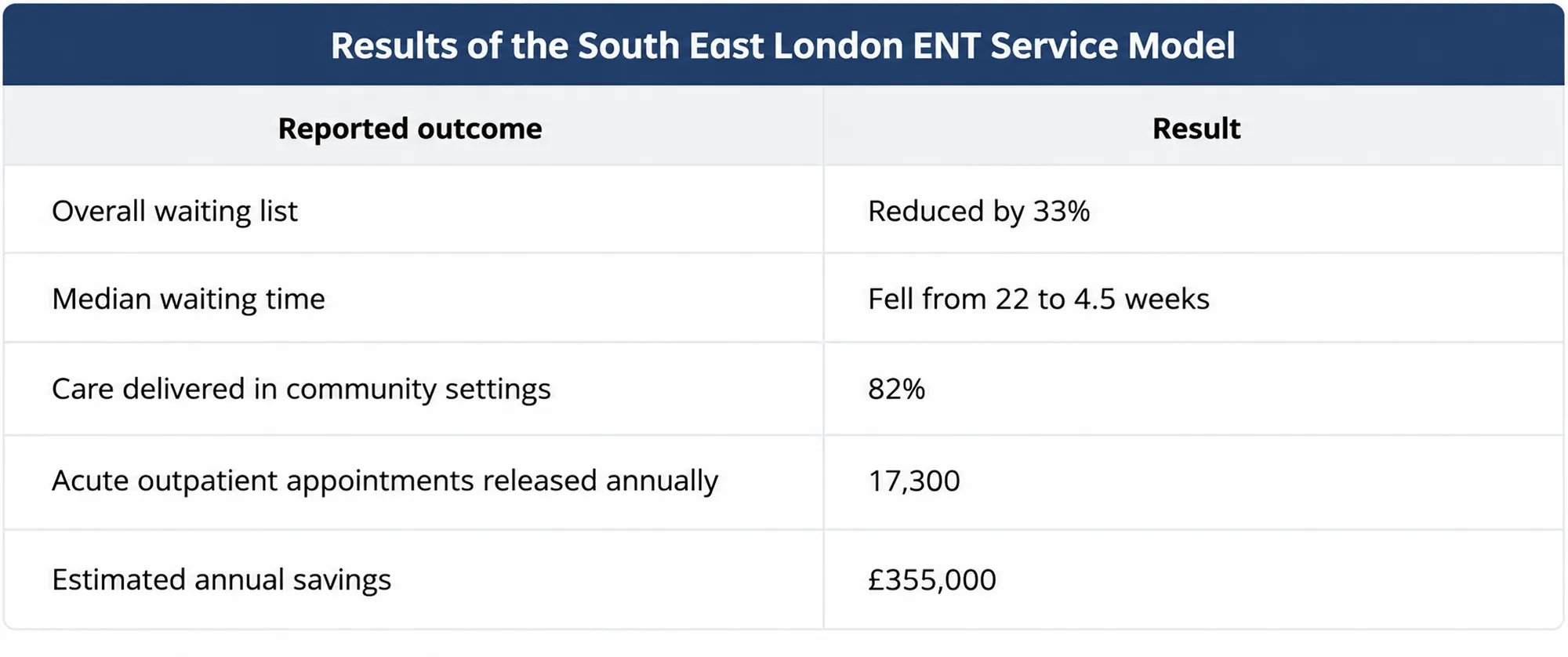
Case Study: Reducing ENT Waiting Times in South East London
South East London faced growing demand for ear, nose and throat (ENT) services, with its waiting list exceeding 26,500 patients by June 2024. Workforce shortages and limited community capacity placed additional pressure on hospital services.
To address the backlog, healthcare providers introduced a coordinated model linking primary care, community clinics and hospitals. The approach included streamlined referrals, one-stop appointments and shared clinical governance to improve access while maintaining care standards.
This example illustrates how coordinated service delivery helps healthcare organisations respond to capacity pressures. When considering healthcare outsourcing services, organisations should assess whether a proposed model can improve access and efficiency while maintaining clinical oversight and continuity of care.
Making Informed Decisions About Healthcare Outsourcing
Choosing the right healthcare outsourcing partner helps your organisation improve efficiency, access specialist expertise and maintain high standards of patient care. The key is finding a provider that understands your operational needs and delivers reliable, high-quality support.
Whether you need medical assessments, diagnostic services, rehabilitation or medico-legal reporting, the right healthcare outsourcing services help you manage growing workloads without compromising patient safety or service quality. To support these needs, Concise Medico provides specialist medical and medico-legal services that help healthcare organisations manage demand, streamline operations and maintain reliable service delivery.
FAQs