TABLE OF CONTENT
Types of Medico-Legal Reports Explained: Which Specialism Fits Your Claim?
What happens when a serious injury affects several parts of your life at once? You may experience physical pain, psychological symptoms, difficulty returning to work and uncertainty about how your condition will develop.
One medical report may not address all these issues.
This is where medico-legal reports become important. Different experts assess different medical and functional issues, helping explain the nature of an injury, its possible causes and its likely impact.
Choosing the right expert is not simply about finding a doctor with impressive qualifications. The expert needs the relevant knowledge, training and experience to address the specific questions arising in your claim.
What Are Medico-Legal Reports?
Medico-legal reports are medical reports prepared to assist with legal claims or disputes. They provide expert opinions on medical issues relevant to the case.
Depending on the circumstances, a report may address diagnosis, causation, prognosis, treatment needs and the effect of an injury on daily activities or the ability to work.
Under CPR Part 35, expert evidence must be restricted to what is reasonably required to resolve the proceedings. Experts also have an overriding duty to help the court on matters within their expertise. This duty takes precedence over any obligation to the person instructing or paying them.
Practice Direction 35 further requires experts to identify when an issue falls outside their expertise or when the available information prevents them from reaching a definite opinion. Selecting an appropriately qualified specialist is therefore essential to obtaining relevant and reliable evidence.
What Are the Main Medico-Legal Report Types?
There is no single list of medico-legal reports types that applies to every claim. The appropriate report depends on the injury, the questions that need answering and the evidence required.
1. Orthopaedic Reports
An orthopaedic expert assesses injuries affecting the musculoskeletal system, including bones, joints, muscles, ligaments and the spine. These reports may be relevant in cases involving:
- Road traffic accidents
- Workplace accidents
- Falls
- Fractures and joint injuries
- Spinal injuries
- Soft tissue injuries
An orthopaedic report may address the nature and severity of an injury, treatment received, ongoing symptoms, causation and prognosis.
Specific procedural requirements also apply to certain low-value road traffic accident claims involving whiplash or other soft tissue injuries. Depending on the claim, these may include requirements concerning fixed-cost medical reports and the use of an appropriately accredited expert through MedCo.
2. Neurological Reports
A neurological report may be appropriate when an injury or condition affects the brain, spinal cord or peripheral nervous system. Relevant claims may involve:
- Traumatic brain injury
- Nerve damage
- Seizures
- Neurological symptoms following an accident
- Other neurological conditions linked to the incident in question
A neurological report assesses neurological symptoms and provides an expert opinion on diagnosis, causation and prognosis, where these matters fall within the neurologist’s expertise.
The appropriate specialist depends on the nature of the injury. For example, some cases may require a neurosurgical opinion, particularly where the issues concern surgical treatment or the consequences of a neurosurgical injury.
3. Neuropsychological Reports
Neuropsychological reports are particularly relevant when a brain injury may have affected memory, concentration, attention, language, executive function or other cognitive abilities.
A neuropsychological assessment may involve standardised cognitive tests, clinical interviews and a review of relevant medical information. This can provide a more detailed picture of cognitive functioning than self-reported symptoms alone.
Such evidence may help clarify the nature and extent of cognitive difficulties and their effect on everyday activities, education or employment. The assessment may also consider whether the findings are consistent with the injury and other relevant factors.
4. Psychiatric Reports
A psychiatric report focuses on mental health conditions, their causes and their effects on the individual. Psychiatric evidence may be relevant to claims involving:
- Depression
- Anxiety disorders
- Post-traumatic stress disorder (PTSD)
- Adjustment disorders
- Other psychiatric conditions arising or worsening after an accident or medical event
A psychiatrist is a medical doctor specialising in mental health. Within their area of expertise, they may assess diagnosis, causation, pre-existing conditions, treatment requirements and prognosis.
The psychiatric report may also consider how the condition affects the person’s daily activities, relationships and ability to work.
5. Psychological Reports
A psychological report assesses psychological functioning, symptoms and the impact of an injury or traumatic event.
Psychologists and psychiatrists have different professional roles. A psychiatrist is a medical doctor who can assess mental health conditions from a medical perspective, while a psychological report may assess emotional and cognitive functioning using recognised psychological assessment methods.
The appropriate expert depends on the questions the case needs to address, the nature of the symptoms and the professional’s specific qualifications and experience.
6. Pain Medicine Reports
Some people experience persistent or complex pain following an injury, surgery or another medical event. In certain cases, the pain may continue after the original injury has healed or may be more severe or persistent than would ordinarily be expected. A pain medicine specialist may be appropriate for claims involving:
- Chronic or persistent pain
- Pain following surgery or injury
- Complex regional pain syndrome
- Complex pain management needs
- The effect of pain on mobility, function and daily activities
The specialist may assess possible causes, relevant diagnoses, treatment options and prognosis. The pain expert report can also explain how persistent pain affects the person’s ability to carry out everyday tasks.
7. Clinical Negligence Reports
Clinical negligence claims require careful matching between the alleged error and the expert’s clinical expertise.
For example, a claim concerning an orthopaedic operation may require an orthopaedic surgeon with relevant experience. A claim involving delayed diagnosis of a neurological condition may require a neurologist or another specialist with appropriate expertise in that condition.
Depending on the allegations, separate experts may be needed to address different aspects of the case, including the standard of care, whether that standard was breached, causation and the resulting injury.
The key consideration is not simply whether an expert is medically qualified. Their knowledge, training and experience must be relevant to the specific clinical questions they are being asked to address.
Which Medico-Legal Report Type Do You Need?
The most useful starting point is the medical question that needs answering, rather than the name of the claim alone:
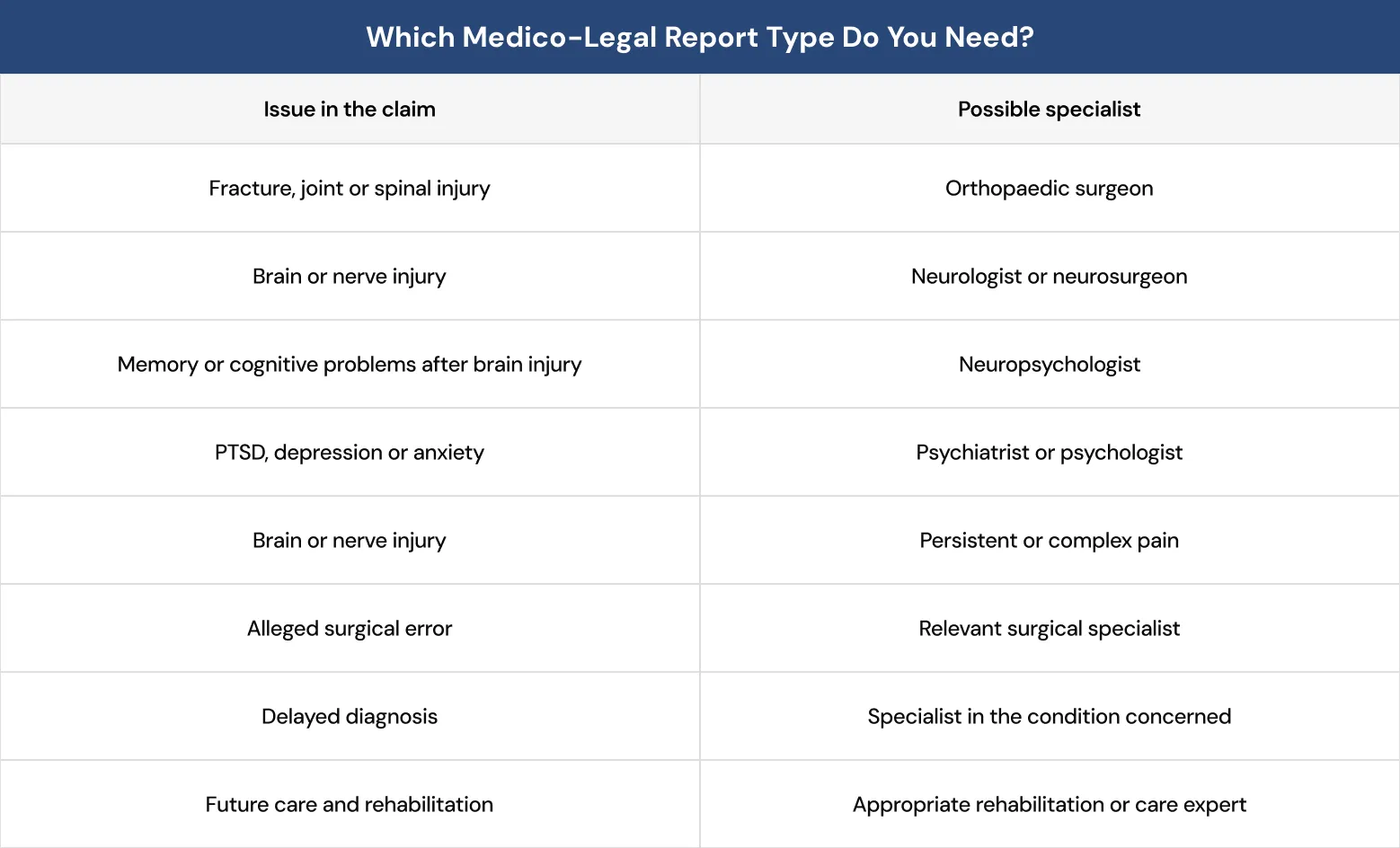
This table provides a general guide rather than a definitive list. Some cases require more than one specialist, and the appropriate expert depends on the facts, the issues in dispute and the expertise needed to address them.
Can One Claim Need More Than One Medical Report?
Yes. A complex claim may require reports from several experts when different medical or functional questions need to be addressed.
For example, someone with a serious brain injury may need neurological evidence about the injury itself, neuropsychological evidence about cognitive impairment and psychiatric evidence about any associated mental health condition. A separate care or occupational therapy assessment may be needed to evaluate the effect on everyday activities and future support needs.
However, more reports do not automatically make a claim stronger. Under CPR Part 35, expert evidence must be reasonably required to resolve the proceedings, and the court controls whether parties may rely on it.
The aim is therefore to obtain evidence that addresses the relevant questions clearly, rather than to commission the largest possible number of reports.
Case Study: Why the Right Specialist Matters
In HJ v Burton Hospitals NHS Foundation Trust [2018] EWHC 1227 (QB), the defendant challenged a trial judge’s decision to accept an occupational therapist’s evidence on certain care needs and equipment, even where it differed from the evidence of a jointly instructed orthopaedic and hand surgeon.
The High Court rejected the argument that the surgeon’s evidence automatically took precedence. It recognised that experts from different disciplines can have overlapping areas of expertise and that their evidence must be assessed in the context of the particular issues being considered.
The occupational therapist’s practical experience was relevant to the disputed questions about care, support and equipment. The judgment illustrates why an expert’s suitability depends on the issue being assessed, rather than seniority or professional title alone.
The wider lesson is that different experts may contribute valuable evidence from their respective areas of knowledge. Their opinions should be considered in light of their expertise and the specific questions the court needs to resolve.
What Should You Check Before Choosing an Expert?
The expert’s specialism is an important starting point, but other factors also matter. Before an expert is instructed, consider whether they:
- Have relevant clinical qualifications, training and experience.
- Regularly assess or treat the condition or injury in question.
- Have the expertise needed to address the specific issues in the claim.
- Can provide an independent, objective opinion.
- Understand the requirements of CPR Part 35 and the relevant guidance where their report will be used as expert evidence in civil proceedings.
- Can explain complex medical evidence clearly and support their conclusions with appropriate reasoning.
The qualifications and experience required will depend on the nature and complexity of the case. A specialist’s professional title alone does not establish that they are suitable for every issue within that field.
The focus should be on finding an expert whose expertise matches the questions the report needs to answer.
Conclusion
Choosing between medico-legal report types involves more than selecting a medical professional with a relevant job title. The expert must have the appropriate knowledge and experience to address the medical issues at the centre of the claim.
Matching the injury, the legal questions and the expert’s expertise helps produce focused evidence about the claimant’s condition, prognosis and support needs.
At Concise Medico, identifying the appropriate medical specialism for a case is an important step towards obtaining relevant evidence to support the claims process.