TABLE OF CONTENT
The mental health of the people seeking safety in the UK is alarming. Mostly, asylum seekers face grief and loss. They have to face extreme stress during their journey.
Do you know that just in 2024, 123 million people were displaced globally? Yes, They are.
People struggle after crossing the border. They are uncertain about upcoming events. They also receive limited financial support. If these problems are addressed at an early stage, it leads to better support and care.
In this blog, we look at the asylum seeker’s problems during and post journey. We also cover its impact on their mental health and the role of policies.
The Level of the Mental Health Crisis
The most common issue among asylum seekers is mental health issues. Only in 2024, millions of people be displaced. Unfortunately, many of them are children.
There is evidence of depression and fear among them. They also face anxiety and PTSD issues. Without early support, stress may turn into a crisis. The magnitude of the problem is also recognised as a critical element of effective mental health responses. Without understanding the scale, you can’t fix it.
“There is no health without mental health, and this is especially true for people who have fled war, torture and persecution. Protection must include psychological care.”
Dr Tedros Adhanom Ghebreyesus, Director-General, WHO
Experiences Before Arrival in the UK
An asylum seeker may face war or torture before coming to the UK. Some have seen things no
one should see. Many have faced harm or lost family. Long and risky journeys involve hunger and fear. These events can cause constant mental harm. They don’t disappear overnight.
Let’s break it down further:
- Depression and anxiety are very common among them.
- In some cases, people develop PTSD or other mental health problems
- The trauma affects mental health after they arrive.
Stress During the Journey
An asylum seeker has to cross several borders while fearing arrest. The journey is not always safe. They cannot sleep well on the way due to fear.
Many people travel without help. These challenges increase stress. Later, stress weakens their capacity to cope with problems. This period can cause mental health problems later.
Challenges After Arrival
For asylum seekers UK, arrival does not mean they get early support. Slow asylum decisions create daily stress. Many live in fear of removal. They don’t have a clue what will happen next.
Can you imagine living without knowing your future? They also have very little financial support.
Most of them cannot work or study. These pressures make their mental health worse. This makes people depend more on mental health asylums and emergency services instead of early help.
Effect of Housing on Wellbeing
Stable housing is a very important factor that affects mental health. Here’s why? Asylum seekers live in temporary or overcrowded houses. Moving often disturbs their daily routine. Bad conditions also add to it. This environment affects rest and mood. It also disturbs their sleepcycle.
Unstable housing can cause depression and suicidal thoughts. It also increases the demand for mental health asylums instead of community care.
The Fatal Role of Poverty and Unemployment
Poverty is one of the important factors that affects mental health badly. Asylum seekers receive limited financial support. This makes it hard to buy essentials or travel.
Inability to work harms purpose and self respect. Many people are stuck and dependent. This situation increases depression. Poverty often leads to an increasing crisis and use of mental health services.
Loneliness and Social Isolation
Social isolation has lasting impacts on many people. It affects those who cannot speak the language well. Many live far away from support networks. They are also away from their family. Loneliness can further make them feel more hopeless.
People also judge them, so they feel worried. As a result, they avoid asking for help. With time, isolation becomes a risk to their mental health.
The Effects of Delayed Asylum Decisions
It takes a long time to seek asylum. This wait often increases stress. They don’t know how to plan their future. This kind of legal uncertainty is a source of continuous stress. On top of it, the fear of removal makes it stronger. Uncertainty becomes part of their life. The rapid decision-making procedure would decrease mental health issues. It also decreases emergency service dependency.
Barriers to Accessing Healthcare
Accessing healthcare in the UK can be difficult. Many asylum seekers may not know how the NHS system works. Delays happen due to language barriers. Some fear sharing their personal details.
Appointments may be difficult to attend because of travel costs. Issues grow before they get help. By the time help arrives, smaller problems turn into bigger. As a result, they may reach the point of crisis rather than get early aid in terms of asylum mental illness.
Children and Family Pressures
Stress is the factor that affects the family the most. The children of asylum seekers also have disturbed education and unsafe housing. Parents feel weak and guilty. Stress affects the bond within a family. Children feel upset. This continuous stress can lead to severe mental health problems.
Related: How do mental health issues affect children?
Case Study: Mental Health Concerns at RAF Wethersfield
Background
This was the case in 2023–2024, when male asylum seekers were waiting for decisions at RAF Wethersfield in Essex. Medical organisations like Doctors Without Borders (MSF) provided them with limited healthcare services. Many residents were afraid when they got to the UK.
What happened
People living in a big and isolated house experience stress. They suffered from anxiety and depression. Suicidal thoughts came to their minds. Symptoms linked to asylum illness were worsened by long waits and uncertainty about the future.
Support provided
MSF and doctors of the world gave medical checkups and basic mental health support. Clinicians noted that it was a place that could not allow recovery. Institutional housing made people more dependent on crisis responses rather than community care or mental health asylums.
Results
Medical staff noted that locations like Wethersfield are bad for mental health. They suggested community homes and early help to prevent crises for people.
What Helps Protect Mental Health
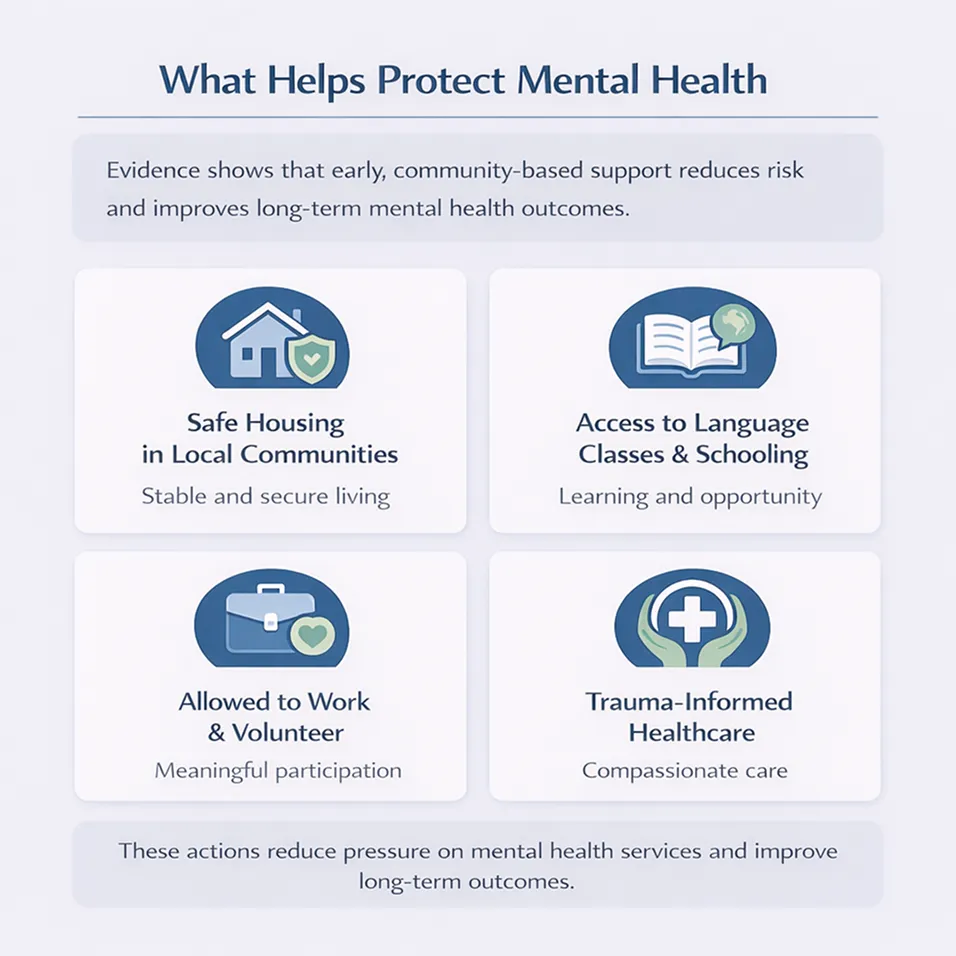
Evidence shows that some actions reduce risks and improve healing. The best help is early support from the community. Key ways to protect mental health are:
- Safe housing in the local societies
- Access to Language classes and schooling
- Allowed to work and volunteer
- Traumainformed healthcare
These will reduce pressure on the mental health of asylum seekers. It also improves the lifelong results for all of them.
Related: Refugee mental health UK
The Importance of Integration
Being included is more about mental well-being than social life. When people value someone, that person feels more confident and secure. Because:
- Being part of a community builds confidence and trust
- Engaging with locals is important
- Integration reduces stigma and fear
- According to research, inclusive policies lower mental health crises
- With good integration, there is less reliance on mental health asylums
Policy and Service Responsibilities
Public services are key in supporting mental health. Policies must address mental health.
Faster decisions reduce people’s anxiety. Safe housing also reduces their fear. The presence of trained staff increases trust and results. A polite model reduces the crisis of asylum mental diseases. This also improves welfare in society.
On the contrary, the failure of the system leads to a decrease in mental health.
Why Awareness Benefits Everyone
Mental health helps the whole community. When an asylum seeker feels well, he joins community life. Early support costs less than crisis treatment. Reducing stigma helps people learn about mental health.
Mental health support also strengthens the community. Early responses reduce pressure on health care.
The Role of Trauma-Informed Care
Proper care is essential for asylum seekers. Many people suffered violence, fear and loss. The health services must understand how trauma affects behaviour.
Safety, trust and cultural sensitivity improve their involvement. It also helps in recovery. If services use good care, they can prevent crises. It also increases mental health over time.
Conclusion
This is the fact that asylum seekers have serious mental health issues. They are in good mental condition when they arrive. Their health deteriorates because of poor living conditions and delays. The right policies can prevent these. Good care and stable housing help in recovery. Involvement also accelerates this process. The government can perform better by protecting mental health at any cost. This is necessary for dignity, recovery and social unity.
This article is informational only. It can not replace clinical advice. Concise Medico understands that each patient has a different situation. We can guide you on early help and support options. Contact us now to know how you can perform better.
FAQs
The mental health of the people seeking safety in the UK is alarming. Mostly, asylum seekers face grief and loss. They have to face extreme stress during their journey.
Do you know that just in 2024, 123 million people were displaced globally? Yes, They are.
People struggle after crossing the border. They are uncertain about upcoming events. They also receive limited financial support. If these problems are addressed at an early stage, it leads to better support and care.
In this blog, we look at the asylum seeker’s problems during and post journey. We also cover its impact on their mental health and the role of policies.
The Level of the Mental Health Crisis
The most common issue among asylum seekers is mental health issues. Only in 2024, millions of people be displaced. Unfortunately, many of them are children.
There is evidence of depression and fear among them. They also face anxiety and PTSD issues. Without early support, stress may turn into a crisis. The magnitude of the problem is also recognised as a critical element of effective mental health responses. Without understanding the scale, you can’t fix it.
“There is no health without mental health, and this is especially true for people who have fled war, torture and persecution. Protection must include psychological care.”
Dr Tedros Adhanom Ghebreyesus, Director-General, WHO
Experiences Before Arrival in the UK
An asylum seeker may face war or torture before coming to the UK. Some have seen things no
one should see. Many have faced harm or lost family. Long and risky journeys involve hunger and fear. These events can cause constant mental harm. They don’t disappear overnight.
Let’s break it down further:
- Depression and anxiety are very common among them.
- In some cases, people develop PTSD or other mental health problems
- The trauma affects mental health after they arrive.
Stress During the Journey
An asylum seeker has to cross several borders while fearing arrest. The journey is not always safe. They cannot sleep well on the way due to fear.
Many people travel without help. These challenges increase stress. Later, stress weakens their capacity to cope with problems. This period can cause mental health problems later.
Challenges After Arrival
For asylum seekers UK, arrival does not mean they get early support. Slow asylum decisions create daily stress. Many live in fear of removal. They don’t have a clue what will happen next.
Can you imagine living without knowing your future? They also have very little financial support.
Most of them cannot work or study. These pressures make their mental health worse. This makes people depend more on mental health asylums and emergency services instead of early help.
Effect of Housing on Wellbeing
Stable housing is a very important factor that affects mental health. Here’s why? Asylum seekers live in temporary or overcrowded houses. Moving often disturbs their daily routine. Bad conditions also add to it. This environment affects rest and mood. It also disturbs their sleepcycle.
Unstable housing can cause depression and suicidal thoughts. It also increases the demand for mental health asylums instead of community care.
The Fatal Role of Poverty and Unemployment
Poverty is one of the important factors that affects mental health badly. Asylum seekers receive limited financial support. This makes it hard to buy essentials or travel.
Inability to work harms purpose and self respect. Many people are stuck and dependent. This situation increases depression. Poverty often leads to an increasing crisis and use of mental health services.
Loneliness and Social Isolation
Social isolation has lasting impacts on many people. It affects those who cannot speak the language well. Many live far away from support networks. They are also away from their family. Loneliness can further make them feel more hopeless.
People also judge them, so they feel worried. As a result, they avoid asking for help. With time, isolation becomes a risk to their mental health.
The Effects of Delayed Asylum Decisions
It takes a long time to seek asylum. This wait often increases stress. They don’t know how to plan their future. This kind of legal uncertainty is a source of continuous stress. On top of it, the fear of removal makes it stronger. Uncertainty becomes part of their life. The rapid decision-making procedure would decrease mental health issues. It also decreases emergency service dependency.
Barriers to Accessing Healthcare
Accessing healthcare in the UK can be difficult. Many asylum seekers may not know how the NHS system works. Delays happen due to language barriers. Some fear sharing their personal details.
Appointments may be difficult to attend because of travel costs. Issues grow before they get help. By the time help arrives, smaller problems turn into bigger. As a result, they may reach the point of crisis rather than get early aid in terms of asylum mental illness.
Children and Family Pressures
Stress is the factor that affects the family the most. The children of asylum seekers also have disturbed education and unsafe housing. Parents feel weak and guilty. Stress affects the bond within a family. Children feel upset. This continuous stress can lead to severe mental health problems.
Related: How do mental health issues affect children?
Case Study: Mental Health Concerns at RAF Wethersfield
Background
This was the case in 2023–2024, when male asylum seekers were waiting for decisions at RAF Wethersfield in Essex. Medical organisations like Doctors Without Borders (MSF) provided them with limited healthcare services. Many residents were afraid when they got to the UK.
What happened
People living in a big and isolated house experience stress. They suffered from anxiety and depression. Suicidal thoughts came to their minds. Symptoms linked to asylum illness were worsened by long waits and uncertainty about the future.
Support provided
MSF and doctors of the world gave medical checkups and basic mental health support. Clinicians noted that it was a place that could not allow recovery. Institutional housing made people more dependent on crisis responses rather than community care or mental health asylums.
Results
Medical staff noted that locations like Wethersfield are bad for mental health. They suggested community homes and early help to prevent crises for people.
What Helps Protect Mental Health
Evidence shows that some actions reduce risks and improve healing. The best help is early support from the community. Key ways to protect mental health are:
- Safe housing in the local societies
- Access to Language classes and schooling
- Allowed to work and volunteer
- Traumainformed healthcare
These will reduce pressure on the mental health of asylum seekers. It also improves the lifelong results for all of them.
Related: Refugee mental health UK
The Importance of Integration
Being included is more about mental well-being than social life. When people value someone, that person feels more confident and secure. Because:
- Being part of a community builds confidence and trust
- Engaging with locals is important
- Integration reduces stigma and fear
- According to research, inclusive policies lower mental health crises
- With good integration, there is less reliance on mental health asylums
Policy and Service Responsibilities
Public services are key in supporting mental health. Policies must address mental health.
Faster decisions reduce people’s anxiety. Safe housing also reduces their fear. The presence of trained staff increases trust and results. A polite model reduces the crisis of asylum mental diseases. This also improves welfare in society.
On the contrary, the failure of the system leads to a decrease in mental health.
Why Awareness Benefits Everyone
Mental health helps the whole community. When an asylum seeker feels well, he joins community life. Early support costs less than crisis treatment. Reducing stigma helps people learn about mental health.
Mental health support also strengthens the community. Early responses reduce pressure on health care.
The Role of Trauma-Informed Care
Proper care is essential for asylum seekers. Many people suffered violence, fear and loss. The health services must understand how trauma affects behaviour.
Safety, trust and cultural sensitivity improve their involvement. It also helps in recovery. If services use good care, they can prevent crises. It also increases mental health over time.
Conclusion
This is the fact that asylum seekers have serious mental health issues. They are in good mental condition when they arrive. Their health deteriorates because of poor living conditions and delays. The right policies can prevent these. Good care and stable housing help in recovery. Involvement also accelerates this process. The government can perform better by protecting mental health at any cost. This is necessary for dignity, recovery and social unity.
This article is informational only. It can not replace clinical advice. Concise Medico understands that each patient has a different situation. We can guide you on early help and support options. Contact us now to know how you can perform better.