TABLE OF CONTENT
What Is The Bolam Test?
It has been found that the NHS received 13,784 new cases and incidents of clinical negligence in the year 2023/24.
The Bolam test is considered to be the most vital principle under the law of medical negligence in the UK. This principle is the legal principle which assists the court in deciding whether the health care professional like a doctor, a nurse or any other health care professional has met the standard of care.
This guide contains information about the history, application, workings, and significance of the Bolam test.
History of Bolam Test?
The history of the Bolam test dates back to 1950 in England. Prior to this case, there was no set legal criteria to determine the standard of care of a medical expert.
The legal case of Bolam v Friern Hospital Management Committee [1957] established the legal principle which stated that when a healthcare provider acts according to accepted medical practice, then he cannot be held accountable. This test came to be known as the Bolam test.
Since then, the Bolam test has continued to be one of the key legal rule in the medical negligence law of the UK.
Bolam v Friern Hospital Management Committee 1957
The Bolam test is named after Mr John Hector Bolam, a patient of depression, who was treated at Friern Hospital in London. ECT treatment was provided to him, which was popular in the 1950s for mental illnesses.
Mr Bolam did not receive any restraints during the course of his treatment. His body made an involuntary move during the process of treatment, resulting in fractures. He sued the hospital on grounds of negligence and lack of warning about the risk involved.
In this case, the defence contended that there were many doctors who held an opinion that muscle relaxers and restraints were not always necessary. The medical experts submitted an opinion to the court that this procedure was acceptable to a responsible body of healthcare practitioners. The court considered the opinions of the experts before taking any decision. In light of these opinions, Justice McNair decided in favour of the hospital. The opinion given by Justice McNair was that a doctor cannot be considered negligent when he follows the accepted practice of a responsible body of healthcare practitioners.
The Importance of the Bolam Test in Cases of Medical Negligence
This test is essential because it enables courts to fairly and consistently judge cases of medical negligence. Medical practice is filled with many complex issues which only an expert can properly judge on. The patient has a right to expect that his healthcare provider would adhere to professional standards of practice.
At the same time, a healthcare provider cannot be regarded as negligent just because a particular method failed to achieve the desired result.
Another significance of the Bolam test is that it promotes excellence in health care practice. Doctors are aware that any decision they make will have to stand the test of comparison against the established medical practice.
“A doctor is not guilty of negligence if he has acted in accordance with a practice accepted as proper by a responsible body of medical men skilled in that particular art.”
Justice McNair
When Is the Bolam Test Applied?
The Bolam test is applied when it is necessary to determine whether a standard of care was provided by a healthcare professional or not. This test is applied to medical negligence where a patient has a claim that an error led to damage.
Below are 2 situations in which the Bolam test is applied:
1. Misdiagnosis Claims
Misdiagnosis means that a health condition is not diagnosed properly or at all. It results in inappropriate treatment of the condition or its delayed treatment. In this case, the Bolam test is applied in order to establish whether the healthcare professional was reasonable in his/her actions or not.
2. Surgical Negligence Claims
There is a lot of planning, skill and decision-making in any surgery. However, even if the surgery is conducted perfectly, problems can arise. In the eyes of the law, not every problem is due to medical negligence. When a patient makes a claim against a surgeon for making an error that could have been avoided during surgery, the Bolam test can be applied.
How Is the Bolam Test Applied?
The Bolam test is used by the court in cases where the court needs to make a decision about whether the standard of care of the healthcare expert was met or not. The court examines the record of the patient, the test result, treatment notes and other evidence. In addition, the court takes into account the available information at the time of treatment of the healthcare expert. It is necessary for the court to use the expertise of the group of medical experts in this field to evaluate the standard of care and treatment according to the existing acceptable medical practice. The court makes its decision based on the existing facts but not the information revealed later.
The court makes a decision regarding whether the healthcare expert was careful enough.
The usual procedure of the Bolam test applied consists of the following steps:
1. Duty of Care
Here the court determines if the healthcare expert owed any duty of care to the patient. Generally, such a duty arises once the healthcare expert accepts to conduct an examination, give an opinion or treat the patient.
2. Evaluation of the Medical Treatment
Records, reports of the examinations, scans and test results are considered. The court takes a careful look at the treatment received by the patient and whether the medical procedures were followed accordingly or not.
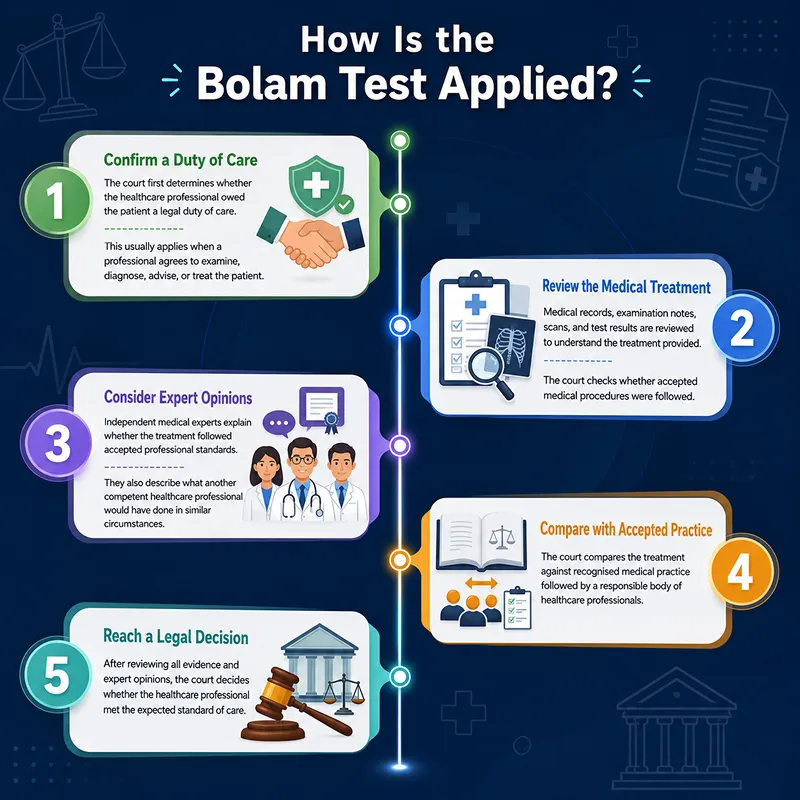
3. Experts’ Opinions
Here independent experts give opinions about whether the treatment followed professional norms or not and how the treatment should be conducted in the same case but by another doctor.
4. Comparison to Professional Practice
It is determined whether a responsible body of health professionals would act in the same way. The treatment is compared with the recognised medical practice at the moment of the treatment.
5. Legal Conclusion
In the last step the judge makes the decision about negligence of the health care expert or lack thereof.
Does the Bolam Test Still Apply Today?
Yes, the Bolam test is still relevant in today’s UK litigation concerning medical negligence. The Bolam test remains one of the key principles in the area of medical negligence that can be applied to determine whether a healthcare provider complied with the required standard of care.
Nevertheless, there have been developments in medical law. Some recent cases of the court have supplemented the original Bolam test in order to ensure its relevance to the contemporary practice of healthcare.
Refinement of the Key Point
The 1997 landmark case of “Bolitho v City and Hackney Health Authority” modified the Bolam test. This ruling neither superseded the Bolam doctrine nor introduced any changes to it but rather provided an additional layer of protection to guarantee that expert opinion would be properly scrutinised.
“Bolitho v City and Hackney Health Authority” was delivered some four decades after the Bolam test. This decision contributed to the improvement of the process of judicial assessment of claims for medical negligence. In this case, a seven-year-old boy named Patrick Bolitho had sustained severe brain injury because of the delayed intubation to assist with breathing. Patrick Bolitho subsequently died and his parents alleged that his condition could have been improved through timely medical care.
The House of Lords acknowledged that opinions of experts are highly valued but, at the same time, pointed out that judges could not rely on any expert opinion blindly. In fact, the judge needed to determine whether such an opinion was reasonable, responsible and logical.
The test of Bolitho improved the Bolam test because the judge received additional power for the evaluation of the opinion of experts. In case a certain opinion of a doctor is not based on logic or lacks proper justification, such an opinion could be rejected by the judge.
Case Study: Vision Damage Permanently
In the Northern Ireland High Court case McGovern v James A. Sharkey and Belfast Health & Social Care Trust [2014] NIQB 117, the patient alleged that the negligence of the defendant in diagnosing and treating a detached retina resulted in permanent vision damage.
After applying the Bolam test, the court held the following:
- Medical experts opined that the decisions made by the defendant regarding the diagnosis and treatment were in line with the medical practice.
- It was concluded that the decisions made by the defendant were reasonable and within the scope of medical practice.
- Since the defendant maintained the required level of care, the court dismissed the claim of medical negligence.
This case illustrates how the Bolam test shields doctors from liability for making appropriate decisions.
Conclusion
The Bolam test has been very instrumental in medical negligence cases in the UK for many years. This is because it allows the courts to evaluate the skills and due care shown by the health professional against medical practice.
This principle was established in the case of Bolam v. Friern Hospital Management Committee [1957]. This has been followed by various judges in different types of medical negligence cases. At Concise Medico, we provide accurate medico-legal reports to strengthen your medical negligence case.