TABLE OF CONTENT
How do issues at work get resolved? What happens when a dispute is so big that it is one’s word against another’s? In many employment law cases, this happens a lot. As a result it is difficult to tell who is right in an employment tribunal.
Here is when expert witnesses come in very handy. They help explain difficult issues in a simple and clear way. The experts remain impartial during the hearing. In cases related to employment and HR law, experts include:
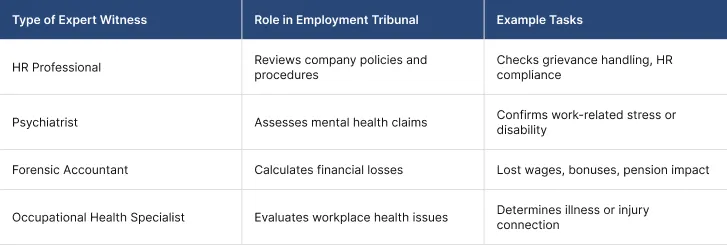
In this blog, we will cover all you need to know about the role of expert witness in employment tribunals.
What Is an Expert Witness?
An expert witness is a trained professional that provides his or her opinion to enable a tribunal in their evaluation of something that is complex. They do not go there to win the case. It is their mandate to remain impartial.
Experts may be appointed in cases, which may involve:
- Doctors or psychiatrists
- The occupational health experts.
- HR professionals.
- Forensic accountants.
- Industry specialists.
Experts in the UK are not allowed to lie or be dependent and are obligated by the law. They are not supposed to serve the individual who hires them. Their duty is to the tribunal.
Types of Expert Witnesses in Employment Law
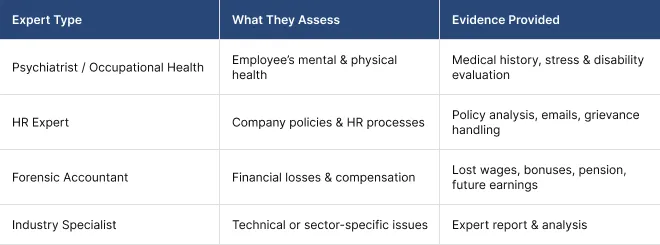
Different types of experts bring unique insights that clarify complex issues to provide the Tribunal with clear impartial evidence.
What Is the Relevance of Experts in Employment Law Claims?
Certain issues in the work environment are easy. Others are not. A number of court actions allow questions which require expertise.
For example:
- Was someone sick because of work stress?
- Is the illness considered a disability?
- Did the employer act according to the right HR guidelines?
- To what extent was the employee deprived of money?
These questions are not easy. A judge is neither a physician nor an accountant. These issues can be explained by expert witnesses. It is due to this that they tend to enforce claims in a more firm way.
The Rules Under UK Employment Law
Experts must follow clear rules. They cannot just give personal opinions. Their reports must be based on facts and proper reasoning.
Under UK employment law, expert reports should:
- Elucidate the commanding party.
- List the documents reviewed
- Account of how conclusions have been made.
- Give clear findings
- Include a statement to the effect that there is a duty to the tribunal.
When inaccurately done, expert testimony can be an enormous burden during employment proceedings.
To learn more: What are three important aspects of the testimony of an expert witness?
Case Study: Leicester Stress Claim.
Sarah was a marketing manager from Leicester. In due course, her work became stressful. She claimed that she was bullied by her boss and became ill.
She later went on to resign and initiate claims against Leicester on the basis of constructive dismissal and disability discrimination.
She said:
- Her workload was too high.
- She was hard spoken to by her manager.
- She was not addressed with her complaints by HR.
- She acquired anxiety and depression.
The employer disagreed. They said she was underperforming and they had acted reasonably. At this stage, nobody could determine who was wrong or right.
Seeking the Right Employment Law Advice.
Sarah had the advice of a solicitor. They chose to instruct two experts:
- A consultant psychiatrist.
- An HR procedures expert.
This turned the case the other way around. Sarah no longer had to rely on personal accounts. She now had interview evidence.
What the Psychiatrist Said
Sarah was met by the psychiatrist, who looked at her medical history. The expert found:
She had moderate depression
- Her condition was identified as being due to stress at the workplace.
- Her situation fit the legal concept of disability.
There should have been warning signs that were noticed by the employer.
This was quite critical within the UK employment law. It demonstrated that her condition was severe and legally binding. The connection of work and illness would not necessarily have been accepted without this report.
What the HR Expert Found
The HR specialist analysed the company policies and company-employee emails. The expert arrived at the conclusion:
- The employer failed to undertake its own process of grievance.
- Faults were not followed up in a proper manner.
- No equitable performance appraisal was done.
- There was no consideration of reasonable adjustments.
This provided a great backing to Sarah. It demonstrated that good practices were not observed.
The Way that the Experts Influenced the Case.
Prior to the expert reports, there were only personal accounts. Once the reports were distributed, the situation was more apparent.
The employer now faces:
- Medical evidence linking stress to illness
- Establishing disability according to the law
- Criticism of the HR process by professionals
- Well-defined financial estimates
The employer perceived the possibility of losing in tribunal. Sarah was paid and the case was resolved before it could go to the court.
She was not alone in expert evidence benefiting her case. It made it far more powerful.
What Is the Most Beneficial Employment Law Claim?
It is not always necessary to have experts. Nevertheless, they are quite helpful in:
| Claim Type | Expert Witness Needed | Key Contribution |
|---|---|---|
| Disability Discrimination | Psychiatrist | Confirms illness or disability |
| Constructive Dismissal | HR Expert | Checks HR procedures followed |
| Workplace Stress | Psychiatrist | Links stress to work environment |
| Equal Pay Disputes | Forensic Accountant | Calculates pay differences |
Bonus formulation and compensation conflicts of high values. Expert evidence may, in most cases, enhance employment claims when medical or financial concerns are present.
Salaries and Remuneration Experts.
In a situation where one is terminated without a fair hearing, the tribunal is required to determine the amount of money someone should get. This can be complicated.
Forensic accountants could compute:
- Lost wages.
- Missed bonuses.
- Pension losses.
- Future earnings.
- Loss of benefits.
Numerical figures simplify employment legal cases. These eliminate conjecture and debate.
Questions to Ask Before Hiring an Expert
Before bringing in an expert, it is important to ask:
- Is this issue too technical for the tribunal to decide alone?
- Will expert evidence improve the chances of success?
- Is the cost reasonable compared to the claim value?
- Does the expert understand tribunal rules?
- Can their report stand up to questioning?
Good employment law advice helps answer these questions early.
Common Mistakes to Avoid
Even strong employment cases can weaken if expert evidence is handled badly.
Some common mistakes include:
- Waiting too long to instruct an expert.
- Giving incomplete documents.
- Choosing someone without tribunal experience.
- Allowing biased language in the report.
- Failing to ask clear legal questions.
Tribunals respect fairness and clarity. Poor expert reports may carry little weight.
To learn more: When Should Expert Witnesses Be Instructed?
Conclusion:
Employment law claims can be confusing and stressful. Both sides may believe they are right. Clear proof is what matters most in such cases. An expert witness brings clarity in these cases. Their opinion and evidence give solid grounds for courts to base their judgment on.
At Concise Medico, we understand the importance of expert opinion in court cases. Getting proper employment law advice early helps decide if expert evidence is needed. In complex cases, the right expert can turn a weak argument into strong, clear proof. Contact us now to get the right legal course today.
FAQs
How do issues at work get resolved? What happens when a dispute is so big that it is one’s word against another’s? In many employment law cases, this happens a lot. As a result it is difficult to tell who is right in an employment tribunal.
Here is when expert witnesses come in very handy. They help explain difficult issues in a simple and clear way. The experts remain impartial during the hearing. In cases related to employment and HR law, experts include:
In this blog, we will cover all you need to know about the role of expert witness in employment tribunals.
What Is an Expert Witness?
An expert witness is a trained professional that provides his or her opinion to enable a tribunal in their evaluation of something that is complex. They do not go there to win the case. It is their mandate to remain impartial.
Experts may be appointed in cases, which may involve:
- Doctors or psychiatrists
- The occupational health experts.
- HR professionals.
- Forensic accountants.
- Industry specialists.
Experts in the UK are not allowed to lie or be dependent and are obligated by the law. They are not supposed to serve the individual who hires them. Their duty is to the tribunal.
Types of Expert Witnesses in Employment Law
Different types of experts bring unique insights that clarify complex issues to provide the Tribunal with clear impartial evidence.
What Is the Relevance of Experts in Employment Law Claims?
Certain issues in the work environment are easy. Others are not. A number of court actions allow questions which require expertise.
For example:
- Was someone sick because of work stress?
- Is the illness considered a disability?
- Did the employer act according to the right HR guidelines?
- To what extent was the employee deprived of money?
These questions are not easy. A judge is neither a physician nor an accountant. These issues can be explained by expert witnesses. It is due to this that they tend to enforce claims in a more firm way.
The Rules Under UK Employment Law
Experts must follow clear rules. They cannot just give personal opinions. Their reports must be based on facts and proper reasoning.
Under UK employment law, expert reports should:
- Elucidate the commanding party.
- List the documents reviewed
- Account of how conclusions have been made.
- Give clear findings
- Include a statement to the effect that there is a duty to the tribunal.
When inaccurately done, expert testimony can be an enormous burden during employment proceedings.
To learn more: What are three important aspects of the testimony of an expert witness?
Case Study: Leicester Stress Claim.
Sarah was a marketing manager from Leicester. In due course, her work became stressful. She claimed that she was bullied by her boss and became ill.
She later went on to resign and initiate claims against Leicester on the basis of constructive dismissal and disability discrimination.
She said:
- Her workload was too high.
- She was hard spoken to by her manager.
- She was not addressed with her complaints by HR.
- She acquired anxiety and depression.
The employer disagreed. They said she was underperforming and they had acted reasonably. At this stage, nobody could determine who was wrong or right.
Seeking the Right Employment Law Advice.
Sarah had the advice of a solicitor. They chose to instruct two experts:
- A consultant psychiatrist.
- An HR procedures expert.
This turned the case the other way around. Sarah no longer had to rely on personal accounts. She now had interview evidence.
What the Psychiatrist Said
Sarah was met by the psychiatrist, who looked at her medical history. The expert found:
She had moderate depression
- Her condition was identified as being due to stress at the workplace.
- Her situation fit the legal concept of disability.
There should have been warning signs that were noticed by the employer.
This was quite critical within the UK employment law. It demonstrated that her condition was severe and legally binding. The connection of work and illness would not necessarily have been accepted without this report.
What the HR Expert Found
The HR specialist analysed the company policies and company-employee emails. The expert arrived at the conclusion:
- The employer failed to undertake its own process of grievance.
- Faults were not followed up in a proper manner.
- No equitable performance appraisal was done.
- There was no consideration of reasonable adjustments.
This provided a great backing to Sarah. It demonstrated that good practices were not observed.
The Way that the Experts Influenced the Case.
Prior to the expert reports, there were only personal accounts. Once the reports were distributed, the situation was more apparent.
The employer now faces:
- Medical evidence linking stress to illness
- Establishing disability according to the law
- Criticism of the HR process by professionals
- Well-defined financial estimates
The employer perceived the possibility of losing in tribunal. Sarah was paid and the case was resolved before it could go to the court.
She was not alone in expert evidence benefiting her case. It made it far more powerful.
What Is the Most Beneficial Employment Law Claim?
It is not always necessary to have experts. Nevertheless, they are quite helpful in:
| Claim Type | Expert Witness Needed | Key Contribution |
|---|---|---|
| Disability Discrimination | Psychiatrist | Confirms illness or disability |
| Constructive Dismissal | HR Expert | Checks HR procedures followed |
| Workplace Stress | Psychiatrist | Links stress to work environment |
| Equal Pay Disputes | Forensic Accountant | Calculates pay differences |
Bonus formulation and compensation conflicts of high values. Expert evidence may, in most cases, enhance employment claims when medical or financial concerns are present.
Salaries and Remuneration Experts.
In a situation where one is terminated without a fair hearing, the tribunal is required to determine the amount of money someone should get. This can be complicated.
Forensic accountants could compute:
- Lost wages.
- Missed bonuses.
- Pension losses.
- Future earnings.
- Loss of benefits.
Numerical figures simplify employment legal cases. These eliminate conjecture and debate.
Questions to Ask Before Hiring an Expert
Before bringing in an expert, it is important to ask:
- Is this issue too technical for the tribunal to decide alone?
- Will expert evidence improve the chances of success?
- Is the cost reasonable compared to the claim value?
- Does the expert understand tribunal rules?
- Can their report stand up to questioning?
Good employment law advice helps answer these questions early.
Common Mistakes to Avoid
Even strong employment cases can weaken if expert evidence is handled badly.
Some common mistakes include:
- Waiting too long to instruct an expert.
- Giving incomplete documents.
- Choosing someone without tribunal experience.
- Allowing biased language in the report.
- Failing to ask clear legal questions.
Tribunals respect fairness and clarity. Poor expert reports may carry little weight.
To learn more: When Should Expert Witnesses Be Instructed?
Conclusion:
Employment law claims can be confusing and stressful. Both sides may believe they are right. Clear proof is what matters most in such cases. An expert witness brings clarity in these cases. Their opinion and evidence give solid grounds for courts to base their judgment on.
At Concise Medico, we understand the importance of expert opinion in court cases. Getting proper employment law advice early helps decide if expert evidence is needed. In complex cases, the right expert can turn a weak argument into strong, clear proof. Contact us now to get the right legal course today.