TABLE OF CONTENT
Childbirth should feel safe and cared for. But things can still go wrong during labour. With care, certain consequences can be avoided. Even with good care, some harm happens. These cases can change people’s lives forever. Babies may need help and care for the rest of their lives. Parents may experience trauma and bereavement. Mothers may have health problems that last a long time. A midwife negligence claim can help pay for things you need in the future.
What Is Midwife Negligence?
A midwife is a registered healthcare professional who helps women and babies during pregnancy, birth, and after birth. Midwife negligence means bad care that could have been avoided. It can affect the mother or the baby. “Any bad outcome” is not negligence. It means that the care wasn’t proper. It also means that poor care affects someone.
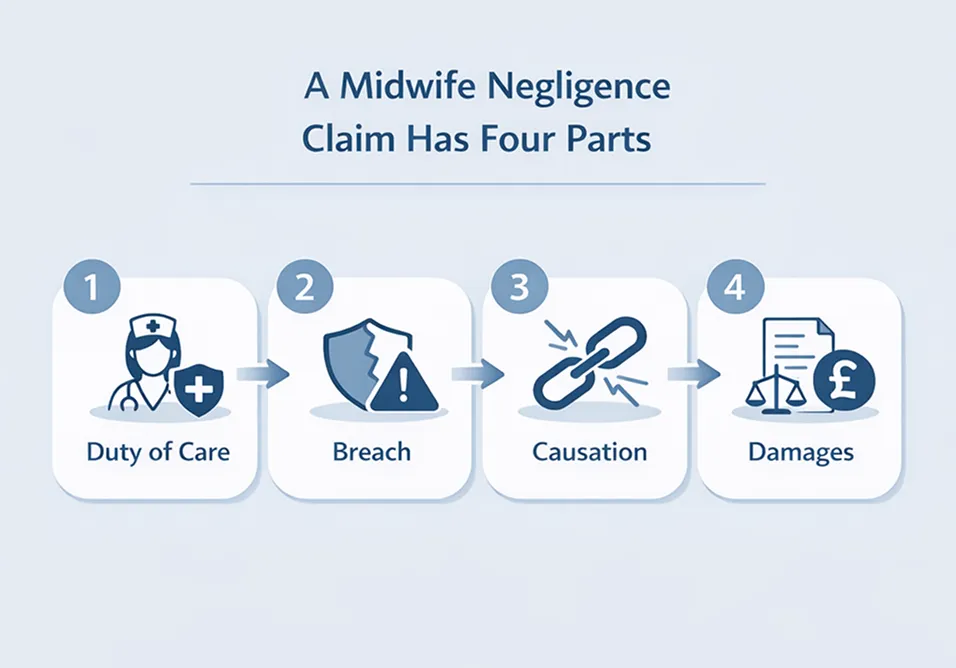
A midwife negligence claim has four parts:
- Duty of care
- Breach
- Causation
- Damages
Common Examples of Possible Midwife Negligence
These examples are based on facts. They do not show negligence on their own. An expert must review the records for midwife negligence claim.
- They forgot to check the baby’s heart rate.
- CTG traces were misread or ignored.
- Warning signs weren’t acted on quickly.
- There wasn’t a quick response to the labour delay.
- Handling shoulder dystocia was bad.
- Excess force caused nerve injury.
- Signs of infection were missed after birth.
- They didn’t catch jaundice early.
- A bad handover made it take longer to act quickly.
- The records weren’t clear or complete.
Even with good care, things can still go wrong. That can be very hard on families. But it’s not always carelessness. A midwife negligence claim needs proof that the mistake could have been avoided.
What Is an Expert Witness?
An expert witness is a professional who works on their own. A midwife expert witness may be involved in midwife negligence claims. It could also be an obstetrician. It could also be a neonatologist. The expert tells you what good care is. They compare care to safe levels. They give the court their opinion.
Experts have a responsibility in England and Wales. Their job is to help the court. That duty comes before party instructions. CPR Part 35 explains this. An expert is not a “supporter.” They ought to be fair and even. They should have both useful and formation that does not support either party. Practice Direction 35 stresses being independent.
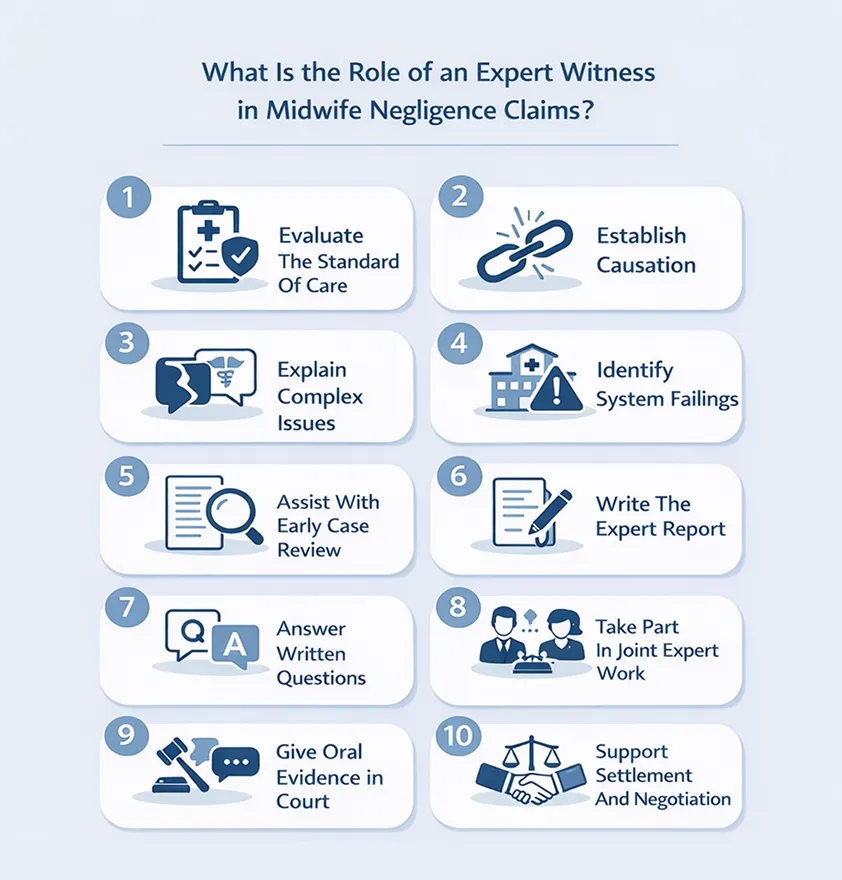
What Is the Role of an Expert Witness in Midwife Negligence Claims?
Now let’s look at what the expert witness in midwife negligence claims cases does and why it matters.
1. Evaluate the Standard of Care
This is usually the first important job in midwife negligence claims. The expert asks, “Was the care safe?” They look at what was done and when. They look at that and compare it to what they think should happen. Experts talk about any problems with the care. They might first look at monitoring the foetus. They might look at the quality and actions of the CTG. Also, they might check how often you listen. They might check how you respond to strange signs. These checks are supported by NICE guidance.
They also look at how the mother is doing. They check blood pressure and symptoms. Midwife expert witnesses look for signs of bleeding and infection. They also look into pain and health issues. They check to see if the problems got worse. Experts also look at fluids and medicines. They check the dose, the route, and the time. They check to see if side effects were looked for. Experts check to see if allergies were taken into account.
They check how people respond to emergencies at work. They check how quickly things are getting worse and what needs to be done. Experts see if help got there fast enough. They look into who made important choices. They also check to see how good the notes are. Good notes help make sure handovers go smoothly. Bad notes can make it take longer to get urgent care. The NMC Code requires clear records.
2. Establish Causation
The hardest part in midwife negligence claims is usually figuring out what caused something. The expert wants to know, “Did the breach hurt anyone?” They look at changes in timing and the clinic. They think about what is most likely to happen. Experts also consider other possible explanations. They might check how much oxygen babies are losing. They might also look for signs of brain damage. Midwife expert witness might look at injuries from shoulder dystocia. They might look for broken bones or bruises. They may check for sepsis and the timing of the infection.
Experts might also look at injuries to the mother. They might look at bad tears and fix them. They might look at bleeding and shock. Experts may assess pre-eclampsia complications too. They might look at the infection and the delay in treatment.
Experts frequently employ timelines for establishing causation. They connect events to changes in the clinic. They look at when the signs first showed up. Experts check to see when action should happen. They check to see if the delays will change. There are times when harm has more than one cause. Experts make it clear for the court. They talk about what could have been stopped and why. They also talk about what couldn’t be helped.
3. Explain Complex Issues
Judges and juries are not doctors. Experts turn medical language into everyday language. They explain what the words mean in real life. They also talk about charts and vital signs.
These are some common words used in midwife negligence claims:
- CTG stands for “baby heart tracing.
- Hypoxia means that the baby doesn’t get enough oxygen.
- Shoulder dystocia is when your shoulders get stuck.
- Sepsis is a very bad infection in the body.
- Pre-eclampsia is a disease that causes high blood pressure.
- Abruption means that the placenta came apart too soon.
Experts explain what a trace means. They tell you what “late decelerations” mean. They talk about what “reduced variability” means. They talk about why it was important to act quickly. Experts also talk about how to make decisions in an emergency. They talk about the choices that were there. They say what a fair answer was. Experts say if the answer was late.
4. Identify System Failings
It’s not always one person’s fault when things go wrong. Poor care can be caused by staffing and systems. Experts might look into bigger service problems in midwife negligence claims.
They might look over the number of staff and the mix of skills. They might look at the workload and the stress in the wards. Midwife expert witness might look at the quality of handovers and how long they take. They might go over training and emergency drills. They might check to see if they can get to the equipment and if it’s ready. Also, they might look over policies for escalation and compliance.
When systems don’t work right, small mistakes can get worse. A sign that is missed may not be checked for longer. A delay could lead to serious harm. Not getting help might slow down urgent action. Experts talk about how systems changed care. They help judges understand the whole picture. They also help show that everyone is responsible.
5. Assist with Early Case Review
Lawyers can get help from experts early on during midwife negligence claims. They can flag if a case looks strong. They can also say if the evidence isn’t strong. This helps families not be stressed out for a long time. It also helps lawyers act responsibly. They can identify likely breaches in records. They can identify gaps in documentation.
Experts can also find CTG strips that are missing. They can find missing observation charts. They can tell you which records to ask for. Midwife expert witness can also recommend other experts who are needed. A neonatologist, for instance, might be able to help. A radiologist can help with scans. A care expert might be able to help with needs.
Learn more about psychology expert witnesses in UK legal cases reading our guide “Psychology Expert Witness.“
6. Write the Expert Report
The expert report is a very important document for midwife negligence claims. It has to be clear and organised. It has to deal with the legal issues. It must be based on the evidence that was looked at.
These parts are often found in a report.
- The expert’s level of experience and knowledge.
- The records and documents that were looked at.
- A timeline of important clinical events.
- Opinion and reasons for the standard of care.
- Causation opinion and reasons.
- Points that make midwife negligence claims stronger or weaker.
- Any restrictions on the information that is available.
- A statement of duty to the court.
CPR Part 35 sets out the duties of experts. Practice Direction 35 adds important rules. Experts need to stay fair and independent.
Learn more about expert witness reports reading our guide “Understanding Expert Witness Report and Medico-Legal Report in the UK.“
7. Answer Written Questions
There may be questions after a report. CPR lets you write questions to experts. The answers are added to the report record. These questions put the expert’s logic to the test. They might also ask about records that are missing. They might want to know how different people see things. Also, they might also look into other possible causes. A good midwife expert witness speaks clearly and calmly. They explain why their view stands. They will also accept corrections that are correct. Lastly, they need to stick to what they know.
8. Take Part in Joint Expert Work
Experts can also meet with experts who disagree with them. They might agree on some things over time. They may narrow down disputed issues. This can lower costs and stress. Often, they conclude on a mutually agreed statement. It shows what both experts agree on. It also says what they still disagree on. This helps the court stay on track with the most important things.
9. Give Oral Evidence in Court
Many cases settle before trial. But some people go to court to get a decision. At that point, experts might be able to give oral evidence. Experts give their opinion in court. They answer questions from both sides. They might be questioned about their reasoning. Experts need to be clear and objective.
They can use timelines and records in court. They can explain CTG events stepwise. Experts can tell you when it was necessary to escalate. They can tell you how delays changed the results. Their evidence can be very influential. Judges depend on clear and logical reasoning from experts. That’s why the quality of the expert matters.
10. Support Settlement and Negotiation
Most midwife negligence claims are settled without going to court. Experts can help make sure that settlement amounts are fair. They talk about possible harm and what will be needed in the future.
- For baby injuries, needs may last a long time. Therapy and equipment may be some of the needs. Care support and housing might be other needs. People also may need help with school and other things.
- For maternal injury, surgery may be necessary. Therapy for pelvic health may also be needed. They might need help with their mental health. Time off from work might also be one of the needs.
How Midwife Negligence Claims Are Proven?
A midwife negligence claim must show the main steps. Every step needs proof and reasoning. Expert evidence helps at every step.
1. Duty of Care
Most of the time, duty is not questioned. Maternity staff have a duty of care. This includes care during labour and after birth. It includes keeping an eye on the mother and baby. It includes a safe way to raise concerns.
2. Breach of Duty
Breach means that care wasn’t up to standards. Experts show what should have happened. They compare that to what actually happened. This comparison may be supported by guidance. NICE includes monitoring the foetus during labour. The NMC Code talks about how to keep records. Courts also want to see clear independence from experts.
3. Causation
Causation connects the breach to the harm. The breach must have a real effect on the harm. Experts make this connection clear. They use timelines and clinical results. They also think about other things that could be wrong. Midwife expert witnesses explain why those reasons work or don’t work. They explain probabilities based on evidence.
4. Damages
Damages are the money you get for the damage you do. Losses can happen in the past or the future. Some losses are costs that come directly from medical care. Some losses are needs for care and support. Some losses include losing money and jobs. Some losses are painful and hard to bear.
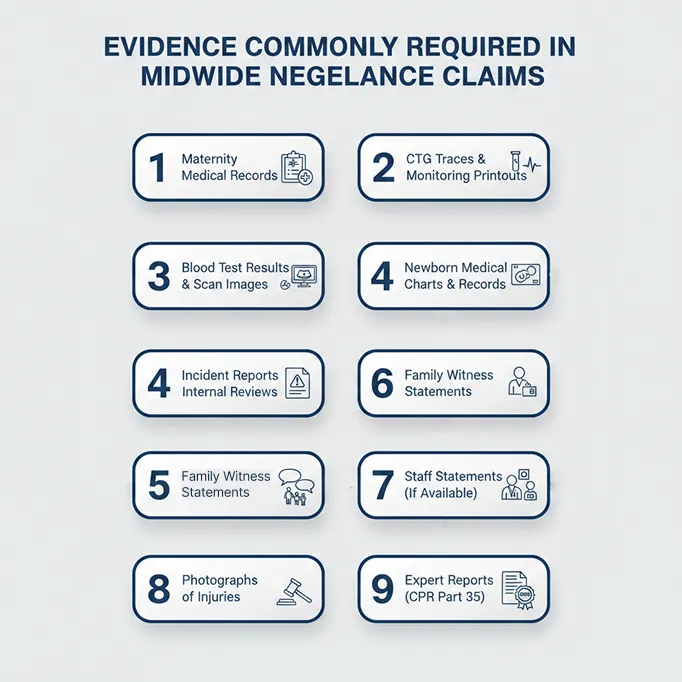
Evidence Commonly Required in Midwife Negligence Claims
Evidence must be factual and trustworthy. It should show what happened and when.
- Request for full maternity medical records.
- CTG traces and printouts of monitoring.
- Results of blood tests and pictures from scans.
- Records and charts for newborns.
- Reports of incidents and reviews if they are done.
- Family members’ statements as witnesses.
- Staff statements when they are available.
- Pictures of injuries when they are needed.
- Reports from experts under CPR Part 35.
Time Limits for Bringing Midwife Negligence Claims
Time limits can apply to midwife negligence claims. In many cases, a three year limit applies. The Limitation Act of 1980 is important. The “date of knowledge” can also be important. It can push back the deadline. This is where people didn’t know they were hurting. Rules may be different for kids. A lot of guides say that time runs from 18. Here, legal advice is very important.
How a Midwife Negligence Compensation Claim Can Be Made?
Midwife negligence claims need to be made in a careful and planned way. Families often feel overwhelmed at first. A clear plan can help them relax.
1. Gather Records and Evidence
Get all of your medical records first. Keep all of your appointment notes and letters. Keep any results and discharge summaries. Write down important dates and events. If you know the names of the staff, write them down. Keep any pictures of injuries you have. Save any messages or emails you get. Write down your symptoms and how they affect you. Keep receipts for travel and care costs.
2. Raise Concerns with the Provider
Some families use the process for complaints. This can help you get answers sooner. It can also lead to reviews within the company. A midwife negligence claim is not the same as a complaint. But it can help the record of evidence. It can also highlight missing information.
3. Speak with a Specialist Solicitor
A lawyer who specialises in clinical negligence can help you figure out what to do. They also talk about funding and risk. They can ask for records and reports from experts. They can also stay within the time limits. Pick someone who has worked with midwife negligence claims before. Enquire about their utilisation of expert evidence. Find out how they deal with sensitive family needs.
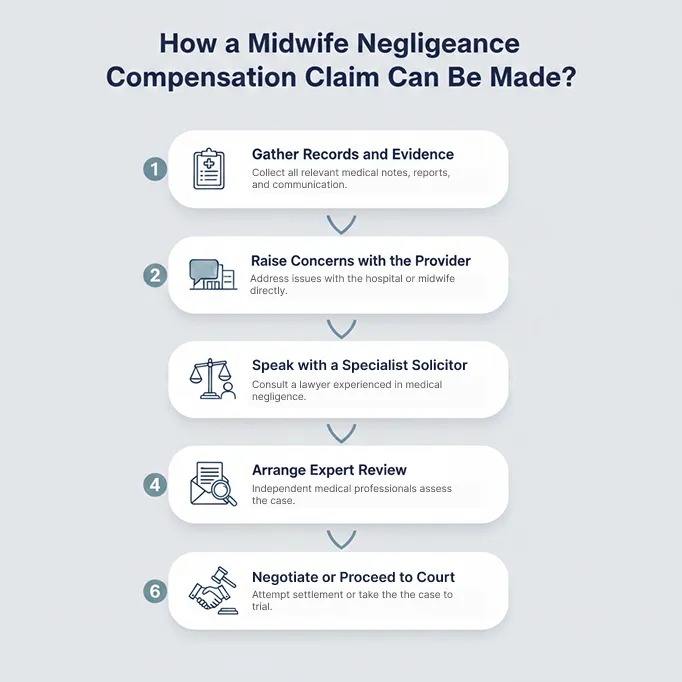
4. Arrange Expert Review
The lawyer tells an expert witness what to do. The expert looks over the whole record bundle. They find possible breaches and the reasons for them. If they need to, they write a formal report. This report often decides what happens next in the case. If breach is weak, the case may stop. If breach is strong, the case may proceed.
5. Send the Letter of Claim
A letter is sent if there is proof to back up a midwife negligence claim. It sets out allegations and key facts. It also includes the general case theory. Then, the defendant looks into it and answers. Expert testimony backs up that case. It helps to show the standard and the breach. It also backs up arguments about cause and effect.
6. Negotiate or Proceed to Court
Many cases are settled through negotiation. Some use mediation or meetings too. NHS Resolution also encourages quick solutions. The court may come next if there is no settlement. After that, experts may give oral evidence. CPR Part 35 sets rules for how experts should act.
Why Do Expert Witnesses Matter so Much?
Without experts, courts would struggle. A lot of clinical facts are hard to understand and technical. Experts break down standards into simple terms. They talk about how timing made a difference in what they did. They talk about what safer care looked like.
Experts also make sure that everyone is treated fairly. They can help people who are making midwife negligence claims by giving them proof. They can also show when care was fair. That prevents weak midwife negligence claims from progressing. They also help make things safer in the future. Good expert analysis shows problems that keep happening. It also points out gaps in training and policy. It can help you learn after something bad happens.
Conclusion
Midwife negligence claims can change your life. Families often need help and answers. They might also need money for a long time. Expert witnesses help make things clear in court. They talk about standards, violations, and the cause of something. They also explain records and key timelines.
Midwife expert witness must go to court first. CPR Part 35 makes that duty clear. Their independence helps make sure that things are fair. They help judges and juries make decisions because they are clear. Their reports can also help people reach an agreement. Their work can also help make care safer.
FAQs
Childbirth should feel safe and cared for. But things can still go wrong during labour. With care, certain consequences can be avoided. Even with good care, some harm happens. These cases can change people’s lives forever. Babies may need help and care for the rest of their lives. Parents may experience trauma and bereavement. Mothers may have health problems that last a long time. A midwife negligence claim can help pay for things you need in the future.
What Is Midwife Negligence?
A midwife is a registered healthcare professional who helps women and babies during pregnancy, birth, and after birth. Midwife negligence means bad care that could have been avoided. It can affect the mother or the baby. “Any bad outcome” is not negligence. It means that the care wasn’t proper. It also means that poor care affects someone.
A midwife negligence claim has four parts:
- Duty of care
- Breach
- Causation
- Damages
Common Examples of Possible Midwife Negligence
These examples are based on facts. They do not show negligence on their own. An expert must review the records for midwife negligence claim.
- They forgot to check the baby’s heart rate.
- CTG traces were misread or ignored.
- Warning signs weren’t acted on quickly.
- There wasn’t a quick response to the labour delay.
- Handling shoulder dystocia was bad.
- Excess force caused nerve injury.
- Signs of infection were missed after birth.
- They didn’t catch jaundice early.
- A bad handover made it take longer to act quickly.
- The records weren’t clear or complete.
Even with good care, things can still go wrong. That can be very hard on families. But it’s not always carelessness. A midwife negligence claim needs proof that the mistake could have been avoided.
What Is an Expert Witness?
An expert witness is a professional who works on their own. A midwife expert witness may be involved in midwife negligence claims. It could also be an obstetrician. It could also be a neonatologist. The expert tells you what good care is. They compare care to safe levels. They give the court their opinion.
Experts have a responsibility in England and Wales. Their job is to help the court. That duty comes before party instructions. CPR Part 35 explains this. An expert is not a “supporter.” They ought to be fair and even. They should have both useful and formation that does not support either party. Practice Direction 35 stresses being independent.
What Is the Role of an Expert Witness in Midwife Negligence Claims?
Now let’s look at what the expert witness in midwife negligence claims cases does and why it matters.
1. Evaluate the Standard of Care
This is usually the first important job in midwife negligence claims. The expert asks, “Was the care safe?” They look at what was done and when. They look at that and compare it to what they think should happen. Experts talk about any problems with the care. They might first look at monitoring the foetus. They might look at the quality and actions of the CTG. Also, they might check how often you listen. They might check how you respond to strange signs. These checks are supported by NICE guidance.
They also look at how the mother is doing. They check blood pressure and symptoms. Midwife expert witnesses look for signs of bleeding and infection. They also look into pain and health issues. They check to see if the problems got worse. Experts also look at fluids and medicines. They check the dose, the route, and the time. They check to see if side effects were looked for. Experts check to see if allergies were taken into account.
They check how people respond to emergencies at work. They check how quickly things are getting worse and what needs to be done. Experts see if help got there fast enough. They look into who made important choices. They also check to see how good the notes are. Good notes help make sure handovers go smoothly. Bad notes can make it take longer to get urgent care. The NMC Code requires clear records.
2. Establish Causation
The hardest part in midwife negligence claims is usually figuring out what caused something. The expert wants to know, “Did the breach hurt anyone?” They look at changes in timing and the clinic. They think about what is most likely to happen. Experts also consider other possible explanations. They might check how much oxygen babies are losing. They might also look for signs of brain damage. Midwife expert witness might look at injuries from shoulder dystocia. They might look for broken bones or bruises. They may check for sepsis and the timing of the infection.
Experts might also look at injuries to the mother. They might look at bad tears and fix them. They might look at bleeding and shock. Experts may assess pre-eclampsia complications too. They might look at the infection and the delay in treatment.
Experts frequently employ timelines for establishing causation. They connect events to changes in the clinic. They look at when the signs first showed up. Experts check to see when action should happen. They check to see if the delays will change. There are times when harm has more than one cause. Experts make it clear for the court. They talk about what could have been stopped and why. They also talk about what couldn’t be helped.
3. Explain Complex Issues
Judges and juries are not doctors. Experts turn medical language into everyday language. They explain what the words mean in real life. They also talk about charts and vital signs.
These are some common words used in midwife negligence claims:
- CTG stands for “baby heart tracing.
- Hypoxia means that the baby doesn’t get enough oxygen.
- Shoulder dystocia is when your shoulders get stuck.
- Sepsis is a very bad infection in the body.
- Pre-eclampsia is a disease that causes high blood pressure.
- Abruption means that the placenta came apart too soon.
Experts explain what a trace means. They tell you what “late decelerations” mean. They talk about what “reduced variability” means. They talk about why it was important to act quickly. Experts also talk about how to make decisions in an emergency. They talk about the choices that were there. They say what a fair answer was. Experts say if the answer was late.
4. Identify System Failings
It’s not always one person’s fault when things go wrong. Poor care can be caused by staffing and systems. Experts might look into bigger service problems in midwife negligence claims.
They might look over the number of staff and the mix of skills. They might look at the workload and the stress in the wards. Midwife expert witness might look at the quality of handovers and how long they take. They might go over training and emergency drills. They might check to see if they can get to the equipment and if it’s ready. Also, they might look over policies for escalation and compliance.
When systems don’t work right, small mistakes can get worse. A sign that is missed may not be checked for longer. A delay could lead to serious harm. Not getting help might slow down urgent action. Experts talk about how systems changed care. They help judges understand the whole picture. They also help show that everyone is responsible.
5. Assist with Early Case Review
Lawyers can get help from experts early on during midwife negligence claims. They can flag if a case looks strong. They can also say if the evidence isn’t strong. This helps families not be stressed out for a long time. It also helps lawyers act responsibly. They can identify likely breaches in records. They can identify gaps in documentation.
Experts can also find CTG strips that are missing. They can find missing observation charts. They can tell you which records to ask for. Midwife expert witness can also recommend other experts who are needed. A neonatologist, for instance, might be able to help. A radiologist can help with scans. A care expert might be able to help with needs.
Learn more about psychology expert witnesses in UK legal cases reading our guide “Psychology Expert Witness.“
6. Write the Expert Report
The expert report is a very important document for midwife negligence claims. It has to be clear and organised. It has to deal with the legal issues. It must be based on the evidence that was looked at.
These parts are often found in a report.
- The expert’s level of experience and knowledge.
- The records and documents that were looked at.
- A timeline of important clinical events.
- Opinion and reasons for the standard of care.
- Causation opinion and reasons.
- Points that make midwife negligence claims stronger or weaker.
- Any restrictions on the information that is available.
- A statement of duty to the court.
CPR Part 35 sets out the duties of experts. Practice Direction 35 adds important rules. Experts need to stay fair and independent.
Learn more about expert witness reports reading our guide “Understanding Expert Witness Report and Medico-Legal Report in the UK.“
7. Answer Written Questions
There may be questions after a report. CPR lets you write questions to experts. The answers are added to the report record. These questions put the expert’s logic to the test. They might also ask about records that are missing. They might want to know how different people see things. Also, they might also look into other possible causes. A good midwife expert witness speaks clearly and calmly. They explain why their view stands. They will also accept corrections that are correct. Lastly, they need to stick to what they know.
8. Take Part in Joint Expert Work
Experts can also meet with experts who disagree with them. They might agree on some things over time. They may narrow down disputed issues. This can lower costs and stress. Often, they conclude on a mutually agreed statement. It shows what both experts agree on. It also says what they still disagree on. This helps the court stay on track with the most important things.
9. Give Oral Evidence in Court
Many cases settle before trial. But some people go to court to get a decision. At that point, experts might be able to give oral evidence. Experts give their opinion in court. They answer questions from both sides. They might be questioned about their reasoning. Experts need to be clear and objective.
They can use timelines and records in court. They can explain CTG events stepwise. Experts can tell you when it was necessary to escalate. They can tell you how delays changed the results. Their evidence can be very influential. Judges depend on clear and logical reasoning from experts. That’s why the quality of the expert matters.
10. Support Settlement and Negotiation
Most midwife negligence claims are settled without going to court. Experts can help make sure that settlement amounts are fair. They talk about possible harm and what will be needed in the future.
- For baby injuries, needs may last a long time. Therapy and equipment may be some of the needs. Care support and housing might be other needs. People also may need help with school and other things.
- For maternal injury, surgery may be necessary. Therapy for pelvic health may also be needed. They might need help with their mental health. Time off from work might also be one of the needs.
How Midwife Negligence Claims Are Proven?
A midwife negligence claim must show the main steps. Every step needs proof and reasoning. Expert evidence helps at every step.
1. Duty of Care
Most of the time, duty is not questioned. Maternity staff have a duty of care. This includes care during labour and after birth. It includes keeping an eye on the mother and baby. It includes a safe way to raise concerns.
2. Breach of Duty
Breach means that care wasn’t up to standards. Experts show what should have happened. They compare that to what actually happened. This comparison may be supported by guidance. NICE includes monitoring the foetus during labour. The NMC Code talks about how to keep records. Courts also want to see clear independence from experts.
3. Causation
Causation connects the breach to the harm. The breach must have a real effect on the harm. Experts make this connection clear. They use timelines and clinical results. They also think about other things that could be wrong. Midwife expert witnesses explain why those reasons work or don’t work. They explain probabilities based on evidence.
4. Damages
Damages are the money you get for the damage you do. Losses can happen in the past or the future. Some losses are costs that come directly from medical care. Some losses are needs for care and support. Some losses include losing money and jobs. Some losses are painful and hard to bear.
Evidence Commonly Required in Midwife Negligence Claims
Evidence must be factual and trustworthy. It should show what happened and when.
- Request for full maternity medical records.
- CTG traces and printouts of monitoring.
- Results of blood tests and pictures from scans.
- Records and charts for newborns.
- Reports of incidents and reviews if they are done.
- Family members’ statements as witnesses.
- Staff statements when they are available.
- Pictures of injuries when they are needed.
- Reports from experts under CPR Part 35.
Time Limits for Bringing Midwife Negligence Claims
Time limits can apply to midwife negligence claims. In many cases, a three year limit applies. The Limitation Act of 1980 is important. The “date of knowledge” can also be important. It can push back the deadline. This is where people didn’t know they were hurting. Rules may be different for kids. A lot of guides say that time runs from 18. Here, legal advice is very important.
How a Midwife Negligence Compensation Claim Can Be Made?
Midwife negligence claims need to be made in a careful and planned way. Families often feel overwhelmed at first. A clear plan can help them relax.
1. Gather Records and Evidence
Get all of your medical records first. Keep all of your appointment notes and letters. Keep any results and discharge summaries. Write down important dates and events. If you know the names of the staff, write them down. Keep any pictures of injuries you have. Save any messages or emails you get. Write down your symptoms and how they affect you. Keep receipts for travel and care costs.
2. Raise Concerns with the Provider
Some families use the process for complaints. This can help you get answers sooner. It can also lead to reviews within the company. A midwife negligence claim is not the same as a complaint. But it can help the record of evidence. It can also highlight missing information.
3. Speak with a Specialist Solicitor
A lawyer who specialises in clinical negligence can help you figure out what to do. They also talk about funding and risk. They can ask for records and reports from experts. They can also stay within the time limits. Pick someone who has worked with midwife negligence claims before. Enquire about their utilisation of expert evidence. Find out how they deal with sensitive family needs.
4. Arrange Expert Review
The lawyer tells an expert witness what to do. The expert looks over the whole record bundle. They find possible breaches and the reasons for them. If they need to, they write a formal report. This report often decides what happens next in the case. If breach is weak, the case may stop. If breach is strong, the case may proceed.
5. Send the Letter of Claim
A letter is sent if there is proof to back up a midwife negligence claim. It sets out allegations and key facts. It also includes the general case theory. Then, the defendant looks into it and answers. Expert testimony backs up that case. It helps to show the standard and the breach. It also backs up arguments about cause and effect.
6. Negotiate or Proceed to Court
Many cases are settled through negotiation. Some use mediation or meetings too. NHS Resolution also encourages quick solutions. The court may come next if there is no settlement. After that, experts may give oral evidence. CPR Part 35 sets rules for how experts should act.
Why Do Expert Witnesses Matter so Much?
Without experts, courts would struggle. A lot of clinical facts are hard to understand and technical. Experts break down standards into simple terms. They talk about how timing made a difference in what they did. They talk about what safer care looked like.
Experts also make sure that everyone is treated fairly. They can help people who are making midwife negligence claims by giving them proof. They can also show when care was fair. That prevents weak midwife negligence claims from progressing. They also help make things safer in the future. Good expert analysis shows problems that keep happening. It also points out gaps in training and policy. It can help you learn after something bad happens.
Conclusion
Midwife negligence claims can change your life. Families often need help and answers. They might also need money for a long time. Expert witnesses help make things clear in court. They talk about standards, violations, and the cause of something. They also explain records and key timelines.
Midwife expert witness must go to court first. CPR Part 35 makes that duty clear. Their independence helps make sure that things are fair. They help judges and juries make decisions because they are clear. Their reports can also help people reach an agreement. Their work can also help make care safer.