TABLE OF CONTENT
The American public was outraged by the 1981 murder attempt on President Ronald Reagan. The real shocking aspect, however, was the trial of the gunman John Hinckley. His team put up John Hinckley’s insanity defence, citing several reasons. The major ones were an obsession with Jodie Foster and diagnosed mental issues. They argued that he was not guilty by reason of insanity. Insanity defence argues that a person is not responsible for the crime they committed due to insanity at that time. As a result, he was acquitted. The John Hinckley Jr. case is, thus, a defining moment in this kind of defence. Here is what happened.
Get an insight into famous insanity defence cases.
Early life of John Hinckley Jr.:
John Hinckley was born in 1955 in Texas in an affluent household. He went to school in Dallas County. He went to school in Dallas County. He then enrolled in Texas Tech University but never graduated. Afterwards, he moved to Los Angeles. He focused on songwriting while here. In 1977, he was forced to return to his parents’ house because his attempts had failed. His depression worsened as his relatives enquired about his objectives. During the same time, he began practising with the weapons he had gathered.
The Jodie Foster obsession
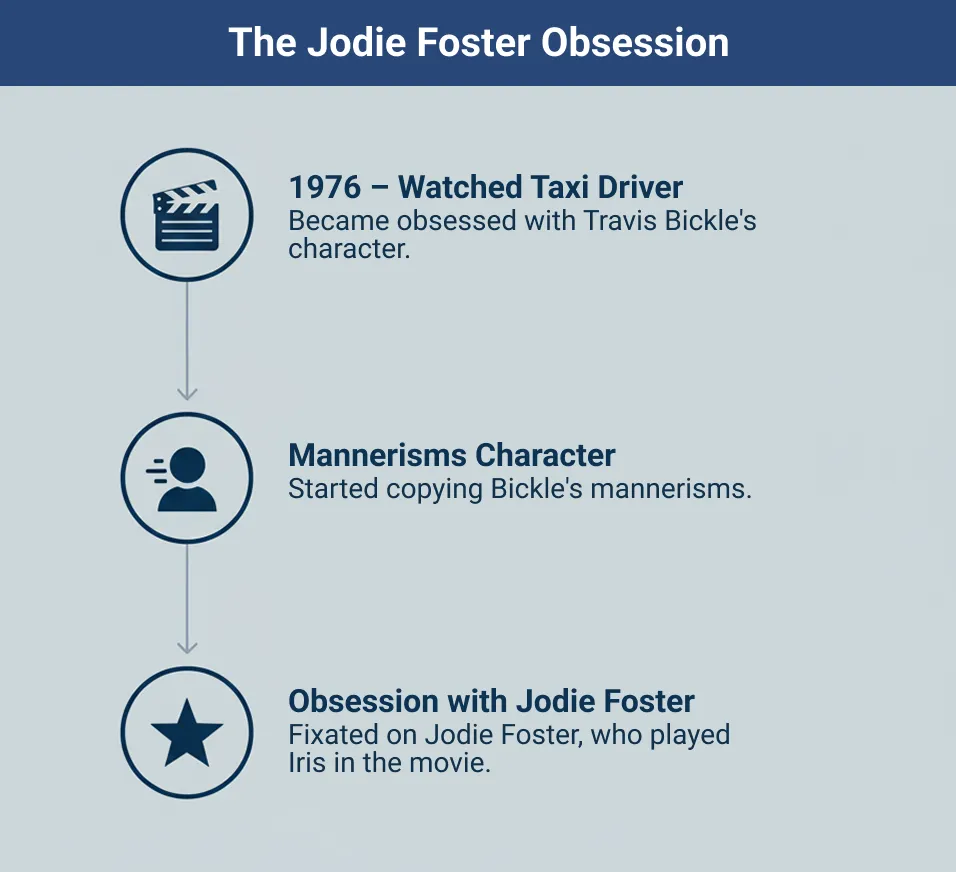
Around 1976, he watched the movie ‘Taxi Driver’ and became obsessed with Travis Bickle, the movie’s antihero. Bickle plots to kill the president. He began copying the mannerisms of the character. This was also the beginning of his obsession with actor Jodie Foster, who played Iris in the movie. This event became one of the key causes of the John Hinckley Jr. case.
This obsession led to Hinckley moving to Connecticut following Jodie Foster, who was attending Yale University there. Hinckley took funds from his parents in the garb of attending a writing course. With the money, he supported himself as he wrote poems and love letters to Foster. He also left her messages, but to no avail.
The Assassination Attempt:
Since writing to Foster was of no use, Hinckley began thinking of other means. His fantasies involved hijacking a plane and killing himself in front of her. He finally found an idea to act upon: killing the president.
Following Jimmy Carter:
Hinckley began following Jimmy Carter as he campaigned for the elections in 1980. He managed to be within 20 feet of him. While moving places, he was arrested at one point. This was because of him trying to board a plane with guns in his luggage. He was arrested but eventually released after a $50 fine.
Assassination attempt of Ronald Reagan:
After the money his parents gave him finished, he returned. He underwent treatment for depression for some time, but no improvement was seen.
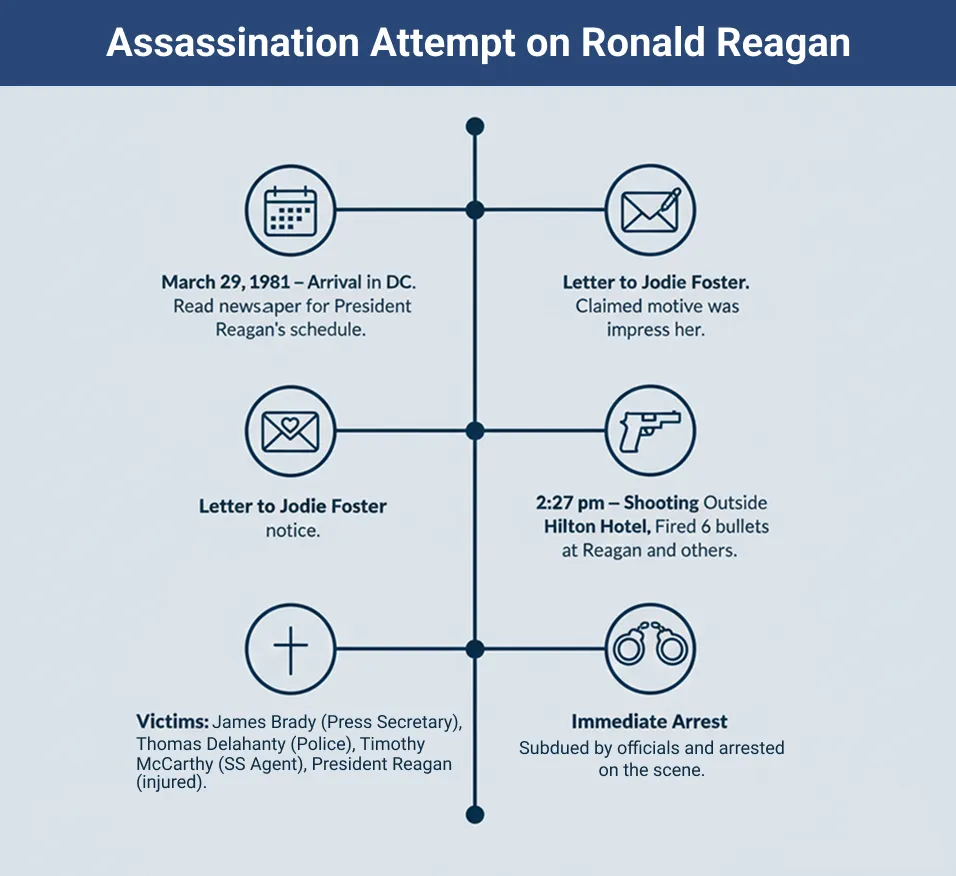
On 29th March 1981, he arrived in Washington, DC. He read the schedule of the newly elected president in a newspaper. Before leaving for the Hilton Hotel, where the president was supposed to be, he wrote a letter to Foster. He claimed in that letter that his motive was to impress her.
At around 2:27 pm, he was outside the hotel in the crowd. As the president got out of the hotel, he shot 6 bullets at him. The bullets hit the following:
- Press secretary James Brady
- Police officer Thomas Delahanty
- Secret Service Agent Timothy McCarthy
- The glass of the limousine
- The president injuring him gravely
He was then pulled to the ground by a labour official. Seconds later, an agent dove onto him to protect him. Another labour official hit him in the head. He was then arrested.
The John Hinckley case:
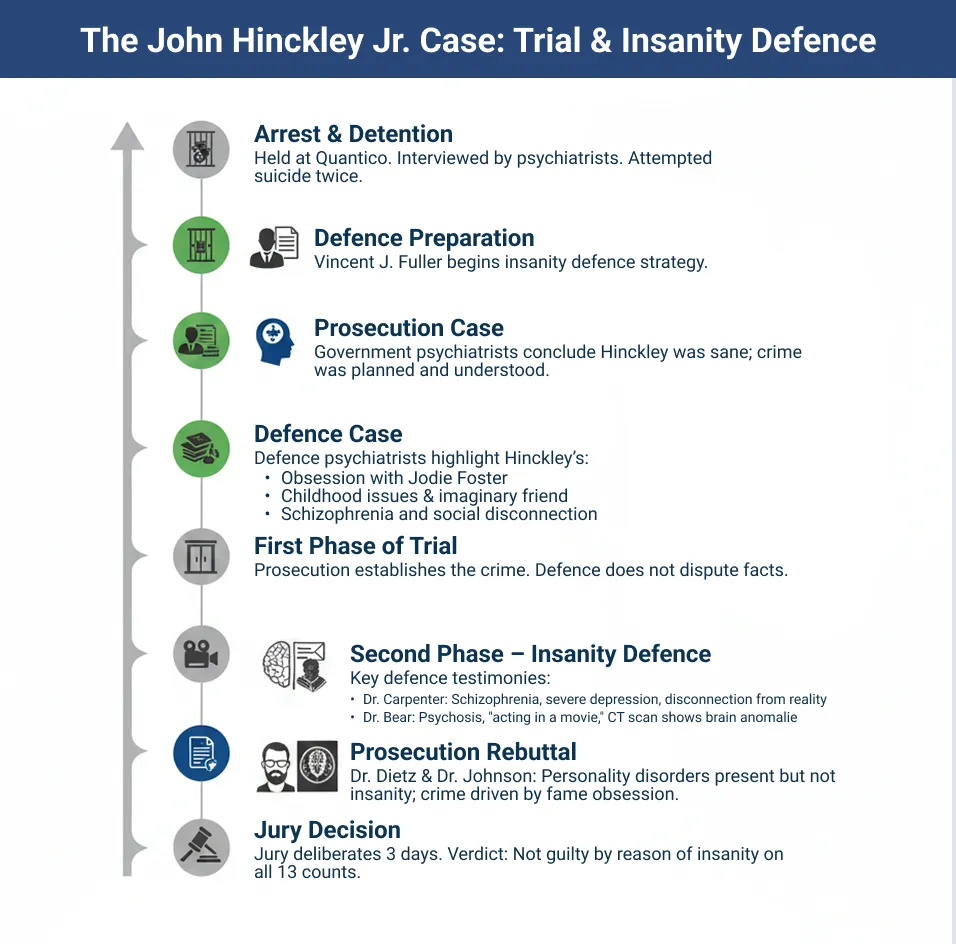
Hinckley was held in Quantico at a Marine base. Here, he was interviewed by multiple psychiatrists from the government and the defence. He tried suicide twice during this period in jail.
His defence lawyer was Vincent J. Fuller. He was the one who began John Hinckley’s insanity defence.
Learn more about insanity defence in the UK, here.
The prosecution:
The psychiatrists from the government all concluded him to be sane. They supported their judgment with the fact that the crime was planned properly. They also stated that he appreciated his crime at that time.
The defence
The expert psychology witnesses on the other side took the John Hinckley insanity defence. They indicated this on the basis of his obsession with Foster.
Testimony from Jodie Foster:
On insisting, his lawyers convinced hers to testify. It was a closed session with the lawyers, judge and Hinckley present. When he received no attention, Hinckley acted out. He was taken out of the room.
The John Hinckley Jr. case: first phase
In the first phase, the prosecution established the crime. The defence did not dispute any of the information. Evidence included statements of the victims, video footage, and an attendant at a rifle range etc.
The John Hinckley insanity defence: second phase
Vince Fuller attempted the John Hinckley insanity defence with the following points:
- His childhood
- His letters about an imaginary friend from Texas Tech University
- His stealing from his brother
The district attorney asked his mother why she had stated to his doctor that he was fine some time before the crime. His psychiatrist, Dr. Hopper, was called to testify. He admitted that he failed to grasp the seriousness of Hinckley’s state. He further claimed he didn’t know about his stalking of President Carter. Then came the testimonies.
Testimonies of defence attorneys:
The testimony of Dr. Carpenter in the John Hinckley insanity defence:
The defence used experts to prove their case. The one who led was Dr. Carpenter. He played a very important role in the John Hinckley insanity defence. He stated that Hinckley was disconnected from reality and that he suffered from schizophrenia. His forty-five hours of interview led him to the following conclusions:
- Hinckley had fewer emotional reactions
- He was disconnected from reality
- He had severe depression with suicidal thoughts
- He couldn’t form social connections
- His traits were taken from characters like the antihero of ‘Taxi Driver’ and John Lennon.
His delusion increased when he was stopped from coming home. He began signing his name as J. Travis. He also thought Jodie Foster needed saving. He interpreted President Carter’s wave as a signal.
Dr. Carpenter concluded the John Hinckley insanity defence with his inability to process the emotional aspect.
The testimony of Dr. Bear:
Dr Bear supported the John Hinckley insanity defence with psychosis. He stated that Hinckley felt like he was acting in a movie. Dr. Bear suggested a CT scan of Hinckley’s brain. A certain part of the brain(sulci) is enlarged in schizophrenia. Two-thirds of the total patients have this.
In patients with the disease, this anomaly is seen in two-thirds of the total cases. In the normal population, it is only 2%.
Testimonies of prosecution in John Hinckley’s insanity defence:
The testimony of Dr. Dietz:
Dr. Dietz opposed the John Hinckley insanity defence. He found three to four personality disorders, but he stated none of them made Hinckley insane.
The testimony of Dr. Johnson:
Dr. Johnson also opposed the John Hinckley insanity defence. She cited his obsession with fame as the reason for the crime. She claimed that his interest in Jodie Foster was akin to any other young person’s.
Decision:
The jury made a decision in three days. The John Hinckley insanity defence worked. For all thirteen counts, Hinckley was found not guilty by reason of insanity.
John Hinckley Jr. sentence:
He never received a sentence. He was sent to St. Elizabeth’s Hospital after he was acquitted. Initially, he was thought to be very dangerous. Later, in an interview, he described his routine. It included therapy, TV, music, medication, and a pool. He and the hospital often made requests for his visits. The doctor conducting his initial evaluation didn’t think he was a danger to anybody. However, he had written letters to Ted Bundy and sought the address of Charles Manson. Regardless, in 1986, he was transferred to a ward with fewer restrictions. He was allowed to visit his family in 2003. These visits were unsupervised. In 2009, he was allowed ten-day visits and a driver’s license. His visits were extended to more days in 2013.
John Hinckley Jr. release date:
On 27th July, 2016, Hinckley’s release date was announced. It was 5th August 2016. He was no longer considered a threat. The conditions to his release included:
- Working three days a week
- Recording his browser history
- Living with his mother
- Bans on contact with the victims of his family
- Consuming violent media or pornography
He was allowed to live independently in November 2018. In 2021, his complete release was approved. It was set to take effect in June 2022. He was released from all court-imposed rules in June 2022.
Aftermath
The John Hinckley insanity defence had a huge impact on such cases. It led to reform in the insanity defence due to how unpopular it was.
“The verdict of “not guilty” for reason of insanity in the 1982 trial of John Hinckley, Jr. for his attempted assassination of President Ronald Reagan stunned and outraged many Americans. An ABC News poll taken the day after the verdict showed 83% of those
polled thought “justice was not done” …”
Shifting the burden of proof:
Senator Arlen Spectre brought a bill. It proposed shifting the burden of proof. Now the defence would prove insanity. This move was supported by President Reagan himself. Within three years, most of the US states adopted this change. This means that the accused has to now convince the jury of their insanity. The evidence should be clear and convincing.
This verdict means that the accused is convicted and gets a sentence. Mental health professionals will assess this person and decide if they are to be sent to a mental health facility. Otherwise, they’ll be sent to prison.
Limited use of expert witnesses:
The use of expert witnesses also came under attack after the Hinckley trial. The American Psychiatric Association admitted that the testimonies in such trials cannot be free of doubt. They also stated that they wouldn’t push laws opposing this.
Making of a law:
In 1984, a law was made at the federal level. It required proof of severe mental disease. Additionally, the insanity defence was limited to cases where the doer could not comprehend their actions.
Abolishing Insanity Defence:
This act was done by the state of Utah. Montana and Idaho followed suit. They do admit the evidence of mental disorders.
Insanity Defence in the UK:
The M’Naghten Rule guides the insanity defence in the UK. M’Naghten was a Scottish person. He tried to assassinate the British prime minister, Sir Robert Peel. Instead, he killed his secretary. He was considered not guilty by insanity. The verdict was received negatively. The parliament enacted a new rule by which all accused are considered to be sane. This puts the burden of proof on the defendant. They have to prove they were insane at the time of the crime. If the defendant knew about their actions being wrong, then the verdict is guilty, even if they were insane. The US implemented the same rule after the John Hinckley insanity defence verdict.
Conclusion:
For what it is worth, the defence built its case with the help of expert psychology witnesses. Their qualifications and expertise truly come in handy in such instances. At Concise Medico, we understand their value of the insanity defence. We also make sure that the reports are accurate. We further ensure they outline all aspects that depict the complete picture of the mental state. Contact us today for the best legal witnesses and medical reports.
FAQs
The American public was outraged by the 1981 murder attempt on President Ronald Reagan. The real shocking aspect, however, was the trial of the gunman John Hinckley. His team put up John Hinckley’s insanity defence, citing several reasons. The major ones were an obsession with Jodie Foster and diagnosed mental issues. They argued that he was not guilty by reason of insanity. Insanity defence argues that a person is not responsible for the crime they committed due to insanity at that time. As a result, he was acquitted. The John Hinckley Jr. case is, thus, a defining moment in this kind of defence. Here is what happened.
Get an insight into famous insanity defence cases.
Early life of John Hinckley Jr.:
John Hinckley was born in 1955 in Texas in an affluent household. He went to school in Dallas County. He went to school in Dallas County. He then enrolled in Texas Tech University but never graduated. Afterwards, he moved to Los Angeles. He focused on songwriting while here. In 1977, he was forced to return to his parents’ house because his attempts had failed. His depression worsened as his relatives enquired about his objectives. During the same time, he began practising with the weapons he had gathered.
The Jodie Foster obsession
Around 1976, he watched the movie ‘Taxi Driver’ and became obsessed with Travis Bickle, the movie’s antihero. Bickle plots to kill the president. He began copying the mannerisms of the character. This was also the beginning of his obsession with actor Jodie Foster, who played Iris in the movie. This event became one of the key causes of the John Hinckley Jr. case.
This obsession led to Hinckley moving to Connecticut following Jodie Foster, who was attending Yale University there. Hinckley took funds from his parents in the garb of attending a writing course. With the money, he supported himself as he wrote poems and love letters to Foster. He also left her messages, but to no avail.
The Assassination Attempt:
Since writing to Foster was of no use, Hinckley began thinking of other means. His fantasies involved hijacking a plane and killing himself in front of her. He finally found an idea to act upon: killing the president.
Following Jimmy Carter:
Hinckley began following Jimmy Carter as he campaigned for the elections in 1980. He managed to be within 20 feet of him. While moving places, he was arrested at one point. This was because of him trying to board a plane with guns in his luggage. He was arrested but eventually released after a $50 fine.
Assassination attempt of Ronald Reagan:
After the money his parents gave him finished, he returned. He underwent treatment for depression for some time, but no improvement was seen.
On 29th March 1981, he arrived in Washington, DC. He read the schedule of the newly elected president in a newspaper. Before leaving for the Hilton Hotel, where the president was supposed to be, he wrote a letter to Foster. He claimed in that letter that his motive was to impress her.
At around 2:27 pm, he was outside the hotel in the crowd. As the president got out of the hotel, he shot 6 bullets at him. The bullets hit the following:
- Press secretary James Brady
- Police officer Thomas Delahanty
- Secret Service Agent Timothy McCarthy
- The glass of the limousine
- The president injuring him gravely
He was then pulled to the ground by a labour official. Seconds later, an agent dove onto him to protect him. Another labour official hit him in the head. He was then arrested.
The John Hinckley case:
Hinckley was held in Quantico at a Marine base. Here, he was interviewed by multiple psychiatrists from the government and the defence. He tried suicide twice during this period in jail.
His defence lawyer was Vincent J. Fuller. He was the one who began John Hinckley’s insanity defence.
Learn more about insanity defence in the UK, here.
The prosecution:
The psychiatrists from the government all concluded him to be sane. They supported their judgment with the fact that the crime was planned properly. They also stated that he appreciated his crime at that time.
The defence
The expert psychology witnesses on the other side took the John Hinckley insanity defence. They indicated this on the basis of his obsession with Foster.
Testimony from Jodie Foster:
On insisting, his lawyers convinced hers to testify. It was a closed session with the lawyers, judge and Hinckley present. When he received no attention, Hinckley acted out. He was taken out of the room.
The John Hinckley Jr. case: first phase
In the first phase, the prosecution established the crime. The defence did not dispute any of the information. Evidence included statements of the victims, video footage, and an attendant at a rifle range etc.
The John Hinckley insanity defence: second phase
Vince Fuller attempted the John Hinckley insanity defence with the following points:
- His childhood
- His letters about an imaginary friend from Texas Tech University
- His stealing from his brother
The district attorney asked his mother why she had stated to his doctor that he was fine some time before the crime. His psychiatrist, Dr. Hopper, was called to testify. He admitted that he failed to grasp the seriousness of Hinckley’s state. He further claimed he didn’t know about his stalking of President Carter. Then came the testimonies.
Testimonies of defence attorneys:
The testimony of Dr. Carpenter in the John Hinckley insanity defence:
The defence used experts to prove their case. The one who led was Dr. Carpenter. He played a very important role in the John Hinckley insanity defence. He stated that Hinckley was disconnected from reality and that he suffered from schizophrenia. His forty-five hours of interview led him to the following conclusions:
- Hinckley had fewer emotional reactions
- He was disconnected from reality
- He had severe depression with suicidal thoughts
- He couldn’t form social connections
- His traits were taken from characters like the antihero of ‘Taxi Driver’ and John Lennon.
His delusion increased when he was stopped from coming home. He began signing his name as J. Travis. He also thought Jodie Foster needed saving. He interpreted President Carter’s wave as a signal.
Dr. Carpenter concluded the John Hinckley insanity defence with his inability to process the emotional aspect.
The testimony of Dr. Bear:
Dr Bear supported the John Hinckley insanity defence with psychosis. He stated that Hinckley felt like he was acting in a movie. Dr. Bear suggested a CT scan of Hinckley’s brain. A certain part of the brain(sulci) is enlarged in schizophrenia. Two-thirds of the total patients have this.
In patients with the disease, this anomaly is seen in two-thirds of the total cases. In the normal population, it is only 2%.
Testimonies of prosecution in John Hinckley’s insanity defence:
The testimony of Dr. Dietz:
Dr. Dietz opposed the John Hinckley insanity defence. He found three to four personality disorders, but he stated none of them made Hinckley insane.
The testimony of Dr. Johnson:
Dr. Johnson also opposed the John Hinckley insanity defence. She cited his obsession with fame as the reason for the crime. She claimed that his interest in Jodie Foster was akin to any other young person’s.
Decision:
The jury made a decision in three days. The John Hinckley insanity defence worked. For all thirteen counts, Hinckley was found not guilty by reason of insanity.
John Hinckley Jr. sentence:
He never received a sentence. He was sent to St. Elizabeth’s Hospital after he was acquitted. Initially, he was thought to be very dangerous. Later, in an interview, he described his routine. It included therapy, TV, music, medication, and a pool. He and the hospital often made requests for his visits. The doctor conducting his initial evaluation didn’t think he was a danger to anybody. However, he had written letters to Ted Bundy and sought the address of Charles Manson. Regardless, in 1986, he was transferred to a ward with fewer restrictions. He was allowed to visit his family in 2003. These visits were unsupervised. In 2009, he was allowed ten-day visits and a driver’s license. His visits were extended to more days in 2013.
John Hinckley Jr. release date:
On 27th July, 2016, Hinckley’s release date was announced. It was 5th August 2016. He was no longer considered a threat. The conditions to his release included:
- Working three days a week
- Recording his browser history
- Living with his mother
- Bans on contact with the victims of his family
- Consuming violent media or pornography
He was allowed to live independently in November 2018. In 2021, his complete release was approved. It was set to take effect in June 2022. He was released from all court-imposed rules in June 2022.
Aftermath
The John Hinckley insanity defence had a huge impact on such cases. It led to reform in the insanity defence due to how unpopular it was.
“The verdict of “not guilty” for reason of insanity in the 1982 trial of John Hinckley, Jr. for his attempted assassination of President Ronald Reagan stunned and outraged many Americans. An ABC News poll taken the day after the verdict showed 83% of those
polled thought “justice was not done” …”
Shifting the burden of proof:
Senator Arlen Spectre brought a bill. It proposed shifting the burden of proof. Now the defence would prove insanity. This move was supported by President Reagan himself. Within three years, most of the US states adopted this change. This means that the accused has to now convince the jury of their insanity. The evidence should be clear and convincing.
This verdict means that the accused is convicted and gets a sentence. Mental health professionals will assess this person and decide if they are to be sent to a mental health facility. Otherwise, they’ll be sent to prison.
Limited use of expert witnesses:
The use of expert witnesses also came under attack after the Hinckley trial. The American Psychiatric Association admitted that the testimonies in such trials cannot be free of doubt. They also stated that they wouldn’t push laws opposing this.
Making of a law:
In 1984, a law was made at the federal level. It required proof of severe mental disease. Additionally, the insanity defence was limited to cases where the doer could not comprehend their actions.
Abolishing Insanity Defence:
This act was done by the state of Utah. Montana and Idaho followed suit. They do admit the evidence of mental disorders.
Insanity Defence in the UK:
The M’Naghten Rule guides the insanity defence in the UK. M’Naghten was a Scottish person. He tried to assassinate the British prime minister, Sir Robert Peel. Instead, he killed his secretary. He was considered not guilty by insanity. The verdict was received negatively. The parliament enacted a new rule by which all accused are considered to be sane. This puts the burden of proof on the defendant. They have to prove they were insane at the time of the crime. If the defendant knew about their actions being wrong, then the verdict is guilty, even if they were insane. The US implemented the same rule after the John Hinckley insanity defence verdict.
Conclusion:
For what it is worth, the defence built its case with the help of expert psychology witnesses. Their qualifications and expertise truly come in handy in such instances. At Concise Medico, we understand their value of the insanity defence. We also make sure that the reports are accurate. We further ensure they outline all aspects that depict the complete picture of the mental state. Contact us today for the best legal witnesses and medical reports.