TABLE OF CONTENT
- Understanding Psychotherapy
- 10 Main Types of Psychotherapy
- 10 Signs You May Need Psychotherapy
- Conclusion
- FAQs
Psychotherapy is the practice of using talk to change the behaviour, feelings or thoughts of a person. When most people think of mental health care, they think of psychotherapy. Beneath this simple word are many ways and methods. There are many types of psychotherapy and each one uses different psychotherapy techniques, ideas and ways of work. While people may use therapy for a number of issues, psychotherapy deals with mental, behaviour and feeling problems. Knowing these types can help you find and choose the best way for you. This guide breaks down the most common types of psychotherapy in a simple way.
Note: This guide is general information and not a medical diagnosis. If there is immediate risk of self-harm or harm, seek urgent help in your area.
Understanding Psychotherapy
Psychotherapy is more than just talk. It uses psychotherapy techniques that are chosen based on what the client is struggling with. It is a process where a therapist and a client work as a team, using psychotherapy techniques to help them understand thought and behaviour patterns, manage feelings, break unhealthy behaviour or feeling loops, build ways to cope, improve bonds with others and make better choices. Different types of psychotherapy focus on different patterns, so the best fit depends on the person and the goal.
Since human minds are so wide and so rich, the field of psychotherapy has built many views and ways. There are many types of psychotherapy, each view has its own logic, plan and map.
10 Main Types of Psychotherapy
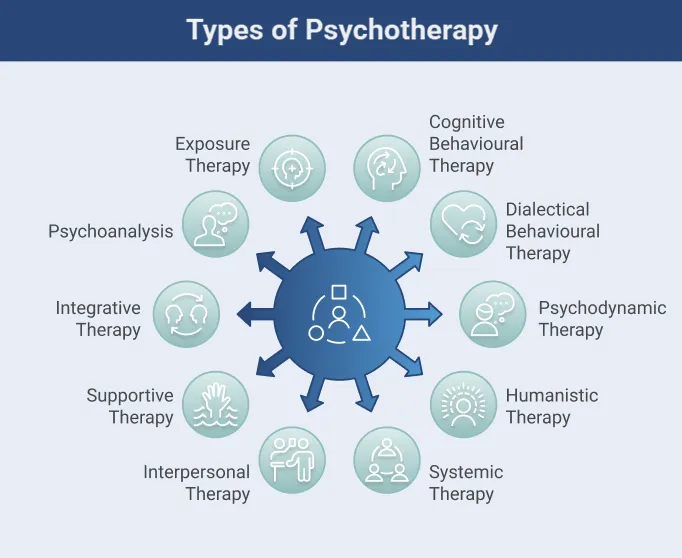
Even with many kinds of psychotherapy, the first step is often noticing when support may be needed. These types of psychotherapy can feel very different in how sessions run and what they focus on. Each type draws on different views, tools and ways of work. Knowing each type can help you choose what fits your needs. You may find one kind of psychotherapy works best for one issue, while a new kind works best for a new issue. Some therapists use a mix of these ways. Knowing these kinds of psychotherapy also helps a patient get a clear view of their own issues.
Here are some of the most common types of psychotherapy. These kinds of psychotherapy are often chosen based on the issue, the person’s comfort and the time available.
1. Cognitive Behavioural Therapy (CBT)
Cognitive Behavioural Therapy or CBT, aims to spot the thought and belief patterns that may push a person into unhelpful behaviours. This helps a client see why they do what they do. Thoughts and feelings link closely with behaviour. CBT works to show how your thoughts and beliefs shape your behaviour. In CBT, you are urged to think your behaviour through. People pick CBT when they want fast and clear change that can be seen. This type of psychotherapy is usually structured and practical, with clear steps between sessions. This is one of the types of psychotherapy that works on the idea that if you change behaviours, your thoughts can shift too. With CBT, you learn to spot and deal with bad patterns that shape your behaviour.
CBT is often used for anxiety, depression, panic attacks and addictions.
Some gains of CBT are that it is short term and goal based, it helps with thought control and it builds problem solving skills.
2. Dialectical Behavioural Therapy
Dialectical Behavioural Therapy is one of those types of psychotherapy made for those who go through very strong and hard feelings. This therapy aims to hold two things at once, self acceptance and change. It gives real skills to help you stay calm and act with care when feelings feel too big.
DBT is often used for chronic thoughts of self harm, mood swings and poor mood control, bipolar disorder support, self harm patterns and borderline personality disorder.
Some gains of DBT are that it helps with self acceptance, it helps you move on through change and it helps you keep moods and feelings in check.
DBT was first developed for people with borderline personality disorder and chronic self-harm risk. The skills can still help with other health issues too.
3. Psychodynamic Therapy
This is an inner look. It looks at hidden inner clashes, old feeling knots and old behaviour patterns. By seeing the hidden knots in the mind, a person can gain clear sight and more choice and they can step out of bad loops.
Psychodynamic types of psychotherapy are often slow when put next to CBT, but it can lead to deep and strong insight. It is one of the oldest forms of psychotherapy. It is close to psychoanalysis, but it is much more brief. In most cases, fifty minute talks are set once or twice each week.
Psychodynamic therapy can help with bond issues, long term issues that do not make sense in a plain way and low self worth.
This type of psychotherapy is often used for attachment issues, past trauma, long term grief or depression, PTSD, identity issues and repeated self-sabotage.
Some gains of psychodynamic therapy are that it builds self knowledge, it shows how feelings can lead to change, it does deep work on identity and it gives the client more choice.
4. Humanistic Therapy
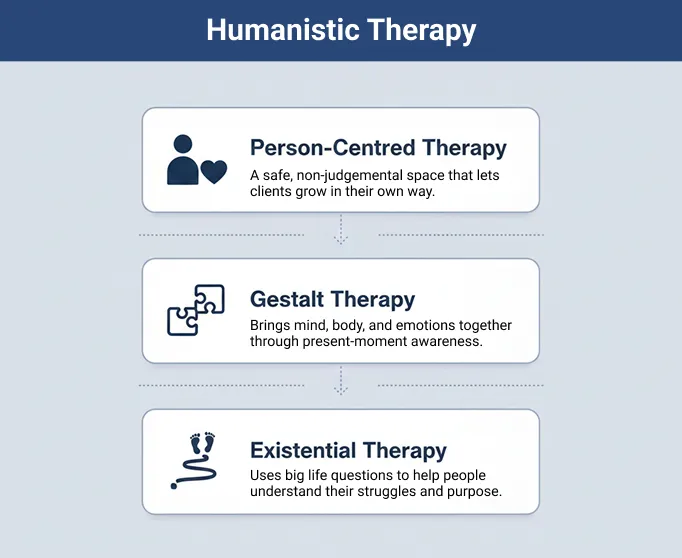
Humanistic type of psychotherapy looks at each person as a whole and as a one-off case. The goal is to look at the traits of one person, not just look for shared traits and then label them as a set “case”. This way aims to help the client find and know their own self. The tone is warm and kind. The therapist urges the client to speak in an open and true way. The stress on self-talk and self-sharing can help the client feel heard and can ease the fear of being judged. Different types of psychotherapy can come under humanistic definition.
The humanistic way is based on a few key views and it has many tools and methods linked to it. Some of these methods are below.
a. Person centred therapy (Carl Rogers)
Made known by Carl Rogers, person centred therapy aims to build a safe and healing space for the client. This way puts less focus on “fixing” the client and more focus on a safe space that lets the client grow.
Rogers held that clients have an inborn skill to grow. This growth can get blocked by shame and fear of being judged. When these fears drop, a client can grow in a more free and calm way.
b. Gestalt Therapy
This form of therapy can feel more full on. Gestalt means “whole configuration”. The key idea is that the mind, body and feelings all work as one. In this form of therapy, the person is urged to feel feelings in real time. So, the person does not just talk about feelings in a far way. Gestalt urges you to bring all parts into clear awareness.
c. Existential Therapy
This form of therapy goes past plain psychotherapy and leans into life views. It urges a client to face big life questions, such as, Who am I? What is the goal of life? What do I care for most? What gives life meaning? These questions can help a person see their issues as a human response to the big needs and pulls of life.
5. Systemic Therapy (Family and Couples Therapy)
Systemic therapy is based on the view that issues do not come up on their own. They grow in a “system”. A system can be any set of bonds, such as work, home, family or even a wider culture. Such types of psychotherapy involve more than one person. The goal is to cut clashes, boost clear talk and build more healthy bonds. Couples and families use this a lot. Among all kinds of psychotherapy, this one focuses strongly on patterns between people, not just one person.
With help from the therapist, the couple, family or one person is urged to share their thoughts and views about their own self and about each other. This can help build trust, care and fair norms in the bond.
Systemic therapy is often used for family clashes, marriage issues, parent child strain, behaviour issues in kids and teens, culture based or age gap trauma and talk issues.
Its gains are that it can help fast with talk issues, it cuts blame and shame, it can leave long term change, it can face root causes and it can help close gaps in couples and families.
6. Interpersonal Therapy (IPT)
Interpersonal therapy is a short term therapy that aims to help a person’s bonds and social life work better. Like systemic therapy, it puts focus on bond health. The key idea is that if bonds get better, so can behaviour.
When bonds break down, signs and symptoms can start to show up.
IPT does not go deep into a person’s past or into the hidden mind. The goal is to work on the client’s life. It sees the client’s now state as linked to their current thoughts, acts and bonds and to the life they live each day.
IPT is often used for depression, anxiety disorders, eating disorders, bipolar disorders, long term grief, bond issues and big life change.
The gains of IPT are that it is hands-on and action based, the time plan keeps it brief, it can help grow support ties, it suits those who do not want deep inner work and it helps clients face real life issues.
7. Supportive Therapy
Supportive therapy is a key type of psychotherapy. It believes in a calm and firm base in a strong bond with a therapist.
While some types of psychotherapy aim to build deep change and deep insight, supportive therapy aims to build coping skills, cut distress, help a person work well day to day, raise trust in self, build grit and keep life steady.
Supportive therapy helps clients deal with stress and keep feelings in check. The goal is not to judge a person. The goal is to help them feel heard, backed and strong in hard times. With this support, a client can feel more calm and more safe.
This way can help a person feel steady, so they can face life tests with more skill. The therapy bond can help cut anxiety and help the client feel safe enough to cope.
The supportive way is often used for impulse control, mood and feeling control, reality checks, judgement and self worth.
The therapist helps the client deal with symptoms by building a support net around them. Supportive therapy is often used for depression, anxiety disorders, chronic stress, health or mind health issues and grief or loss.
8. Integrative or Holistic Therapy
Integrative Therapy takes the view that humans are not shaped in lone form. Life, home, work and the full world all play a part in how the mind is built. This means that holistic therapy uses tools from different types of psychotherapy and puts them into one plan. In many cases, psychotherapy techniques are combined to match the client’s needs and pace.
Holistic therapy is built on the idea that true health needs change in thought patterns, feelings, self know, bonds, habits and beliefs and values.
One key part of integrative therapy is the idea that being able to shift and adapt can lead to the best end result. The therapist may shift their psychotherapy techniques as the work goes on.
Since holistic therapy uses many ways, it can cover a wide set of types of psychotherapy. These tools may be used for work like exploring hard feelings, spotting thought patterns, checking how the body reacts to stress, learning coping skills and looking at beliefs once more.
The therapist may shift the plan based on the client’s needs and pace. One week may focus on mood skills and the next week may focus on coping skills for stress.
Due to the wide scope of this type of psychotherapy, it is often used for anxiety, depression, trauma, chronic stress, identity crises and bond strain.
9. Psychoanalysis
“My love is something valuable to me which I ought not to throw away without reflection.”
Sigmund Freud, aCivilisation and Its Discontents
This is where a lot of it began. Psychoanalysis is one of the oldest types of psychotherapy. It rests on the view of the unconscious mind. The idea is that hidden thoughts, old memories and deep feelings shape a person’s real life. This hidden part of the mind keeps on being shaped through life. From early years, it forms from home life, how one was raised, what one saw, what one felt and what one kept in.
Psychoanalysis aims to bring deep change in a person’s traits and inner self. It is for people who want deep insight into who they are. The key idea is that what we do not know in our own mind can still rule us.
Psychoanalysis uses psychotherapy techniques such as free association, dream analysis, interpretation, analysis of transference and early memory work.
With these psychotherapy techniques, psychoanalysis can lead to deep trait change, high self know, strong feeling awareness, change in deep behaviour patterns and work on strong inner knots.
Psychoanalysis is often used for chronic depression, long standing behaviour patterns, bond issues, identity issues, numb feelings, inner pain and trauma.
Psychoanalysis still stands as a key base among different kinds of psychotherapy and it is more fit for long term change.
10. Exposure Therapy
Exposure therapy aims to face fear. It is one of those kinds of psychotherapy where, rather than avoid fear based events, a client is asked to face them in a safe and well led way. The therapist uses psychotherapy techniques to keep the steps gradual and manageable.
Exposure therapy works on the idea that avoiding makes anxiety grow, while safe exposure can make it weak.
While it is most used for anxiety, exposure therapy aims to help a person gain more skill and calm. It can help with fear response, break avoid habits, re-train the brain’s threat sense, raise tolerance for hard feelings, help with anxiety control and build self trust.
Exposure therapy helps people live with anxiety, not be ruled by it.
Exposure therapy is used for phobias, panic disorders, social anxiety, obsessive compulsive disorder (OCD), post traumatic stress disorder (PTSD) and fear tied to set places or events.
10 Signs You May Need Psychotherapy
Psychotherapy is not for the “broken”. Many people seek different kinds of psychotherapy because they feel low, worn out or stuck. These ten signs may show that psychotherapy may be needed. Sometimes it starts small. Sometimes it feels big. When it keeps coming back, life can start to feel hard inside.
1. Persistent Sadness
A person may feel sad, empty or helpless most days, even when there is no clear reason. It can make normal life feel heavy. Simple things can feel pointless, like getting out of bed, replying to messages or doing daily tasks. It can feel like a quiet weight that does not go away.
2. Excessive Anxiety
A person may feel worry, fear or restlessness most of the time. It can make daily tasks hard. There can be a strong fear feeling inside, like something bad will happen. The mind may keep thinking the worst things, even when life looks fine outside. This can make a person feel tired a lot.
3. Trauma or Grief
Grief after loss can be normal, but sometimes it stays heavy too long. Trauma can also stay in the body and mind. If moving forward feels very hard, psychotherapy may help. A person may replay the event many times, avoid reminders or feel numb like feelings shut down. It can feel like the heart is still stuck in the same painful time.
4. Mood Swings
A person may feel emotions change fast and it feels hard to control. One moment I feel okay, next moment I feel very upset. Small things can make big reactions. Later guilt or shame can come. Over time, it can hurt self trust and make feelings feel confusing.
5. Difficulty Coping With Stress
Stress is part of life, but sometimes it becomes too much. Even normal pressure can feel too hard to handle. The person may feel close to breaking down and not know the real reason. It can feel like the mind and body are always on alert and cannot relax.
6. Unhealthy Coping Behaviours
A person may start coping in harmful ways, like overeating, doing the same habits again and again or self harm to manage emotions. It may give short relief, but later it brings regret and more pain. It can feel like being stuck in a loop that keeps hurting.
7. Social Withdrawal
A person may pull away from friends, family and things they once enjoyed. Messages may stay unanswered. Plans may get cancelled. Calls may feel too hard to pick. Sometimes it is not because care is gone, it is because energy is low. Over time, loneliness can grow and life can feel smaller.
8. Changes In Sleep Or Appetite
A person may sleep too much or too little without clear medical reason. Eating can also change. Some people eat too much. Some people cannot eat much at all. This can be a sign the mind is struggling. Sleep may not feel restful. The body often shows stress when words are not coming.
9. Chronic Fatigue
A person may feel tired all the time, even after sleep and rest. The body can feel heavy. The mind can feel slow. Focus can become weak. Life can feel hard even when the person wants to try.
10. Strained Relationships
A person may face more fights, more distance or more misunderstandings with others. They may feel misunderstood often. They may feel they keep hurting people they care about even when they do not want to. This can bring guilt and sadness. It can also make a person feel alone, even when people are around.
Conclusion
Psychotherapy is not the last step. With so many types of psychotherapy, it becomes easier to choose support that matchealth remains in top form. Contact us now to get the best care and help that the field of psychotherapy can offer.
hes real needs. It is a tool that can help with self know, help manage hard feelings and help deal with the world around you. With many types of psychotherapy, clients can find an approach that fits their needs, ease and aims.
When a person is dealing with anxiety, trauma or bond issues, different kinds of psychotherapy and proven psychotherapy techniques can help bring back calm and clear thought. Spotting the signs and then picking the right type of psychotherapy can go a long way for well being. Here at Concise Medico, we offer all kinds of psychotherapy and methods to help keep mental
Remember, taking the first step does not mean something is wrong, it just means that you are taking care of your mental health. Check out our expert psychotherapy services to reclaim your health today.
FAQs
Psychotherapy is the practice of using talk to change the behaviour, feelings or thoughts of a person. When most people think of mental health care, they think of psychotherapy. Beneath this simple word are many ways and methods. There are many types of psychotherapy and each one uses different psychotherapy techniques, ideas and ways of work. While people may use therapy for a number of issues, psychotherapy deals with mental, behaviour and feeling problems. Knowing these types can help you find and choose the best way for you. This guide breaks down the most common types of psychotherapy in a simple way.
Note: This guide is general information and not a medical diagnosis. If there is immediate risk of self-harm or harm, seek urgent help in your area.
Understanding Psychotherapy
Psychotherapy is more than just talk. It uses psychotherapy techniques that are chosen based on what the client is struggling with. It is a process where a therapist and a client work as a team, using psychotherapy techniques to help them understand thought and behaviour patterns, manage feelings, break unhealthy behaviour or feeling loops, build ways to cope, improve bonds with others and make better choices. Different types of psychotherapy focus on different patterns, so the best fit depends on the person and the goal.
Since human minds are so wide and so rich, the field of psychotherapy has built many views and ways. There are many types of psychotherapy, each view has its own logic, plan and map.
10 Main Types of Psychotherapy
Even with many kinds of psychotherapy, the first step is often noticing when support may be needed. These types of psychotherapy can feel very different in how sessions run and what they focus on. Each type draws on different views, tools and ways of work. Knowing each type can help you choose what fits your needs. You may find one kind of psychotherapy works best for one issue, while a new kind works best for a new issue. Some therapists use a mix of these ways. Knowing these kinds of psychotherapy also helps a patient get a clear view of their own issues.
Here are some of the most common types of psychotherapy. These kinds of psychotherapy are often chosen based on the issue, the person’s comfort and the time available.
1. Cognitive Behavioural Therapy (CBT)
Cognitive Behavioural Therapy or CBT, aims to spot the thought and belief patterns that may push a person into unhelpful behaviours. This helps a client see why they do what they do. Thoughts and feelings link closely with behaviour. CBT works to show how your thoughts and beliefs shape your behaviour. In CBT, you are urged to think your behaviour through. People pick CBT when they want fast and clear change that can be seen. This type of psychotherapy is usually structured and practical, with clear steps between sessions. This is one of the types of psychotherapy that works on the idea that if you change behaviours, your thoughts can shift too. With CBT, you learn to spot and deal with bad patterns that shape your behaviour.
CBT is often used for anxiety, depression, panic attacks and addictions.
Some gains of CBT are that it is short term and goal based, it helps with thought control and it builds problem solving skills.
2. Dialectical Behavioural Therapy
Dialectical Behavioural Therapy is one of those types of psychotherapy made for those who go through very strong and hard feelings. This therapy aims to hold two things at once, self acceptance and change. It gives real skills to help you stay calm and act with care when feelings feel too big.
DBT is often used for chronic thoughts of self harm, mood swings and poor mood control, bipolar disorder support, self harm patterns and borderline personality disorder.
Some gains of DBT are that it helps with self acceptance, it helps you move on through change and it helps you keep moods and feelings in check.
DBT was first developed for people with borderline personality disorder and chronic self-harm risk. The skills can still help with other health issues too.
3. Psychodynamic Therapy
This is an inner look. It looks at hidden inner clashes, old feeling knots and old behaviour patterns. By seeing the hidden knots in the mind, a person can gain clear sight and more choice and they can step out of bad loops.
Psychodynamic types of psychotherapy are often slow when put next to CBT, but it can lead to deep and strong insight. It is one of the oldest forms of psychotherapy. It is close to psychoanalysis, but it is much more brief. In most cases, fifty minute talks are set once or twice each week.
Psychodynamic therapy can help with bond issues, long term issues that do not make sense in a plain way and low self worth.
This type of psychotherapy is often used for attachment issues, past trauma, long term grief or depression, PTSD, identity issues and repeated self-sabotage.
Some gains of psychodynamic therapy are that it builds self knowledge, it shows how feelings can lead to change, it does deep work on identity and it gives the client more choice.
4. Humanistic Therapy
Humanistic type of psychotherapy looks at each person as a whole and as a one-off case. The goal is to look at the traits of one person, not just look for shared traits and then label them as a set “case”. This way aims to help the client find and know their own self. The tone is warm and kind. The therapist urges the client to speak in an open and true way. The stress on self-talk and self-sharing can help the client feel heard and can ease the fear of being judged. Different types of psychotherapy can come under humanistic definition.
The humanistic way is based on a few key views and it has many tools and methods linked to it. Some of these methods are below.
a. Person centred therapy (Carl Rogers)
Made known by Carl Rogers, person centred therapy aims to build a safe and healing space for the client. This way puts less focus on “fixing” the client and more focus on a safe space that lets the client grow.
Rogers held that clients have an inborn skill to grow. This growth can get blocked by shame and fear of being judged. When these fears drop, a client can grow in a more free and calm way.
b. Gestalt Therapy
This form of therapy can feel more full on. Gestalt means “whole configuration”. The key idea is that the mind, body and feelings all work as one. In this form of therapy, the person is urged to feel feelings in real time. So, the person does not just talk about feelings in a far way. Gestalt urges you to bring all parts into clear awareness.
c. Existential Therapy
This form of therapy goes past plain psychotherapy and leans into life views. It urges a client to face big life questions, such as, Who am I? What is the goal of life? What do I care for most? What gives life meaning? These questions can help a person see their issues as a human response to the big needs and pulls of life.
5. Systemic Therapy (Family and Couples Therapy)
Systemic therapy is based on the view that issues do not come up on their own. They grow in a “system”. A system can be any set of bonds, such as work, home, family or even a wider culture. Such types of psychotherapy involve more than one person. The goal is to cut clashes, boost clear talk and build more healthy bonds. Couples and families use this a lot. Among all kinds of psychotherapy, this one focuses strongly on patterns between people, not just one person.
With help from the therapist, the couple, family or one person is urged to share their thoughts and views about their own self and about each other. This can help build trust, care and fair norms in the bond.
Systemic therapy is often used for family clashes, marriage issues, parent child strain, behaviour issues in kids and teens, culture based or age gap trauma and talk issues.
Its gains are that it can help fast with talk issues, it cuts blame and shame, it can leave long term change, it can face root causes and it can help close gaps in couples and families.
6. Interpersonal Therapy (IPT)
Interpersonal therapy is a short term therapy that aims to help a person’s bonds and social life work better. Like systemic therapy, it puts focus on bond health. The key idea is that if bonds get better, so can behaviour.
When bonds break down, signs and symptoms can start to show up.
IPT does not go deep into a person’s past or into the hidden mind. The goal is to work on the client’s life. It sees the client’s now state as linked to their current thoughts, acts and bonds and to the life they live each day.
IPT is often used for depression, anxiety disorders, eating disorders, bipolar disorders, long term grief, bond issues and big life change.
The gains of IPT are that it is hands-on and action based, the time plan keeps it brief, it can help grow support ties, it suits those who do not want deep inner work and it helps clients face real life issues.
7. Supportive Therapy
Supportive therapy is a key type of psychotherapy. It believes in a calm and firm base in a strong bond with a therapist.
While some types of psychotherapy aim to build deep change and deep insight, supportive therapy aims to build coping skills, cut distress, help a person work well day to day, raise trust in self, build grit and keep life steady.
Supportive therapy helps clients deal with stress and keep feelings in check. The goal is not to judge a person. The goal is to help them feel heard, backed and strong in hard times. With this support, a client can feel more calm and more safe.
This way can help a person feel steady, so they can face life tests with more skill. The therapy bond can help cut anxiety and help the client feel safe enough to cope.
The supportive way is often used for impulse control, mood and feeling control, reality checks, judgement and self worth.
The therapist helps the client deal with symptoms by building a support net around them. Supportive therapy is often used for depression, anxiety disorders, chronic stress, health or mind health issues and grief or loss.
8. Integrative or Holistic Therapy
Integrative Therapy takes the view that humans are not shaped in lone form. Life, home, work and the full world all play a part in how the mind is built. This means that holistic therapy uses tools from different types of psychotherapy and puts them into one plan. In many cases, psychotherapy techniques are combined to match the client’s needs and pace.
Holistic therapy is built on the idea that true health needs change in thought patterns, feelings, self know, bonds, habits and beliefs and values.
One key part of integrative therapy is the idea that being able to shift and adapt can lead to the best end result. The therapist may shift their psychotherapy techniques as the work goes on.
Since holistic therapy uses many ways, it can cover a wide set of types of psychotherapy. These tools may be used for work like exploring hard feelings, spotting thought patterns, checking how the body reacts to stress, learning coping skills and looking at beliefs once more.
The therapist may shift the plan based on the client’s needs and pace. One week may focus on mood skills and the next week may focus on coping skills for stress.
Due to the wide scope of this type of psychotherapy, it is often used for anxiety, depression, trauma, chronic stress, identity crises and bond strain.
9. Psychoanalysis
“My love is something valuable to me which I ought not to throw away without reflection.”
Sigmund Freud, aCivilisation and Its Discontents
This is where a lot of it began. Psychoanalysis is one of the oldest types of psychotherapy. It rests on the view of the unconscious mind. The idea is that hidden thoughts, old memories and deep feelings shape a person’s real life. This hidden part of the mind keeps on being shaped through life. From early years, it forms from home life, how one was raised, what one saw, what one felt and what one kept in.
Psychoanalysis aims to bring deep change in a person’s traits and inner self. It is for people who want deep insight into who they are. The key idea is that what we do not know in our own mind can still rule us.
Psychoanalysis uses psychotherapy techniques such as free association, dream analysis, interpretation, analysis of transference and early memory work.
With these psychotherapy techniques, psychoanalysis can lead to deep trait change, high self know, strong feeling awareness, change in deep behaviour patterns and work on strong inner knots.
Psychoanalysis is often used for chronic depression, long standing behaviour patterns, bond issues, identity issues, numb feelings, inner pain and trauma.
Psychoanalysis still stands as a key base among different kinds of psychotherapy and it is more fit for long term change.
10. Exposure Therapy
Exposure therapy aims to face fear. It is one of those kinds of psychotherapy where, rather than avoid fear based events, a client is asked to face them in a safe and well led way. The therapist uses psychotherapy techniques to keep the steps gradual and manageable.
Exposure therapy works on the idea that avoiding makes anxiety grow, while safe exposure can make it weak.
While it is most used for anxiety, exposure therapy aims to help a person gain more skill and calm. It can help with fear response, break avoid habits, re-train the brain’s threat sense, raise tolerance for hard feelings, help with anxiety control and build self trust.
Exposure therapy helps people live with anxiety, not be ruled by it.
Exposure therapy is used for phobias, panic disorders, social anxiety, obsessive compulsive disorder (OCD), post traumatic stress disorder (PTSD) and fear tied to set places or events.
10 Signs You May Need Psychotherapy
Psychotherapy is not for the “broken”. Many people seek different kinds of psychotherapy because they feel low, worn out or stuck. These ten signs may show that psychotherapy may be needed. Sometimes it starts small. Sometimes it feels big. When it keeps coming back, life can start to feel hard inside.
1. Persistent Sadness
A person may feel sad, empty or helpless most days, even when there is no clear reason. It can make normal life feel heavy. Simple things can feel pointless, like getting out of bed, replying to messages or doing daily tasks. It can feel like a quiet weight that does not go away.
2. Excessive Anxiety
A person may feel worry, fear or restlessness most of the time. It can make daily tasks hard. There can be a strong fear feeling inside, like something bad will happen. The mind may keep thinking the worst things, even when life looks fine outside. This can make a person feel tired a lot.
3. Trauma or Grief
Grief after loss can be normal, but sometimes it stays heavy too long. Trauma can also stay in the body and mind. If moving forward feels very hard, psychotherapy may help. A person may replay the event many times, avoid reminders or feel numb like feelings shut down. It can feel like the heart is still stuck in the same painful time.
4. Mood Swings
A person may feel emotions change fast and it feels hard to control. One moment I feel okay, next moment I feel very upset. Small things can make big reactions. Later guilt or shame can come. Over time, it can hurt self trust and make feelings feel confusing.
5. Difficulty Coping With Stress
Stress is part of life, but sometimes it becomes too much. Even normal pressure can feel too hard to handle. The person may feel close to breaking down and not know the real reason. It can feel like the mind and body are always on alert and cannot relax.
6. Unhealthy Coping Behaviours
A person may start coping in harmful ways, like overeating, doing the same habits again and again or self harm to manage emotions. It may give short relief, but later it brings regret and more pain. It can feel like being stuck in a loop that keeps hurting.
7. Social Withdrawal
A person may pull away from friends, family and things they once enjoyed. Messages may stay unanswered. Plans may get cancelled. Calls may feel too hard to pick. Sometimes it is not because care is gone, it is because energy is low. Over time, loneliness can grow and life can feel smaller.
8. Changes In Sleep Or Appetite
A person may sleep too much or too little without clear medical reason. Eating can also change. Some people eat too much. Some people cannot eat much at all. This can be a sign the mind is struggling. Sleep may not feel restful. The body often shows stress when words are not coming.
9. Chronic Fatigue
A person may feel tired all the time, even after sleep and rest. The body can feel heavy. The mind can feel slow. Focus can become weak. Life can feel hard even when the person wants to try.
10. Strained Relationships
A person may face more fights, more distance or more misunderstandings with others. They may feel misunderstood often. They may feel they keep hurting people they care about even when they do not want to. This can bring guilt and sadness. It can also make a person feel alone, even when people are around.
Conclusion
Psychotherapy is not the last step. With so many types of psychotherapy, it becomes easier to choose support that matchealth remains in top form. Contact us now to get the best care and help that the field of psychotherapy can offer.
hes real needs. It is a tool that can help with self know, help manage hard feelings and help deal with the world around you. With many types of psychotherapy, clients can find an approach that fits their needs, ease and aims.
When a person is dealing with anxiety, trauma or bond issues, different kinds of psychotherapy and proven psychotherapy techniques can help bring back calm and clear thought. Spotting the signs and then picking the right type of psychotherapy can go a long way for well being. Here at Concise Medico, we offer all kinds of psychotherapy and methods to help keep mental
Remember, taking the first step does not mean something is wrong, it just means that you are taking care of your mental health. Check out our expert psychotherapy services to reclaim your health today.