TABLE OF CONTENT
When do courts need more than general medical opinion? It is when legal cases involve disability, injury or rehab. It questions daily life matters and needs an insight. In such cases, an occupational therapist expert witness plays a key role. They help you recover your loss after illness and injury.
In the UK, 67% of occupational therapists state an increased service demand. In 2025, more than 28,000 people were found on the waiting list to see an OT. This shows an unmet need for OTs. Health and social care is complex. It puts pressure on rehab services. This is why the role of OTs in legal cases is more important.
OT expert witnesses are health care professionals who provide expert opinion in legal cases. These opinions are independent and evidence based. OTs assist judges, solicitors and tribunals to understand medical matters.
Occupational therapists look beyond diagnosis. They check how people function in the real world. They assess what a person can do. OTs assess their struggles as well. They check the support they need to live in a safe and independent way. In legal cases, this practical analysis is essential.
In this blog, you will learn:
- What is an OT expert witness
- What does an occupational therapist do
- How OTs support legal cases as an expert witness
- The main duties of an occupational therapist
- The types of cases an occupational therapist can help with
- The assessments an occupational therapist carries out
- The legal rules an occupational therapist must follow
What Is an Occupational Therapist Expert Witness?
Occupational therapists are health care professionals who provide expert opinion in legal cases. They have specialised knowledge and experience. They give expert opinions within their field to assist judges, solicitors and tribunals. OTs help them understand medical matters.
In legal contexts, an OT expert witness may be asked to:
- Assess daily abilities of a person
- Explain how an injury affects daily life
- Look at how an injury impacts work or education
- Suggest rehab plans
- Suggest changes to the home
- Suggest changes to the environment
- Review if the care met the standard
The role of an occupational therapist is not to support one side. The claimant or defendant can instruct them. Sometimes both parties can jointly instruct them. But they must remain neutral, because their duty is to the court.
Their opinion must be:
- Clear
- Unbiased
- Grounded in expertise
Roles of an Occupational Therapist Expert Witness
The roles of an occupational therapist include:
- Planning treatment
- Recommending equipment
- Supporting safe independence
The duty of an expert witness is vast. It is beyond medical records. It involves an expert opinion to help the court. They help the jury understand complex clinical matters.
An occupational therapist must:
- Give opinions in a clear and fair way
- Share findings based on solid evidence
- Explain complex terms in simple language
- Help the court understand functional limits of a person
- Stay confident and steady during cross examination
Courts rely on OT experts’ opinions. They need their guidance to make decisions.
Roles of an occupational therapist are not limited to injury claims. They have a role in medical negligence and family law cases. They play a key role in disability matters and Court of Protection cases as well.
The roles of an occupational therapist also involve assessing physical, cognitive and emotional needs.
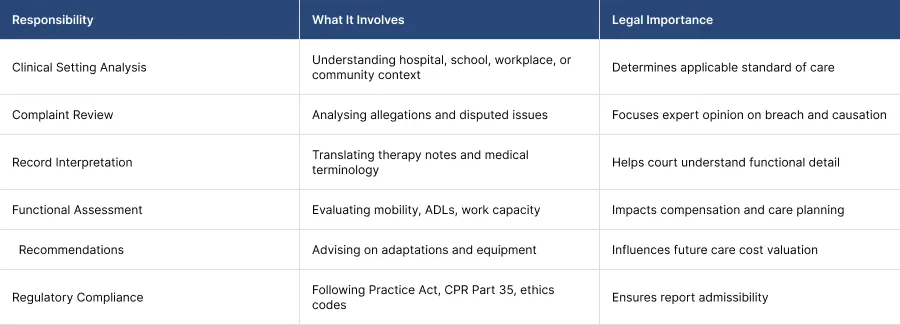
1. Understanding the Clinical Setting
The role of an OT expert is to understand the clinical setting where an incident took place. Injury can occur anywhere. Medical malpractice can also happen anywhere.
The following are settings where an incident may occur:
- Acute inpatient hospitals
- Skilled nursing facilities
- Outpatient clinics
- Schools and workplaces
- Community rehab settings
The expert must understand the ‘ins and outs’ of that setting. Standards of care differ between an acute hospital and a school setting. There is a difference in resources and staffing levels in all these settings. The supervision protocols and documentation practices can also vary.
An OT has worked with inpatient and outpatient orthopaedic and neurological populations. They have experience with adults and paediatrics. This helps them bring valuable knowledge. This experience adds to their credibility and improves the quality of their opinion.
Understanding the setting helps them observe what happened.
2. Analysing the Complaint and Allegations
When instructed on a case, the role of occupational therapist is to carefully analyse the complaint. This is a key step in the process.
The complaint outlines:
- The accusations
- The alleged failures
- The claimed damages
- The areas under dispute
OTs must understand the allegations. They may work with the claimant or defence. They identify where to focus their review.
Having access to the formal complaint at the start of the claim saves time. It also ensures precision. It allows the expert to focus on the issue and avoids reviewing unrelated material.
Example: If the claim is about unsafe transfer methods, the expert will look at the records very carefully. They will check records about mobility help and supervision. They will also review what the therapist did.
This approach increases efficiency. It also adds to the credibility of the report.
3. Reviewing Therapy Records and Interpreting Medical Terms
The role of an OT expert witness is to review therapy records. These records often contain technical language and abbreviations. This may not be easily understood by legal experts.
The OT expert must interpret this. They make the details clear for solicitors and the court.
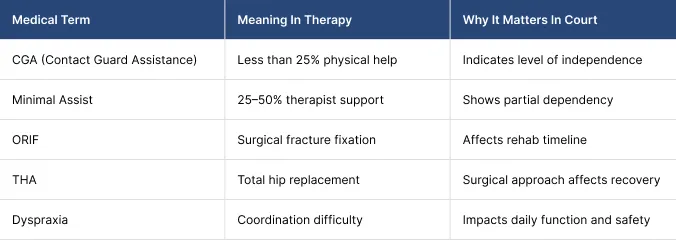
Common therapy terms that appear in medical chart reviews include:
a. CGA (Contact Guard Assistance)
In CGA, the therapist stays very close during movement or transfers. Their hands may lightly touch the person to keep them safe. In this, OT gives less than 25% physical help.
b. Minimal Assist
In minimal assist, the therapist helps during movement or transfers. In this, OT gives 25% to 50% physical help.
OTs show how independent the patient is. They also show how much the therapist helped. These details can be crucial in legal cases.
Occupational therapy assistants may help with these transfers under the OT’s plan. Their session notes can show what actually happened in practice and this can be important evidence in a legal case.
c. ORIF (Open Reduction Internal Fixation)
ORIF fixes a broken bone. Screws, metal plates or pins are used to hold the bone in place.
d. THA (Total Hip Arthroplasty)
Total hip replacement is the surgical approach (front or back) that affects rehab and movement limits.
e. Dyspraxia
Dyspraxia is difficulty in planning and doing coordinated movements. It is often seen in children with neurodevelopmental conditions.
These details are not minor. OTs can check if the care provided was enough. They can also check if the restrictions were followed. They can further check if the care was aligned with the standard.
The ability to translate medical terms for the court is a crucial skill. An OT expert witness must be able to explain them.
4. Reviewing Past Medical History
An OT expert witness must review past medical records and history. This includes surgical history as well.
Past medical history helps check:
- If the person had any existing health conditions
- If past injuries affect their current issues
- If past injuries affected recovery
- If the current injury is directly caused by the incident
This analysis is crucial to establish causation.
Example: If the person had spinal surgery before the injury, the expert must consider it. They must check how it affects the current condition. This helps them understand the case clearly.
A careful review helps make the findings fair and strong.
5. Regulatory and Ethical Duties
It’s a duty of an OT expert witness to follow the laws and maintain ethics.
In the UK, this may include:
- CPR Part 35 for expert reports
- The Equality Act 2010 for work related cases
- The Mental Capacity Act 2005 for Court of Protection cases
This helps make sure the expert opinion is legally sound. The expert’s duty is to the court. It is not to the side that hired them. They must stay impartial and honest.
Rules can vary across the UK. The expert must understand the law in the part of the UK where the incident happened.
If an occupational therapy assistant was involved, the expert must check what the assistant was permitted to do under that part of the UK’s rules. They must also check whether the OT provided proper supervision.
6. Assessing Functional Abilities
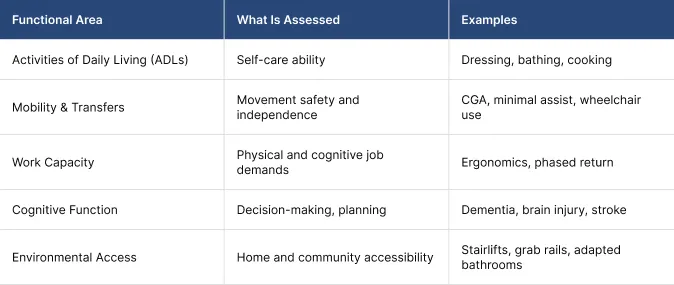
An OT expert witness checks the functional ability of a person. OTs assess how impairments affect the daily life of a person. This includes:
- Mobility
- Self care
- Domestic tasks
- Work capacity
- Social participation
- Ability to study
- Ability to drive
- Independent living
They assess Activities of Daily Living (ADLs), such as:
- Dressing
- Bathing
- Cooking
- Cleaning
- Managing finances
They check the impact of physical and cognitive impairment. The impact of psychological impairments is also checked. This enables OTs to inform compensation decisions.
7. Recommending Environmental Adaptations and Assistive Devices
An OT expert witness plays a role to suggest home changes and support equipment. In many cases, the key question is not only if someone was injured. It is how that person will live in the future.
They may suggest:
- Wheelchairs
- Grab rails
- Stairlifts
- Hoists
- Adapted bathrooms
- Ramps
- Modified kitchens
- Assistive technology
These suggestions come from a functional assessment.
Example: If a person has reduced mobility after a spinal injury or amputation, the OT may check transfers, balance, endurance, arm strength and home layout.
They decide what changes are needed for safe and independent living. These factors can affect costs. It can also influence compensation for care and home changes.
8. Identifying Rehab Needs and Giving a Prognosis
An OT expert witness also plays a role in explaining rehab needs.
Their report may include:
- A suggested therapy plan
- How often support is needed
- How long rehab may take
- Expected recovery milestones
- Risk of long term disability
Occupational therapist assistants may deliver parts of this rehab under the OT’s plan. Their progress notes can show response to therapy and functional change over time. These details can support or challenge a claim.
In medical negligence claims, they may review if earlier rehab could have led to better results. In injury cases, they give an opinion on recovery and long term function.
This helps the court understand:
- If the injury is short term or permanent
- If independence may improve
- What long term support may be needed
- Prognosis is often key for financial decisions
9. Covering Lifespan and Population Needs
OTs work with people of all ages. This wide experience supports their expert role. The roles of an occupational therapist include helping people improve their ability to perform daily activities.
They may work with:
a. Children and Adolescents
This may include:
- Delays in development
- Neurodevelopmental disorders
- Learning disabilities
- Mental health needs
- School support needs
b. Adults
This may include:
- Recovery after injury
- Chronic illness
- Work related injury
- Mental health conditions
c. Older Adults
This may include:
- Age related conditions
- Assisted living residents
- Long term care residents
d. Neurological Conditions
This may include:
- Stroke
- Traumatic brain injury
- Parkinson’s disease
In complex neurological cases, a neuro occupational therapist may be asked to assess the person. They check how conditions such as brain injury, stroke or spinal cord damage affect daily life. They may assess:
- Thinking of a person
- Movement of a person
- Coordination of a person
- Independence of a person
In addition, trauma surgery is a specialised medical procedure. Learn more about trauma surgery after injury.
e. Sensory Impairments
This may include:
- Visual impairment
- Hearing impairment
This range of experience adds credibility. It helps OTs assess cases in many legal settings.
10. Working Across Community, School and Home Based Settings
OTs also play a key role across community, school, home and other settings. This includes:
- Acute hospitals
- Outpatient clinics
- Nursing homes
- Schools
- Workplaces
- Psychiatric hospitals
- Community rehab programmes
- Home care
In legal cases, it is important to understand how therapy works in each place. Care can differ by setting. The expert must decide what was reasonable in that situation.
11. Maintaining Objectivity and Impartiality
A key rule for expert witnesses is to maintain impartiality and objectivity.
OTs must:
- Give unbiased opinions
- Use evidence to support findings
- Stay neutral, even if one side hired them
- Focus on the facts and standards
Whether hired by the claimant or the defendant, their duty is to the court. They should not support one side.
Their opinion must hold up in cross examination. This needs:
- Clear reasoning
- Accurate reading of records
- Consistent judgement
In the UK, expert reports must follow CPR Part 35. This sets the rules for expert evidence in civil cases.
An expert occupational therapist must explain their findings clearly and stay neutral. They must also make sure their report follows legal rules, such as CPR Part 35.
It helps make reports clear, legal and ready for court.
12. Translating Complex Details for the Court
An OT expert witness explains complex issues in simple, legal terms.
For example, they may explain:
- What ‘minimal assistance’ looks like in daily life
- How surgery affects recovery and rehab
- Why dyspraxia makes everyday tasks harder
- How cognitive problems affect money
- How cognitive problems affect decision making
OTs must use clear language. This helps judges and juries understand the evidence. It also supports fair decisions.
Types of Legal Cases Involving Occupational Therapist Expert Witness
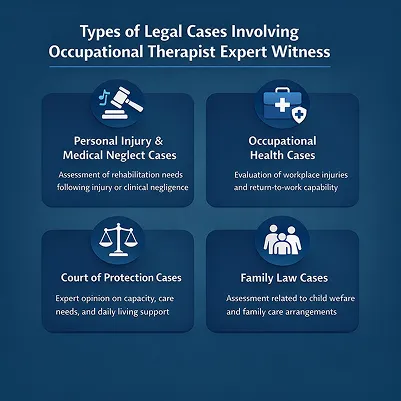
An OT expert witness is instructed in a range of legal cases. Following are the types of legal cases that involve an OT expert witness:
1. Personal Injury and Medical Negligence Cases
Personal injury claims and medical negligence claims are the most common cases where OT experts are involved. In these cases, they check how the injury affects daily life. This can include:
- Fractures
- Stroke
- Brain injury
- Spinal injuries
- Amputations
- Nerve damage
- Soft tissue injuries
- Parkinson’s disease
They assess:
- Reduced mobility
- Loss of hand function and dexterity
- Mental barriers after trauma
- Emotional barriers after trauma
They provide:
- Prognosis
- Rehab suggestions
- An opinion on long term disability
- Advice on equipment to support daily tasks
- Advice on home changes and modifications
They also help courts to check compensation for:
- Loss of earnings
- Care costs
- Future support needs
Their input directly affects financial matters in these claims.
2. Occupational Health Cases
OT experts are also involved in occupational health cases. The role of OT is crucial in workplace injury and disability cases. Legal disputes arise after a person is injured at work, when they become unwell or when they can not return to their past role.
In the UK, these cases often involve the Equality Act 2010. According to this, employers adjust for employees with disabilities.
An OT expert witness may be asked to check:
- If the person can return to work
- If workplace changes are reasonable
- If long term work is realistic
- Which tasks are safe to do
- What limits or restrictions are needed
Their report may include a workplace assessment. This looks at:
- Physical demands of the job
- Barriers in the work setting
- How long the person can sit or stand
- Cognitive demands such as focus and memory
- Ergonomics and workstation setup
- Lifting needs of a person
The expert may suggest:
- Modified duties
- Reduced hours
- Better ergonomic workstations
- A phased return to work
- A different role in the same organisation
OTs may also review the long term impact on career options. This matters in compensation claims, especially if the person can not do their job anymore.
Their input helps courts and tribunals make decisions. They assess:
- If the employer is at fault
- Compensation for lost income
- What adjustments are reasonable
- Future earning potential
OTs understand both daily function and job demands. Their advice is practical and evidence based.
3. Court of Protection Cases
OTs are also involved in Court of Protection cases. These cases involve people who may not have the mental capacity to make some decisions. In the UK, this is covered by the Mental Capacity Act 2005.
An OT expert witness may check if the person can:
- Manage money
- Manage personal care
- Do household tasks
- Take part in community life
- Make informed decisions
They may assess people with:
- Brain injury
- Stroke
- Neurological conditions
- Cognitive impairment
- Dementia
The assessment is not only about the diagnosis. It also focuses on real life function. The expert looks at how the condition affects daily living.
Their suggestions may include:
- Residential care
- Supported living
- Support workers
- Equipment like hoists
- Riser recliner chairs
- Adapted bathrooms
- Live-in carers
They may also check if the home is safe and suitable and assess if changes are needed.
These reports help the court make fair decisions. The aim is to support independence, while keeping the person safe.
4. Family Law Cases
OTs are also involved in family law cases. The court may need to know how a parent’s physical or mental health affects childcare.
The expert may assess:
- Ability to keep children safe
- Ability to cope with parenting demands
- Ability to do childcare tasks
- Ability to manage the home
They may review how any damage affects parenting. This can include disability, chronic illness, depression or neurological problems.
They may suggest:
- Support workers for childcare help
- Home changes to improve safety
- Changes at home to make tasks easier
- Parenting programmes suited to the parent’s needs
The main focus is the child’s best interests. They also support the parent’s independence where possible. These reports are sensitive. They need careful and balanced judgement.
Do Courts Rely on Occupational Therapist Expert Witnesses?
Yes, courts rely on OTs expert witnesses because they explain how any injury affects daily life. Doctors often focus on diagnosis and treatment but OTs focus on function.
They answer questions like:
- Can the person return to work?
- What care support is needed?
- What equipment is required?
- Can they live safely alone?
- Can the person dress without help?
These are real life questions. They affect compensation and care planning. Courts need to understand not only what diagnosis a person has, but how that condition affects daily life. OTs help fill the gap between medical diagnosis and practical living needs.
However, judges assess the case themselves. They do not rely solely on what the OT says. They assess the expert’s opinion alongside other medical evidence. They also assess witness testimony, legal arguments and the full facts of the case.
The OT provides professional and evidence based insight. The court then weighs that evidence carefully before reaching its final decision.
OT Expert Witness Case Study
Background
Muyepa v Ministry of Defence was a UK case from 2022. Muyepa was a former British Army soldier. He said he got a serious cold injury in his hands and feet while on duty.
Muyepa asked the court for money to cover his future care and support needs. Several expert witnesses wrote reports including OT experts.
One OT expert suggested the support and equipment he might need in the future. But the judge did not accept this. The judge read the reports closely and checked how well the experts explained their opinions.
Findings
The judge found that:
- Some experts, including one OT, did not explain their views clearly
- Expert opinions did not have enough evidence behind them
- Some parts of the reports missed important facts
- Some opinions supported one side instead of staying neutral
- The judge criticised the overall quality and objectivity of the expert evidence
- The court did not fully rely on the expert opinions
Outcome
The court dismissed the claim. The judge decided the evidence was not reliable enough. This shows expert witnesses must follow strict rules and give clear and balanced evidence. If they do not, their opinion can be challenged or rejected.
This case shows why OT expert witnesses must be clear, honest and neutral when writing reports for legal cases.
Conclusion
Occupational therapist expert witnesses play a key role in legal cases. Their role is both complex and essential. They provide functional assessments, rehab planning and environmental change advice.
Roles of an occupational therapist are beyond work capacity evaluations and capacity under mental health law. They also provide parenting capacity assessments. Their opinions are evidence based and they assist with the following:
- They examine past medical history
- They review therapy records
- They interpret medical jargon
- They analyse complaints
- They ensure compliance with ethical and legal standards
An OT expert witness helps courts make informed, fair and balanced decisions. They operate across multiple settings, populations and legal contexts. They provide vital insight. Following are the cases where they help you most:
- Workplace disputes
- Court of Protection cases
- Family law cases
- Personal injury claims
- Medical negligence cases
- Disability discrimination matters
The occupational therapist’s duty is to the court. Their goal is clarity. Their focus is function. They combine legal awareness and clear communication. This helps courts make informed, fair and balanced decisions.
Concise Medico understands that OT experts play a crucial role in the justice system. They turn your medical details into practical understanding. Contact us today if you need an occupational therapy expert witness who understands you and puts you first.
FAQs
When do courts need more than general medical opinion? It is when legal cases involve disability, injury or rehab. It questions daily life matters and needs an insight. In such cases, an occupational therapist expert witness plays a key role. They help you recover your loss after illness and injury.
In the UK, 67% of occupational therapists state an increased service demand. In 2025, more than 28,000 people were found on the waiting list to see an OT. This shows an unmet need for OTs. Health and social care is complex. It puts pressure on rehab services. This is why the role of OTs in legal cases is more important.
OT expert witnesses are health care professionals who provide expert opinion in legal cases. These opinions are independent and evidence based. OTs assist judges, solicitors and tribunals to understand medical matters.
Occupational therapists look beyond diagnosis. They check how people function in the real world. They assess what a person can do. OTs assess their struggles as well. They check the support they need to live in a safe and independent way. In legal cases, this practical analysis is essential.
In this blog, you will learn:
- What is an OT expert witness
- What does an occupational therapist do
- How OTs support legal cases as an expert witness
- The main duties of an occupational therapist
- The types of cases an occupational therapist can help with
- The assessments an occupational therapist carries out
- The legal rules an occupational therapist must follow
What Is an Occupational Therapist Expert Witness?
Occupational therapists are health care professionals who provide expert opinion in legal cases. They have specialised knowledge and experience. They give expert opinions within their field to assist judges, solicitors and tribunals. OTs help them understand medical matters.
In legal contexts, an OT expert witness may be asked to:
- Assess daily abilities of a person
- Explain how an injury affects daily life
- Look at how an injury impacts work or education
- Suggest rehab plans
- Suggest changes to the home
- Suggest changes to the environment
- Review if the care met the standard
The role of an occupational therapist is not to support one side. The claimant or defendant can instruct them. Sometimes both parties can jointly instruct them. But they must remain neutral, because their duty is to the court.
Their opinion must be:
- Clear
- Unbiased
- Grounded in expertise
Roles of an Occupational Therapist Expert Witness
The roles of an occupational therapist include:
- Planning treatment
- Recommending equipment
- Supporting safe independence
The duty of an expert witness is vast. It is beyond medical records. It involves an expert opinion to help the court. They help the jury understand complex clinical matters.
An occupational therapist must:
- Give opinions in a clear and fair way
- Share findings based on solid evidence
- Explain complex terms in simple language
- Help the court understand functional limits of a person
- Stay confident and steady during cross examination
Courts rely on OT experts’ opinions. They need their guidance to make decisions.
Roles of an occupational therapist are not limited to injury claims. They have a role in medical negligence and family law cases. They play a key role in disability matters and Court of Protection cases as well.
The roles of an occupational therapist also involve assessing physical, cognitive and emotional needs.
1. Understanding the Clinical Setting
The role of an OT expert is to understand the clinical setting where an incident took place. Injury can occur anywhere. Medical malpractice can also happen anywhere.
The following are settings where an incident may occur:
- Acute inpatient hospitals
- Skilled nursing facilities
- Outpatient clinics
- Schools and workplaces
- Community rehab settings
The expert must understand the ‘ins and outs’ of that setting. Standards of care differ between an acute hospital and a school setting. There is a difference in resources and staffing levels in all these settings. The supervision protocols and documentation practices can also vary.
An OT has worked with inpatient and outpatient orthopaedic and neurological populations. They have experience with adults and paediatrics. This helps them bring valuable knowledge. This experience adds to their credibility and improves the quality of their opinion.
Understanding the setting helps them observe what happened.
2. Analysing the Complaint and Allegations
When instructed on a case, the role of occupational therapist is to carefully analyse the complaint. This is a key step in the process.
The complaint outlines:
- The accusations
- The alleged failures
- The claimed damages
- The areas under dispute
OTs must understand the allegations. They may work with the claimant or defence. They identify where to focus their review.
Having access to the formal complaint at the start of the claim saves time. It also ensures precision. It allows the expert to focus on the issue and avoids reviewing unrelated material.
Example: If the claim is about unsafe transfer methods, the expert will look at the records very carefully. They will check records about mobility help and supervision. They will also review what the therapist did.
This approach increases efficiency. It also adds to the credibility of the report.
3. Reviewing Therapy Records and Interpreting Medical Terms
The role of an OT expert witness is to review therapy records. These records often contain technical language and abbreviations. This may not be easily understood by legal experts.
The OT expert must interpret this. They make the details clear for solicitors and the court.
Common therapy terms that appear in medical chart reviews include:
a. CGA (Contact Guard Assistance)
In CGA, the therapist stays very close during movement or transfers. Their hands may lightly touch the person to keep them safe. In this, OT gives less than 25% physical help.
b. Minimal Assist
In minimal assist, the therapist helps during movement or transfers. In this, OT gives 25% to 50% physical help.
OTs show how independent the patient is. They also show how much the therapist helped. These details can be crucial in legal cases.
Occupational therapy assistants may help with these transfers under the OT’s plan. Their session notes can show what actually happened in practice and this can be important evidence in a legal case.
c. ORIF (Open Reduction Internal Fixation)
ORIF fixes a broken bone. Screws, metal plates or pins are used to hold the bone in place.
d. THA (Total Hip Arthroplasty)
Total hip replacement is the surgical approach (front or back) that affects rehab and movement limits.
e. Dyspraxia
Dyspraxia is difficulty in planning and doing coordinated movements. It is often seen in children with neurodevelopmental conditions.
These details are not minor. OTs can check if the care provided was enough. They can also check if the restrictions were followed. They can further check if the care was aligned with the standard.
The ability to translate medical terms for the court is a crucial skill. An OT expert witness must be able to explain them.
4. Reviewing Past Medical History
An OT expert witness must review past medical records and history. This includes surgical history as well.
Past medical history helps check:
- If the person had any existing health conditions
- If past injuries affect their current issues
- If past injuries affected recovery
- If the current injury is directly caused by the incident
This analysis is crucial to establish causation.
Example: If the person had spinal surgery before the injury, the expert must consider it. They must check how it affects the current condition. This helps them understand the case clearly.
A careful review helps make the findings fair and strong.
5. Regulatory and Ethical Duties
It’s a duty of an OT expert witness to follow the laws and maintain ethics.
In the UK, this may include:
- CPR Part 35 for expert reports
- The Equality Act 2010 for work related cases
- The Mental Capacity Act 2005 for Court of Protection cases
This helps make sure the expert opinion is legally sound. The expert’s duty is to the court. It is not to the side that hired them. They must stay impartial and honest.
Rules can vary across the UK. The expert must understand the law in the part of the UK where the incident happened.
If an occupational therapy assistant was involved, the expert must check what the assistant was permitted to do under that part of the UK’s rules. They must also check whether the OT provided proper supervision.
6. Assessing Functional Abilities
An OT expert witness checks the functional ability of a person. OTs assess how impairments affect the daily life of a person. This includes:
- Mobility
- Self care
- Domestic tasks
- Work capacity
- Social participation
- Ability to study
- Ability to drive
- Independent living
They assess Activities of Daily Living (ADLs), such as:
- Dressing
- Bathing
- Cooking
- Cleaning
- Managing finances
They check the impact of physical and cognitive impairment. The impact of psychological impairments is also checked. This enables OTs to inform compensation decisions.
7. Recommending Environmental Adaptations and Assistive Devices
An OT expert witness plays a role to suggest home changes and support equipment. In many cases, the key question is not only if someone was injured. It is how that person will live in the future.
They may suggest:
- Wheelchairs
- Grab rails
- Stairlifts
- Hoists
- Adapted bathrooms
- Ramps
- Modified kitchens
- Assistive technology
These suggestions come from a functional assessment.
Example: If a person has reduced mobility after a spinal injury or amputation, the OT may check transfers, balance, endurance, arm strength and home layout.
They decide what changes are needed for safe and independent living. These factors can affect costs. It can also influence compensation for care and home changes.
8. Identifying Rehab Needs and Giving a Prognosis
An OT expert witness also plays a role in explaining rehab needs.
Their report may include:
- A suggested therapy plan
- How often support is needed
- How long rehab may take
- Expected recovery milestones
- Risk of long term disability
Occupational therapist assistants may deliver parts of this rehab under the OT’s plan. Their progress notes can show response to therapy and functional change over time. These details can support or challenge a claim.
In medical negligence claims, they may review if earlier rehab could have led to better results. In injury cases, they give an opinion on recovery and long term function.
This helps the court understand:
- If the injury is short term or permanent
- If independence may improve
- What long term support may be needed
- Prognosis is often key for financial decisions
9. Covering Lifespan and Population Needs
OTs work with people of all ages. This wide experience supports their expert role. The roles of an occupational therapist include helping people improve their ability to perform daily activities.
They may work with:
a. Children and Adolescents
This may include:
- Delays in development
- Neurodevelopmental disorders
- Learning disabilities
- Mental health needs
- School support needs
b. Adults
This may include:
- Recovery after injury
- Chronic illness
- Work related injury
- Mental health conditions
c. Older Adults
This may include:
- Age related conditions
- Assisted living residents
- Long term care residents
d. Neurological Conditions
This may include:
- Stroke
- Traumatic brain injury
- Parkinson’s disease
In complex neurological cases, a neuro occupational therapist may be asked to assess the person. They check how conditions such as brain injury, stroke or spinal cord damage affect daily life. They may assess:
- Thinking of a person
- Movement of a person
- Coordination of a person
- Independence of a person
In addition, trauma surgery is a specialised medical procedure. Learn more about trauma surgery after injury.
e. Sensory Impairments
This may include:
- Visual impairment
- Hearing impairment
This range of experience adds credibility. It helps OTs assess cases in many legal settings.
10. Working Across Community, School and Home Based Settings
OTs also play a key role across community, school, home and other settings. This includes:
- Acute hospitals
- Outpatient clinics
- Nursing homes
- Schools
- Workplaces
- Psychiatric hospitals
- Community rehab programmes
- Home care
In legal cases, it is important to understand how therapy works in each place. Care can differ by setting. The expert must decide what was reasonable in that situation.
11. Maintaining Objectivity and Impartiality
A key rule for expert witnesses is to maintain impartiality and objectivity.
OTs must:
- Give unbiased opinions
- Use evidence to support findings
- Stay neutral, even if one side hired them
- Focus on the facts and standards
Whether hired by the claimant or the defendant, their duty is to the court. They should not support one side.
Their opinion must hold up in cross examination. This needs:
- Clear reasoning
- Accurate reading of records
- Consistent judgement
In the UK, expert reports must follow CPR Part 35. This sets the rules for expert evidence in civil cases.
An expert occupational therapist must explain their findings clearly and stay neutral. They must also make sure their report follows legal rules, such as CPR Part 35.
It helps make reports clear, legal and ready for court.
12. Translating Complex Details for the Court
An OT expert witness explains complex issues in simple, legal terms.
For example, they may explain:
- What ‘minimal assistance’ looks like in daily life
- How surgery affects recovery and rehab
- Why dyspraxia makes everyday tasks harder
- How cognitive problems affect money
- How cognitive problems affect decision making
OTs must use clear language. This helps judges and juries understand the evidence. It also supports fair decisions.
Types of Legal Cases Involving Occupational Therapist Expert Witness
An OT expert witness is instructed in a range of legal cases. Following are the types of legal cases that involve an OT expert witness:
1. Personal Injury and Medical Negligence Cases
Personal injury claims and medical negligence claims are the most common cases where OT experts are involved. In these cases, they check how the injury affects daily life. This can include:
- Fractures
- Stroke
- Brain injury
- Spinal injuries
- Amputations
- Nerve damage
- Soft tissue injuries
- Parkinson’s disease
They assess:
- Reduced mobility
- Loss of hand function and dexterity
- Mental barriers after trauma
- Emotional barriers after trauma
They provide:
- Prognosis
- Rehab suggestions
- An opinion on long term disability
- Advice on equipment to support daily tasks
- Advice on home changes and modifications
They also help courts to check compensation for:
- Loss of earnings
- Care costs
- Future support needs
Their input directly affects financial matters in these claims.
2. Occupational Health Cases
OT experts are also involved in occupational health cases. The role of OT is crucial in workplace injury and disability cases. Legal disputes arise after a person is injured at work, when they become unwell or when they can not return to their past role.
In the UK, these cases often involve the Equality Act 2010. According to this, employers adjust for employees with disabilities.
An OT expert witness may be asked to check:
- If the person can return to work
- If workplace changes are reasonable
- If long term work is realistic
- Which tasks are safe to do
- What limits or restrictions are needed
Their report may include a workplace assessment. This looks at:
- Physical demands of the job
- Barriers in the work setting
- How long the person can sit or stand
- Cognitive demands such as focus and memory
- Ergonomics and workstation setup
- Lifting needs of a person
The expert may suggest:
- Modified duties
- Reduced hours
- Better ergonomic workstations
- A phased return to work
- A different role in the same organisation
OTs may also review the long term impact on career options. This matters in compensation claims, especially if the person can not do their job anymore.
Their input helps courts and tribunals make decisions. They assess:
- If the employer is at fault
- Compensation for lost income
- What adjustments are reasonable
- Future earning potential
OTs understand both daily function and job demands. Their advice is practical and evidence based.
3. Court of Protection Cases
OTs are also involved in Court of Protection cases. These cases involve people who may not have the mental capacity to make some decisions. In the UK, this is covered by the Mental Capacity Act 2005.
An OT expert witness may check if the person can:
- Manage money
- Manage personal care
- Do household tasks
- Take part in community life
- Make informed decisions
They may assess people with:
- Brain injury
- Stroke
- Neurological conditions
- Cognitive impairment
- Dementia
The assessment is not only about the diagnosis. It also focuses on real life function. The expert looks at how the condition affects daily living.
Their suggestions may include:
- Residential care
- Supported living
- Support workers
- Equipment like hoists
- Riser recliner chairs
- Adapted bathrooms
- Live-in carers
They may also check if the home is safe and suitable and assess if changes are needed.
These reports help the court make fair decisions. The aim is to support independence, while keeping the person safe.
4. Family Law Cases
OTs are also involved in family law cases. The court may need to know how a parent’s physical or mental health affects childcare.
The expert may assess:
- Ability to keep children safe
- Ability to cope with parenting demands
- Ability to do childcare tasks
- Ability to manage the home
They may review how any damage affects parenting. This can include disability, chronic illness, depression or neurological problems.
They may suggest:
- Support workers for childcare help
- Home changes to improve safety
- Changes at home to make tasks easier
- Parenting programmes suited to the parent’s needs
The main focus is the child’s best interests. They also support the parent’s independence where possible. These reports are sensitive. They need careful and balanced judgement.
Do Courts Rely on Occupational Therapist Expert Witnesses?
Yes, courts rely on OTs expert witnesses because they explain how any injury affects daily life. Doctors often focus on diagnosis and treatment but OTs focus on function.
They answer questions like:
- Can the person return to work?
- What care support is needed?
- What equipment is required?
- Can they live safely alone?
- Can the person dress without help?
These are real life questions. They affect compensation and care planning. Courts need to understand not only what diagnosis a person has, but how that condition affects daily life. OTs help fill the gap between medical diagnosis and practical living needs.
However, judges assess the case themselves. They do not rely solely on what the OT says. They assess the expert’s opinion alongside other medical evidence. They also assess witness testimony, legal arguments and the full facts of the case.
The OT provides professional and evidence based insight. The court then weighs that evidence carefully before reaching its final decision.
OT Expert Witness Case Study
Background
Muyepa v Ministry of Defence was a UK case from 2022. Muyepa was a former British Army soldier. He said he got a serious cold injury in his hands and feet while on duty.
Muyepa asked the court for money to cover his future care and support needs. Several expert witnesses wrote reports including OT experts.
One OT expert suggested the support and equipment he might need in the future. But the judge did not accept this. The judge read the reports closely and checked how well the experts explained their opinions.
Findings
The judge found that:
- Some experts, including one OT, did not explain their views clearly
- Expert opinions did not have enough evidence behind them
- Some parts of the reports missed important facts
- Some opinions supported one side instead of staying neutral
- The judge criticised the overall quality and objectivity of the expert evidence
- The court did not fully rely on the expert opinions
Outcome
The court dismissed the claim. The judge decided the evidence was not reliable enough. This shows expert witnesses must follow strict rules and give clear and balanced evidence. If they do not, their opinion can be challenged or rejected.
This case shows why OT expert witnesses must be clear, honest and neutral when writing reports for legal cases.
Conclusion
Occupational therapist expert witnesses play a key role in legal cases. Their role is both complex and essential. They provide functional assessments, rehab planning and environmental change advice.
Roles of an occupational therapist are beyond work capacity evaluations and capacity under mental health law. They also provide parenting capacity assessments. Their opinions are evidence based and they assist with the following:
- They examine past medical history
- They review therapy records
- They interpret medical jargon
- They analyse complaints
- They ensure compliance with ethical and legal standards
An OT expert witness helps courts make informed, fair and balanced decisions. They operate across multiple settings, populations and legal contexts. They provide vital insight. Following are the cases where they help you most:
- Workplace disputes
- Court of Protection cases
- Family law cases
- Personal injury claims
- Medical negligence cases
- Disability discrimination matters
The occupational therapist’s duty is to the court. Their goal is clarity. Their focus is function. They combine legal awareness and clear communication. This helps courts make informed, fair and balanced decisions.
Concise Medico understands that OT experts play a crucial role in the justice system. They turn your medical details into practical understanding. Contact us today if you need an occupational therapy expert witness who understands you and puts you first.