TABLE OF CONTENT
Birth injuries are not just medical events. They can create lifelong care needs. When care goes wrong, the harm can be life changing for a baby and for parents. NHS Resolution data shows that obstetric claims are a smaller share of all claims, but they make up a much larger share of the total cost. As per the data, obstetrics made up about 11% of the total volume, but 53% of the total value. So the goal isn’t a payout. The goal is lifelong support and security for the people.
What Is a Childbirth Injury Claim?
Clinical negligence during pregnancy, labour, delivery, or after birth is the basis of childbirth injury claims. Clinical negligence is care that falls below the expected standard and causes harm to the baby or the mother. In the UK, many claims relate to NHS care, but private care can also be involved.
Most birth injury claims follow a structured process under the Pre-Action Protocol, although steps may vary depending on the case.
- You ask for and look over medical records.
- An independent expert looks over the care.
- You send a Letter of Notification early.
- If there is a case, a Letter of Claim is sent.
- The defendant looks into the matter and responds.
- The case is settled, or it goes to court if it has to.
The protocol also states when to do things:
- A Letter of Notification is usually acknowledged promptly. A response is often expected within around 14 days.
- Medical records are usually provided within the standard timeframe once they are requested.
- A defendant is usually given up to four months to respond to a Letter of Claim.
- Court proceedings are usually started only after the defendant has had time to respond to the Letter of Claim.
Lawyers usually look at two main things when deciding if a birth injury compensation claim will be successful:
- Breach of duty. This means the care fell below the expected standard.
- Causation. This means the poor care caused the injury, or made it worse.
So, compensation is not paid just because an injury happened. It is paid when records and expert evidence show the injury was caused by avoidable mistakes. A child under 18 is usually represented by an adult called a litigation friend, often a parent or guardian.
Explore our guide on claiming compensation for a child, which explains the compensation claim process in simple steps.
What Are the Types of Birth Injuries?
Birth injuries can harm the mother or baby. Birth trauma refers to physical injuries and, in some cases, recognised psychological harm caused during labour or delivery.
1. Injuries that Can Affect the Baby
Some injuries get better over time. Some events can change a child’s life forever. In long-term cases, the diagnosis is not the only thing that matters. What matters more is the child’s day to day needs. The birth injury compensation can, however, help pay for the support and treatment they may need.
Common medical conditions and injuries that may affect babies include:
| Medical Conditions/Injuries | Simple Meaning | Why It Matters |
|---|---|---|
| Hypoxia | Low oxygen. | Can damage the brain. |
| Ischaemia | Low blood flow. | Can injure brain tissue. |
| HIE (Hypoxic-Ischaemic Encephalopathy) | Brain injury from low oxygen/blood flow around birth. | Can cause seizures, delays, CP. |
| Seizures | Sudden abnormal brain activity. | May signal brain injury. |
| Developmental Delay | Slower milestone progress. | May need long-term support. |
| Cerebral Palsy | Movement/posture condition from early brain injury. | Can require lifelong care. |
| Brachial Plexus Injury | Nerve damage affecting arm/shoulder. | Weakness or limited arm movement. |
| Erb’s Palsy | Common brachial plexus injury (upper arm). | Shoulder/arm weakness. |
| C5–C6 Nerves | Neck nerves controlling shoulder/arm. | Injury weakens the arm. |
| Soft Tissue Injury | Damage to muscles/ligaments/skin. | Pain, bruising, swelling. |
| Clavicle (Collarbone) Fracture | Broken collarbone. | Birth trauma injury. |
| Infection-Related Injury | Harm from untreated/delayed infection. | Can become serious quickly. |
| Feeding Difficulties | Trouble eating/sucking. | Affects growth/nutrition. |
| Swallowing Difficulties | Trouble swallowing safely. | Choking/aspiration risk. |
| Shoulder Dystocia | The baby’s shoulder gets stuck during birth. | Higher risk of nerve/bone injury. |
2. Injuries that Can Affect the Mother
Mothers can also get hurt in ways that could have been avoided. These could be physical, mental, or both.
Some examples are:
- Very severe perineal lacerations, including OASI.
- Postpartum bleeding and complications.
- Infection or sepsis after surgery or childbirth.
- Injury from tools or surgery.
- Bladder or bowel issues after birth trauma.
- PTSD, anxiety, etc.
If the mother is injured due to poor care, she may also be able to claim compensation.
Who Is Eligible to Make a Childbirth Injury Claim?
Who was hurt, what caused the hurt, and whether the claim is in time all affect who can get money.
Who Can Bring the Claim?
These people often make or back a claim:
- The child, usually through a litigation friend, until they turn 18.
- A parent or guardian speaking for the child.
- The mother, for injuries she got while giving birth.
What Is the Time Limit?
Time limits are not the same across the UK. The correct limit depends on where the care happened. This could be England and Wales, Scotland, or Northern Ireland.
| Nation (Where Care Happened) | Adults | Children |
|---|---|---|
| England and Wales | 3 years from injury or date of knowledge | Clock usually starts at 18 (often up to 21) |
| Scotland | 3 years (rules differ slightly) | Clock usually starts at 16 (often up to 19) |
| Northern Ireland | 3 years from injury or date of knowledge | Clock usually starts at 18 (often up to 21) |
What You Must Show?
To get birth injury compensation, you usually need proof of:
- Substandard care. For instance, medical team missed or ignored warning signs.
- A link to the injury. Better care would have probably kept the damage from happening.
- Real impact. A clear effect on health, growth, work, or daily life.
- Getting records is a strong early step. The protocol says that requests should be clear and can include a continuous copy of the CTG trace in cases of birth injury.
If you want help understanding medical evidence and reports, read how to obtain medical reports for a CICA claim.
What Does Childbirth Injury Compensation Cover?
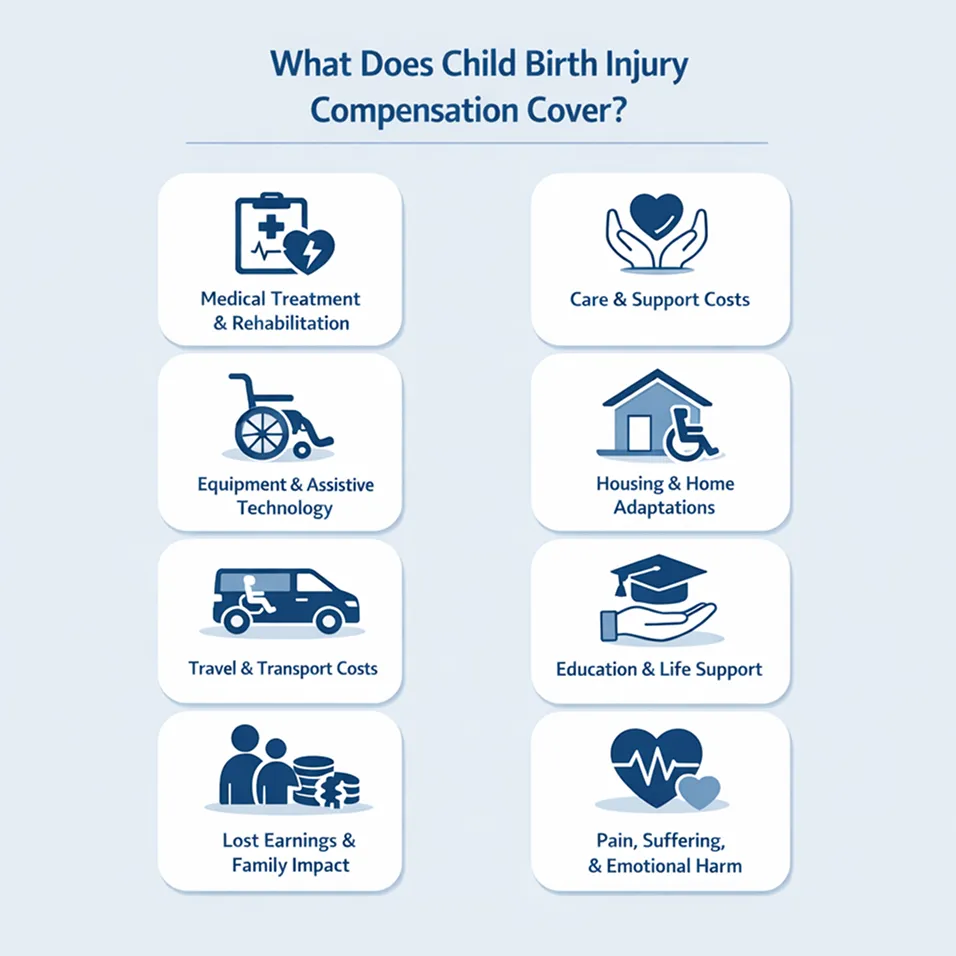
Birth injuries compensation is meant to pay for both the damage itself and the costs that come from it. It is often broken up into:
- General damages for pain, suffering, and loss of enjoyment.
- Special damages for money lost and costs, both now and in the future.
In very critical cases, special damages can be the biggest part because the person may need care and support for the rest of their life.
1. Medical Treatment and Rehabilitation
Birth injury compensation can pay for medical care and rehabilitation related to the injury, including private care if it is reasonable.
This can mean:
- Appointments with specialists and follow-ups.
- Therapy for the body and the mind.
- Therapy for speech and language.
- Neuropsychology and counselling to help with emotional and behavioural issues.
- Medication and prescriptions.
In complicated cases, lawyers may try to get interim payments to pay for urgent help while the birth injury compensation claim is still going on.
2. Care and Support Costs
Care is often the biggest long-term cost. It may be professional care, family care, or both.
This part of birth injury compensation may include:
- People who take care of you at home, including at night if you need it.
- Respite care for family caregivers.
- People who help with school and community access.
- Case management to plan and organise care.
- Training for carers to make sure care is safe and consistent.
NHS Resolution says that the high costs of cerebral palsy claims are often due to the need for care and help for the rest of a person’s life. In a thematic review, NHS Resolution said that the average financial reserve for cerebral palsy claims was about £10 million when talking about possible future costs for the rest of the cases.
3. Equipment and Assistive Technology
Children may need equipment or technology that must be updated as they grow. A care plan will often say when to replace things.
Birth injury compensation can include:
- Seating for people in wheelchairs and people with bad posture.
- Frames for standing and things to help you walk.
- Communication aids, like special devices.
- Orthotics and other things that help.
- Hoists and tools for lifting.
- Specialist beds and pressure-relief equipment.
4. Housing and Home Adaptations
A lot of families need to change their homes or move to a better one. The goal is to keep the child safe while they move around and receive care.
Birth injury compensation may include:
- Wider doorways and ramps.
- A bathroom or wet room that has been changed.
- A safe way to set up your bedroom on the right floor.
- Room for therapy and storage of tools.
- Extra costs for building because of accessibility needs.
5. Travel and Transport Costs
It’s common to have regular appointments. So is travel for therapy, education, and respite.
Birth injury compensation can include:
- Travelling and parking for doctor visits.
- Costs for taxis when needed.
- Changes to vehicles to make them safer for transport.
6. Education and Life Support
Some children need extra help with school and everyday life, especially if they have trouble moving around or talking.
Payment may include:
- Specialised help with school.
- Technology that helps with learning.
- More supervision for safety and access.
- Help with moving into adulthood when it’s needed.
7. Lost Earnings and Family Impact
A parent might have to cut back on work to take care of their child. A child may also have to deal with limits on work in the future.
This part of birth injury compensation can pay for:
- Money that was lost in the past and money that will be lost in the future.
- Contributions to pensions that were lost.
- Costs associated with job changes due to caregiving responsibilities.
8. Pain, Suffering, and Emotional Harm
This is the part about how people are affected. It can show pain, loss of freedom, and long-term emotional stress. For mothers, it can also include mental harm after a traumatic birth.
Birth injury compensation is not always paid as a single lump sum. It could be:
- A one-time payment for big expenses like housing.
- Regular yearly payments may be made for the rest of the person’s life to help fund ongoing care.
What Factors Influence Childbirth Injury Compensation Amounts?
There is no fixed amount. A few factors make the biggest difference.
1. Severity and Long-term Needs
The more needs a person has over their lifetime, the more likely they are to get money for a birth injury. Official NHS Resolution and NAO show that severe birth injury cases can be very costly because long-term care needs are high.
2. Strength of Evidence
Strong evidence plays a key role in determining both the value of a claim and how quickly it can be resolved. Such a case usually has clear expert reports on the breach of duty and the cause of injury, as well as a clear care plan. Records are important too. NICE guidance says CTG traces should be reviewed alongside the wider clinical picture, including risk factors linked to the mother, baby, and labour.
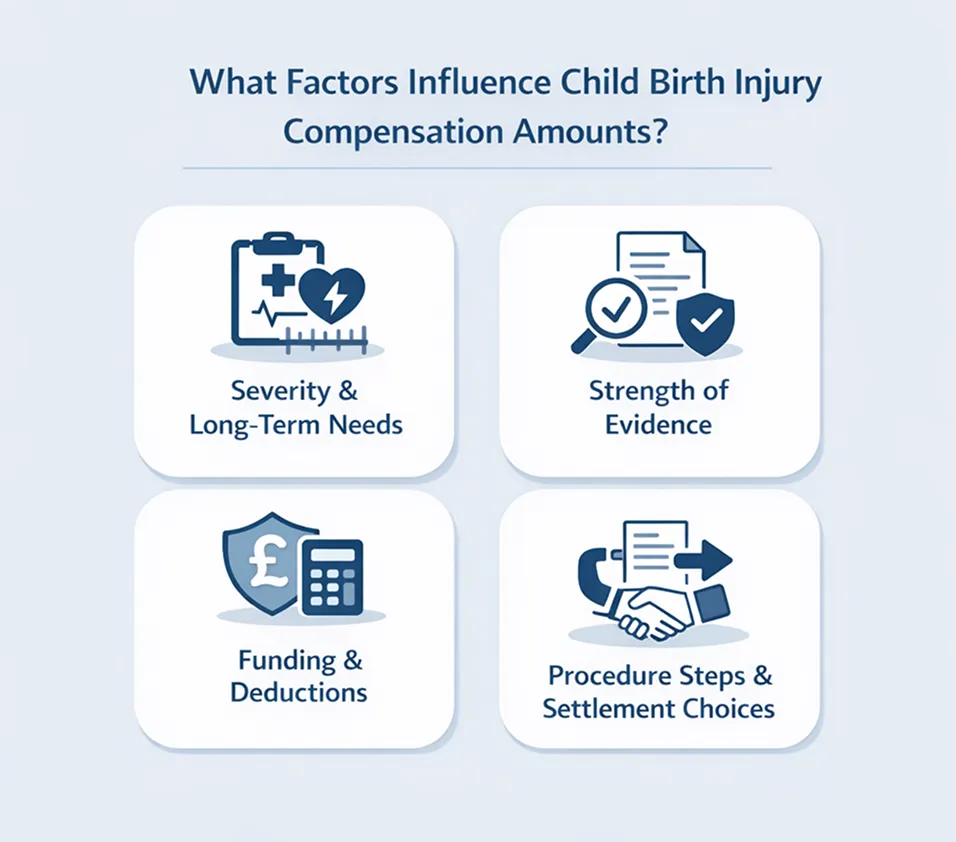
3. Funding and Deductions
A lot of families use a Conditional Fee Agreement that says ‘no win, no fee.’ In England and Wales, personal injury success fees are capped. The limit is often up to 25% of certain damages, and future care damages are usually treated differently. This is important in cases with a lot of money at stake because future care is often the biggest part of the payout.
4. Procedure Steps and Settlement Choices
The way a case settles can also be important. A case can be settled through mediation, a round-table meeting, or a court. In very serious cases, families may want a combination of a one-time payment and yearly payments so that they don’t have to rely only on investment returns to pay for ongoing care.
Case Study: Childbirth Injury Claim Compensation (NHS)
In 2015, a baby (named NKX in the public report) was born by emergency caesarean section. This happened after the mother had a uterine rupture. The baby did not get enough oxygen during birth. He was later diagnosed with severe cerebral palsy.
In 2020, the case went to court. The court decided the hospital’s care during labour was not good enough. The mother should have been advised to have continuous monitoring of the baby’s heartbeat (CTG). Instead, the heartbeat was only checked at times. The court said that continuous monitoring would likely have shown the danger earlier. If this had happened, doctors could have delivered the baby sooner.
In January 2023, the claim settled. The settlement included £7 million as a one-off payment. It also included £700,000 each year to pay for long-term care. This care included two carers, 24 hours a day, and nursing support.
Conclusion
A birth injury can change the lives of everyone in the family. A strong birth injury compensation claim clearly sets out the affected person’s current needs and their future care requirements. The goal of birth injury compensation is to help people in a practical way. That could involve therapy, care, equipment, and a safer house.
Record what you remember if you suspect a problem. Consult an expert about birth injury compensation. Evidence and expert views determine outcomes in each case. This page provides general information only. It is not legal advice.
That is exactly where expert medical input helps. At Concise Medico, we support childbirth injury claims with clear, independent medico-legal insight. Our medico-legal experts can help review records, explain standards of care, and prepare strong medical evidence for your legal team.
FAQs
Birth injuries are not just medical events. They can create lifelong care needs. When care goes wrong, the harm can be life changing for a baby and for parents. NHS Resolution data shows that obstetric claims are a smaller share of all claims, but they make up a much larger share of the total cost. As per the data, obstetrics made up about 11% of the total volume, but 53% of the total value. So the goal isn’t a payout. The goal is lifelong support and security for the people.
What Is a Childbirth Injury Claim?
Clinical negligence during pregnancy, labour, delivery, or after birth is the basis of childbirth injury claims. Clinical negligence is care that falls below the expected standard and causes harm to the baby or the mother. In the UK, many claims relate to NHS care, but private care can also be involved.
Most birth injury claims follow a structured process under the Pre-Action Protocol, although steps may vary depending on the case.
- You ask for and look over medical records.
- An independent expert looks over the care.
- You send a Letter of Notification early.
- If there is a case, a Letter of Claim is sent.
- The defendant looks into the matter and responds.
- The case is settled, or it goes to court if it has to.
The protocol also states when to do things:
- A Letter of Notification is usually acknowledged promptly. A response is often expected within around 14 days.
- Medical records are usually provided within the standard timeframe once they are requested.
- A defendant is usually given up to four months to respond to a Letter of Claim.
- Court proceedings are usually started only after the defendant has had time to respond to the Letter of Claim.
Lawyers usually look at two main things when deciding if a birth injury compensation claim will be successful:
- Breach of duty. This means the care fell below the expected standard.
- Causation. This means the poor care caused the injury, or made it worse.
So, compensation is not paid just because an injury happened. It is paid when records and expert evidence show the injury was caused by avoidable mistakes. A child under 18 is usually represented by an adult called a litigation friend, often a parent or guardian.
Explore our guide on claiming compensation for a child, which explains the compensation claim process in simple steps.
What Are the Types of Birth Injuries?
Birth injuries can harm the mother or baby. Birth trauma refers to physical injuries and, in some cases, recognised psychological harm caused during labour or delivery.
1. Injuries that Can Affect the Baby
Some injuries get better over time. Some events can change a child’s life forever. In long-term cases, the diagnosis is not the only thing that matters. What matters more is the child’s day to day needs. The birth injury compensation can, however, help pay for the support and treatment they may need.
Common medical conditions and injuries that may affect babies include:
| Medical Conditions/Injuries | Simple Meaning | Why It Matters |
|---|---|---|
| Hypoxia | Low oxygen. | Can damage the brain. |
| Ischaemia | Low blood flow. | Can injure brain tissue. |
| HIE (Hypoxic-Ischaemic Encephalopathy) | Brain injury from low oxygen/blood flow around birth. | Can cause seizures, delays, CP. |
| Seizures | Sudden abnormal brain activity. | May signal brain injury. |
| Developmental Delay | Slower milestone progress. | May need long-term support. |
| Cerebral Palsy | Movement/posture condition from early brain injury. | Can require lifelong care. |
| Brachial Plexus Injury | Nerve damage affecting arm/shoulder. | Weakness or limited arm movement. |
| Erb’s Palsy | Common brachial plexus injury (upper arm). | Shoulder/arm weakness. |
| C5–C6 Nerves | Neck nerves controlling shoulder/arm. | Injury weakens the arm. |
| Soft Tissue Injury | Damage to muscles/ligaments/skin. | Pain, bruising, swelling. |
| Clavicle (Collarbone) Fracture | Broken collarbone. | Birth trauma injury. |
| Infection-Related Injury | Harm from untreated/delayed infection. | Can become serious quickly. |
| Feeding Difficulties | Trouble eating/sucking. | Affects growth/nutrition. |
| Swallowing Difficulties | Trouble swallowing safely. | Choking/aspiration risk. |
| Shoulder Dystocia | The baby’s shoulder gets stuck during birth. | Higher risk of nerve/bone injury. |
2. Injuries that Can Affect the Mother
Mothers can also get hurt in ways that could have been avoided. These could be physical, mental, or both.
Some examples are:
- Very severe perineal lacerations, including OASI.
- Postpartum bleeding and complications.
- Infection or sepsis after surgery or childbirth.
- Injury from tools or surgery.
- Bladder or bowel issues after birth trauma.
- PTSD, anxiety, etc.
If the mother is injured due to poor care, she may also be able to claim compensation.
Who Is Eligible to Make a Childbirth Injury Claim?
Who was hurt, what caused the hurt, and whether the claim is in time all affect who can get money.
Who Can Bring the Claim?
These people often make or back a claim:
- The child, usually through a litigation friend, until they turn 18.
- A parent or guardian speaking for the child.
- The mother, for injuries she got while giving birth.
What Is the Time Limit?
Time limits are not the same across the UK. The correct limit depends on where the care happened. This could be England and Wales, Scotland, or Northern Ireland.
| Nation (Where Care Happened) | Adults | Children |
|---|---|---|
| England and Wales | 3 years from injury or date of knowledge | Clock usually starts at 18 (often up to 21) |
| Scotland | 3 years (rules differ slightly) | Clock usually starts at 16 (often up to 19) |
| Northern Ireland | 3 years from injury or date of knowledge | Clock usually starts at 18 (often up to 21) |
What You Must Show?
To get birth injury compensation, you usually need proof of:
- Substandard care. For instance, medical team missed or ignored warning signs.
- A link to the injury. Better care would have probably kept the damage from happening.
- Real impact. A clear effect on health, growth, work, or daily life.
- Getting records is a strong early step. The protocol says that requests should be clear and can include a continuous copy of the CTG trace in cases of birth injury.
If you want help understanding medical evidence and reports, read how to obtain medical reports for a CICA claim.
What Does Childbirth Injury Compensation Cover?
Birth injuries compensation is meant to pay for both the damage itself and the costs that come from it. It is often broken up into:
- General damages for pain, suffering, and loss of enjoyment.
- Special damages for money lost and costs, both now and in the future.
In very critical cases, special damages can be the biggest part because the person may need care and support for the rest of their life.
1. Medical Treatment and Rehabilitation
Birth injury compensation can pay for medical care and rehabilitation related to the injury, including private care if it is reasonable.
This can mean:
- Appointments with specialists and follow-ups.
- Therapy for the body and the mind.
- Therapy for speech and language.
- Neuropsychology and counselling to help with emotional and behavioural issues.
- Medication and prescriptions.
In complicated cases, lawyers may try to get interim payments to pay for urgent help while the birth injury compensation claim is still going on.
2. Care and Support Costs
Care is often the biggest long-term cost. It may be professional care, family care, or both.
This part of birth injury compensation may include:
- People who take care of you at home, including at night if you need it.
- Respite care for family caregivers.
- People who help with school and community access.
- Case management to plan and organise care.
- Training for carers to make sure care is safe and consistent.
NHS Resolution says that the high costs of cerebral palsy claims are often due to the need for care and help for the rest of a person’s life. In a thematic review, NHS Resolution said that the average financial reserve for cerebral palsy claims was about £10 million when talking about possible future costs for the rest of the cases.
3. Equipment and Assistive Technology
Children may need equipment or technology that must be updated as they grow. A care plan will often say when to replace things.
Birth injury compensation can include:
- Seating for people in wheelchairs and people with bad posture.
- Frames for standing and things to help you walk.
- Communication aids, like special devices.
- Orthotics and other things that help.
- Hoists and tools for lifting.
- Specialist beds and pressure-relief equipment.
4. Housing and Home Adaptations
A lot of families need to change their homes or move to a better one. The goal is to keep the child safe while they move around and receive care.
Birth injury compensation may include:
- Wider doorways and ramps.
- A bathroom or wet room that has been changed.
- A safe way to set up your bedroom on the right floor.
- Room for therapy and storage of tools.
- Extra costs for building because of accessibility needs.
5. Travel and Transport Costs
It’s common to have regular appointments. So is travel for therapy, education, and respite.
Birth injury compensation can include:
- Travelling and parking for doctor visits.
- Costs for taxis when needed.
- Changes to vehicles to make them safer for transport.
6. Education and Life Support
Some children need extra help with school and everyday life, especially if they have trouble moving around or talking.
Payment may include:
- Specialised help with school.
- Technology that helps with learning.
- More supervision for safety and access.
- Help with moving into adulthood when it’s needed.
7. Lost Earnings and Family Impact
A parent might have to cut back on work to take care of their child. A child may also have to deal with limits on work in the future.
This part of birth injury compensation can pay for:
- Money that was lost in the past and money that will be lost in the future.
- Contributions to pensions that were lost.
- Costs associated with job changes due to caregiving responsibilities.
8. Pain, Suffering, and Emotional Harm
This is the part about how people are affected. It can show pain, loss of freedom, and long-term emotional stress. For mothers, it can also include mental harm after a traumatic birth.
Birth injury compensation is not always paid as a single lump sum. It could be:
- A one-time payment for big expenses like housing.
- Regular yearly payments may be made for the rest of the person’s life to help fund ongoing care.
What Factors Influence Childbirth Injury Compensation Amounts?
There is no fixed amount. A few factors make the biggest difference.
1. Severity and Long-term Needs
The more needs a person has over their lifetime, the more likely they are to get money for a birth injury. Official NHS Resolution and NAO show that severe birth injury cases can be very costly because long-term care needs are high.
2. Strength of Evidence
Strong evidence plays a key role in determining both the value of a claim and how quickly it can be resolved. Such a case usually has clear expert reports on the breach of duty and the cause of injury, as well as a clear care plan. Records are important too. NICE guidance says CTG traces should be reviewed alongside the wider clinical picture, including risk factors linked to the mother, baby, and labour.
3. Funding and Deductions
A lot of families use a Conditional Fee Agreement that says ‘no win, no fee.’ In England and Wales, personal injury success fees are capped. The limit is often up to 25% of certain damages, and future care damages are usually treated differently. This is important in cases with a lot of money at stake because future care is often the biggest part of the payout.
4. Procedure Steps and Settlement Choices
The way a case settles can also be important. A case can be settled through mediation, a round-table meeting, or a court. In very serious cases, families may want a combination of a one-time payment and yearly payments so that they don’t have to rely only on investment returns to pay for ongoing care.
Case Study: Childbirth Injury Claim Compensation (NHS)
In 2015, a baby (named NKX in the public report) was born by emergency caesarean section. This happened after the mother had a uterine rupture. The baby did not get enough oxygen during birth. He was later diagnosed with severe cerebral palsy.
In 2020, the case went to court. The court decided the hospital’s care during labour was not good enough. The mother should have been advised to have continuous monitoring of the baby’s heartbeat (CTG). Instead, the heartbeat was only checked at times. The court said that continuous monitoring would likely have shown the danger earlier. If this had happened, doctors could have delivered the baby sooner.
In January 2023, the claim settled. The settlement included £7 million as a one-off payment. It also included £700,000 each year to pay for long-term care. This care included two carers, 24 hours a day, and nursing support.
Conclusion
A birth injury can change the lives of everyone in the family. A strong birth injury compensation claim clearly sets out the affected person’s current needs and their future care requirements. The goal of birth injury compensation is to help people in a practical way. That could involve therapy, care, equipment, and a safer house.
Record what you remember if you suspect a problem. Consult an expert about birth injury compensation. Evidence and expert views determine outcomes in each case. This page provides general information only. It is not legal advice.
That is exactly where expert medical input helps. At Concise Medico, we support childbirth injury claims with clear, independent medico-legal insight. Our medico-legal experts can help review records, explain standards of care, and prepare strong medical evidence for your legal team.