TABLE OF CONTENT
How to File a Personal Injury Protection Claim? A Step-by-Step Guide
Did you know that more than 435,000 compensation cases were registered with the UK’s Compensation Recovery Unit (CRU) during the last financial year? More than 300,000 of these involved motor-related injuries. This highlights how common personal injury claims are in the UK. So, what should you do if you are injured in an accident? Understanding the claims process can make it easier to protect your rights and claim compensation. A personal injury protection claim helps you recover the costs of your injuries and other financial losses after a car accident.
This guide explains what a personal injury protection claim is and how to file one.
What Is a Personal Injury Protection Claim?
Personal injury protection is an insurance type that covers rehab and medication costs associated with injuries after an accident. The compensation you receive depends on the type of claim and who is responsible for paying it. It helps injured people pay for medical treatment, rehabilitation and time away from work. You may be eligible if the accident happened on the road, at work, in a public place or elsewhere. The claims process usually follows the same steps. First, seek medical treatment. Then, report the incident, gather evidence, submit your claim and track its progress until you receive a decision or settlement.
How to Claim Personal Injury Protection?
When you file a personal injury claim, you seek compensation through the appropriate insurer, claims service or legal process, depending on the type of accident. Compensation may cover medical treatment, rehabilitation, lost income and other financial losses caused by your injury.
1. Get Medical Care Immediately
Get medical care instantly after an accident. If you are seriously injured or facing a medical emergency, call 999. For urgent but non-life-threatening symptoms, use the appropriate NHS service for medical advice and treatment. Keep in mind that certain injuries take time to appear. Pain may appear later after a crash. The NHS advises seeking immediate medical attention for whiplash symptoms that include extreme pain, tingling, weakness, or difficulty walking. Here’s what to do:
- Check if the pain gets worse.
- Do what your doctor says.
- Write down your symptoms every day.
- Keep copies of any medical papers you get when you leave.
Getting medical care immediately protects your health and creates an official record of your injuries. These medical records are important evidence that can support your personal injury protection claim.
2. Notify Your Insurer Promptly
The UK government’s official site clearly states that you must notify your insurer promptly after a road accident. Even if you don’t plan to file a personal injury protection claim, you still need to tell your insurance company about the accident. You also need to provide names, addresses and registration number details if the accident caused damage or injury. The official website of the Government of the UK says that if you didn’t give your information at the time of the accident, you need to tell the police within 24 hours.
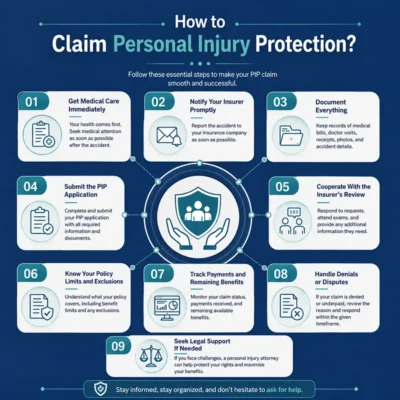
3. Document Everything
Good documentation is the main part of your personal injury protection claim. Make a simple folder, either on paper or online, and keep:
Accident Facts
You must include the date, time, exact location, and other relevant details regarding the accident. Also, explain where you were going and what happened in what order. If you know the speed, include it. Do not guess if you are unsure.
People and Vehicles Details
Include the details of the people and vehicles involved, such as name, address, and registration of the other driver. Also, include the make and model of the car and information about the insurer (if you have it). Provide the names and contact information for witnesses as well.
Photos and Evidence
Take close-up and wide-angle photos of the damage to your vehicle. Also, photograph road signs, traffic signals, skid marks, and any other evidence at the scene. Take clear photos of your injuries as soon as possible because bruises and swelling can change quickly. If you have dashcam footage, save a copy and keep it in a safe place.
Costs and Losses
Keep records of all expenses and financial losses caused by the accident involving you. These may include pay slips and a doctor’s note if you missed work, travel receipts for medical appointments and receipts for prescriptions, treatment or rehabilitation.
“You must make records at the same time as the events you are recording or as soon as possible afterwards.”
General Medical Council, Good Medical Practice
4. Cooperate With the Insurer’s Review
After you send in your personal injury claim, the insurers (or compensator in OIC terms) will review it. OIC says that after you submit your personal injury claim, it goes to the insurance company for the driver you say is at fault, and they look into it. Here’s what cooperation usually looks like:
- Answering questions that come up later.
- Sending more papers.
- Going to a medical exam (if necessary).
- Confirming payment information for the bank.
Avoid making common mistakes that could affect your claim. Do not submit edited photos without keeping the originals. Also, never exaggerate or change your account of what happened. If you cannot meet a deadline, inform the relevant party as soon as possible and request more time in writing.
5. Track Payments and Remaining Benefits
Use a simple tracker (Notes app is fine), or, if you use Official Injury Claim (OIC), it says you can check the status of your personal injury protection claim online and get updates when they happen. If you get money from a personal accident policy, make sure you know:
- If it’s one payment or a series of payments.
- If it affects any other policy benefits.
- If more medical evidence is needed later.
6. Handle a Rejected or Disputed Claim
If your claim is rejected or disputed, do not panic. Claims may be rejected for several reasons, such as your injury not meeting the policy terms or missing supporting evidence. Other reasons include reporting the incident late, a policy exclusion or a dispute over liability. If your claim is rejected or disputed, take these steps:
- Get the decision in writing.
- Ask them what rule or clause they used.
- Ask what proof would change the choice.
7. Seek Legal Support If Needed
You might not need a lawyer for every personal injury protection claim, but legal assistance can be helpful if:
- The injury is severe.
- There is a lot of disagreement about who is to blame.
- Your losses are complicated (future care, being away from work for a long time).
- You are given a settlement that doesn’t feel right.
- There is a lot of pressure to settle quickly.
If you plan to take legal action, make sure you understand the relevant time limits for making personal injury claims. If you have suffered a low-value injury in a road traffic accident in England or Wales, you may be able to make a claim through the OIC service if your claim meets its eligibility criteria. The OIC is an online service that allows eligible people to make certain road traffic injury claims without using a solicitor. You can make your claim without paying legal fees.
Case Study: How a Serious Road Accident Claim Resulted in £7.5 Million
A man suffered a severe brain injury after a road accident that left him with long-term care and support needs. The driver initially disputed responsibility for the collision, making evidence important in establishing what had happened.
After reviewing the available evidence and the claimant’s medical needs, legal representatives established the driver’s liability. The claim also considered the claimant’s future care, rehabilitation, medical treatment and accommodation requirements.
The case eventually resulted in a £7.5 million settlement, providing financial support for the claimant’s lifelong care and other needs.
Lesson learned: A personal injury claim is not simply about proving that an accident happened. Medical evidence, evidence of liability and information about the injury’s long-term impact can all be important when seeking appropriate compensation.
Conclusion
Filing a personal injury protection claim is easier when you act promptly and keep clear records from the start. Prioritise your health, report the accident, preserve your evidence and keep track of every expense and loss linked to your injury. If your claim is simple, you may be able to manage the process yourself. However, serious injuries, disputed liability, complex losses or a rejected claim can make the process more difficult. In these situations, getting legal advice early can help you understand your options and avoid mistakes that could affect your compensation.
Don’t wait for problems to arise; get medical evidence, organise your records, and act promptly. If you are unsure what evidence you need or how your injuries may affect your claim, contact us for support with your personal injury protection claim.