TABLE OF CONTENT
Your home should feel the safest place for you. If you were harmed by domestic abuse, you may be able to claim domestic violence compensation through CICA for your injuries. CICA is the Criminal Injuries Compensation Authority, a UK government scheme that pays domestic violence compensation to victims of violent crime.
This guide explains who can apply, what injuries may count, and what proof helps most. It also shows the key steps and common mistakes to avoid.
Who Gets Compensation in Domestic Violence?
There are many situations in which you can get domestic violence compensation. The most common case is when you are the direct victim. In some cases, close family members can also get money, especially if the victim dies.
Who Can Claim?
Domestic violence compensation goes beyond victims. Relatives of the victim may also apply.
Simply put, who was affected and how?
Let’s further clarify the two clear groups of claimants. The first person is the one who was abused. Second, some family members may be eligible in certain situations.
1. The Victim
If you can prove domestic violence, you may receive domestic violence compensation.
- You were hurt in some way.
- You had a mental injury that made you unable to work.
- You were sexually assaulted.
- The CICA Scheme covers the pattern of physical abuse you went through.
You don’t have to wait for your case to end. You can often apply even while the police are still looking into the case. Also, CICA can look at a domestic violence compensation claim even if the person who did it hasn’t been caught or found guilty yet. What matters is that it was reported and you meet the CICA Scheme rules.
2. Members of the Family
In some cases, a family member can claim, for example if:
- A close relative died because of the violent crime.
- You paid for the funeral or burial.
- You saw what happened, or you saw the immediate aftermath, and it involved someone close to you.
CICA may also pay funeral costs and other compensation to eligible relatives if a person dies because of domestic violence.
What Is the Eligibility Criteria?
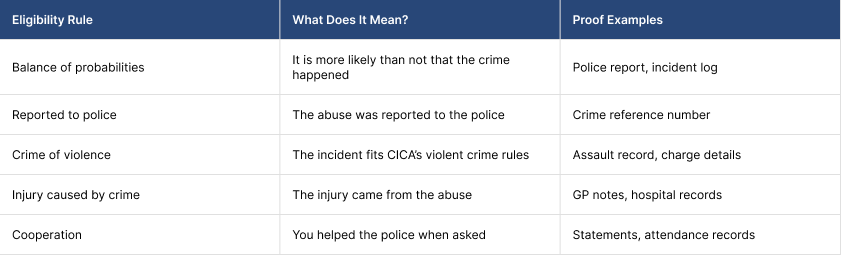
Details matter when seeking domestic violence compensation. Late reporting and insufficient proof cause many domestic violence claims to fail.
1. Report to Police
You must report domestic violence to the police before filing a CICA claim. Reporting abuse is scary, especially if the abuser is powerful or lives with you. But reporting is a very important action. CICA may still accept the domestic violence compensation claim even if there was a delay, as long as it was not possible to report it sooner, such as because of trauma.
2. Cooperate with Investigation
You should usually do what the police ask you to do. Otherwise, the award may be denied or reduced. You don’t have to do everything alone. You can request aid. Victim Support says reviewing the details can be upsetting, but they can help.
3. Application Deadline
Most of the time, you have to apply as soon as you can and within two years of the event. There are some exceptions. For example, childhood physical or sexual abuse can affect time limits, and CICA can sometimes extend time where there are exceptional circumstances and the domestic violence claim can be decided without extensive further enquiries.
There are different rules for people who were under 18 at the time. In general, you have until your 20th birthday if the crime was reported before you turned 18, or two years from the first police report if it was reported on or after your 18th birthday.
4. Location
CICA usually deals with violent crime in England, Scotland, and Wales. The CICA Scheme calls this area Great Britain and a few other “relevant places” that are listed in the rules. If the crime happened in Northern Ireland, the process is different.
5. Crime of Violence
To be eligible for CICA, what happened must fit the Scheme’s definition of a violent crime. This includes things like physical assault, sexual assault, making someone afraid of immediate violence, and some other things like arson. It’s good to know that the CICA test is civil, not criminal. You usually have to show that it happened “on the balance of probabilities.” That means that it is more likely than not.
What Domestic Violence Compensation Covers?
Dividing domestic violence compensation into two main parts is helpful. People often refer to these as general damages and special damages. These ideas are shown through injury payments, possible loss of income, special expenses, and other payments in fatal cases under CICA.
1. Special Damages
These are the costs and losses that come from the damage.
i. Medical Expenses
CICA can pay for some “special expenses” if they are directly related to the injury, not available for free from another source, and are reasonable. This is important for things like therapy, equipment, or support that you need. In a lot of cases, you might have to explain why NHS services weren’t available in a good way.
ii. Lost Earnings
It is possible to lose money, but the rules are very strict. According to the government of UK official site, you usually have to be unable to work or only able to work a little bit for 28 weeks or longer, and you don’t get paid for the first 28 weeks. The CICA Scheme also tells you how to figure it out. It uses the weekly rate of Statutory Sick Pay (SSP) at the time of the decision and multiplies it by the number of weeks in the relevant period.
iii. Travel Costs
Travel can sometimes be a special expense if it is needed because of the injury and follows the rules of the CICA Scheme. The main point is that the cost has to be reasonable, related to the injury, and not available for free anywhere else.
iv. Future Care Costs
Depending on the evidence and the need, future care may also fall under special expenses. In the special expenses section of the CICA Scheme, it lists costs like care and supervision.
2. General Damages
This part of the domestic violence compensation is for the injury itself, which includes both the physical and emotional effects.
i. Pain and Suffering
CICA uses an injury tariff to figure out how much compensation to give for pain and suffering. This tariff shows how much domestic violence compensation you can get for injuries based on how bad they are. Pain and suffering include both the physical and mental effects of your injury. Strong medical evidence helps make sure you get the right amount.
ii. Loss of Quality of Life
The level of your injury’s tariff often shows how much your quality of life has changed, especially for mental injuries and long-term physical injuries. CICA looks at what you can and can’t do now compared to before.
How to Claim Compensation for Domestic Violence?
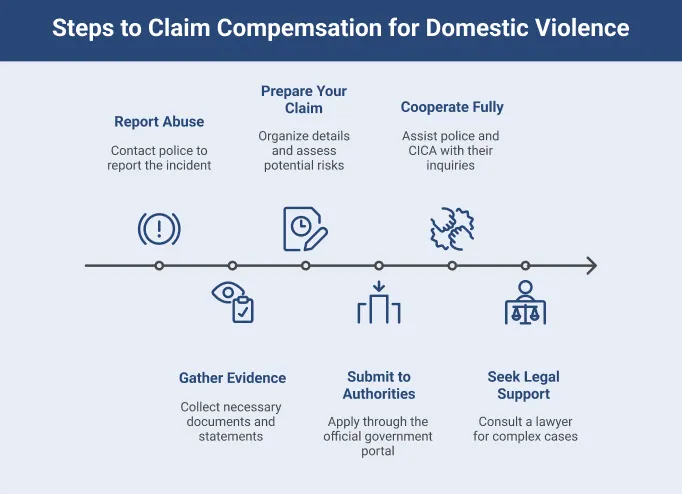
Many people who file a claim for domestic violence compensation through CICA follow the steps below.
1. Report Abuse
Usually, the first thing you need to do is tell the police about the abuse. The UK government official site says that you have to tell the police about the crime, and you usually have to do so within two years. If you don’t feel safe reporting domestic violence claims, get help from a professional service. You can also talk to the police about ways to stay safe.
2. Gather Evidence
Evidence is what makes or breaks a claim for domestic violence compensation. Some common pieces of evidence are:
- Police reference numbers and updates.
- Records from a GP, hospital, or mental health service.
- Pictures of injuries (with dates if you can).
- Statements from witnesses.
- Records of counselling or therapy.
- Court orders or paperwork for protecting someone, if needed.
A lot of injuries also need medical proof. You might need this to explain what happened and how it changed your life. Victim Support says you can get domestic violence compensation for both physical and mental injuries. You still need medical proof to back up your claim, though.
If you want a simple walkthrough on this part, you can read our guide on How to Obtain Medical Reports for a CICA Claim.
3. Prepare Your Claim
Get the most important information before you apply. Keep them clear and simple.
- The times and places where the abuse happened.
- What caused your injuries.
- How long your symptoms lasted.
- How it affected your work, school, relationships, and daily life.
4. Submit to Authorities
Most people send their applications directly to CICA. It doesn’t cost anything to apply. You don’t have to wait for the police case to finish. In most cases, the incident must have been reported to the police. You also need to reply to any questions from CICA.
5. Cooperate Fully
CICA may get in touch with you while your claim is being processed. They might want more information or papers. They might also want you to come to an appointment. If you don’t respond and don’t have a good reason, your claim may be denied or your payment may be cut. A good reason could be a serious illness or concerns about safety.
6. Seek Legal Support
Some people fill out the application on their own. Some people decide to get help. Support can help if your case is complicated, the abuse happened more than once, or the damage is serious. It can also help if you need medical proof or reports from experts.
If you want to understand what that looks like in the UK, read our Expert Witness Reports Guide.
Case Study: Successful CICA Domestic Abuse Claim (UK)
Mrs. Z (name changed for privacy) was in a long-term abusive relationship with a former partner. The abuse affected both the physical being and mental health in a serious way. She couldn’t work because the mental suffering was severe.
What she did first:
- She told the police about the abuse.
- She stayed involved in the process and gave information when it was needed. CICA can consider a claim even if the offender is not convicted, as long as the claim meets the Scheme rules and the incident was reported.
Proof of the harm and proof of Mrs. Z’s financial loss were two pieces of evidence that backed up her claim. A big part of the claim was about lost wages. The case notes stated that HMRC papers and a full employment schedule were gathered to back up her claim for lost money.
CICA awarded Mrs Z a total of £106,687.19. The reward included:
- £13,500 for disabling mental injury.
- £2,000 for physical domestic abuse.
- £85,577.75 for past loss of earnings.
- £7,009.44 for future loss of earnings.
This case makes two simple points:
- The Scheme says that mental injury can be treated as a serious injury, and if there is evidence to back it up, it can lead to a large reward.
- Clear paperwork for lost wages can make a big difference, especially if you can’t work for a long time.
Please note that each CICA claim is based on its own facts and evidence. The result and amount can be different even if the abuse is the same.
Conclusion
Domestic violence can change your life in many ways. The effects could change your health, work, and daily life. Some effects appear right away. Others develop over time. CICA may be able to help you get money if you were hurt in a violent crime. Every claim is unique. The outcome depends on the evidence, when you apply, and the Scheme’s rules. Getting help early on can help you understand your options and feel more sure about what to do next.
At Concise Medico, we support people and professionals with clear, structured medical documentation. This can help explain injuries and long-term impact in a way that fits claim requirements. You can also learn more about our Expert Witness Reports service.
At Concise Medico, we support people and professionals with clear, structured medical documentation. This can help explain injuries and long-term impact in a way that fits claim requirements. You can also learn more about our Expert Witness Reports service.
FAQs
Your home should feel the safest place for you. If you were harmed by domestic abuse, you may be able to claim domestic violence compensation through CICA for your injuries. CICA is the Criminal Injuries Compensation Authority, a UK government scheme that pays domestic violence compensation to victims of violent crime.
This guide explains who can apply, what injuries may count, and what proof helps most. It also shows the key steps and common mistakes to avoid.
Who Gets Compensation in Domestic Violence?
There are many situations in which you can get domestic violence compensation. The most common case is when you are the direct victim. In some cases, close family members can also get money, especially if the victim dies.
Who Can Claim?
Domestic violence compensation goes beyond victims. Relatives of the victim may also apply.
Simply put, who was affected and how?
Let’s further clarify the two clear groups of claimants. The first person is the one who was abused. Second, some family members may be eligible in certain situations.
1. The Victim
If you can prove domestic violence, you may receive domestic violence compensation.
- You were hurt in some way.
- You had a mental injury that made you unable to work.
- You were sexually assaulted.
- The CICA Scheme covers the pattern of physical abuse you went through.
You don’t have to wait for your case to end. You can often apply even while the police are still looking into the case. Also, CICA can look at a domestic violence compensation claim even if the person who did it hasn’t been caught or found guilty yet. What matters is that it was reported and you meet the CICA Scheme rules.
2. Members of the Family
In some cases, a family member can claim, for example if:
- A close relative died because of the violent crime.
- You paid for the funeral or burial.
- You saw what happened, or you saw the immediate aftermath, and it involved someone close to you.
CICA may also pay funeral costs and other compensation to eligible relatives if a person dies because of domestic violence.
What Is the Eligibility Criteria?
Details matter when seeking domestic violence compensation. Late reporting and insufficient proof cause many domestic violence claims to fail.
1. Report to Police
You must report domestic violence to the police before filing a CICA claim. Reporting abuse is scary, especially if the abuser is powerful or lives with you. But reporting is a very important action. CICA may still accept the domestic violence compensation claim even if there was a delay, as long as it was not possible to report it sooner, such as because of trauma.
2. Cooperate with Investigation
You should usually do what the police ask you to do. Otherwise, the award may be denied or reduced. You don’t have to do everything alone. You can request aid. Victim Support says reviewing the details can be upsetting, but they can help.
3. Application Deadline
Most of the time, you have to apply as soon as you can and within two years of the event. There are some exceptions. For example, childhood physical or sexual abuse can affect time limits, and CICA can sometimes extend time where there are exceptional circumstances and the domestic violence claim can be decided without extensive further enquiries.
There are different rules for people who were under 18 at the time. In general, you have until your 20th birthday if the crime was reported before you turned 18, or two years from the first police report if it was reported on or after your 18th birthday.
4. Location
CICA usually deals with violent crime in England, Scotland, and Wales. The CICA Scheme calls this area Great Britain and a few other “relevant places” that are listed in the rules. If the crime happened in Northern Ireland, the process is different.
5. Crime of Violence
To be eligible for CICA, what happened must fit the Scheme’s definition of a violent crime. This includes things like physical assault, sexual assault, making someone afraid of immediate violence, and some other things like arson. It’s good to know that the CICA test is civil, not criminal. You usually have to show that it happened “on the balance of probabilities.” That means that it is more likely than not.
What Domestic Violence Compensation Covers?
Dividing domestic violence compensation into two main parts is helpful. People often refer to these as general damages and special damages. These ideas are shown through injury payments, possible loss of income, special expenses, and other payments in fatal cases under CICA.
1. Special Damages
These are the costs and losses that come from the damage.
i. Medical Expenses
CICA can pay for some “special expenses” if they are directly related to the injury, not available for free from another source, and are reasonable. This is important for things like therapy, equipment, or support that you need. In a lot of cases, you might have to explain why NHS services weren’t available in a good way.
ii. Lost Earnings
It is possible to lose money, but the rules are very strict. According to the government of UK official site, you usually have to be unable to work or only able to work a little bit for 28 weeks or longer, and you don’t get paid for the first 28 weeks. The CICA Scheme also tells you how to figure it out. It uses the weekly rate of Statutory Sick Pay (SSP) at the time of the decision and multiplies it by the number of weeks in the relevant period.
iii. Travel Costs
Travel can sometimes be a special expense if it is needed because of the injury and follows the rules of the CICA Scheme. The main point is that the cost has to be reasonable, related to the injury, and not available for free anywhere else.
iv. Future Care Costs
Depending on the evidence and the need, future care may also fall under special expenses. In the special expenses section of the CICA Scheme, it lists costs like care and supervision.
2. General Damages
This part of the domestic violence compensation is for the injury itself, which includes both the physical and emotional effects.
i. Pain and Suffering
CICA uses an injury tariff to figure out how much compensation to give for pain and suffering. This tariff shows how much domestic violence compensation you can get for injuries based on how bad they are. Pain and suffering include both the physical and mental effects of your injury. Strong medical evidence helps make sure you get the right amount.
ii. Loss of Quality of Life
The level of your injury’s tariff often shows how much your quality of life has changed, especially for mental injuries and long-term physical injuries. CICA looks at what you can and can’t do now compared to before.
How to Claim Compensation for Domestic Violence?
Many people who file a claim for domestic violence compensation through CICA follow the steps below.
1. Report Abuse
Usually, the first thing you need to do is tell the police about the abuse. The UK government official site says that you have to tell the police about the crime, and you usually have to do so within two years. If you don’t feel safe reporting domestic violence claims, get help from a professional service. You can also talk to the police about ways to stay safe.
2. Gather Evidence
Evidence is what makes or breaks a claim for domestic violence compensation. Some common pieces of evidence are:
- Police reference numbers and updates.
- Records from a GP, hospital, or mental health service.
- Pictures of injuries (with dates if you can).
- Statements from witnesses.
- Records of counselling or therapy.
- Court orders or paperwork for protecting someone, if needed.
A lot of injuries also need medical proof. You might need this to explain what happened and how it changed your life. Victim Support says you can get domestic violence compensation for both physical and mental injuries. You still need medical proof to back up your claim, though.
If you want a simple walkthrough on this part, you can read our guide on How to Obtain Medical Reports for a CICA Claim.
3. Prepare Your Claim
Get the most important information before you apply. Keep them clear and simple.
- The times and places where the abuse happened.
- What caused your injuries.
- How long your symptoms lasted.
- How it affected your work, school, relationships, and daily life.
4. Submit to Authorities
Most people send their applications directly to CICA. It doesn’t cost anything to apply. You don’t have to wait for the police case to finish. In most cases, the incident must have been reported to the police. You also need to reply to any questions from CICA.
5. Cooperate Fully
CICA may get in touch with you while your claim is being processed. They might want more information or papers. They might also want you to come to an appointment. If you don’t respond and don’t have a good reason, your claim may be denied or your payment may be cut. A good reason could be a serious illness or concerns about safety.
6. Seek Legal Support
Some people fill out the application on their own. Some people decide to get help. Support can help if your case is complicated, the abuse happened more than once, or the damage is serious. It can also help if you need medical proof or reports from experts.
If you want to understand what that looks like in the UK, read our Expert Witness Reports Guide.
Case Study: Successful CICA Domestic Abuse Claim (UK)
Mrs. Z (name changed for privacy) was in a long-term abusive relationship with a former partner. The abuse affected both the physical being and mental health in a serious way. She couldn’t work because the mental suffering was severe.
What she did first:
- She told the police about the abuse.
- She stayed involved in the process and gave information when it was needed. CICA can consider a claim even if the offender is not convicted, as long as the claim meets the Scheme rules and the incident was reported.
Proof of the harm and proof of Mrs. Z’s financial loss were two pieces of evidence that backed up her claim. A big part of the claim was about lost wages. The case notes stated that HMRC papers and a full employment schedule were gathered to back up her claim for lost money.
CICA awarded Mrs Z a total of £106,687.19. The reward included:
- £13,500 for disabling mental injury.
- £2,000 for physical domestic abuse.
- £85,577.75 for past loss of earnings.
- £7,009.44 for future loss of earnings.
This case makes two simple points:
- The Scheme says that mental injury can be treated as a serious injury, and if there is evidence to back it up, it can lead to a large reward.
- Clear paperwork for lost wages can make a big difference, especially if you can’t work for a long time.
Please note that each CICA claim is based on its own facts and evidence. The result and amount can be different even if the abuse is the same.
Conclusion
Domestic violence can change your life in many ways. The effects could change your health, work, and daily life. Some effects appear right away. Others develop over time. CICA may be able to help you get money if you were hurt in a violent crime. Every claim is unique. The outcome depends on the evidence, when you apply, and the Scheme’s rules. Getting help early on can help you understand your options and feel more sure about what to do next.
At Concise Medico, we support people and professionals with clear, structured medical documentation. This can help explain injuries and long-term impact in a way that fits claim requirements. You can also learn more about our Expert Witness Reports service.
At Concise Medico, we support people and professionals with clear, structured medical documentation. This can help explain injuries and long-term impact in a way that fits claim requirements. You can also learn more about our Expert Witness Reports service.