TABLE OF CONTENT
- What Neuropsychological Testing Can Do for Brain Injury?
- Real Life Example: Road Traffic Claim in the UK From Hidden Brain Injury
- Levels of Analysis in Neuropsychological Testing
- Why Neuropsychological Testing Matters for Brain Injury?
- What Are the Types of Brain Injuries?
- What Role Does Neuropsychological Testing Play in Brain Injury?
- How Neuropsychological Testing Works After a Brain Injury?
- Final Words
- FAQs
Ever wonder how a head injury can change someone? How do doctors show this in a legal claim?
You cannot always see a brain injury. Many people look well but have trouble with memory, focus or mood.
Studies show that some adults still have problems after a mild brain injury. Some have thinking or memory issues three months later. This makes it hard to make a fair claim without evidence.
Visiting hospitals for brain injuries is very common in the UK. In previous years, 123,969 people went to the hospital for a head injury. That is about one person every four minutes. This number shows how many people may need a brain test after an injury. This shows how big the problem is.
Brain injury can affect a person’s thinking, feelings and daily life. It can make memory, attention, mood and daily tasks harder.
Everyone gets better in their own way. It depends on age, how severe the injury is and past health.
Mild injuries often improve with time. Bad injuries may get worse or cause long-term problems. Multiple hits can raise the risk of dementia. That is why careful checks, including neurological testing, are very important.
Neuropsychological testing is important in UK brain injury claims. These tests show how the brain works. They check skills such as memory, focus and decision-making.
They also help show if there are real thinking problems or if the issues come from feelings or coping skills.
This is very important in legal cases when symptoms cannot be seen. Sometimes, doctors use neurological testing with neuropsychological evaluation.
This evaluation checks how the brain is working. It checks thinking, memory and everyday skills after an injury. Neuropsychological testing brain can show small thinking changes. These changes may not appear on regular scans or routine check-ups.
In this blog, you will find out:
- What is neuropsychological testing for brain injury and how it works
- Why it matters in brain injury claims
- How neuropsychological testing helps after a brain injury
- What are types of brain injuries
- How different levels are studied in neuropsychological testing
What Neuropsychological Testing Can Do for Brain Injury?
Neuropsychological testing checks how the brain works after an injury. It checks thinking, behaviour and emotions. In brain injury claims in the UK, these tests are very important. They show how the injury changes daily life, even if the problems are not clear.
These tests check key thinking skills, like:
- Memory
- Attention
- Problem-solving
- Language
- Decision-making
These tests give clear results and show how the injury changes daily life. A person may look okay, but tests can show slow thinking, weak memory or trouble focusing. These problems can make work, school and getting along with others harder.
Without tests, they may be missed.
The Montreal Cognitive Assessment (MoCA) is the most commonly used tool, which checks thinking skills quickly. Other tests track progress over months or years. Tests can be done at any time during recovery. They help spot early problems, track progress and guide treatment.
Neuropsychological tests also help tell the difference between:
- True thinking problems
- Emotional responses
- Coping skills
This matters because memory problems can look like stress, tiredness or low effort, rathe rthan real brain damage. These tests connect symptoms to daily life and show how the injury affects a person.
In brain injury claims, this evidence helps make a fair assessment. It shows what has changed and what support a person needs to manage daily life.
In some tough claims, expert witnesses help show how brain injuries affect daily life. They explain the changes clearly to the court. This helps guide fair compensation for the person.
Learn more: Brain Injury Expert Witness
Neuropsychological testing brain is often very important. It shows the hidden effects of mild or moderate brain injuries in court cases.
A new challenge keeps the brain kicking and the heart ticking.
– E.A. Bucchianeri
Real Life Example: Road Traffic Claim in the UK From Hidden Brain Injury
A person had a small brain injury after a car crash. At first, they were offered a small payout. The claim was moved to a new team. They used detailed proof, including neuropsychological testing, to show problems with thinking and daily life.
The case ended before trial with a £1.75 million payout. This shows why brain injury claims matter in the UK. Careful tests of thinking skills can be very important. They help get fair payment even for mild or hidden injuries.
Why It Is Important?
Neuropsychological testing can show small thinking problems. These problems may not show up on normal scans. This evidence shows how the injury affects life and work.
Levels of Analysis in Neuropsychological Testing
Brain injuries are complex and can affect many areas of life. Neuropsychological evaluation looks at many levels to give a full picture. It does not only look at symptoms.
It also checks these things to see the full effect:
- Brain
- Thinking
- Feelings
- Daily life
- Age
- Social support
Neuropsychology testing analysis levels are:
Biological Level
This level looks at the brain itself. It checks which areas are damaged, how severe the injury is and changes like swelling or breakdown. Damage to the frontal or temporal parts of the brain can change thinking and emotions.
Repeated injuries may cause long-term changes in the brain. There is also a higher risk of conditions like dementia over time. This level shows why problems happen.
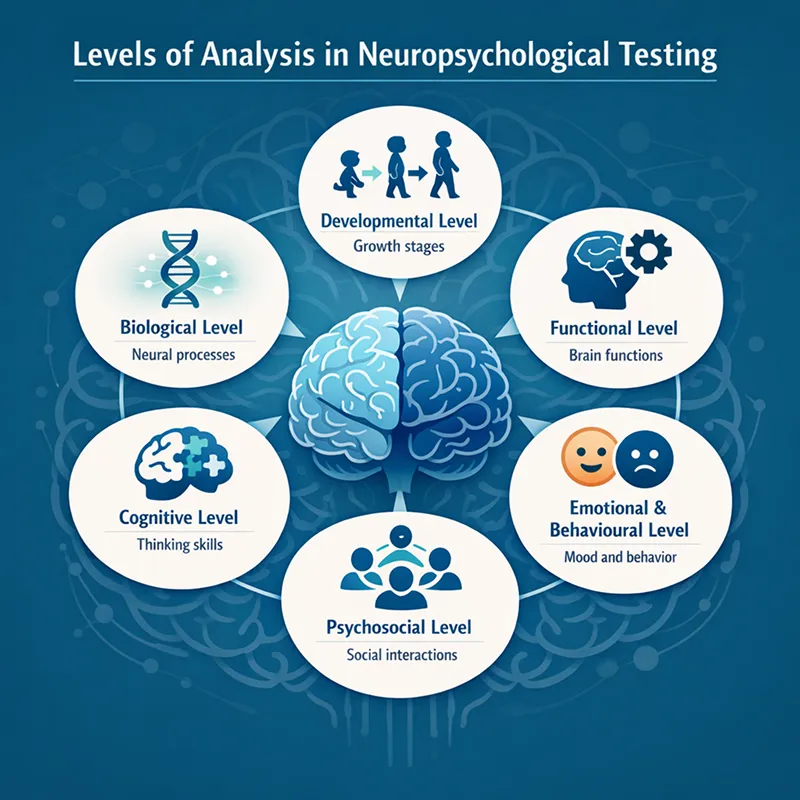
Developmental Level
Age and life stage affect the injury and recovery. Children’s brains are still growing. Teenagers are at key stages for thinking and social skills, while adults balance work and life. Older adults often recover more slowly. This level shows how age affects recovery.
Functional Level
This level looks at daily life. It checks work or school, social life, communication and independence. Many patients have limits in daily activities. Social life often drops, even if some independence returns. It shows how the injury affects real life.
Cognitive Level
This level looks at thinking skills, like memory, focus, speed and planning.
- Moderate or severe injuries often cause noticeable thinking difficulties
- Mild injuries may cause small thinking problems
Some problems may show up later in recovery. This shows how thinking can be affected.
Psychosocial Level
Recovery is also shaped by the environment and support. Family, friends, education, healthcare and coping skills all matter. Good support can help with recovery and well-being. Poor support can cause isolation and stress. This level shows how outside factors affect recovery.
Emotional and Behavioural Level
Brain injury often changes mood and behaviour. Patients may feel:
- Anxious
- Depressed
- Irritable
- like living alone
Teenagers are more likely to have mental health problems. Severe injuries can change personality and make emotions harder to control. This level shows why mood and behaviour can change.
Each year in the UK, about 200,000 people visit the hospital with a head injury. Of these, around 40,000 people have a TBI. Many of them need follow-up brain tests to check thinking and daily skills.
Why Neuropsychological Testing Matters for Brain Injury?
Brain injuries do more than affect the body. They can change how a person thinks, feels and acts each day. Many of these problems are hidden and hard to see without tests.
Neuropsychological testing shows how the brain really works.
It can show unseen problems:
- Memory loss
- Trouble focusing
These problems can make work, getting an education and daily life harder. This can happen even if scans and basic tests look normal.
Another key use of neuropsychological testing is to find long-term risks. Repeated brain injuries can increase the risk of memory loss and dementia.
By checking over time, testing shows if a person is improving, staying the same or getting worse.
Testing also helps tell the difference between brain problems and mental or behavioural issues. Neuropsychological testing shows that these behaviours come from brain injury. They are not caused by personality or feelings.
Testing also shows why people recover in different ways:
- Mild injuries often get better in a few months
- Moderate injuries can cause lasting memory or focus problems
- Severe injuries may lead to long-term thinking problems
Without proper tests, these differences are hard to show.
What Are the Types of Brain Injuries?
Brain injuries can be different. The type and severity of the injury affect recovery and test results. Knowing this shows why neuropsychological testing is needed.
A traumatic brain injury happens when the head is hurt. Common causes of this injury are:
- Workplace accidents
- Falls
- Sports injuries
- Road accidents
TBI can change thinking, behaviour and feelings. Effects may last a short or long time.
TBI is divided into three main types:
1. Severe TBI
This is the most serious type. Key effects include:
- Can cause long-term memory or thinking problems
- May need help with daily tasks
- Changes in mood and behaviour
In several cases:
- Early recovery is slow or uneven
- Some patients get worse in the first year
- More decline can happen in 2 years
- Higher risk of death, especially for older people
Severe brain injuries usually need care for a long time and many tests.
Related: Understanding Traumatic Brain Injury
2. Moderate TBI
This type causes clearer and longer-lasting problems. Its main characteristics are:
- Memory problems, short or long term
- Lower attention and slower thinking
- Trouble with daily tasks
It is often seen that:
- Some people get better in 6–12 months
- Abilities may still be lower than after a mild TBI
- Work and social life may still be hard
Brain tests help follow these changes over time.
3. Mild TBI
This is the most common type of brain injury and is also called a concussion. Key features include:
- Symptoms can be headache, confusion and memory problems
- Most people get better in a few weeks or months
- Some experience problems for 3 to 6 months or more
In many cases:
- Early recovery is usually good
- Some people feel life gets harder over time
- Many mild injuries over time can cause more problems later
Even mild injuries may need tests to find small problems.
What Role Does Neuropsychological Testing Play in Brain Injury?
Neuropsychological testing is essential for understanding brain injury. It not only gives a diagnosis but also shows how the injury affects everyday life. This is very important in brain injury claims in the UK. Tests give clear proof of thinking and daily life problems, which can affect the outcome.
The following points explain the role of neuropsychological tests in brain injury:
Captures Emotional and Social Impact
Brain injury affects more than just thinking. Patients often feel worried, sad or may pull away from others. They may feel confused and have trouble returning to work or school.
Teenagers may have trouble with social skills. Adults may struggle with work and daily life and older adults often have poorer outcomes. Testing shows these hidden effects, which help with care and claims.
Sets Expectations and Long-Term Results
Brain tests help set expectations but can’t predict exactly. Recovery depends on how bad the injury is, age, which brain parts are hurt, past health and repeated injuries.
Younger adults often recover faster. Repeated TBIs raise long-term risks and older adults have higher chances of poor outcomes. Testing finds these risks early, helping plan better care and support.
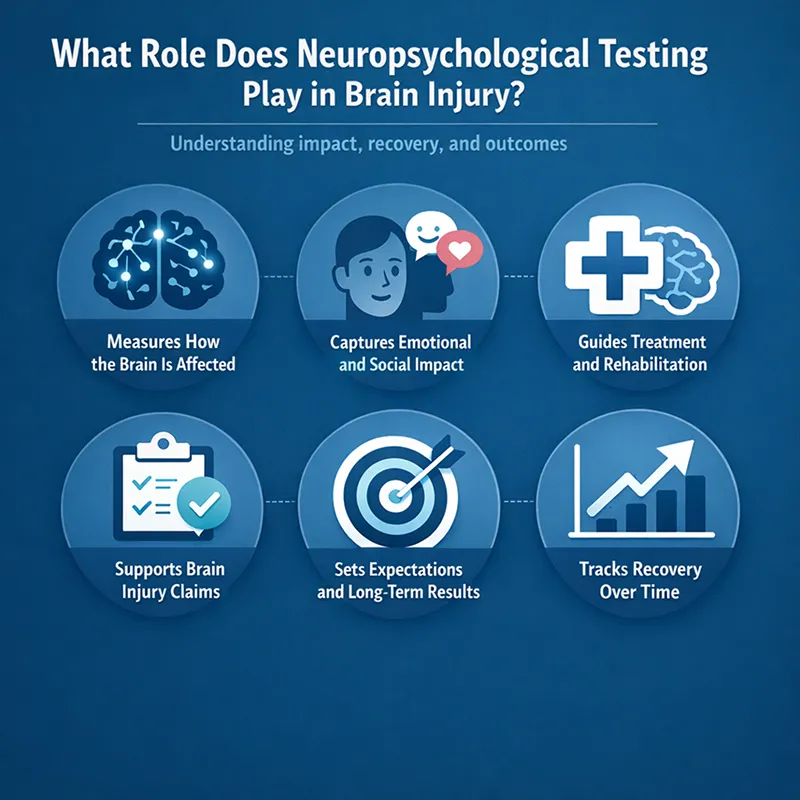
Measures How the Brain Is Affected
Neuropsychological testing checks important areas of thinking and behaviour. They assess memory, learning, attention and focus. They also assess thinking speed, planning, decision-making, language, communication and social and emotional skills.
Research shows that traumatic brain injury (TBI), often affects the frontal and lateral parts of the brain. This can cause problems with memory, attention and emotional control. These tests clearly show these changes.
Supports Brain Injury Claims
In UK brain injury claims, brain tests give clear, evidence-based results. They show what has changed after the injury. They show how daily life is affected and if problems last long.
Testing shows:
- Thinking problems, such as poor memory or slow thinking
- Emotional issues, such as anxiety or depression
It also shows limits in work, school or social life. Tests also help tell real problems from other causes, showing why difficulties happen.
Guides Treatment and Rehabilitation
Neuropsychological testing helps make clear, focused rehab plans. Neurological testing can also guide such treatments. Support may include brain rehabilitation for memory and attention and the use of aids such as diaries or apps. This may include social and communication training and tips to help self-control.
For complex cases, treatments like Transcranial Magnetic Stimulation (TMS), Transcranial Direct Current Stimulation (TDCS) or virtual reality may help. Getting help from different experts can make recovery better.
Without tests, treatment may miss important areas that need help.
Tracks Recovery Over Time
Recovery from brain injury is different for each person. Neuropsychological testing brain can help track progress. Mild TBI often gets better within months. Moderate and severe TBI may get worse at first before improving. Some patients may get worse after initially improving.
Children may improve 6–12 months after the injury. Severe cases can show new problems at 24 months. Adults may get better by 12 months, but not always fully. Testing at different times shows if a patient is improving, staying the same or getting worse.
How Neuropsychological Testing Works After a Brain Injury?
Neuropsychological testing checks how the brain works after an injury. This is a step-by-step process.
It gives a clear view of changes in thinking, feelings and behaviour after the injury. It is not a single test, but is a set of assessments performed over time.
The following steps explain how neuropsychological testing works:
Detailed Brain Tests
Screening tests give an initial overview. They give a clearer view of thinking problems. They show how these problems affect daily life and independence. More detailed tests check:
- Remembering and learning
- Thinking speed
- Problem-solving and decision-making
- Managing emotions
- Understanding and relating to others
Types of Tests Used
Various tools assess how the brain is working.
The MoCA is the most widely used test. The test takes about 10 minutes and is scored out of 30.
Studies show people with mild or moderate brain injuries often do better than those with severe injuries.
It looks over:
- Speaking and understanding
- Planning and problem solving
- Focus and attention
- Knowing the time and place
- Memory
- Visual and perceptual skills
Initial Check and Assessment
The check usually starts by looking at the person’s medical history. They assess the type and severity of the injury. They also look at thinking, mood and behaviour. Doctors usually get information from family or carers. It shows how the injury changes everyday life.
Measuring Recovery Levels
Recovery from a brain injury is tracked using set scales. A neuropsychological evaluation is often used alongside these scales. One example is the Rancho Los Amigos Scale–Revised (RLAS-R). The scale has 10 levels:
- Level I: No response
- Level X: Near full independence
As you go through the levels, awareness, memory and daily skills get better. Recovery does not always follow a straight path. Some people may skip levels or show mixed progress.
Repeated Tests Over Time
Neuropsychological testing is not done just once. Since recovery can change, tests are repeated at different times:
- Some people get better 6-12 months after the injury
- Others may get worse for a while before improving
- Severe injuries may cause problems later, even after early progress
Regular testing makes sure changes in thinking and daily skills are clearly tracked.
Importance in Legal Claims
In UK brain injury claims, how tests are done and how they are recorded is very important. Early tests show the immediate effects, while later tests show the long-term impact. These results help:
- Show a clear link between the injury and problems in daily life
- Record if problems are getting better, staying the same or lasting
- Give strong, clear proof for legal cases
Final Words
Brain injuries affect more than just the body. They can change how a person thinks, feels and lives each day. Recovery can be slow and uncertain, and results can vary for each person.
Neuropsychological testing helps by:
- Showing how the brain is working after an injury
- Linking changes in thinking, emotions and daily life
- Tracking progress
- Showing long-term risks
- Guiding treatment
- Helping with compensation claims
At Concise Medico, we understand how challenging brain injury cases can be. We give clear and organised support to help you understand the impact. We make sure every case is handled with care and checked for accuracy.
If you are managing a brain injury claim, we can give you practical guidance. You can contact us at any time to get help at every step.
FAQs
Ever wonder how a head injury can change someone? How do doctors show this in a legal claim?
You cannot always see a brain injury. Many people look well but have trouble with memory, focus or mood.
Studies show that some adults still have problems after a mild brain injury. Some have thinking or memory issues three months later. This makes it hard to make a fair claim without evidence.
Visiting hospitals for brain injuries is very common in the UK. In previous years, 123,969 people went to the hospital for a head injury. That is about one person every four minutes. This number shows how many people may need a brain test after an injury. This shows how big the problem is.
Brain injury can affect a person’s thinking, feelings and daily life. It can make memory, attention, mood and daily tasks harder.
Everyone gets better in their own way. It depends on age, how severe the injury is and past health.
Mild injuries often improve with time. Bad injuries may get worse or cause long-term problems. Multiple hits can raise the risk of dementia. That is why careful checks, including neurological testing, are very important.
Neuropsychological testing is important in UK brain injury claims. These tests show how the brain works. They check skills such as memory, focus and decision-making.
They also help show if there are real thinking problems or if the issues come from feelings or coping skills.
This is very important in legal cases when symptoms cannot be seen. Sometimes, doctors use neurological testing with neuropsychological evaluation.
This evaluation checks how the brain is working. It checks thinking, memory and everyday skills after an injury. Neuropsychological testing brain can show small thinking changes. These changes may not appear on regular scans or routine check-ups.
In this blog, you will find out:
- What is neuropsychological testing for brain injury and how it works
- Why it matters in brain injury claims
- How neuropsychological testing helps after a brain injury
- What are types of brain injuries
- How different levels are studied in neuropsychological testing
What Neuropsychological Testing Can Do for Brain Injury?
Neuropsychological testing checks how the brain works after an injury. It checks thinking, behaviour and emotions. In brain injury claims in the UK, these tests are very important. They show how the injury changes daily life, even if the problems are not clear.
These tests check key thinking skills, like:
- Memory
- Attention
- Problem-solving
- Language
- Decision-making
These tests give clear results and show how the injury changes daily life. A person may look okay, but tests can show slow thinking, weak memory or trouble focusing. These problems can make work, school and getting along with others harder.
Without tests, they may be missed.
The Montreal Cognitive Assessment (MoCA) is the most commonly used tool, which checks thinking skills quickly. Other tests track progress over months or years. Tests can be done at any time during recovery. They help spot early problems, track progress and guide treatment.
Neuropsychological tests also help tell the difference between:
- True thinking problems
- Emotional responses
- Coping skills
This matters because memory problems can look like stress, tiredness or low effort, rathe rthan real brain damage. These tests connect symptoms to daily life and show how the injury affects a person.
In brain injury claims, this evidence helps make a fair assessment. It shows what has changed and what support a person needs to manage daily life.
In some tough claims, expert witnesses help show how brain injuries affect daily life. They explain the changes clearly to the court. This helps guide fair compensation for the person.
Learn more: Brain Injury Expert Witness
Neuropsychological testing brain is often very important. It shows the hidden effects of mild or moderate brain injuries in court cases.
A new challenge keeps the brain kicking and the heart ticking.
– E.A. Bucchianeri
Real Life Example: Road Traffic Claim in the UK From Hidden Brain Injury
A person had a small brain injury after a car crash. At first, they were offered a small payout. The claim was moved to a new team. They used detailed proof, including neuropsychological testing, to show problems with thinking and daily life.
The case ended before trial with a £1.75 million payout. This shows why brain injury claims matter in the UK. Careful tests of thinking skills can be very important. They help get fair payment even for mild or hidden injuries.
Why It Is Important?
Neuropsychological testing can show small thinking problems. These problems may not show up on normal scans. This evidence shows how the injury affects life and work.
Levels of Analysis in Neuropsychological Testing
Brain injuries are complex and can affect many areas of life. Neuropsychological evaluation looks at many levels to give a full picture. It does not only look at symptoms.
It also checks these things to see the full effect:
- Brain
- Thinking
- Feelings
- Daily life
- Age
- Social support
Neuropsychology testing analysis levels are:
Biological Level
This level looks at the brain itself. It checks which areas are damaged, how severe the injury is and changes like swelling or breakdown. Damage to the frontal or temporal parts of the brain can change thinking and emotions.
Repeated injuries may cause long-term changes in the brain. There is also a higher risk of conditions like dementia over time. This level shows why problems happen.
Developmental Level
Age and life stage affect the injury and recovery. Children’s brains are still growing. Teenagers are at key stages for thinking and social skills, while adults balance work and life. Older adults often recover more slowly. This level shows how age affects recovery.
Functional Level
This level looks at daily life. It checks work or school, social life, communication and independence. Many patients have limits in daily activities. Social life often drops, even if some independence returns. It shows how the injury affects real life.
Cognitive Level
This level looks at thinking skills, like memory, focus, speed and planning.
- Moderate or severe injuries often cause noticeable thinking difficulties
- Mild injuries may cause small thinking problems
Some problems may show up later in recovery. This shows how thinking can be affected.
Psychosocial Level
Recovery is also shaped by the environment and support. Family, friends, education, healthcare and coping skills all matter. Good support can help with recovery and well-being. Poor support can cause isolation and stress. This level shows how outside factors affect recovery.
Emotional and Behavioural Level
Brain injury often changes mood and behaviour. Patients may feel:
- Anxious
- Depressed
- Irritable
- like living alone
Teenagers are more likely to have mental health problems. Severe injuries can change personality and make emotions harder to control. This level shows why mood and behaviour can change.
Each year in the UK, about 200,000 people visit the hospital with a head injury. Of these, around 40,000 people have a TBI. Many of them need follow-up brain tests to check thinking and daily skills.
Why Neuropsychological Testing Matters for Brain Injury?
Brain injuries do more than affect the body. They can change how a person thinks, feels and acts each day. Many of these problems are hidden and hard to see without tests.
Neuropsychological testing shows how the brain really works.
It can show unseen problems:
- Memory loss
- Trouble focusing
These problems can make work, getting an education and daily life harder. This can happen even if scans and basic tests look normal.
Another key use of neuropsychological testing is to find long-term risks. Repeated brain injuries can increase the risk of memory loss and dementia.
By checking over time, testing shows if a person is improving, staying the same or getting worse.
Testing also helps tell the difference between brain problems and mental or behavioural issues. Neuropsychological testing shows that these behaviours come from brain injury. They are not caused by personality or feelings.
Testing also shows why people recover in different ways:
- Mild injuries often get better in a few months
- Moderate injuries can cause lasting memory or focus problems
- Severe injuries may lead to long-term thinking problems
Without proper tests, these differences are hard to show.
What Are the Types of Brain Injuries?
Brain injuries can be different. The type and severity of the injury affect recovery and test results. Knowing this shows why neuropsychological testing is needed.
A traumatic brain injury happens when the head is hurt. Common causes of this injury are:
- Workplace accidents
- Falls
- Sports injuries
- Road accidents
TBI can change thinking, behaviour and feelings. Effects may last a short or long time.
TBI is divided into three main types:
1. Severe TBI
This is the most serious type. Key effects include:
- Can cause long-term memory or thinking problems
- May need help with daily tasks
- Changes in mood and behaviour
In several cases:
- Early recovery is slow or uneven
- Some patients get worse in the first year
- More decline can happen in 2 years
- Higher risk of death, especially for older people
Severe brain injuries usually need care for a long time and many tests.
Related: Understanding Traumatic Brain Injury
2. Moderate TBI
This type causes clearer and longer-lasting problems. Its main characteristics are:
- Memory problems, short or long term
- Lower attention and slower thinking
- Trouble with daily tasks
It is often seen that:
- Some people get better in 6–12 months
- Abilities may still be lower than after a mild TBI
- Work and social life may still be hard
Brain tests help follow these changes over time.
3. Mild TBI
This is the most common type of brain injury and is also called a concussion. Key features include:
- Symptoms can be headache, confusion and memory problems
- Most people get better in a few weeks or months
- Some experience problems for 3 to 6 months or more
In many cases:
- Early recovery is usually good
- Some people feel life gets harder over time
- Many mild injuries over time can cause more problems later
Even mild injuries may need tests to find small problems.
What Role Does Neuropsychological Testing Play in Brain Injury?
Neuropsychological testing is essential for understanding brain injury. It not only gives a diagnosis but also shows how the injury affects everyday life. This is very important in brain injury claims in the UK. Tests give clear proof of thinking and daily life problems, which can affect the outcome.
The following points explain the role of neuropsychological tests in brain injury:
Captures Emotional and Social Impact
Brain injury affects more than just thinking. Patients often feel worried, sad or may pull away from others. They may feel confused and have trouble returning to work or school.
Teenagers may have trouble with social skills. Adults may struggle with work and daily life and older adults often have poorer outcomes. Testing shows these hidden effects, which help with care and claims.
Sets Expectations and Long-Term Results
Brain tests help set expectations but can’t predict exactly. Recovery depends on how bad the injury is, age, which brain parts are hurt, past health and repeated injuries.
Younger adults often recover faster. Repeated TBIs raise long-term risks and older adults have higher chances of poor outcomes. Testing finds these risks early, helping plan better care and support.
Measures How the Brain Is Affected
Neuropsychological testing checks important areas of thinking and behaviour. They assess memory, learning, attention and focus. They also assess thinking speed, planning, decision-making, language, communication and social and emotional skills.
Research shows that traumatic brain injury (TBI), often affects the frontal and lateral parts of the brain. This can cause problems with memory, attention and emotional control. These tests clearly show these changes.
Supports Brain Injury Claims
In UK brain injury claims, brain tests give clear, evidence-based results. They show what has changed after the injury. They show how daily life is affected and if problems last long.
Testing shows:
- Thinking problems, such as poor memory or slow thinking
- Emotional issues, such as anxiety or depression
It also shows limits in work, school or social life. Tests also help tell real problems from other causes, showing why difficulties happen.
Guides Treatment and Rehabilitation
Neuropsychological testing helps make clear, focused rehab plans. Neurological testing can also guide such treatments. Support may include brain rehabilitation for memory and attention and the use of aids such as diaries or apps. This may include social and communication training and tips to help self-control.
For complex cases, treatments like Transcranial Magnetic Stimulation (TMS), Transcranial Direct Current Stimulation (TDCS) or virtual reality may help. Getting help from different experts can make recovery better.
Without tests, treatment may miss important areas that need help.
Tracks Recovery Over Time
Recovery from brain injury is different for each person. Neuropsychological testing brain can help track progress. Mild TBI often gets better within months. Moderate and severe TBI may get worse at first before improving. Some patients may get worse after initially improving.
Children may improve 6–12 months after the injury. Severe cases can show new problems at 24 months. Adults may get better by 12 months, but not always fully. Testing at different times shows if a patient is improving, staying the same or getting worse.
How Neuropsychological Testing Works After a Brain Injury?
Neuropsychological testing checks how the brain works after an injury. This is a step-by-step process.
It gives a clear view of changes in thinking, feelings and behaviour after the injury. It is not a single test, but is a set of assessments performed over time.
The following steps explain how neuropsychological testing works:
Detailed Brain Tests
Screening tests give an initial overview. They give a clearer view of thinking problems. They show how these problems affect daily life and independence. More detailed tests check:
- Remembering and learning
- Thinking speed
- Problem-solving and decision-making
- Managing emotions
- Understanding and relating to others
Types of Tests Used
Various tools assess how the brain is working.
The MoCA is the most widely used test. The test takes about 10 minutes and is scored out of 30.
Studies show people with mild or moderate brain injuries often do better than those with severe injuries.
It looks over:
- Speaking and understanding
- Planning and problem solving
- Focus and attention
- Knowing the time and place
- Memory
- Visual and perceptual skills
Initial Check and Assessment
The check usually starts by looking at the person’s medical history. They assess the type and severity of the injury. They also look at thinking, mood and behaviour. Doctors usually get information from family or carers. It shows how the injury changes everyday life.
Measuring Recovery Levels
Recovery from a brain injury is tracked using set scales. A neuropsychological evaluation is often used alongside these scales. One example is the Rancho Los Amigos Scale–Revised (RLAS-R). The scale has 10 levels:
- Level I: No response
- Level X: Near full independence
As you go through the levels, awareness, memory and daily skills get better. Recovery does not always follow a straight path. Some people may skip levels or show mixed progress.
Repeated Tests Over Time
Neuropsychological testing is not done just once. Since recovery can change, tests are repeated at different times:
- Some people get better 6-12 months after the injury
- Others may get worse for a while before improving
- Severe injuries may cause problems later, even after early progress
Regular testing makes sure changes in thinking and daily skills are clearly tracked.
Importance in Legal Claims
In UK brain injury claims, how tests are done and how they are recorded is very important. Early tests show the immediate effects, while later tests show the long-term impact. These results help:
- Show a clear link between the injury and problems in daily life
- Record if problems are getting better, staying the same or lasting
- Give strong, clear proof for legal cases
Final Words
Brain injuries affect more than just the body. They can change how a person thinks, feels and lives each day. Recovery can be slow and uncertain, and results can vary for each person.
Neuropsychological testing helps by:
- Showing how the brain is working after an injury
- Linking changes in thinking, emotions and daily life
- Tracking progress
- Showing long-term risks
- Guiding treatment
- Helping with compensation claims
At Concise Medico, we understand how challenging brain injury cases can be. We give clear and organised support to help you understand the impact. We make sure every case is handled with care and checked for accuracy.
If you are managing a brain injury claim, we can give you practical guidance. You can contact us at any time to get help at every step.