TABLE OF CONTENT
What Are the Different Types of Expert Witnesses Used in Court?
Did you know that the Crown Court received more than 100,000 new cases majority of which involved complex evidence. Such cases require expert witnesses to help judges and juries to understand technical facts. Not every court case is easy to understand. Some cases involve medical problems, science, or mental health.
Judges and juries may need help from people with special knowledge. These people are called expert witnesses. They explain difficult information in a simple and clear way so the court can make fair decisions. There are different types of expert witnesses and each one has a special role depending on the facts of the case.
What Is an Expert Witness?
An expert witness is a person who gives opinions and evidence in court. They can easily explain complex issues in a simple way that helps judges to understand the case.
“An expert witness should provide independent assistance to the court by giving objective and unbiased opinions.”
— Lord Justice Cresswell, The Ikarian Reefer (UK High Court)
Role of Expert Witness in Court
An expert witness gives their opinions to juries. Their opinions are based on their knowledge, training and experience. They do not favour either side without justification. They help the court understand facts that need expert knowledge.
What Are The Different Types of Expert Witnesses?
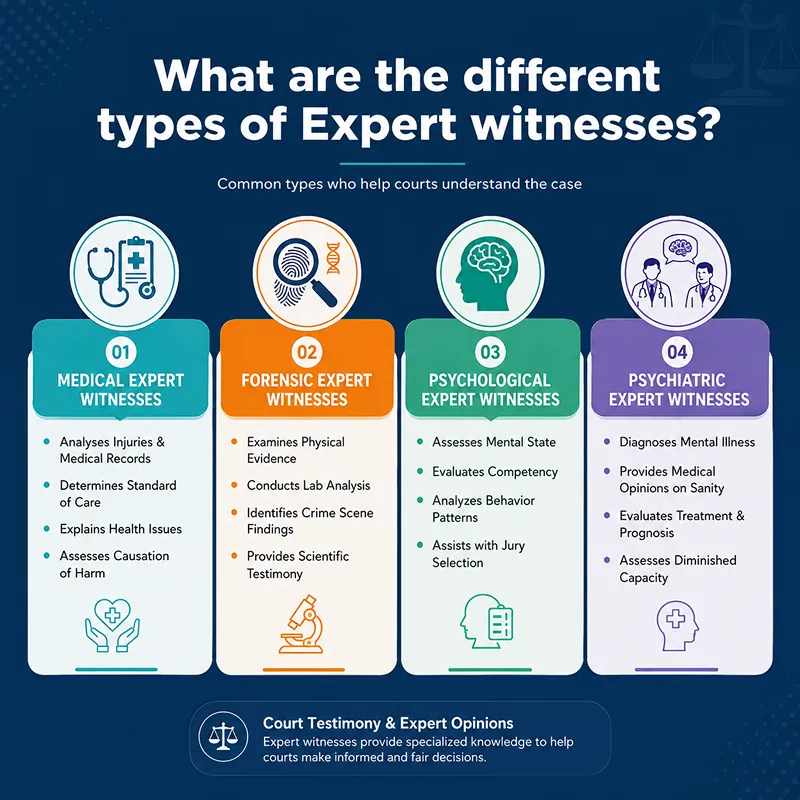
There are many types of expert witnesses who help courts to understand the case. However, here we mentioned some of the most common types of expert witnesses.
- Medical expert witnesses
- Forensic expert witnesses
- Psychological expert witnesses
- Psychiatric expert witnesses
1. Medical Expert Witnesses
A medical expert witness is one of the most common types of expert witnesses in court. They play a key role in cases involving injury and health-related issues.
Role of Medical Experts
Medical experts often explain whether the given care met the right standard or not. In injury cases, medical experts can tell how serious the injury is and how it may affect the life of a person. Medical cases can be difficult, so expert witnesses must have the right skills for the specific condition.
Real Life Example
One of the best-known examples of a medical expert witness in the UK is the case of Lucy Letby, a neonatal nurse who was convicted of murdering and attempting to murder babies at the Countess of Chester Hospital.
Medical expert witnesses played a central role in the case. They carefully reviewed the babies’ medical records, laboratory results, X-rays and treatment notes. Their opinions helped the court to understand whether the babies’ deaths were caused by natural medical conditions or by deliberate harm. For example, paediatric experts explained medical findings such as unexpected insulin levels and signs of air embolism. Their evidence helped the jury understand complex medical issues that could not be explained by ordinary witness testimony.
The case shows why expert witnesses are important in helping courts make informed decisions when medical evidence is difficult to understand.
2. Forensic Expert Witnesses
Forensic experts examine physical or scientific evidence in court cases. They often work in crime cases but may also work in civil cases. They are also among the types of expert witnesses who play a key role in court.
Role of Forensic Experts
Forensic experts study the evidence from an investigation. They check the data and explain the results in a clear and simple way.
Their reports may include:
- Blood samples
- Fingerprints
- Ballistics
- Digital data
Types of Forensic Experts
Forensic pathologists: They perform post-mortems to find the cause of death. Their findings play a key role in murder cases.
Forensic toxicologists: They test body samples for drugs, alcohol or poisons. They often help in cases like poisoning or drug misuse.
3. Psychological Expert Witnesses
Psychological expert witnesses are trained psychologists who assess how a person’s thoughts, feelings and behaviour might have caused an event. In the UK, these experts are often asked to give independent opinions in personal injury, medical negligence and criminal cases. They are one of the important types of expert witnesses used when mental health needs to be carefully assessed.
Role of Psychological Expert
A psychological expert may:
- Assess mental health after an accident or traumatic event.
- Diagnose conditions such as anxiety, depression or post-traumatic stress disorder (PTSD).
- Carry out psychological tests and clinical interviews.
- Explain how mental health affects the daily life and work of a person.
- Prepare an independent report for the court.
- Give expert evidence if asked to attend court.
4. Psychiatric Expert Witnesses
Psychiatric expert witnesses are qualified medical doctors who specialise in mental health. Their medical opinion helps the court to understand whether a person has a recognised mental illness and how it affects their health. They are another key part of the types of expert witnesses used in legal cases involving mental health.
Role of Psychiatric Expert
A psychiatric expert may:
- Assess and diagnose mental health conditions.
- Review medical records and previous treatments.
- Decide whether medication or other treatment is needed or not.
- Explain the cause, severity and future outlook of a mental illness.
- Write an independent medical report for the court.
- Provide expert evidence during legal proceedings when required.
Psychological and psychiatric experts both help the courts in making informed decisions, but they have different training and responsibilities. Knowing these differences makes it easier to understand the types of expert witnesses that may be involved in a legal case.
Choosing the Right Expert for a Case
Choosing the right expert witness is a key step while preparing a legal case. Your expert witness should fit the specific issue in the case. For example, medical cases need medical experts.
Choosing the wrong expert can weaken your case. This is because their views may not explain the relevant issues. You should also check that the expert is ready to attend court if needed. Some experts may write reports but may not be available to give evidence in court. Careful selection ensures the expert witness gives clear and reliable evidence in court and helps you to succeed in your case.
Conclusion
There are many types of expert witnesses to help in court cases. They can include doctors, forensic specialists, psychologists and psychiatrists. Each expert helps the case with their unique knowledge. Their opinions help courts to understand complex facts. They also help courts to make fair decisions. The different types of expert witnesses that we cover throughout the blog show how important they are in today’s legal cases. Concise Medico understands the role of an expert witness in court decisions; that’s why our expert team helps to choose the right expert for your case.