TABLE OF CONTENT
Did you go for orthopaedic treatment and end up with more pain than before? Orthopaedics is a medical field that treats the spine, bones, joints, muscles, tendons, and ligaments. This includes things like broken bones, hip or knee replacements, injuries to ligaments, and back pain.
Most treatments work well, but sometimes mistakes happen. Even a small error in orthopaedics can lead to big problems, like limited movement, needing more surgery, not being able to work, or needing long-term care.
That’s where orthopaedic negligence claims come in. These claims let people ask for compensation when poor care, that could have been avoided, causes harm. You can make an orthopaedic injury claim against both NHS and private healthcare providers. The process is similar in both cases.
What Is an Orthopaedic Injury Claim?
An orthopaedic injury claim is a legal claim for medical mistakes made during orthopaedic treatment. This guide talks about claims related to healthcare, whether from the NHS or private healthcare providers. The claim is based on whether the care provided was not up to the expected standard and caused harm.
Claim Elements and Evidence
When you file an orthopaedic injury claim, it’s because:
So it's not merely a bad outcome. Despite precautions, risks occur. Orthopaedic injury claims involve harm that may have been averted if mistakes were made. Orthopaedic injury claims can result from surgical errors, misdiagnoses, and late diagnoses.
If you want a simple explainer of what an orthopaedic expert witness report is (and how it supports a case), read our orthopaedic expert witness reports page.
What Are the Common Causes of Orthopaedic Negligence Claims?
Orthopaedic negligence can occur at various stages of treatment. It can happen in the emergency room, at a clinic, during surgery, or even after you return home. The following are the most common reasons people file orthopaedic injury claims.
1. Missed or Delayed Diagnosis
This is one of the main reasons people file claims for orthopaedic injuries.
Some such examples are:
- X-rays missed the fracture (for example, scaphoid wrist fractures).
- Dislocation not recognised.
- Tendon rupture missed.
- Septic arthritis, or infection in a joint, wasn't found early.
- Cauda equina “red flags” not acted on.

2. Delayed Referral or Delayed Treatment
The diagnosis is sometimes correct, but the treatment is too sluggish.
For example:
- Not calling an orthopaedic doctor when needed.
- Not setting up more imaging tests when symptoms don't go away.
- Not doing surgery when it is clearly needed.
- There are delays in treating compartment syndrome.
If you wait too long, a problem that can be fixed can become one that changes your life. That's why orthopaedic negligence claims generally centre on "what should have happened sooner."
3. Surgical Errors
Surgery is complicated. But fundamental safety procedures are still important.
Here are some examples of things that can lead to orthopaedic injury claims:
- Doing surgery on the wrong spot or level.
- Bad placement that hurts nerves.
- Avoidable harm to nerves, arteries, or soft tissues.
- Bad fixation that causes early failure.
- Wrong parts.
4. Infection and Poor Post-Op Care
Even if you do everything right, you can still have an infection. But the most important question is whether the care was fair.
You can file an orthopaedic injury claim when:
- Ignoring warning indications including fever, more pain, redness, and drainage.
- When urgent care is needed, antibiotics are put off.
- Wound care isn't good enough.
- There is no follow-up planned or carried out.
In orthopaedics, an untreated infection can lead to osteomyelitis, which is an infection of the deep bone. It can cause many surgeries or perhaps the loss of a limb.
5. Poor Consent and Communication
Patients have the right to know about the main dangers and choices. If you weren't advised of a major risk that was important to you, that can be part of orthopaedic injury claims.
For instance:
- Not being advised that there is a danger of infection during joint replacement.
- Not being told about nerve damage danger in spine surgery.
- Not being told about options other than surgery.
- Not being told that there was a potential of having revision surgery.
Problems with consent aren't simply about the papers. They are about the talk.
6. Poor Rehabilitation Planning
It's not only about the surgery while you recover. It's about what comes next.
Claims for orthopaedic injuries might occasionally include:
- Not getting physiotherapy or getting it late.
- Plans for unsafe discharge.
- Bad pain control that makes rehab harder.
- Not giving walking aids.
- Not following up after problems.
Who Can Make an Orthopaedic Injury Claim?
Most of the time, the individual who was hurt makes the allegation. There are also other times, though.
People who might file claims for orthopaedic injuries are:
- The patient (adult with capacity).
- A parent or guardian (for a child).
- A "litigation friend" is someone who helps someone who can't handle their own case.
- In some cases, family members after a death.
How Is an Orthopaedic Negligence Claim Proven?
Most claims for orthopaedic injuries come down to three questions:
- What should have been done?
- What happened in real life?
- Was that difference harmful?
Step 1: Duty of Care
You had a right to care from a doctor, nurse, physiotherapist, or hospital if they treated you. People normally don't disagree with this part.
Step 2: Breach of Duty
This means that the treatment provided was below the standard expected from a competent professional in the field.
In actual life, this is often indicated by:
- Rules and what is normal.
- What other skilled doctors would have done.
- A report from a medical specialist who is not connected to the case.
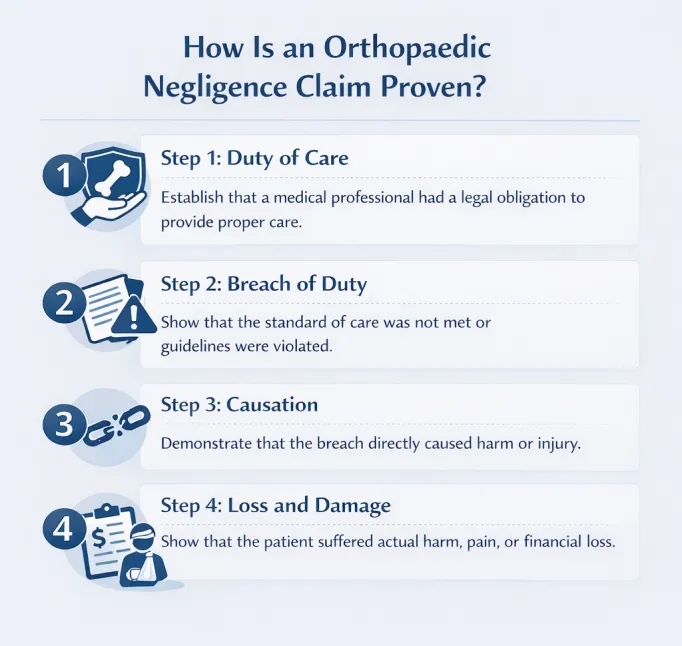
Step 3: Causation
For a lot of people who make claims for orthopaedic injuries, this is the hardest aspect. You need to prove that the breach caused damage or made the situation worse.
For instance:
- Could earlier therapy have prevented surgery for undiscovered fractures?
- Should infection treatment have begun earlier to prevent amputation?
- Did the wrong implant cause early failure and revision surgery?
Sometimes a breach is obvious but not the cause. Thus, expert testimony matters.
Step 4: Loss and Damage
Lastly, you need to be very clear about how your orthopaedic injury has affected you.
This includes:
- Pain and suffering.
- Disability and loss of enjoyment of life.
- Financial losses (past and future).
- Care and help needs.
- Treatment and rehab costs.
What Compensation Types of Orthopaedic Negligence Claims Are Available?
There are usually two compensation types of orthopaedic negligence claims.
1. General Damages
This includes:
- Pain.
- Suffering.
- Loss of amenity (things you can no longer do).
The amount depends on how bad the injury is and how it affects your life.
2. Special Damages
This includes money you have already lost or will lose. It can have:
- Costs of getting to the hospital.
- Costs of prescriptions.
- Costs of private care.
- Rehabilitation and physiotherapy.
- Lost money.
- Less money in the future.
- Changes to the home, like ramps, stairlifts, and wet rooms.
- Tools (like a wheelchair or orthotics).
- Help and care (from paid carers or family).
If you are dealing with spinal issues and long rehab, you may find it helpful to read our guide on rehabilitation strategies for spinal cord injury.
How Does the Claims Process Work and What Funding Options Are There?
In England and Wales, there is a standard process for an orthopaedic injury claim. Many claims follow the Pre-Action Protocol for Clinical Dispute Resolution. Sharing knowledge early is its goal. A defendant normally has 14 days to react to key letters and 4 months to submit a detailed Letter of Response after receiving a Letter of Claim.
Step-by-Step Process
Here is the step-by-step process of filing an orthopaedic claim:
Step 01: Get Your Records
Get your medical records and imaging reports. You can ask for access to a subject in the UK. Unless the request is complicated, most organisations must respond within a month.
Step 02: Take Early Advice
An expert can help you figure out if you might have claims for orthopaedic injuries.
Step 03: Independent Expert Review
An orthopaedic expert may look at records and say whether the care was below standard and whether it caused harm.
Step 04: Pre-Action Letters
The process usually starts with letters that list the claims and the accusations. The Protocol also tells you what a Letter of Claim should have in it and that you shouldn't start legal action until four months after you send the Letter of Claim.
Step 05: Defendant Investigation
The hospital, GP, or provider looks into it. They might accept some or all of the claim. Or they might say no.
Step 06: Negotiation
A lot of cases are settled without going to court. Settlement can include explanations and compensation.
Funding Options
Some common ways to pay for orthopaedic injury claims are:
- No-win, no-fee agreement. No upfront payment is required. You normally don't pay your lawyer if you lose. A success charge, normally restricted at 25%, may lower your damages if you win.
- Legal fees insurance, sometimes included in vehicle or home insurance.
- Trade union funding (some unions aid legal cases).
- Private funding (rare due to cost).
Always request a formal cost breakdown.
What Are the Time Limits and Important Considerations?
Time constraints are quite important when it comes to claims for orthopaedic injuries.
You usually have three years to file a orthopaedic negligence claim. People usually start counting from the day of the injury. You can also use the "date of knowledge" approach if you find out later that your damage is due to careless treatment.
Important exceptions:
- Children: Judgement time usually runs from 18 to 21 for children.
- Mental incapacity: The restriction clock may not run if the person is "disabled," which can entail struggling to think.
Get assistance early because limiting regulations can be hard to understand. Early counsel can help you keep your job even if you're not sure.
Other orthopaedic claim tips are:
- Keep a symptom diary. Record your discomfort, mobility, sleep, and daily life impact.
- Keep receipts. Travel, medical, equipment, and care costs. Small costs accumulate.
- Take pictures of wounds, oedema, mobility assistance, and changes.
What Insights Can Be Learned from Orthopaedic Injury Claim Data?
Data doesn't tell the full story, but it reveals trends. The Medical Defence Union (MDU) has observed patterns in the notifications it receives. In one review, over five years, more than 400 orthopaedic injury claims were filed. The most common areas involved were the hand/wrist and hip/knee. Around 78% of these cases were defended.
These numbers don't mean "most cases win" or "most cases lose." They highlight where issues typically arise and underscore the importance of solid evidence.
Two key lessons often emerge in orthopaedic injury claims:
- Delays cause harm.
- Communication gaps lead to confusion and complaints.
A precise timetable helps you answer:
- When did symptoms start?
- When did you ask for help?
- What was done at each step?
- When did things get worse?
- What was the final outcome?
How Do You Choose the Right Legal Support?
It can be hard to choose assistance. This is a simple list.
1. Look for the Right Experience
Claims for orthopaedic injuries are not the same as claims for little accidents. They often want:
- Detailed medical analysis.
- Expert evidence on breach and causation.
- Careful valuation of future loss.
Ask:
- Do you often work on situations of clinical negligence?
- Have you worked on cases like mine that involve orthopaedic injuries?
- Who will be in charge of my case every day?
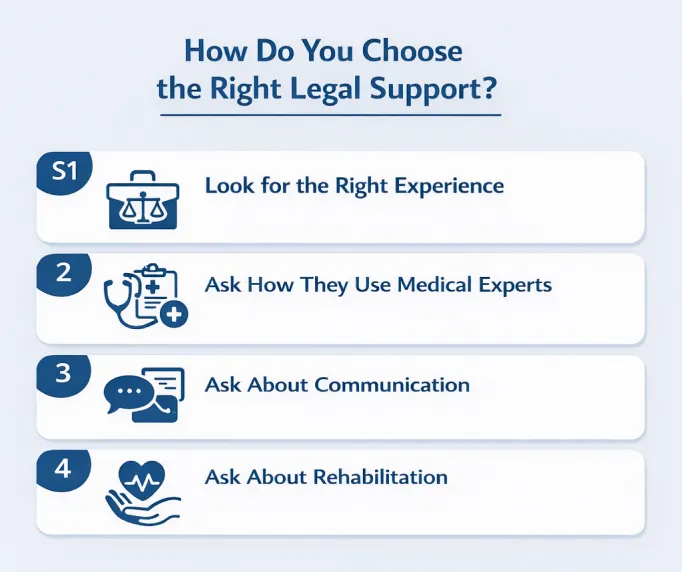
2. Ask How They Use Medical Experts
Good medical evidence is needed for good orthopaedic injury claims.
An attorney may ask an orthopaedic specialist to write a report. You could also need the following in complicated cases:
- Radiology experts.
- Microbiology experts (infection)
- Neurology experts (nerve injury).
- Care and occupational therapy experts.
3. Ask About Communication
You should feel like you know what's going on and that others are listening to you. Find out how often you will get updates and who you should talk to the most.
4. Ask About Rehabilitation
Support isn't just about money. It is about getting better.
Orthopaedic Injury Claim Case Study (UK High Court)
Who Was Involved?
Sylvan Ebanks-Blake (a professional footballer) and Professor James Calder (the surgeon).
What Happened?
Here’s what actually happened:
- Footballer Sylvan Ebanks-Blake broke his fibula in 2013.
- A knife cut him. The surgeon repaired bone, performed ankle arthroscopy, and microfracture.
- According to the claim ankle surgery was unnecessary, painful, and impacted job performance.
What The Court Decided?
This was a divided trial; the court determined on breach of duty and causation, but not yet on final compensation.
The judge found:
- The surgeon breached their duty by performing ankle arthroscopy. The correct approach would have been to only repair the fibula and monitor the ankle.
- The judge concluded that without the arthroscopy, the man's ankle would have stayed pain-free for 3–5 years and allowed him to play high-level football. The impact on earnings was deferred for a later trial.
What Were the Results?
The results were:
- First, Ebanks-Blake won liability and causation.
- Quantum trials will determine future payments.
- The judgment did not specify how much he would receive, but Reuters reports that the amount sought is about £7 million.
Conclusion
You are not the only one who thinks you have been hurt when you shouldn't have been. People sometimes leave the hospital worse off than they should have, which is why there are orthopaedic injury claims.
Early advice makes things easier if you are thinking about filing an orthopaedic injury claim.
The best initial step is easy:
- Get your records.
- Write down the timeline.
- Get proper advice.
Getting answers can help you go forward, even if you don't want to "claim."
FAQs
Did you go for orthopaedic treatment and end up with more pain than before? Orthopaedics is a medical field that treats the spine, bones, joints, muscles, tendons, and ligaments. This includes things like broken bones, hip or knee replacements, injuries to ligaments, and back pain.
Most treatments work well, but sometimes mistakes happen. Even a small error in orthopaedics can lead to big problems, like limited movement, needing more surgery, not being able to work, or needing long-term care.
That’s where orthopaedic negligence claims come in. These claims let people ask for compensation when poor care, that could have been avoided, causes harm. You can make an orthopaedic injury claim against both NHS and private healthcare providers. The process is similar in both cases.
What Is an Orthopaedic Injury Claim?
An orthopaedic injury claim is a legal claim for medical mistakes made during orthopaedic treatment. This guide talks about claims related to healthcare, whether from the NHS or private healthcare providers. The claim is based on whether the care provided was not up to the expected standard and caused harm.
Claim Elements and Evidence
When you file an orthopaedic injury claim, it’s because:
So it's not merely a bad outcome. Despite precautions, risks occur. Orthopaedic injury claims involve harm that may have been averted if mistakes were made. Orthopaedic injury claims can result from surgical errors, misdiagnoses, and late diagnoses.
If you want a simple explainer of what an orthopaedic expert witness report is (and how it supports a case), read our orthopaedic expert witness reports page.
What Are the Common Causes of Orthopaedic Negligence Claims?
Orthopaedic negligence can occur at various stages of treatment. It can happen in the emergency room, at a clinic, during surgery, or even after you return home. The following are the most common reasons people file orthopaedic injury claims.
1. Missed or Delayed Diagnosis
This is one of the main reasons people file claims for orthopaedic injuries.
Some such examples are:
- X-rays missed the fracture (for example, scaphoid wrist fractures).
- Dislocation not recognised.
- Tendon rupture missed.
- Septic arthritis, or infection in a joint, wasn't found early.
- Cauda equina “red flags” not acted on.
2. Delayed Referral or Delayed Treatment
The diagnosis is sometimes correct, but the treatment is too sluggish.
For example:
- Not calling an orthopaedic doctor when needed.
- Not setting up more imaging tests when symptoms don't go away.
- Not doing surgery when it is clearly needed.
- There are delays in treating compartment syndrome.
If you wait too long, a problem that can be fixed can become one that changes your life. That's why orthopaedic negligence claims generally centre on "what should have happened sooner."
3. Surgical Errors
Surgery is complicated. But fundamental safety procedures are still important.
Here are some examples of things that can lead to orthopaedic injury claims:
- Doing surgery on the wrong spot or level.
- Bad placement that hurts nerves.
- Avoidable harm to nerves, arteries, or soft tissues.
- Bad fixation that causes early failure.
- Wrong parts.
4. Infection and Poor Post-Op Care
Even if you do everything right, you can still have an infection. But the most important question is whether the care was fair.
You can file an orthopaedic injury claim when:
- Ignoring warning indications including fever, more pain, redness, and drainage.
- When urgent care is needed, antibiotics are put off.
- Wound care isn't good enough.
- There is no follow-up planned or carried out.
In orthopaedics, an untreated infection can lead to osteomyelitis, which is an infection of the deep bone. It can cause many surgeries or perhaps the loss of a limb.
5. Poor Consent and Communication
Patients have the right to know about the main dangers and choices. If you weren't advised of a major risk that was important to you, that can be part of orthopaedic injury claims.
For instance:
- Not being advised that there is a danger of infection during joint replacement.
- Not being told about nerve damage danger in spine surgery.
- Not being told about options other than surgery.
- Not being told that there was a potential of having revision surgery.
Problems with consent aren't simply about the papers. They are about the talk.
6. Poor Rehabilitation Planning
It's not only about the surgery while you recover. It's about what comes next.
Claims for orthopaedic injuries might occasionally include:
- Not getting physiotherapy or getting it late.
- Plans for unsafe discharge.
- Bad pain control that makes rehab harder.
- Not giving walking aids.
- Not following up after problems.
Who Can Make an Orthopaedic Injury Claim?
Most of the time, the individual who was hurt makes the allegation. There are also other times, though.
People who might file claims for orthopaedic injuries are:
- The patient (adult with capacity).
- A parent or guardian (for a child).
- A "litigation friend" is someone who helps someone who can't handle their own case.
- In some cases, family members after a death.
How Is an Orthopaedic Negligence Claim Proven?
Most claims for orthopaedic injuries come down to three questions:
- What should have been done?
- What happened in real life?
- Was that difference harmful?
Step 1: Duty of Care
You had a right to care from a doctor, nurse, physiotherapist, or hospital if they treated you. People normally don't disagree with this part.
Step 2: Breach of Duty
This means that the treatment provided was below the standard expected from a competent professional in the field.
In actual life, this is often indicated by:
- Rules and what is normal.
- What other skilled doctors would have done.
- A report from a medical specialist who is not connected to the case.
Step 3: Causation
For a lot of people who make claims for orthopaedic injuries, this is the hardest aspect. You need to prove that the breach caused damage or made the situation worse.
For instance:
- Could earlier therapy have prevented surgery for undiscovered fractures?
- Should infection treatment have begun earlier to prevent amputation?
- Did the wrong implant cause early failure and revision surgery?
Sometimes a breach is obvious but not the cause. Thus, expert testimony matters.
Step 4: Loss and Damage
Lastly, you need to be very clear about how your orthopaedic injury has affected you.
This includes:
- Pain and suffering.
- Disability and loss of enjoyment of life.
- Financial losses (past and future).
- Care and help needs.
- Treatment and rehab costs.
What Compensation Types of Orthopaedic Negligence Claims Are Available?
There are usually two compensation types of orthopaedic negligence claims.
1. General Damages
This includes:
- Pain.
- Suffering.
- Loss of amenity (things you can no longer do).
The amount depends on how bad the injury is and how it affects your life.
2. Special Damages
This includes money you have already lost or will lose. It can have:
- Costs of getting to the hospital.
- Costs of prescriptions.
- Costs of private care.
- Rehabilitation and physiotherapy.
- Lost money.
- Less money in the future.
- Changes to the home, like ramps, stairlifts, and wet rooms.
- Tools (like a wheelchair or orthotics).
- Help and care (from paid carers or family).
If you are dealing with spinal issues and long rehab, you may find it helpful to read our guide on rehabilitation strategies for spinal cord injury.
How Does the Claims Process Work and What Funding Options Are There?
In England and Wales, there is a standard process for an orthopaedic injury claim. Many claims follow the Pre-Action Protocol for Clinical Dispute Resolution. Sharing knowledge early is its goal. A defendant normally has 14 days to react to key letters and 4 months to submit a detailed Letter of Response after receiving a Letter of Claim.
Step-by-Step Process
Here is the step-by-step process of filing an orthopaedic claim:
Step 01: Get Your Records
Get your medical records and imaging reports. You can ask for access to a subject in the UK. Unless the request is complicated, most organisations must respond within a month.
Step 02: Take Early Advice
An expert can help you figure out if you might have claims for orthopaedic injuries.
Step 03: Independent Expert Review
An orthopaedic expert may look at records and say whether the care was below standard and whether it caused harm.
Step 04: Pre-Action Letters
The process usually starts with letters that list the claims and the accusations. The Protocol also tells you what a Letter of Claim should have in it and that you shouldn't start legal action until four months after you send the Letter of Claim.
Step 05: Defendant Investigation
The hospital, GP, or provider looks into it. They might accept some or all of the claim. Or they might say no.
Step 06: Negotiation
A lot of cases are settled without going to court. Settlement can include explanations and compensation.
Funding Options
Some common ways to pay for orthopaedic injury claims are:
- No-win, no-fee agreement. No upfront payment is required. You normally don't pay your lawyer if you lose. A success charge, normally restricted at 25%, may lower your damages if you win.
- Legal fees insurance, sometimes included in vehicle or home insurance.
- Trade union funding (some unions aid legal cases).
- Private funding (rare due to cost).
Always request a formal cost breakdown.
What Are the Time Limits and Important Considerations?
Time constraints are quite important when it comes to claims for orthopaedic injuries.
You usually have three years to file a orthopaedic negligence claim. People usually start counting from the day of the injury. You can also use the "date of knowledge" approach if you find out later that your damage is due to careless treatment.
Important exceptions:
- Children: Judgement time usually runs from 18 to 21 for children.
- Mental incapacity: The restriction clock may not run if the person is "disabled," which can entail struggling to think.
Get assistance early because limiting regulations can be hard to understand. Early counsel can help you keep your job even if you're not sure.
Other orthopaedic claim tips are:
- Keep a symptom diary. Record your discomfort, mobility, sleep, and daily life impact.
- Keep receipts. Travel, medical, equipment, and care costs. Small costs accumulate.
- Take pictures of wounds, oedema, mobility assistance, and changes.
What Insights Can Be Learned from Orthopaedic Injury Claim Data?
Data doesn't tell the full story, but it reveals trends. The Medical Defence Union (MDU) has observed patterns in the notifications it receives. In one review, over five years, more than 400 orthopaedic injury claims were filed. The most common areas involved were the hand/wrist and hip/knee. Around 78% of these cases were defended.
These numbers don't mean "most cases win" or "most cases lose." They highlight where issues typically arise and underscore the importance of solid evidence.
Two key lessons often emerge in orthopaedic injury claims:
- Delays cause harm.
- Communication gaps lead to confusion and complaints.
A precise timetable helps you answer:
- When did symptoms start?
- When did you ask for help?
- What was done at each step?
- When did things get worse?
- What was the final outcome?
How Do You Choose the Right Legal Support?
It can be hard to choose assistance. This is a simple list.
1. Look for the Right Experience
Claims for orthopaedic injuries are not the same as claims for little accidents. They often want:
- Detailed medical analysis.
- Expert evidence on breach and causation.
- Careful valuation of future loss.
Ask:
- Do you often work on situations of clinical negligence?
- Have you worked on cases like mine that involve orthopaedic injuries?
- Who will be in charge of my case every day?
2. Ask How They Use Medical Experts
Good medical evidence is needed for good orthopaedic injury claims.
An attorney may ask an orthopaedic specialist to write a report. You could also need the following in complicated cases:
- Radiology experts.
- Microbiology experts (infection)
- Neurology experts (nerve injury).
- Care and occupational therapy experts.
3. Ask About Communication
You should feel like you know what's going on and that others are listening to you. Find out how often you will get updates and who you should talk to the most.
4. Ask About Rehabilitation
Support isn't just about money. It is about getting better.
Orthopaedic Injury Claim Case Study (UK High Court)
Who Was Involved?
Sylvan Ebanks-Blake (a professional footballer) and Professor James Calder (the surgeon).
What Happened?
Here’s what actually happened:
- Footballer Sylvan Ebanks-Blake broke his fibula in 2013.
- A knife cut him. The surgeon repaired bone, performed ankle arthroscopy, and microfracture.
- According to the claim ankle surgery was unnecessary, painful, and impacted job performance.
What The Court Decided?
This was a divided trial; the court determined on breach of duty and causation, but not yet on final compensation.
The judge found:
- The surgeon breached their duty by performing ankle arthroscopy. The correct approach would have been to only repair the fibula and monitor the ankle.
- The judge concluded that without the arthroscopy, the man's ankle would have stayed pain-free for 3–5 years and allowed him to play high-level football. The impact on earnings was deferred for a later trial.
What Were the Results?
The results were:
- First, Ebanks-Blake won liability and causation.
- Quantum trials will determine future payments.
- The judgment did not specify how much he would receive, but Reuters reports that the amount sought is about £7 million.
Conclusion
You are not the only one who thinks you have been hurt when you shouldn't have been. People sometimes leave the hospital worse off than they should have, which is why there are orthopaedic injury claims.
Early advice makes things easier if you are thinking about filing an orthopaedic injury claim.
The best initial step is easy:
- Get your records.
- Write down the timeline.
- Get proper advice.
Getting answers can help you go forward, even if you don't want to "claim."