TABLE OF CONTENT
What happens when a foot or ankle injury becomes the key issue in a legal dispute? How do you prove the effects of a lower limb injury in a court when it gets disputed? In cases that involve lower limb injury, a podiatry expert can play a great role in clearing up the details.
An expert witness can explain the extent of an injury, its impact and how it affects the claimant’s life. This can have a great effect on the decision-making of the jury.
Medical negligence in podiatric cases can lead to severe health concerns. These health concerns may arise due to misdiagnosis, surgical mishaps and failure to handle long-term medical issues like diabetes. Diabetic foot disease costs more than £1 billion each year in the UK.
An expert can provide crucial insights for such medical negligence claims. Their opinion can sway the jury by providing expert witness accounts that clear up the details.
This is why in this blog, we will cover all you need to know about medical negligence claims involving podiatrists. We will explain what podiatry is, whether a podiatrist is a medical doctor and how they can impact.
What Are Medical Negligence Claims?
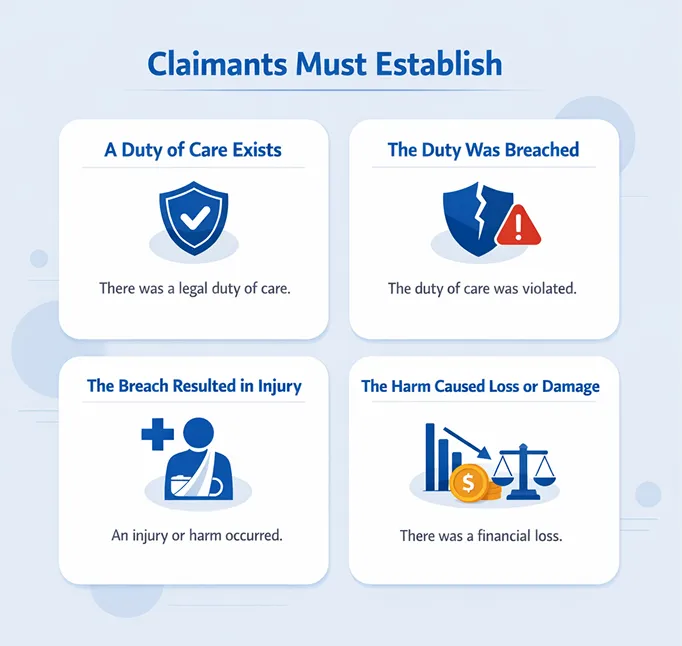
Medical negligence claims can be made when a healthcare professional commits an avoidable harm to a patient. This causes a breach in their duty of care. In order to make a successful claim, claimants must establish.
- A duty of care existed.
- The duty was breached.
- The breach resulted in injury.
- The harm caused a loss or damage.
In podiatry, these cases can include:
- Mismanaged foot surgery.
- Delayed referral.
- Poor diabetic foot care.
- Incorrect biomechanical treatment.
- Nerve damage.
- Infections.
These matters are highly specialised, requiring expert opinion and evidence. A podiatrist expert witness can explain such evidence in medical negligence claims.
Related: What Is the Role of Medical Experts’ Opinion in a Case of Medical Negligence?
What Is Podiatry?
“Feet are the foundation of our mobility, and caring for them is the cornerstone of a healthy, active life.”
– Dr. William Schol
Before we explain the role of a podiatry expert in medical negligence claims. We must define what is podiatry? Podiatry is a branch of healthcare that deals with diagnosing, treating and preventing the conditions affecting feet, ankles and lower limbs. These include:
- Foot pain and deformities.
- Sporting injuries.
- Biomechanical and gait disorders.
- Nail and skin defects.
- Diabetic complexities.
- Ulcers and wound infections.
Podiatrists play a key role in the overall health of a community. They provide crucial mobility-related support to affected individuals. This support prevents disabilities and long-term health complications.
Are Podiatrists Doctors?
A common question asked is whether a podiatrist is a doctor.
In the UK, podiatrists are not medical doctors because they do not hold an MBBS degree. However, they are still highly trained healthcare professionals who specialise in foot and lower limb care. They are regulated healthcare professionals trained to diagnose and treat foot, ankle and lower limb conditions.
Podiatrists generally have:
- A university degree.
- A mandatory registration with the Health and Care Professions Council.
- Ongoing professional development throughout their career.
Some podiatrists take postgraduate courses and become podiatric surgeons. These surgeons can perform complex operations. These operations can include bone and joint operations. Their expertise is recognised in both the medical and legal worlds.
In the medico-legal world, the question, ‘are podiatrists doctors’, is less important. What’s more important is whether they accept the professional standard of care.
What Is a Podiatry Expert Witness?
A podiatry expert witness is a professional who provides expert impartial opinion on a legal case. Their role is to offer insight in podiatric, clinical standards and causation.
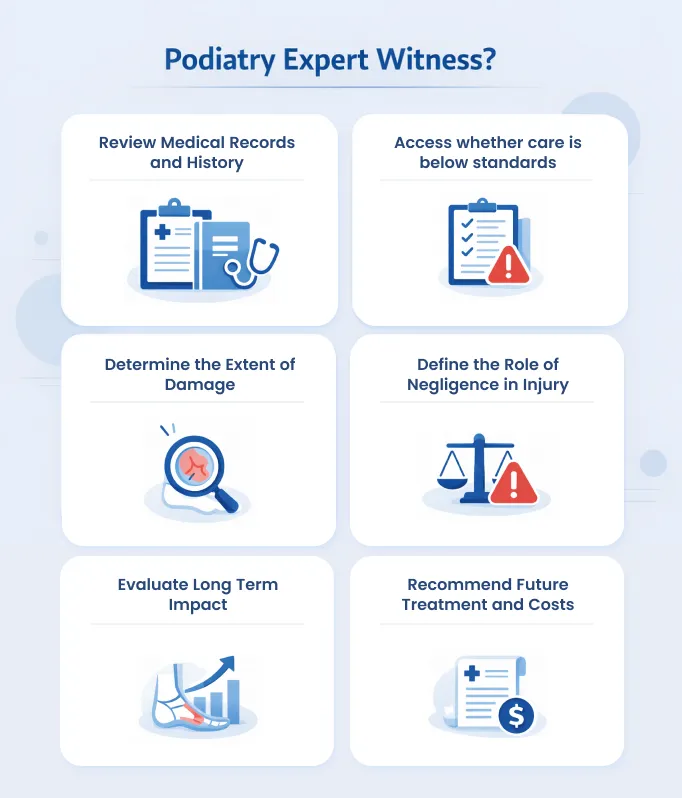
In medical negligence cases a podiatrist may offer:
- Review medical records and history.
- Assess whether care fell below the expected standard.
- Determine the extent of damage.
- Define the role of negligence in injury.
- Evaluate long-term impact.
- Recommend future treatment and costs.
Their duty is to the court. This makes them unbiased, they are not partial to either party.
How Does a Podiatry Expert Witness Strengthen a Medical Negligence Claim?
Medical negligence cases are mostly complex. Judges rely on expert opinions to translate medical evidence into simple language. The opinion of a podiatrist carries a lot of weight in such matters.
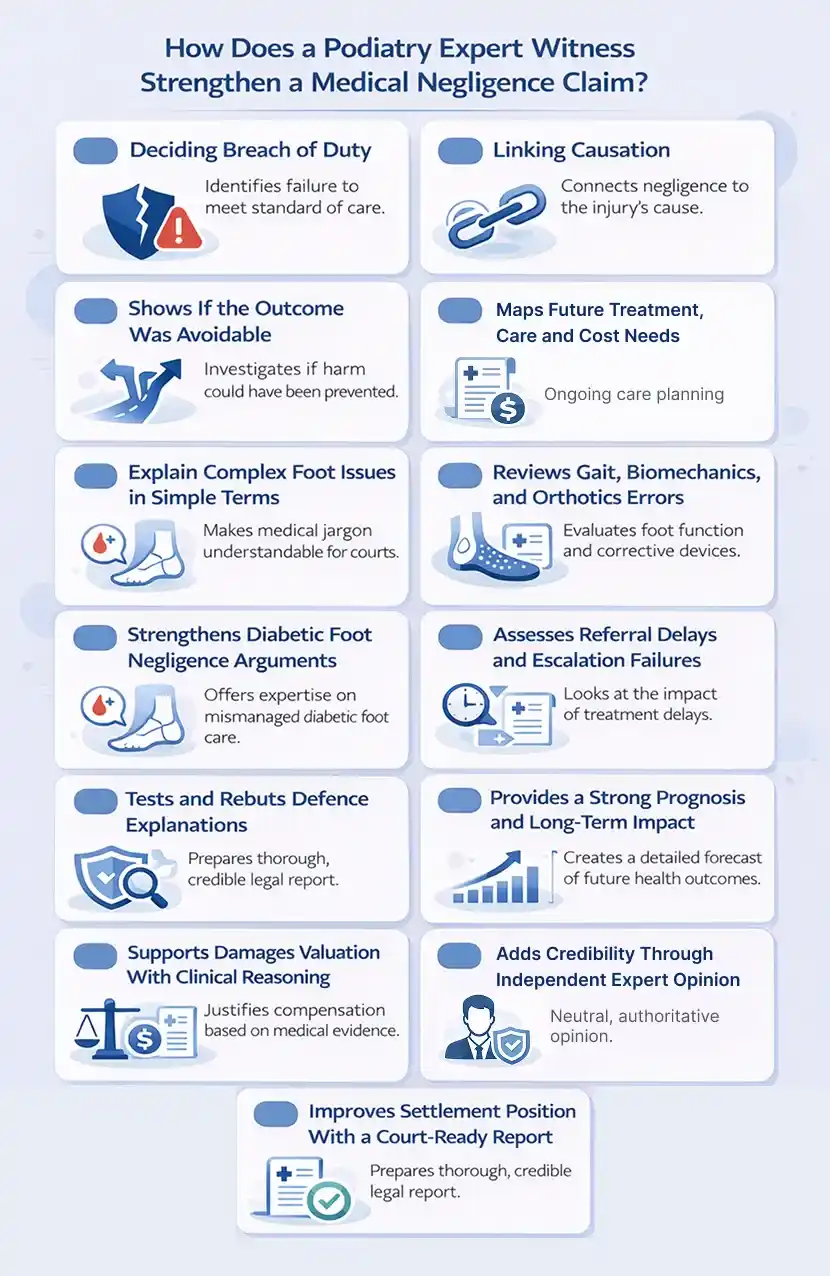
The table below shows how podiatry evidence supports the main parts of a claim.
A podiatry expert witness provides the expert opinion needed to reduce complex issues into clear evidence. A podiatrist does:
- Explain the standards of care for a podiatric procedure.
- Identify where care fell below the expected standard.
- Link the injury to that failure in care.
- Give expert opinion on causes.
What a Strong Podiatry Expert Report Usually Includes
A strong podiatry expert report usually includes:
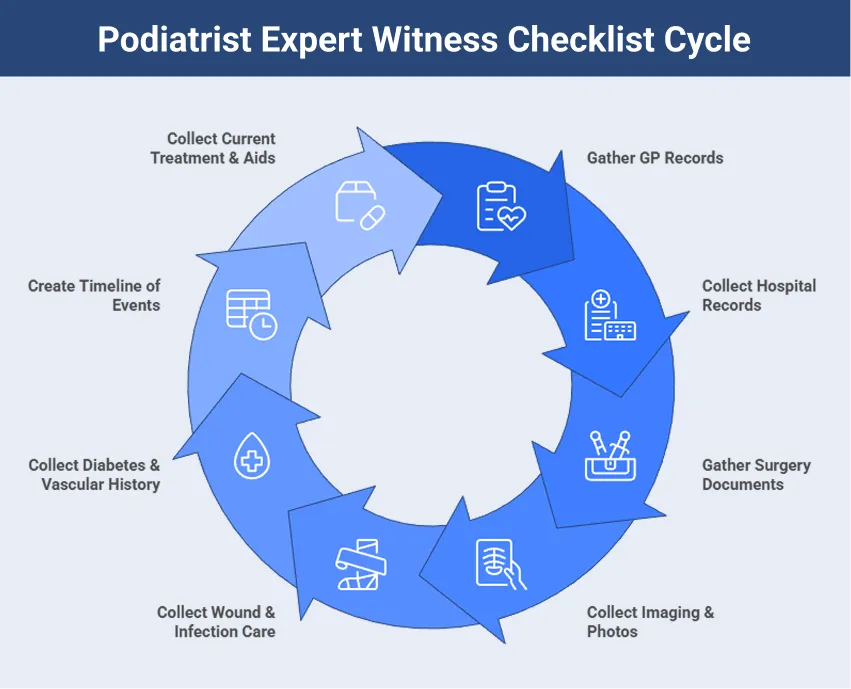
- The records reviewed and key dates in the timeline.
- The expected standard of care for the specific presentation or procedure.
- Clear identification of where care fell below that standard.
- Causation reasoning that links the breach to the harm step by step.
- Prognosis covering mobility, pain, complications, and functional limits.
- Future treatment needs and cost reasoning where relevant.
Without clear expert input, it can be harder to explain the clinical facts and prove key parts of the claim. Expert opinions could be the difference between a win or a loss.
The sections below explain how a podiatry expert witness supports each part of the claim.
1. Breach of Duty
A podiatrist’s most important role is to establish breach of duty.
A podiatry expert witness examines:
- Accepted standards of care.
- National and local guidelines.
- Professional requirements.
They assess:
- Timelines of assessment.
- Standard of treatment.
- Quality of clinical care.
Their reports clarify where the breach took place. This helps support the breach of duty part of the claim.
2. Causation
After deciding that a breach has taken place, the podiatrist must establish the link between the breach and harm.
An expert witness analyses:
- If the injury was unavoidable even with treatment.
- Earlier intervention would have saved harm.
- Surgical errors created disability.
- Inadequate care caused the disease.
Linking causation is the most contested part of a case. A claimant must prove the link with clinical reasons to firmly establish the case. An expert witness opinion can establish a link between damage and medical negligence by:
- Comparing pre- and post-harm functions.
- Assessing the extent of damage across time.
- Analysing changes.
- Analysing medical procedures.
A podiatrist is the key to establishing causation in a medical negligence claim.
3. Avoidability
A podiatry expert looks at the harm and concludes if it could have been avoided.
The experts check:
- When the issue was first diagnosed.
- What was the state of the limb?
- What issues were already present?
- What treatment should have been given?
This helps show:
- If the injury got worse because of negligence.
- If the caring procedures could have been better.
- If the patient was denied the right to proper cure.
This process brings clarity to the court case. The jury is given clear evidence of whether medical negligence occurred or not.
4. Explaining Clinical Issues Clearly
Although not a doctor, a podiatrist can still help a lot when it comes to explaining complex medical issues in the feet. The expert can provide insight into:
- Nerve damage.
- Infections.
- Diabetic impact.
- Bone problems.
- Ulcers.
Not everyone is qualified to give an expert opinion on such issues. Thus, an expert witness can explain:
- How the feet work.
- How conditions like diabetes and nerve damage affect the feet and slow healing.
- What happens to the foot when tissue is damaged or infection develops.
In medical negligence cases, this information is crucial. It allows the judge, jury, patients and the public to have a clear picture of the impact and extent of the harm. The case only works if people can see where failure occurred.
5. Diabetic Foot Negligence
For diabetic patients, foot ulcers and infections are common risks. Poor circulation and nerve damage can hide early warning signs, so ulcers and infection can be missed if checks are not done properly.
An expert can check:
- If ulcers were spotted early.
- If infection signs were missed.
- If blood flow tests were done.
They look for:
- Poor wound care.
- Delayed antibiotics.
- No referral to a foot clinic.
In medical negligence claims, this can prove whether the patient needed prior care and did not receive it.
6. Gait, Biomechanics and Orthotics
Foot issues can affect how a person walks and stands. Even minor negligence can result in crippling concerns if not properly dealt with. The expert opinion can identify the causes of such issues.
The expert studies:
- How weight shifts through the feet
- How the patient walks
- Where pressure builds up.
- Where the pain is, if any.
They also check:
- Insoles.
- Shoes.
- Braces.
They look for:
- Wrong design.
- Bad fit.
- No support where it was needed.
In medical negligence claims, this matters because bad support causes ulcers, pain and joint damage.
7. Referral Delays and Escalation
Delays in podiatric treatment can lead to serious health concerns and even amputations. The expert checks if help was called too late.
They look at:
- When the GP should have sent the patient to a specialist.
- When hospital care was needed
- When the infection became serious.
They check:
- If appointments were delayed.
- If urgent signs were ignored.
This matters in medical negligence claims because:
- Early treatment saves limbs.
- Late treatment causes amputations.
8. Prognosis and Long-Term Impact
Prognosis is an important part of the details in medical negligence cases. An expert witness provides the extent of the harm and its long-term impact.
They explain:
- How the injury will affect walking.
- Work.
- Independence.
They predict:
- Pain levels.
- Risk of more ulcers.
- Risk of more surgery.
In medical negligence claims, this helps show how bad life will be going forward, not just what already happened.
9. Future Treatment, Care and Cost
A podiatrist can suggest further treatment, care and the costs such processes require.
The expert lists:
- Future podiatry.
- Special shoes.
- Dressings.
- Physiotherapy.
They also include:
- Home care.
- Wheelchairs.
- Possible surgeries.
In medical negligence claims, this is used to work out how much compensation is fair.
10. Damages Support
The compensation amount suggested by a podiatrist has to be backed up by clinical reasons. The expert links the injury to the cost and its long-term impact.
The expert can evaluate the compensation a patient requires. This is done through medical expertise and unbiased opinion. Their opinion lends credence to the cause of the victim.
The medical facts provided by the expert witness can back up arguments for deserved compensation. This strengthens the case and makes it harder for insurers to argue against.
11. Defence Challenges
The rebuttal of the defence and testing of their theories is an integral part of the case.
The expert looks at what the other side says:
- ‘It would have happened anyway’
- ‘The patient didn’t follow the advice’
They test:
- If that is true.
- Or if it is just an excuse.
In medical negligence claims, this stops blame being pushed onto the patient.
12. Court-Ready Reporting
The expert puts everything into one strong report. High-quality reports are critical in medical negligence claims.
It answers:
- What went wrong?
- How should it have been treated?
- What damage was caused?
It is written:
- Clear and detailed.
- CPR compliant.
- Simple to understand.
- Ready for court.
In medical negligence claims, this makes insurers more likely to settle because they know they might lose.
13. Independent Credibility
Finally, the expert adds trust to the case.
They are:
- Not on the patient’s side.
- Not on the hospital’s side.
They only say:
- What the medical facts show.
This gives medical negligence claims:
- More weight.
- More honesty.
- More chances of winning.
Conclusion
Medical negligence cases that involve the foot, ankle or lower limb require expert opinion. The podiatry expert witness can provide unbiased, expert and clear explanations of complex medical issues. From explaining simple foot injuries to diabetic complications, a podiatrist is crucial in most cases.
We understand the importance of expert witness opinion in court cases. Whether it is expert reporting or support in medico-legal rehabilitation, Concise Medico can help with podiatry-related evidence and case needs. Contact us to discuss the case and the type of services that may be required.
If the claim involves foot, ankle, or lower-limb care, specialist podiatry evidence can help clarify breach of duty, causation, and long-term impact. Speak with our medical reporting services to discuss expert availability, suitability, fees, and turnaround times.
If the claim involves foot, ankle, or lower-limb care, specialist podiatry evidence can help clarify breach of duty, causation, and long-term impact. Speak with our medical reporting services to discuss expert availability, suitability, fees, and turnaround times.
FAQs
What happens when a foot or ankle injury becomes the key issue in a legal dispute? How do you prove the effects of a lower limb injury in a court when it gets disputed? In cases that involve lower limb injury, a podiatry expert can play a great role in clearing up the details.
An expert witness can explain the extent of an injury, its impact and how it affects the claimant’s life. This can have a great effect on the decision-making of the jury.
Medical negligence in podiatric cases can lead to severe health concerns. These health concerns may arise due to misdiagnosis, surgical mishaps and failure to handle long-term medical issues like diabetes. Diabetic foot disease costs more than £1 billion each year in the UK.
An expert can provide crucial insights for such medical negligence claims. Their opinion can sway the jury by providing expert witness accounts that clear up the details.
This is why in this blog, we will cover all you need to know about medical negligence claims involving podiatrists. We will explain what podiatry is, whether a podiatrist is a medical doctor and how they can impact.
What Are Medical Negligence Claims?
Medical negligence claims can be made when a healthcare professional commits an avoidable harm to a patient. This causes a breach in their duty of care. In order to make a successful claim, claimants must establish.
- A duty of care existed.
- The duty was breached.
- The breach resulted in injury.
- The harm caused a loss or damage.
In podiatry, these cases can include:
- Mismanaged foot surgery.
- Delayed referral.
- Poor diabetic foot care.
- Incorrect biomechanical treatment.
- Nerve damage.
- Infections.
These matters are highly specialised, requiring expert opinion and evidence. A podiatrist expert witness can explain such evidence in medical negligence claims.
Related: What Is the Role of Medical Experts’ Opinion in a Case of Medical Negligence?
What Is Podiatry?
“Feet are the foundation of our mobility, and caring for them is the cornerstone of a healthy, active life.”
– Dr. William Schol
Before we explain the role of a podiatry expert in medical negligence claims. We must define what is podiatry? Podiatry is a branch of healthcare that deals with diagnosing, treating and preventing the conditions affecting feet, ankles and lower limbs. These include:
- Foot pain and deformities.
- Sporting injuries.
- Biomechanical and gait disorders.
- Nail and skin defects.
- Diabetic complexities.
- Ulcers and wound infections.
Podiatrists play a key role in the overall health of a community. They provide crucial mobility-related support to affected individuals. This support prevents disabilities and long-term health complications.
Are Podiatrists Doctors?
A common question asked is whether a podiatrist is a doctor.
In the UK, podiatrists are not medical doctors because they do not hold an MBBS degree. However, they are still highly trained healthcare professionals who specialise in foot and lower limb care. They are regulated healthcare professionals trained to diagnose and treat foot, ankle and lower limb conditions.
Podiatrists generally have:
- A university degree.
- A mandatory registration with the Health and Care Professions Council.
- Ongoing professional development throughout their career.
Some podiatrists take postgraduate courses and become podiatric surgeons. These surgeons can perform complex operations. These operations can include bone and joint operations. Their expertise is recognised in both the medical and legal worlds.
In the medico-legal world, the question, ‘are podiatrists doctors’, is less important. What’s more important is whether they accept the professional standard of care.
What Is a Podiatry Expert Witness?
A podiatry expert witness is a professional who provides expert impartial opinion on a legal case. Their role is to offer insight in podiatric, clinical standards and causation.
In medical negligence cases a podiatrist may offer:
- Review medical records and history.
- Assess whether care fell below the expected standard.
- Determine the extent of damage.
- Define the role of negligence in injury.
- Evaluate long-term impact.
- Recommend future treatment and costs.
Their duty is to the court. This makes them unbiased, they are not partial to either party.
How Does a Podiatry Expert Witness Strengthen a Medical Negligence Claim?
Medical negligence cases are mostly complex. Judges rely on expert opinions to translate medical evidence into simple language. The opinion of a podiatrist carries a lot of weight in such matters.
The table below shows how podiatry evidence supports the main parts of a claim.
A podiatry expert witness provides the expert opinion needed to reduce complex issues into clear evidence. A podiatrist does:
- Explain the standards of care for a podiatric procedure.
- Identify where care fell below the expected standard.
- Link the injury to that failure in care.
- Give expert opinion on causes.
What a Strong Podiatry Expert Report Usually Includes
A strong podiatry expert report usually includes:
- The records reviewed and key dates in the timeline.
- The expected standard of care for the specific presentation or procedure.
- Clear identification of where care fell below that standard.
- Causation reasoning that links the breach to the harm step by step.
- Prognosis covering mobility, pain, complications, and functional limits.
- Future treatment needs and cost reasoning where relevant.
Without clear expert input, it can be harder to explain the clinical facts and prove key parts of the claim. Expert opinions could be the difference between a win or a loss.
The sections below explain how a podiatry expert witness supports each part of the claim.
1. Breach of Duty
A podiatrist’s most important role is to establish breach of duty.
A podiatry expert witness examines:
- Accepted standards of care.
- National and local guidelines.
- Professional requirements.
They assess:
- Timelines of assessment.
- Standard of treatment.
- Quality of clinical care.
Their reports clarify where the breach took place. This helps support the breach of duty part of the claim.
2. Causation
After deciding that a breach has taken place, the podiatrist must establish the link between the breach and harm.
An expert witness analyses:
- If the injury was unavoidable even with treatment.
- Earlier intervention would have saved harm.
- Surgical errors created disability.
- Inadequate care caused the disease.
Linking causation is the most contested part of a case. A claimant must prove the link with clinical reasons to firmly establish the case. An expert witness opinion can establish a link between damage and medical negligence by:
- Comparing pre- and post-harm functions.
- Assessing the extent of damage across time.
- Analysing changes.
- Analysing medical procedures.
A podiatrist is the key to establishing causation in a medical negligence claim.
3. Avoidability
A podiatry expert looks at the harm and concludes if it could have been avoided.
The experts check:
- When the issue was first diagnosed.
- What was the state of the limb?
- What issues were already present?
- What treatment should have been given?
This helps show:
- If the injury got worse because of negligence.
- If the caring procedures could have been better.
- If the patient was denied the right to proper cure.
This process brings clarity to the court case. The jury is given clear evidence of whether medical negligence occurred or not.
4. Explaining Clinical Issues Clearly
Although not a doctor, a podiatrist can still help a lot when it comes to explaining complex medical issues in the feet. The expert can provide insight into:
- Nerve damage.
- Infections.
- Diabetic impact.
- Bone problems.
- Ulcers.
Not everyone is qualified to give an expert opinion on such issues. Thus, an expert witness can explain:
- How the feet work.
- How conditions like diabetes and nerve damage affect the feet and slow healing.
- What happens to the foot when tissue is damaged or infection develops.
In medical negligence cases, this information is crucial. It allows the judge, jury, patients and the public to have a clear picture of the impact and extent of the harm. The case only works if people can see where failure occurred.
5. Diabetic Foot Negligence
For diabetic patients, foot ulcers and infections are common risks. Poor circulation and nerve damage can hide early warning signs, so ulcers and infection can be missed if checks are not done properly.
An expert can check:
- If ulcers were spotted early.
- If infection signs were missed.
- If blood flow tests were done.
They look for:
- Poor wound care.
- Delayed antibiotics.
- No referral to a foot clinic.
In medical negligence claims, this can prove whether the patient needed prior care and did not receive it.
6. Gait, Biomechanics and Orthotics
Foot issues can affect how a person walks and stands. Even minor negligence can result in crippling concerns if not properly dealt with. The expert opinion can identify the causes of such issues.
The expert studies:
- How weight shifts through the feet
- How the patient walks
- Where pressure builds up.
- Where the pain is, if any.
They also check:
- Insoles.
- Shoes.
- Braces.
They look for:
- Wrong design.
- Bad fit.
- No support where it was needed.
In medical negligence claims, this matters because bad support causes ulcers, pain and joint damage.
7. Referral Delays and Escalation
Delays in podiatric treatment can lead to serious health concerns and even amputations. The expert checks if help was called too late.
They look at:
- When the GP should have sent the patient to a specialist.
- When hospital care was needed
- When the infection became serious.
They check:
- If appointments were delayed.
- If urgent signs were ignored.
This matters in medical negligence claims because:
- Early treatment saves limbs.
- Late treatment causes amputations.
8. Prognosis and Long-Term Impact
Prognosis is an important part of the details in medical negligence cases. An expert witness provides the extent of the harm and its long-term impact.
They explain:
- How the injury will affect walking.
- Work.
- Independence.
They predict:
- Pain levels.
- Risk of more ulcers.
- Risk of more surgery.
In medical negligence claims, this helps show how bad life will be going forward, not just what already happened.
9. Future Treatment, Care and Cost
A podiatrist can suggest further treatment, care and the costs such processes require.
The expert lists:
- Future podiatry.
- Special shoes.
- Dressings.
- Physiotherapy.
They also include:
- Home care.
- Wheelchairs.
- Possible surgeries.
In medical negligence claims, this is used to work out how much compensation is fair.
10. Damages Support
The compensation amount suggested by a podiatrist has to be backed up by clinical reasons. The expert links the injury to the cost and its long-term impact.
The expert can evaluate the compensation a patient requires. This is done through medical expertise and unbiased opinion. Their opinion lends credence to the cause of the victim.
The medical facts provided by the expert witness can back up arguments for deserved compensation. This strengthens the case and makes it harder for insurers to argue against.
11. Defence Challenges
The rebuttal of the defence and testing of their theories is an integral part of the case.
The expert looks at what the other side says:
- ‘It would have happened anyway’
- ‘The patient didn’t follow the advice’
They test:
- If that is true.
- Or if it is just an excuse.
In medical negligence claims, this stops blame being pushed onto the patient.
12. Court-Ready Reporting
The expert puts everything into one strong report. High-quality reports are critical in medical negligence claims.
It answers:
- What went wrong?
- How should it have been treated?
- What damage was caused?
It is written:
- Clear and detailed.
- CPR compliant.
- Simple to understand.
- Ready for court.
In medical negligence claims, this makes insurers more likely to settle because they know they might lose.
13. Independent Credibility
Finally, the expert adds trust to the case.
They are:
- Not on the patient’s side.
- Not on the hospital’s side.
They only say:
- What the medical facts show.
This gives medical negligence claims:
- More weight.
- More honesty.
- More chances of winning.
Conclusion
Medical negligence cases that involve the foot, ankle or lower limb require expert opinion. The podiatry expert witness can provide unbiased, expert and clear explanations of complex medical issues. From explaining simple foot injuries to diabetic complications, a podiatrist is crucial in most cases.
We understand the importance of expert witness opinion in court cases. Whether it is expert reporting or support in medico-legal rehabilitation, Concise Medico can help with podiatry-related evidence and case needs. Contact us to discuss the case and the type of services that may be required.
If the claim involves foot, ankle, or lower-limb care, specialist podiatry evidence can help clarify breach of duty, causation, and long-term impact. Speak with our medical reporting services to discuss expert availability, suitability, fees, and turnaround times.
If the claim involves foot, ankle, or lower-limb care, specialist podiatry evidence can help clarify breach of duty, causation, and long-term impact. Speak with our medical reporting services to discuss expert availability, suitability, fees, and turnaround times.