TABLE OF CONTENT
“Slip, trip, or accident? Pre Action Protocol makes claims simple and stress-free!”
Suffered an injury due to someone else’s negligence? Knowing the Pre Action Protocol for personal injury claims can make your claim faster and less stressful.
Personal injury claims happen when someone gets hurt or sick because another person was careless. In these cases, the injured person can ask for money to cover their loss. Common examples are:
- Road accidents
- Injuries at work
- Slips or trips in public places
- Illnesses caused by work conditions.
In 2025, around 413,323 personal injury claims were recorded in the UK. These claims cover road accidents, workplace injuries and public liability cases.
Many people think these legal disputes go straight to court. But in the UK, the law encourages people to try to sort things out first. One main way to sort things is through the Pre Action Protocol.
The Pre Action Protocol guides people on how to act before going to court in a personal injury case. It gives rules on talking to each other, sharing information and carefully checking the claim. By following it, both sides can understand the issue and try to settle it. Understanding the Pre Action Protocol for personal injury claims early can help avoid delays and unnecessary stress.
After reading this blog, you will be able to understand:
- Personal injury claims and the Pre Action Protocol
- Legal background and importance of the Pre Action Protocol
- Benefits and stages involved in Pre Action Protocol for Personal Injury claims
- Personal injury claim timelines
What Is a Personal Injury Claim?
A personal injury occurs when an individual suffers physical injury or illness due to the negligence of another party. Negligence means that someone fails to take reasonable care, causing harm to another person.
Injured parties can claim money as compensation if negligence is proved. In most cases, compensation is paid by the insurance company of the responsible person. An important part of any claim is understanding the personal injury Pre Action Protocol.
Pre Action Protocol for personal injury claims come from different types of accidents. These include:
- Road traffic accidents
- Accidents at work
- Public places accidents like slips or trips
- Occupational illnesses or diseases caused by working conditions
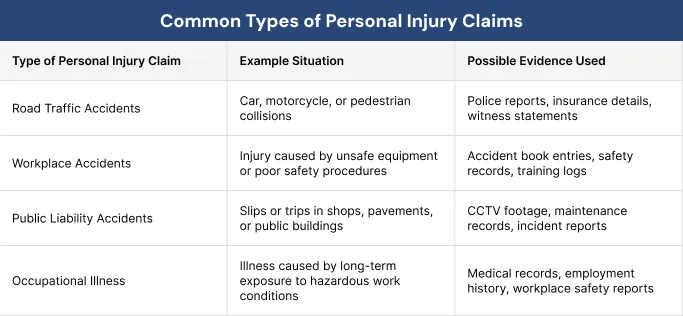
The types of personal injury claims, along with the required evidence, are mentioned in table below:
Different types of losses are covered by compensation. For example:
- General Damages
Compensation for pain and suffering due to injury.
- Financial Losses
Cover medical expenses and loss of earnings.
Learn how to navigate personal injury claims and calculate compensation under the new rules.
Pre Action Protocol for personal injury claims is an important process to be followed before a case reaches court.
What Is the Pre Action Protocol for Personal Injury Claims?
A Pre Action Protocol for personal injury claims is a set of defined rules that need to be followed before a case starts in court. These rules explain how both parties should behave before legal action starts.
The word “protocol” is defined as a clear set of rules or good practice. The personal injury protocol guides people on how to behave in certain situations.
In legal disputes, Pre Action Protocol for personal injury claims helps people deal with a claim in a fair and sensible way before going to court.
The protocol explains how the claimant and the defendant should communicate in Pre Action Protocol for personal injury claims. It shows how to share information and check facts about the case. As per personal injury protocol, both parties are encouraged to settle the dispute without going to court.
The protocol focuses on important points mentioned below:
- Communication should be clear and open between both parties
- Relevant information must be shared early
- Facts should be investigated thoroughly
- Try to settle the case before going to court
The disputes can be resolved more efficiently by following these rules. It also saves time and reduces the burden of the court system.
Legal Background of Pre Action Protocol for Personal Injury Claims
Pre Action Protocols, including the Pre Action Protocol for personal injury claims, were introduced as part of changes to civil court rules. The aim was to make legal cases faster and more efficient. The reforms also aimed to cut down on unnecessary court cases and encourage early settlement.
An important change was the Civil Procedure Rules (CPR) 1998 for England and Wales. These were made on 10 December 1998 and presented to Parliament on 17 December 1998. They came into force on 24 April 1999.
The main idea was to solve disputes before going to court. The Pre Action Protocol for personal injury claims supports this idea. They give a clear process for sharing information early in the dispute. They also help each side review their position.
Pre action protocols explain the expected conduct and set out the steps parties should take before starting proceedings for specific types of civil claims. They are approved by the Master of the Rolls and are annexed to the Civil Procedure Rules (CPR).
A similar system exists in Scotland known as the Compulsory Pre Action Protocol. This applies to some personal injury claims.
The Scottish protocol was introduced by the Act of Sederunt (Sheriff Court Rules Amendment) (Personal Injury Pre Action Protocol) 2016. It sets out rules that must be followed before a case can be taken to court.
Why Is Pre Action Protocol Important
There are many important goals of the Pre Action Protocol. The main aim is to resolve disputes fairly and quickly before reaching court.
One key benefit of the Pre Action Protocol for personal injury claims is early communication. Both parties are asked to share information at an early stage. This helps them understand the facts and the strength of the claim.
The case can be resolved through negotiation depending on the shared information. Most disputes are resolved outside the court through personal injury protocol.
This protocol also helps to narrow the issues. Facts become clear when the case goes to court. The court can also see what steps were taken to settle the dispute.
The use of Alternative Dispute Resolution (ADR) is encouraged in Pre Action Protocol for personal injury claims. ADR is encouraged because it helps resolve disputes before going to court. Negotiation, mediation and arbitration are included in ADR methods.
ADR is beneficial in many ways to resolve disputes. The benefits include:
- Time and money saving
- Reduces stress between parties
- Mutually acceptable outcome
Situations Where the Protocol Applies
The personal injury protocol applies before court proceedings formally start. The Pre Action Protocol for personal injury claims applies whenever a person plans to make a claim for personal injury.
There are certain situations where the protocol can be applied. Situations include:
- A person injured in a road traffic accident who plans to take legal action
- A member of the public injured in a slip or trip accident
- An employee injured at work due to unsafe conditions
- A claim involving negligence in medical treatment
Different types of cases follow different Pre Action Protocols. Personal injury claims have their own protocol. Debt claims and medical negligence claims follow other protocols. Each type of case must follow the correct protocol.
Following the personal injury protocol is required in some cases. It may not be required in other cases but it is still good practice to follow it.
As per courts, parties are expected to follow the protocols wherever possible. It is even better to follow if compliance is not required.
Scope of the Compulsory Pre Action Protocol in Scotland
The compulsory Pre Action Protocol for personal injury applies in Scotland. A financial value of up to £25,000 can be claimed through this protocol. This applies to claims on or after 28 November 2016.
The Voluntary Pre Action Protocol (VPAP) system was in place before compulsory protocol was introduced. This system supported early settlement but had no strong rules.
Parties are not bound to follow the process under the VPAP system. No penalty can be charged if they are not following the process. In this system, claims valued at up to £10,000 could be made.
The compulsory protocol made the system stronger in many personal injury cases. Parties must follow the process. Those who do not follow it may be penalised by the courts. Action can also be taken if they do not follow the protocol or refuse to accept a fair settlement.
Moreover, some claims are not included in compulsory protocol. These are:
- Disease claims
- Professional negligence claims
- Clinical negligence claims
Instead, some other rules may apply in these cases.
Benefits of Following the Protocol
Both claimants and defendants can benefit from following the Pre Action Protocol for personal injury claims.
The major benefit is saving time, as disputes can be resolved more quickly. Early sharing of information and checking settlement options makes it easier for both parties to resolve the dispute. It also helps avoid delays in court proceedings.
Legal costs can also be reduced by following a Pre Action Protocol for personal injury claims. Court cases can be expensive. Legal fees, court costs and expert reports are the major expenses in court cases. These expenses can be minimised by settling a claim earlier.
The other benefit of following a protocol is better cooperation. Both parties are asked to work together to settle a claim. This avoids a legal fight at the start.
This approach reduces stress for claimants by avoiding court hearings when following the Pre Action Protocol for personal injury claims. Defendants get an opportunity to check the claim properly before replying.
The personal injury protocol is a fair and clear process. It gives benefits to all parties involved.
Key Stages of the Pre Action Protocol
This personal injury protocol is not a general guideline to follow. It has clear steps to follow before a case goes to court. Both parties need to understand these steps. It helps them in sharing information and try to settle the dispute early before the formal start of court hearings.
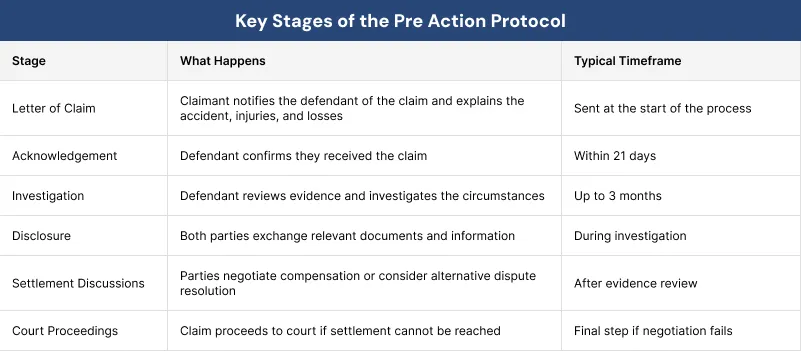
The steps may differ as per the place or the type of protocol used. But the main process remains the same. The table below shows an overview of the whole process:
In this section, you will learn the detailed process of protocol along with its stages.
1. The Letter of Claim
Letter of claim is the first formal step in the pre action process. The claimant or the lawyer of the claimant sends this letter to the defendant or the insurance company of the defendant.
This letter tells the defendant that a claim is being made. It gives the main information about the case.
A properly prepared Letter of Claim is essential in Pre Action Protocol for personal injury claims, as it forms the important part of the personal injury protocol. These may include:
- Full name and contact details of the claimant
- Details of the accident or incident
- The date and place of the incident
- A short description of the injuries
- Details of medical treatment, if received
- Information about financial losses, such as lost income
- Reasons why the defendant is being held responsible
Sometimes additional information may be requested from the defendant. Like in the case of a workplace incident, information may be requested from the defendant. Documents such as training records or health and safety procedures may be required.
The lawyer of the claimant sometimes needs additional time to gather all the details related to the incident. In this case, a Letter of Notification sent to the defendant to inform that a claim may follow. It gives time to the defendant to prepare for the case.
2. The Defendant’s Acknowledgement
The defendant or their insurer must acknowledge the receipt of Letter of Claim. Acknowledgement must be provided within 21 days.
The defendant acknowledges the claim in accordance with Pre Action Protocol for personal injury claims. It also shows the defendant is aware of the claim. This is the initial stage where the defendant can start investigating the incident.
If anything important is missing in the Letter of Claim, defendant can ask for more information at this stage
3. Investigation of the Claim
Defendants can have up to 3 months to investigate the claim under Pre Action Protocol for personal injury claims.
During this time, they review documents and gather evidence. They check the facts of the incident.
They may speak to witnesses. They may review reports. They may also seek expert advice.
A detailed response must be submitted by the defendant at the end of this period. This report shows whether the defendant takes responsibility for the incident or denies it.
If the defendant accepts the responsibility, they agree their actions caused the injury. If they deny it, they must prove their side with supporting documents and proof.
This step of personal injury protocol helps make the issue clear. It allows both parties to assess the strength of the case.
4. Disclosure of Documents and Evidence
Disclosure is another important part of Pre Action Protocol for personal injury claims. It refers to the exchange of information and documents between parties.
Disclosure makes sure that both parties can access the relevant documents. This way a claim can be fairly assessed.
Examples of documents include:
- Accident reports
- Records of workplace safety
- Medical reports
- Photos of the scene
- Witness statements
- Financial records showing loss of earnings
The type of documents depends on the case. Health and safety records are required in workplace accidents. Traffic accidents require insurance details and police reports.
The early sharing of evidence helps both sides understand the facts. It also helps them see the likely outcome of the claim.
5. The Role of Medical Experts
Medical evidence is the most critical part of the personal injury protocol process. This shows the nature and level of injury.
A medical expert needs to examine the claimant. After examining, the expert prepares a report. This report may contain:
- The type of injury
- The treatment given
- Recovery time of claimant
- Long term effects of the injury, if any
Both parties agree on the expert report as suggested by the personal injury protocol. This reduces the biased dispute. It makes sure that the report is clear and reliable.
The defendant has the right to review the report. They can accept the report or challenge it, if needed.
Additional experts may be needed in some cases. This depends on the type and details of the claim.
6. Statement of Valuation
A statement of valuation is prepared by the claimant after the evidence is ready. The amount of compensation is mentioned in this document. This amount depends upon the injuries and loss suffered by claimants.
The statement usually includes proof. They may be financial records, supporting evidence and damages calculation.
A clear valuation helps the defendant to understand the expectations of the claimant. They both discuss the possible settlement for the damages.
7. Settlement Negotiations
Settlement discussions are encouraged by Pre Action Protocol for personal injury claims before court hearings start. This is one of the most important factors in following personal injury protocol.
The defendant makes a settlement offer after reviewing the Statement of Valuation. This needs to be offered within a set time period in some cases.
Once an offer is made, claimants review this carefully. After that, they can accept, reject or make a counter offer.
Both parties continue to negotiate until an offer is finalised. The case may move forward to court if they do not agree.
There are many advantages to settling a claim outside of court. It saves time and reduces legal costs. It allows both parties to avoid the uncertainty of a court decision.
8. Alternative Dispute Resolution
Alternative Dispute Resolution (ADR) is highly encouraged for both parties by the Pre Action Protocol for personal injury claims.
The method used to resolve disputes without going to court is called ADR. Arbitration, negotiation and mediation are commonly used methods.
For example, in mediation, an independent person helps both parties to reach an agreement.
Courts expect people to follow ADR where possible. When one party refuses to accept a fair settlement, the court may take this into account when deciding legal costs.
9. The Stocktake Stage
If both parties do not reach a mutual agreement, then personal injury protocol suggests stocktake before going to court.
The case can be reviewed in the stocktake stage. They evaluate the strengths and weaknesses of both parties’ positions.
Both sides should consider:
- Is there enough evidence to support the claim or defence
- Will further negotiations help reach an agreement
- Is going to court the right next step
This stage gives both parties a chance to think again about their positions. They may still reach an agreement before going to court.
Time Limits for Personal Injury Claims
There are strict timelines involved in personal injury claims. This is called the limitation period.
The claim must be started within three years from the date of accident or injury. Claimants may not be eligible for compensation if they do not bring the case within this time limit.
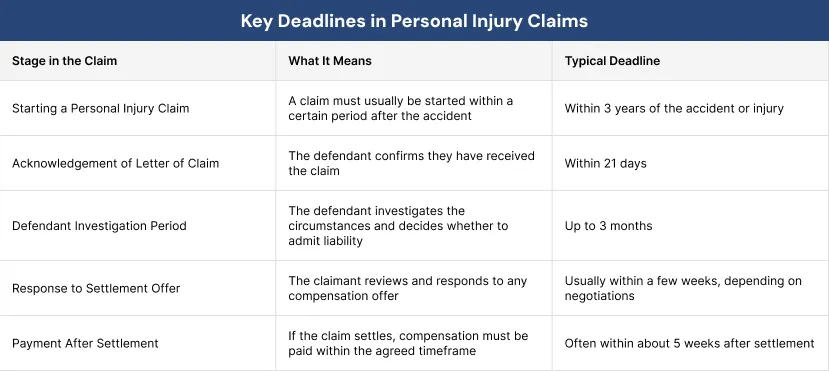
The key deadlines in personal injury claims are shown in table below:
This rule has some exceptions. Like, the limitation period is different for the injured person who is under sixteen years of age.
If the claim has not been resolved by Pre Action Protocol for personal injury claims and the time limit has expired, the claimant may start court action. This helps protect their legal rights.
Consequences of Failing to Follow the Protocol
Courts expect parties to follow the Pre Action Protocol for personal injury claims where possible. There are several consequences for not following this.
A cost penalty may be imposed by the court for ignoring Pre Action Protocol for personal injury claims. This applies to a party who does not act fairly during the pre action stage. For example, this occurs if they refuse to share information, ignore offers or are not involved in the process.
There may be case delays due to non compliance of protocol. This also impacts how the court views the party.
Following the protocol shows that parties have acted responsibly and have tried fairly to resolve the dispute.
Following the protocol demonstrates that a party has acted responsibly and has made genuine efforts to resolve the dispute.
When the Case Proceeds to Court
The claimant may start a court case if the dispute cannot be resolved during the pre action stage.
Despite 1.7 million civil claims, only a small number reach court, meaning most disputes are resolved outside court.
Starting a case in court involves filing a claim form. It also needs to provide a detailed statement of the case. At this stage, the dispute formally moves from the pre action stage to the legal process.
A claim can be settled at a later stage through court proceedings. But the purpose of Pre Action Protocol is to resolve most of the claims before reaching the court.
Although court proceedings may still result in settlement at a later stage, the aim of the Pre Action Protocol for personal injury claims is to resolve as many cases as possible beforehand.
Pre Action Protocol in Action: A Real Case
A woman slipped on a wet floor in a supermarket aisle. There were no warning signs and she hurt her wrist and back. She contacted a solicitor and followed the Pre Action Protocol. This meant she shared details early, gave medical evidence and let the other side see the facts.
She was able to settle the claim out of court because of these details. She received the claim of £18,000 for her pain, suffering and loss. Out of court settlement saves her time, extra cost and stress. She did not even have to go for a trial.
This case shows how the Pre Action Protocol for personal injury claims works in real life. By sharing information, checking the claim and talking openly, disputes can be solved fairly, quickly and without going to court.
Conclusion
The Pre Action Protocol is very important in personal injury cases. It gives a clear process that guides parties through the early stages of a dispute. It encourages them to solve the dispute before going to court.
By promoting early communication, information sharing and careful investigation, Pre Action Protocol for personal injury claims helps both claimants and defendants understand the strengths and weaknesses of their positions. This protocol encourages the parties to settle the dispute through negotiations or use the ADR method. It avoids unnecessary litigation.
Understanding the Pre Action Protocol for personal injury claims is essential for individuals, if they are pursuing this claim. Following the personal injury protocols can help strengthen your case and reduce legal costs. It also helps you in achieving a fair resolution.
Ultimately, this protocol benefits the involved parties as well as the whole legal system. By resolving disputes quickly and fairly, it makes sure that court resources are used only when needed and justice is delivered in a timely manner.
Concise Medico delivers expert medico legal guidance to support your claim from start to finish. Speak to our team today for expert legal and medical support.
FAQs
“Slip, trip, or accident? Pre Action Protocol makes claims simple and stress-free!”
Suffered an injury due to someone else’s negligence? Knowing the Pre Action Protocol for personal injury claims can make your claim faster and less stressful.
Personal injury claims happen when someone gets hurt or sick because another person was careless. In these cases, the injured person can ask for money to cover their loss. Common examples are:
- Road accidents
- Injuries at work
- Slips or trips in public places
- Illnesses caused by work conditions.
In 2025, around 413,323 personal injury claims were recorded in the UK. These claims cover road accidents, workplace injuries and public liability cases.
Many people think these legal disputes go straight to court. But in the UK, the law encourages people to try to sort things out first. One main way to sort things is through the Pre Action Protocol.
The Pre Action Protocol guides people on how to act before going to court in a personal injury case. It gives rules on talking to each other, sharing information and carefully checking the claim. By following it, both sides can understand the issue and try to settle it. Understanding the Pre Action Protocol for personal injury claims early can help avoid delays and unnecessary stress.
After reading this blog, you will be able to understand:
- Personal injury claims and the Pre Action Protocol
- Legal background and importance of the Pre Action Protocol
- Benefits and stages involved in Pre Action Protocol for Personal Injury claims
- Personal injury claim timelines
What Is a Personal Injury Claim?
A personal injury occurs when an individual suffers physical injury or illness due to the negligence of another party. Negligence means that someone fails to take reasonable care, causing harm to another person.
Injured parties can claim money as compensation if negligence is proved. In most cases, compensation is paid by the insurance company of the responsible person. An important part of any claim is understanding the personal injury Pre Action Protocol.
Pre Action Protocol for personal injury claims come from different types of accidents. These include:
- Road traffic accidents
- Accidents at work
- Public places accidents like slips or trips
- Occupational illnesses or diseases caused by working conditions
The types of personal injury claims, along with the required evidence, are mentioned in table below:
Different types of losses are covered by compensation. For example:
- General Damages
Compensation for pain and suffering due to injury.
- Financial Losses
Cover medical expenses and loss of earnings.
Learn how to navigate personal injury claims and calculate compensation under the new rules.
Pre Action Protocol for personal injury claims is an important process to be followed before a case reaches court.
What Is the Pre Action Protocol for Personal Injury Claims?
A Pre Action Protocol for personal injury claims is a set of defined rules that need to be followed before a case starts in court. These rules explain how both parties should behave before legal action starts.
The word “protocol” is defined as a clear set of rules or good practice. The personal injury protocol guides people on how to behave in certain situations.
In legal disputes, Pre Action Protocol for personal injury claims helps people deal with a claim in a fair and sensible way before going to court.
The protocol explains how the claimant and the defendant should communicate in Pre Action Protocol for personal injury claims. It shows how to share information and check facts about the case. As per personal injury protocol, both parties are encouraged to settle the dispute without going to court.
The protocol focuses on important points mentioned below:
- Communication should be clear and open between both parties
- Relevant information must be shared early
- Facts should be investigated thoroughly
- Try to settle the case before going to court
The disputes can be resolved more efficiently by following these rules. It also saves time and reduces the burden of the court system.
Legal Background of Pre Action Protocol for Personal Injury Claims
Pre Action Protocols, including the Pre Action Protocol for personal injury claims, were introduced as part of changes to civil court rules. The aim was to make legal cases faster and more efficient. The reforms also aimed to cut down on unnecessary court cases and encourage early settlement.
An important change was the Civil Procedure Rules (CPR) 1998 for England and Wales. These were made on 10 December 1998 and presented to Parliament on 17 December 1998. They came into force on 24 April 1999.
The main idea was to solve disputes before going to court. The Pre Action Protocol for personal injury claims supports this idea. They give a clear process for sharing information early in the dispute. They also help each side review their position.
Pre action protocols explain the expected conduct and set out the steps parties should take before starting proceedings for specific types of civil claims. They are approved by the Master of the Rolls and are annexed to the Civil Procedure Rules (CPR).
A similar system exists in Scotland known as the Compulsory Pre Action Protocol. This applies to some personal injury claims.
The Scottish protocol was introduced by the Act of Sederunt (Sheriff Court Rules Amendment) (Personal Injury Pre Action Protocol) 2016. It sets out rules that must be followed before a case can be taken to court.
Why Is Pre Action Protocol Important
There are many important goals of the Pre Action Protocol. The main aim is to resolve disputes fairly and quickly before reaching court.
One key benefit of the Pre Action Protocol for personal injury claims is early communication. Both parties are asked to share information at an early stage. This helps them understand the facts and the strength of the claim.
The case can be resolved through negotiation depending on the shared information. Most disputes are resolved outside the court through personal injury protocol.
This protocol also helps to narrow the issues. Facts become clear when the case goes to court. The court can also see what steps were taken to settle the dispute.
The use of Alternative Dispute Resolution (ADR) is encouraged in Pre Action Protocol for personal injury claims. ADR is encouraged because it helps resolve disputes before going to court. Negotiation, mediation and arbitration are included in ADR methods.
ADR is beneficial in many ways to resolve disputes. The benefits include:
- Time and money saving
- Reduces stress between parties
- Mutually acceptable outcome
Situations Where the Protocol Applies
The personal injury protocol applies before court proceedings formally start. The Pre Action Protocol for personal injury claims applies whenever a person plans to make a claim for personal injury.
There are certain situations where the protocol can be applied. Situations include:
- A person injured in a road traffic accident who plans to take legal action
- A member of the public injured in a slip or trip accident
- An employee injured at work due to unsafe conditions
- A claim involving negligence in medical treatment
Different types of cases follow different Pre Action Protocols. Personal injury claims have their own protocol. Debt claims and medical negligence claims follow other protocols. Each type of case must follow the correct protocol.
Following the personal injury protocol is required in some cases. It may not be required in other cases but it is still good practice to follow it.
As per courts, parties are expected to follow the protocols wherever possible. It is even better to follow if compliance is not required.
Scope of the Compulsory Pre Action Protocol in Scotland
The compulsory Pre Action Protocol for personal injury applies in Scotland. A financial value of up to £25,000 can be claimed through this protocol. This applies to claims on or after 28 November 2016.
The Voluntary Pre Action Protocol (VPAP) system was in place before compulsory protocol was introduced. This system supported early settlement but had no strong rules.
Parties are not bound to follow the process under the VPAP system. No penalty can be charged if they are not following the process. In this system, claims valued at up to £10,000 could be made.
The compulsory protocol made the system stronger in many personal injury cases. Parties must follow the process. Those who do not follow it may be penalised by the courts. Action can also be taken if they do not follow the protocol or refuse to accept a fair settlement.
Moreover, some claims are not included in compulsory protocol. These are:
- Disease claims
- Professional negligence claims
- Clinical negligence claims
Instead, some other rules may apply in these cases.
Benefits of Following the Protocol
Both claimants and defendants can benefit from following the Pre Action Protocol for personal injury claims.
The major benefit is saving time, as disputes can be resolved more quickly. Early sharing of information and checking settlement options makes it easier for both parties to resolve the dispute. It also helps avoid delays in court proceedings.
Legal costs can also be reduced by following a Pre Action Protocol for personal injury claims. Court cases can be expensive. Legal fees, court costs and expert reports are the major expenses in court cases. These expenses can be minimised by settling a claim earlier.
The other benefit of following a protocol is better cooperation. Both parties are asked to work together to settle a claim. This avoids a legal fight at the start.
This approach reduces stress for claimants by avoiding court hearings when following the Pre Action Protocol for personal injury claims. Defendants get an opportunity to check the claim properly before replying.
The personal injury protocol is a fair and clear process. It gives benefits to all parties involved.
Key Stages of the Pre Action Protocol
This personal injury protocol is not a general guideline to follow. It has clear steps to follow before a case goes to court. Both parties need to understand these steps. It helps them in sharing information and try to settle the dispute early before the formal start of court hearings.
The steps may differ as per the place or the type of protocol used. But the main process remains the same. The table below shows an overview of the whole process:
In this section, you will learn the detailed process of protocol along with its stages.
1. The Letter of Claim
Letter of claim is the first formal step in the pre action process. The claimant or the lawyer of the claimant sends this letter to the defendant or the insurance company of the defendant.
This letter tells the defendant that a claim is being made. It gives the main information about the case.
A properly prepared Letter of Claim is essential in Pre Action Protocol for personal injury claims, as it forms the important part of the personal injury protocol. These may include:
- Full name and contact details of the claimant
- Details of the accident or incident
- The date and place of the incident
- A short description of the injuries
- Details of medical treatment, if received
- Information about financial losses, such as lost income
- Reasons why the defendant is being held responsible
Sometimes additional information may be requested from the defendant. Like in the case of a workplace incident, information may be requested from the defendant. Documents such as training records or health and safety procedures may be required.
The lawyer of the claimant sometimes needs additional time to gather all the details related to the incident. In this case, a Letter of Notification sent to the defendant to inform that a claim may follow. It gives time to the defendant to prepare for the case.
2. The Defendant’s Acknowledgement
The defendant or their insurer must acknowledge the receipt of Letter of Claim. Acknowledgement must be provided within 21 days.
The defendant acknowledges the claim in accordance with Pre Action Protocol for personal injury claims. It also shows the defendant is aware of the claim. This is the initial stage where the defendant can start investigating the incident.
If anything important is missing in the Letter of Claim, defendant can ask for more information at this stage
3. Investigation of the Claim
Defendants can have up to 3 months to investigate the claim under Pre Action Protocol for personal injury claims.
During this time, they review documents and gather evidence. They check the facts of the incident.
They may speak to witnesses. They may review reports. They may also seek expert advice.
A detailed response must be submitted by the defendant at the end of this period. This report shows whether the defendant takes responsibility for the incident or denies it.
If the defendant accepts the responsibility, they agree their actions caused the injury. If they deny it, they must prove their side with supporting documents and proof.
This step of personal injury protocol helps make the issue clear. It allows both parties to assess the strength of the case.
4. Disclosure of Documents and Evidence
Disclosure is another important part of Pre Action Protocol for personal injury claims. It refers to the exchange of information and documents between parties.
Disclosure makes sure that both parties can access the relevant documents. This way a claim can be fairly assessed.
Examples of documents include:
- Accident reports
- Records of workplace safety
- Medical reports
- Photos of the scene
- Witness statements
- Financial records showing loss of earnings
The type of documents depends on the case. Health and safety records are required in workplace accidents. Traffic accidents require insurance details and police reports.
The early sharing of evidence helps both sides understand the facts. It also helps them see the likely outcome of the claim.
5. The Role of Medical Experts
Medical evidence is the most critical part of the personal injury protocol process. This shows the nature and level of injury.
A medical expert needs to examine the claimant. After examining, the expert prepares a report. This report may contain:
- The type of injury
- The treatment given
- Recovery time of claimant
- Long term effects of the injury, if any
Both parties agree on the expert report as suggested by the personal injury protocol. This reduces the biased dispute. It makes sure that the report is clear and reliable.
The defendant has the right to review the report. They can accept the report or challenge it, if needed.
Additional experts may be needed in some cases. This depends on the type and details of the claim.
6. Statement of Valuation
A statement of valuation is prepared by the claimant after the evidence is ready. The amount of compensation is mentioned in this document. This amount depends upon the injuries and loss suffered by claimants.
The statement usually includes proof. They may be financial records, supporting evidence and damages calculation.
A clear valuation helps the defendant to understand the expectations of the claimant. They both discuss the possible settlement for the damages.
7. Settlement Negotiations
Settlement discussions are encouraged by Pre Action Protocol for personal injury claims before court hearings start. This is one of the most important factors in following personal injury protocol.
The defendant makes a settlement offer after reviewing the Statement of Valuation. This needs to be offered within a set time period in some cases.
Once an offer is made, claimants review this carefully. After that, they can accept, reject or make a counter offer.
Both parties continue to negotiate until an offer is finalised. The case may move forward to court if they do not agree.
There are many advantages to settling a claim outside of court. It saves time and reduces legal costs. It allows both parties to avoid the uncertainty of a court decision.
8. Alternative Dispute Resolution
Alternative Dispute Resolution (ADR) is highly encouraged for both parties by the Pre Action Protocol for personal injury claims.
The method used to resolve disputes without going to court is called ADR. Arbitration, negotiation and mediation are commonly used methods.
For example, in mediation, an independent person helps both parties to reach an agreement.
Courts expect people to follow ADR where possible. When one party refuses to accept a fair settlement, the court may take this into account when deciding legal costs.
9. The Stocktake Stage
If both parties do not reach a mutual agreement, then personal injury protocol suggests stocktake before going to court.
The case can be reviewed in the stocktake stage. They evaluate the strengths and weaknesses of both parties’ positions.
Both sides should consider:
- Is there enough evidence to support the claim or defence
- Will further negotiations help reach an agreement
- Is going to court the right next step
This stage gives both parties a chance to think again about their positions. They may still reach an agreement before going to court.
Time Limits for Personal Injury Claims
There are strict timelines involved in personal injury claims. This is called the limitation period.
The claim must be started within three years from the date of accident or injury. Claimants may not be eligible for compensation if they do not bring the case within this time limit.
The key deadlines in personal injury claims are shown in table below:
This rule has some exceptions. Like, the limitation period is different for the injured person who is under sixteen years of age.
If the claim has not been resolved by Pre Action Protocol for personal injury claims and the time limit has expired, the claimant may start court action. This helps protect their legal rights.
Consequences of Failing to Follow the Protocol
Courts expect parties to follow the Pre Action Protocol for personal injury claims where possible. There are several consequences for not following this.
A cost penalty may be imposed by the court for ignoring Pre Action Protocol for personal injury claims. This applies to a party who does not act fairly during the pre action stage. For example, this occurs if they refuse to share information, ignore offers or are not involved in the process.
There may be case delays due to non compliance of protocol. This also impacts how the court views the party.
Following the protocol shows that parties have acted responsibly and have tried fairly to resolve the dispute.
Following the protocol demonstrates that a party has acted responsibly and has made genuine efforts to resolve the dispute.
When the Case Proceeds to Court
The claimant may start a court case if the dispute cannot be resolved during the pre action stage.
Despite 1.7 million civil claims, only a small number reach court, meaning most disputes are resolved outside court.
Starting a case in court involves filing a claim form. It also needs to provide a detailed statement of the case. At this stage, the dispute formally moves from the pre action stage to the legal process.
A claim can be settled at a later stage through court proceedings. But the purpose of Pre Action Protocol is to resolve most of the claims before reaching the court.
Although court proceedings may still result in settlement at a later stage, the aim of the Pre Action Protocol for personal injury claims is to resolve as many cases as possible beforehand.
Pre Action Protocol in Action: A Real Case
A woman slipped on a wet floor in a supermarket aisle. There were no warning signs and she hurt her wrist and back. She contacted a solicitor and followed the Pre Action Protocol. This meant she shared details early, gave medical evidence and let the other side see the facts.
She was able to settle the claim out of court because of these details. She received the claim of £18,000 for her pain, suffering and loss. Out of court settlement saves her time, extra cost and stress. She did not even have to go for a trial.
This case shows how the Pre Action Protocol for personal injury claims works in real life. By sharing information, checking the claim and talking openly, disputes can be solved fairly, quickly and without going to court.
Conclusion
The Pre Action Protocol is very important in personal injury cases. It gives a clear process that guides parties through the early stages of a dispute. It encourages them to solve the dispute before going to court.
By promoting early communication, information sharing and careful investigation, Pre Action Protocol for personal injury claims helps both claimants and defendants understand the strengths and weaknesses of their positions. This protocol encourages the parties to settle the dispute through negotiations or use the ADR method. It avoids unnecessary litigation.
Understanding the Pre Action Protocol for personal injury claims is essential for individuals, if they are pursuing this claim. Following the personal injury protocols can help strengthen your case and reduce legal costs. It also helps you in achieving a fair resolution.
Ultimately, this protocol benefits the involved parties as well as the whole legal system. By resolving disputes quickly and fairly, it makes sure that court resources are used only when needed and justice is delivered in a timely manner.
Concise Medico delivers expert medico legal guidance to support your claim from start to finish. Speak to our team today for expert legal and medical support.