TABLE OF CONTENT
Do you know why facts alone are not enough when a case reaches the courtroom? Some details of the case are too technical for a judge or jury to fully understand. They need guidance and that’s where an expert witness steps in. They explain the facts in simple words.
Court cases are not always easy to understand. Many of them involve technical facts and medical issues. They also involve financial data and scientific proof. Judges and juries are not experts in every field. That is why courts often rely on experts.
Not every expert witness can help a case win but the right one can make your case stronger. These experts have deep knowledge in their fields. Knowing the types of expert witnesses in court helps you understand court trials.
An expert witness gives their opinions to juries. Their views are based on their knowledge, training and experience. They do not favour either side without justification. They help the court understand facts that need expert knowledge.
The UK Ministry of Justice reports that Crown Courts dealt with over 121,000 cases in 2024-2025. This high number shows growing demand for an expert witness, as cases today are more complex.
In addition, what an expert witness says in court can strongly influence the outcome of a case.
In this blog, you will learn:
- The role of an expert witness in court
- Expert witness vs factual witness
- Choosing the right expert for a case
- Role and types of medical expert witness
- Role and types of forensic expert witness
- Role and types of engineering and technical expert witness
- Role and types of financial and economic expert witness
- Role and types of scientific expert witness
What Is an Expert Witness?
An expert witness is a person who gives opinions and evidence in court. Their views are based on their specialised knowledge and skills. Expert witnesses can easily explain complex issues.
Role of Expert Witness in Court
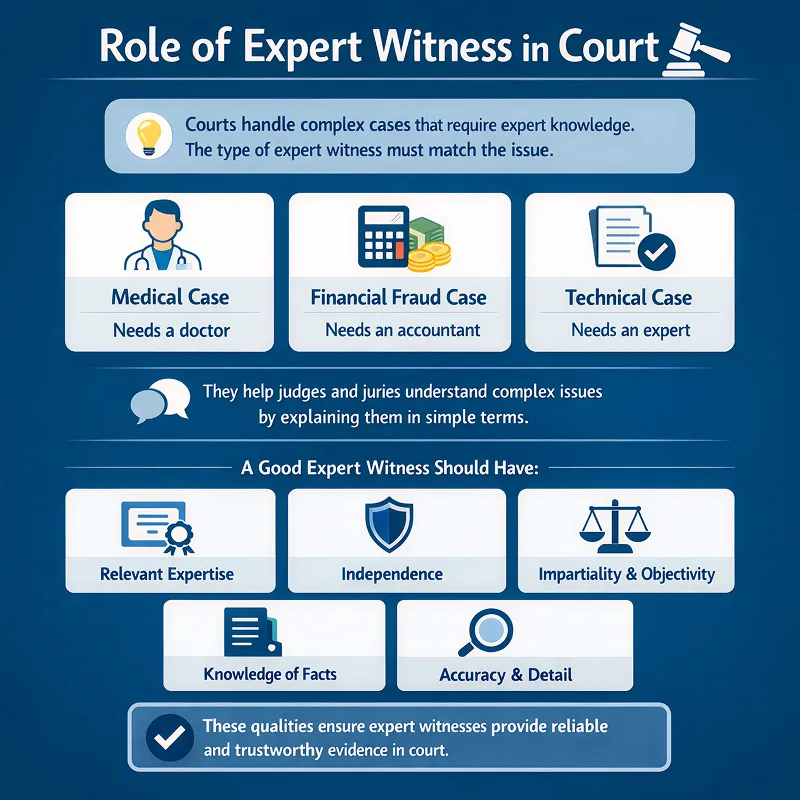
Courts often handle cases with difficult questions that need expert knowledge. So, the types of expert witness should match the issue in the case. For example:
- A medical case needs a doctor.
- A financial fraud case needs an accountant.
Expert witnesses help judges and juries with complex issues. They explain their viewpoint in simple words.
A good expert witness should have:
- Relevant expertise in the subject being discussed
- Independence from the parties involved
- Impartiality and objectivity
- Knowledge about facts
- Accuracy and attention to detail
These qualities help ensure that an expert witness provides reliable evidence in court.
Why Courts Use Expert Witnesses
Courts need expert witnesses when cases involve specialised knowledge. The judges and juries do not normally have that knowledge.
For example, some cases need technical explanations. They may involve medical procedures or engineering failures. In these situations, an expert witness helps the court understand the case. They also help explain how events occurred. They tell whether expert standards were followed.
Some reports based on the Ministry of Justice data show that expert fees can make up to 20% of the total cost in complex civil cases. This shows that expert witnesses can also increase the cost of a case.
An expert witness also help to determine whether:
- Negligence occurred
- Injuries match the alleged cause
- Financial losses were properly calculated
- Scientific evidence support the claims made
The different types of expert witnesses in legal proceedings help courts assess proofs properly and make fair decisions.
Expert Witnesses vs Factual Witnesses
Before looking at the types of expert witnesses, you should also know how they are different from factual witnesses.
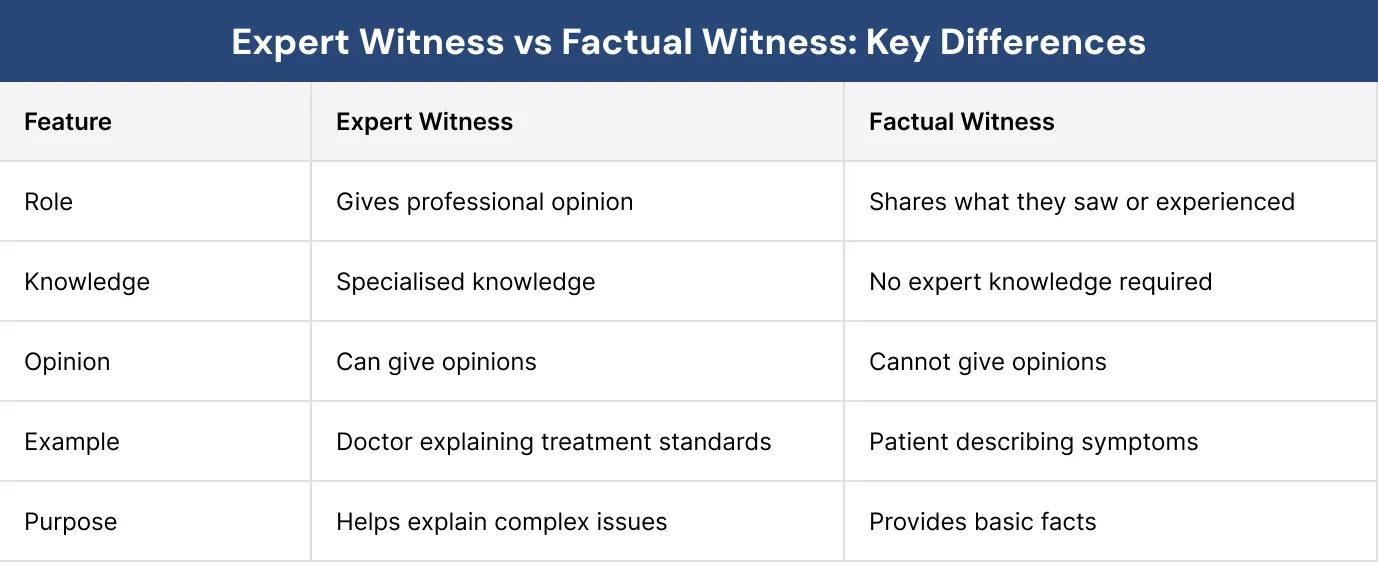
A factual witness only talks about what they saw or experienced. They cannot provide expert opinions.
For example:
- A doctor who treated a patient may explain the treatment provided
- A police officer may describe what happened at a crime scene
- An accountant may explain financial records they managed
These people only provide proof based on their involvement in the case. Expert witnesses give their analysis and expert judgment. Their role is to explain the evidence and what it means.
For example:
- A medical expert may explain whether a doctor followed proper treatment standards
- A forensic expert may analyse DNA or physical evidence
- A financial expert may investigate fraud or hidden assets
These cases rely on expert opinions. Your expert witness must have the right skills and knowledge.
Main Types of Expert Witnesses
There are many types of expert witnesses who help in court cases.
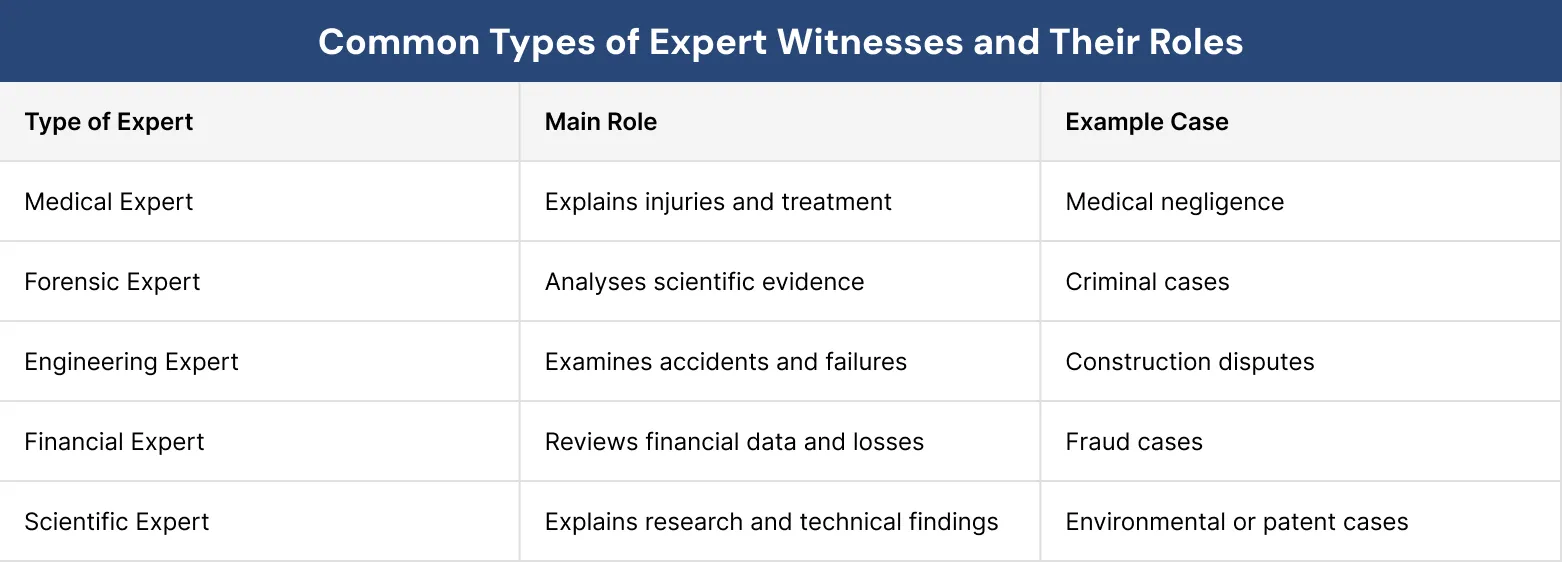
Five main types of expert witnesses include:
- Medical expert witnesses
- Forensic expert witnesses
- Engineering expert witnesses
- Financial expert witnesses
- Scientific expert witnesses
These five main types are discussed below:
1. Medical Expert Witnesses
A medical expert witness is one of the most common types of expert witnesses in court. They play a key role in cases involving injury, health issues and crime. Medical expert witnesses help courts understand medical conditions, injuries and treatment.
Role of Medical Experts
Medical experts often explain whether proper care was given. Their views can tell whether care met the right standards. They can also tell if there was poor medical care. For example, a doctor can say whether another doctor followed the right standard of care.
In injury cases, medical experts can tell how serious the injury is and how it may affect a person’s life. Because medical cases can be difficult, expert witnesses must have the right skills for the specific condition.
Types of Medical Experts
Many medical experts may serve as expert witnesses, including:
- Physicians and surgeons who explain medical treatment and care
- Psychiatrists and psychologists who assess mental health issues
- Nurses and allied health experts who explain patient care
Specialist doctors may also be called depending on the case.
For example:
- Cardiologists may testify in cases involving heart issues
- Neurologists may explain brain injuries or nerve disorders
- Forensic pathologists may find the cause of death in court cases
These medical experts provide support for health care related legal cases.
2. Forensic Expert Witnesses
Forensic experts are also among the types of expert witnesses. They examine physical or scientific evidence in court cases.
Forensic experts often work in crime cases but may also work in civil cases.
Role of Forensic Experts
Forensic experts study evidence from an investigation. They check the data and explain the results in a clear way.
Their reports may include:
- Blood samples
- Fingerprints
- Ballistics
- Digital data
- Financial records
Their views can tell whether a suspect was linked to a crime. They can also tell if an event happened as claimed. For example, a forensic scientist can tell if a person was at a crime scene by checking DNA.
Forensic experts can also rebuild an accident scene. This scene shows the cause of the crash. These experts are important types of expert witnesses. They can help in cases with scientific evidence.
Types of Forensic Experts
Many specialised forensic experts serve as expert witnesses.
Forensic pathologists perform post mortems to find the cause of death. Their findings play a key role in murder cases.
Forensic toxicologists test body samples for drugs, alcohol or poisons. They often help in cases like poisoning or drug misuse.
Forensic accountants check financial records to find fraud, stolen money or hidden transfers.
Forensic specialists play a key role as expert witnesses in legal cases.
Specialised Forensic Fields
New forensic fields continue to develop as technology grows. This has led to new types of expert witnesses in court.
For example, digital forensic experts study computers, phones and other electronic devices. They play a key role in cases like cybercrime, data leaks and online fraud.
Forensic odontologists check teeth records and bite marks to help identify a person.
Forensic anthropologists study human remains, especially in cases involving advanced decay or mass disasters.
These roles show how expert witnesses in court keep changing as science and technology grow.
Real Life Example:
In 1996 Dr. Adams was accused of murder after several patients died under his care. The case depended heavily on medical evidence. Expert witnesses gave different proofs about whether the deaths were natural or caused by medical actions.
The jury found Dr. Adams not guilty. This case shows how expert witness views can create doubt and influence the final decision.
3. Engineering Expert Witnesses
Engineering experts also work as expert witnesses in court. They check accidents, building failures and product faults.
Their job is to check technical evidence. They also explain whether equipment, structures or systems were made and used properly.
Engineering experts often work on cases involving:
- Building collapses
- Machinery failures
- Product liability claims
- Electrical fires
- Construction accidents
Technical cases often need detailed analysis. These types of expert witnesses must have the relevant engineering background to examine the specific issues.
The expert witness you choose must have the right engineering degree to handle issues in a case.
Engineering Expert Specialisations
Engineering experts are the types of expert witnesses in court. They help in cases with construction problems and product defects. They also help with machine failures and road and bridge accidents.
These experts study technical details and tell if industry standards were followed. For example, if a bridge falls or a building fails, engineers may check the design, how it was built and the materials used. They can then find out if poor work or negligence caused the problem.
Many engineering fields are involved in legal cases. Structural engineers work on buildings, bridges and other structures. Their views help courts understand why a structure failed. Mechanical and electrical engineers help in cases related to machine failures.
Civil engineers work on projects like roads, water systems and land plans. They check if safety rules and building standards were followed.
These experts act as expert witnesses in technical cases.
Advanced Engineering Specialisations
Highly specialised engineers play a key role in many modern cases.
Aerospace engineers may examine plane crashes or flight faults. They check flight data and aircraft design to find possible causes of an incident.
Chemical engineers are often involved in factory accidents or pollution cases. They check chemical processes and safety rules.
Another advanced field involves robotics and automation. Experts in these systems may assess the safety checks. They evaluate factory robots and self-driving vehicles.
The growth of these fields shows how the types of expert witnesses in court increase as technology develops.
4. Financial Expert Witnesses
Financial experts are one of the types of expert witnesses in court. They deal with financial cases. These financial cases can involve complex data and large records. Courts often rely on financial experts to explain these records.
These experts help judges and juries with complex financial issues related to damages, fraud, business value or money loss.
Role of Financial Experts
Financial expert witness performs tasks like:
- Checking financial records
- Calculating financial losses
- Assessing financial harm
- Valuing a business or asset
- Finding fraud or false transactions
These experts work in cases like business disputes, bankruptcy, fraud and financial harm. The different types of expert witnesses in the financial field help courts understand financial evidence.
Types of Financial Experts
Many financial experts can work as an expert witness. Forensic accountants check financial records, trace assets and spot fraud or stolen money.
Economists check market situations and money trends. They may estimate future financial losses. They can also explain the economic impact of a business interruption.
Business valuation experts decide the fair market value of companies. They may also value intellectual property or other assets. Their views often help in divorce cases, partnership disputes and company cases. These experts represent key types of expert witnesses in financial cases.
Additional Financial Specialisations
Financial expertise can also include more specialised areas.
Real estate valuation experts check the value of property in land ownership cases. They may also help in building projects or compensation claims.
Investment analysts assess investment plans and financial strategies. They may explain whether financial advisers acted with proper care.
Actuaries use statistical models to assess financial risk and future outcomes. They often work in insurance or pension cases.
Financial cases can involve many complex issues. So, these experts are some of the most common types of expert witnesses in litigation.
5. Scientific Expert Witnesses
Scientific experts provide specialist knowledge in cases about environmental or chemical issues. They also help understand cases involving biological evidence or patent disputes.
These experts give scientific evidence in court. This helps courts understand complex research data and technical findings.
Role of Scientific Experts
Scientific experts are also crucial types of expert witnesses. The role of scientific experts is:
- Studying scientific data
- Doing laboratory tests
- Performing experiments or tests
- Explaining research data
They clearly explain scientific evidence. That is why judges and juries rely on them.
Types of Scientific Experts
Scientific experts often appear in court cases. For example, environmental scientists check pollution levels. They explain how pollution affects public health. Chemists test chemicals used in product cases or factory accidents.
Biologists may explain body processes, medical research and the effects of certain substances.
Patent experts specialise in intellectual property law. They can tell whether inventions are original or if a patent has been infringed. These experts are some of the most technical types of expert witnesses. They have knowledge of law and the relevant scientific field.
Additional Scientific Specialisations
Scientific evidence continues to grow as research advances. Geneticists can check DNA evidence in criminal investigations or paternity cases.
Pharmacologists assess whether a drug is safe. They also tell if it works in drug related cases.
Materials scientists check the physical properties of materials used in making products. Their evidence can help explain why a product failed or caused harm.
These specialised experts show how the different types of expert witnesses continue to grow as science changes.
Choosing the Right Expert for a Case
Choosing the right expert witness is a key step while preparing a legal case. Your expert witness should fit the specific issue in the case.
For example:
- Medical cases need healthcare experts
- Financial fraud cases need accountants or economists
- Engineering accidents need technical experts
Choosing the wrong expert can weaken a case. This is because their views may not explain the relevant issues effectively. You should also check that the expert is ready to attend court if needed.
Some experts may write reports but may not be available to give evidence in court. Location is another point to check. Courts may ask why a distant expert is hired if a similar expert is available nearby. Careful selection ensures the expert witness gives clear and reliable evidence in your case.
Qualifications Required for Expert Witnesses
Not everyone with knowledge can be an expert witness. Courts want experts to show clear skills and relevant experience. Courts may consider several factors to see if a person qualifies as an expert witness.
These include:
- Occupation and expert role
- Formal qualifications and education
- Field of expertise
- Level of experience in that field
Experts are often Professionals who actively work in their field. Current knowledge and updated experience make their views more reliable. Teachers and researchers can also serve as expert witnesses if they are highly experienced in their field.
The types of expert witnesses you choose must have strong skills. Their skills should be relevant to the issues in the case to build trust in their evidence. The court may also ask for extra documents to check their expertise, like an expert’s CV.
Independence and Impartiality of Expert Witness
Lord Justice Cresswell said:
An expert witness is there to assist the court, not to win the case.
An expert witness should stay fair. They should stay loyal to the court instead of the side that hired them. They can lose trust if they seem biased. They should not refuse to consider other views in the case.
A few important qualities help an expert witness build trust:
- Staying independent from everyone involved in the case
- Looking at the evidence in a fair and neutral way
- Being willing to change their views if new facts come up
- Explaining things clearly and accurately
Courts may reject an expert’s opinion if it appears biased. The facts should be supported by the evidence. This rule applies to all expert witnesses, even if they are experts in their field.
The experts’ views should be based on strong methods and facts. Their views can lose value if it does not match the evidence.
How to Become an Expert Witness in Court
Many experts are interested in learning how to be an expert witness in court. The process usually requires education, work experience and expertise in a specific field.
If you want to learn how to be an expert witness in court, you must also learn how court proceedings work. An expert witness must explain things with clarity. They should stay fair when answering questions in court cases.
Good speaking skills also play a key role in learning how to be an expert witness in court. It is also important when you explain complex topics to judges and juries.
Learning how to be an expert witness in court also means understanding your expert duties. Experts should be independent and base their views on valid proof. Courts depend on experts who are skilled and fair because evidence can affect legal decisions.
Conclusion
The legal system often deals with issues that need expert help. An expert witness helps the court understand technical, scientific, medical and financial evidence.
There are many types of expert witnesses to help in court cases. They can include doctors, forensic specialists, engineers, financial experts and scientific experts.
Each expert helps the case with their unique knowledge. Their views help courts understand complex facts. They also help courts make fair decisions. The different types of expert witnesses show how important they are in today’s legal cases.
Today, court cases involve new technology and scientific developments. The types of expert witnesses are also growing. With the help of the right experts, courts can handle difficult cases better. The expert views must stay fair.
Concise Medico understands the expert witness role in court decisions. We helpto make your court journey smooth and easy.
Contact us today if you need an expert witness for a court case.
FAQs
Do you know why facts alone are not enough when a case reaches the courtroom? Some details of the case are too technical for a judge or jury to fully understand. They need guidance and that’s where an expert witness steps in. They explain the facts in simple words.
Court cases are not always easy to understand. Many of them involve technical facts and medical issues. They also involve financial data and scientific proof. Judges and juries are not experts in every field. That is why courts often rely on experts.
Not every expert witness can help a case win but the right one can make your case stronger. These experts have deep knowledge in their fields. Knowing the types of expert witnesses in court helps you understand court trials.
An expert witness gives their opinions to juries. Their views are based on their knowledge, training and experience. They do not favour either side without justification. They help the court understand facts that need expert knowledge.
The UK Ministry of Justice reports that Crown Courts dealt with over 121,000 cases in 2024-2025. This high number shows growing demand for an expert witness, as cases today are more complex.
In addition, what an expert witness says in court can strongly influence the outcome of a case.
In this blog, you will learn:
- The role of an expert witness in court
- Expert witness vs factual witness
- Choosing the right expert for a case
- Role and types of medical expert witness
- Role and types of forensic expert witness
- Role and types of engineering and technical expert witness
- Role and types of financial and economic expert witness
- Role and types of scientific expert witness
What Is an Expert Witness?
An expert witness is a person who gives opinions and evidence in court. Their views are based on their specialised knowledge and skills. Expert witnesses can easily explain complex issues.
Role of Expert Witness in Court
Courts often handle cases with difficult questions that need expert knowledge. So, the types of expert witness should match the issue in the case. For example:
- A medical case needs a doctor.
- A financial fraud case needs an accountant.
Expert witnesses help judges and juries with complex issues. They explain their viewpoint in simple words.
A good expert witness should have:
- Relevant expertise in the subject being discussed
- Independence from the parties involved
- Impartiality and objectivity
- Knowledge about facts
- Accuracy and attention to detail
These qualities help ensure that an expert witness provides reliable evidence in court.
Why Courts Use Expert Witnesses
Courts need expert witnesses when cases involve specialised knowledge. The judges and juries do not normally have that knowledge.
For example, some cases need technical explanations. They may involve medical procedures or engineering failures. In these situations, an expert witness helps the court understand the case. They also help explain how events occurred. They tell whether expert standards were followed.
Some reports based on the Ministry of Justice data show that expert fees can make up to 20% of the total cost in complex civil cases. This shows that expert witnesses can also increase the cost of a case.
An expert witness also help to determine whether:
- Negligence occurred
- Injuries match the alleged cause
- Financial losses were properly calculated
- Scientific evidence support the claims made
The different types of expert witnesses in legal proceedings help courts assess proofs properly and make fair decisions.
Expert Witnesses vs Factual Witnesses
Before looking at the types of expert witnesses, you should also know how they are different from factual witnesses.
A factual witness only talks about what they saw or experienced. They cannot provide expert opinions.
For example:
- A doctor who treated a patient may explain the treatment provided
- A police officer may describe what happened at a crime scene
- An accountant may explain financial records they managed
These people only provide proof based on their involvement in the case. Expert witnesses give their analysis and expert judgment. Their role is to explain the evidence and what it means.
For example:
- A medical expert may explain whether a doctor followed proper treatment standards
- A forensic expert may analyse DNA or physical evidence
- A financial expert may investigate fraud or hidden assets
These cases rely on expert opinions. Your expert witness must have the right skills and knowledge.
Main Types of Expert Witnesses
There are many types of expert witnesses who help in court cases.
Five main types of expert witnesses include:
- Medical expert witnesses
- Forensic expert witnesses
- Engineering expert witnesses
- Financial expert witnesses
- Scientific expert witnesses
These five main types are discussed below:
1. Medical Expert Witnesses
A medical expert witness is one of the most common types of expert witnesses in court. They play a key role in cases involving injury, health issues and crime. Medical expert witnesses help courts understand medical conditions, injuries and treatment.
Role of Medical Experts
Medical experts often explain whether proper care was given. Their views can tell whether care met the right standards. They can also tell if there was poor medical care. For example, a doctor can say whether another doctor followed the right standard of care.
In injury cases, medical experts can tell how serious the injury is and how it may affect a person’s life. Because medical cases can be difficult, expert witnesses must have the right skills for the specific condition.
Types of Medical Experts
Many medical experts may serve as expert witnesses, including:
- Physicians and surgeons who explain medical treatment and care
- Psychiatrists and psychologists who assess mental health issues
- Nurses and allied health experts who explain patient care
Specialist doctors may also be called depending on the case.
For example:
- Cardiologists may testify in cases involving heart issues
- Neurologists may explain brain injuries or nerve disorders
- Forensic pathologists may find the cause of death in court cases
These medical experts provide support for health care related legal cases.
2. Forensic Expert Witnesses
Forensic experts are also among the types of expert witnesses. They examine physical or scientific evidence in court cases.
Forensic experts often work in crime cases but may also work in civil cases.
Role of Forensic Experts
Forensic experts study evidence from an investigation. They check the data and explain the results in a clear way.
Their reports may include:
- Blood samples
- Fingerprints
- Ballistics
- Digital data
- Financial records
Their views can tell whether a suspect was linked to a crime. They can also tell if an event happened as claimed. For example, a forensic scientist can tell if a person was at a crime scene by checking DNA.
Forensic experts can also rebuild an accident scene. This scene shows the cause of the crash. These experts are important types of expert witnesses. They can help in cases with scientific evidence.
Types of Forensic Experts
Many specialised forensic experts serve as expert witnesses.
Forensic pathologists perform post mortems to find the cause of death. Their findings play a key role in murder cases.
Forensic toxicologists test body samples for drugs, alcohol or poisons. They often help in cases like poisoning or drug misuse.
Forensic accountants check financial records to find fraud, stolen money or hidden transfers.
Forensic specialists play a key role as expert witnesses in legal cases.
Specialised Forensic Fields
New forensic fields continue to develop as technology grows. This has led to new types of expert witnesses in court.
For example, digital forensic experts study computers, phones and other electronic devices. They play a key role in cases like cybercrime, data leaks and online fraud.
Forensic odontologists check teeth records and bite marks to help identify a person.
Forensic anthropologists study human remains, especially in cases involving advanced decay or mass disasters.
These roles show how expert witnesses in court keep changing as science and technology grow.
Real Life Example:
In 1996 Dr. Adams was accused of murder after several patients died under his care. The case depended heavily on medical evidence. Expert witnesses gave different proofs about whether the deaths were natural or caused by medical actions.
The jury found Dr. Adams not guilty. This case shows how expert witness views can create doubt and influence the final decision.
3. Engineering Expert Witnesses
Engineering experts also work as expert witnesses in court. They check accidents, building failures and product faults.
Their job is to check technical evidence. They also explain whether equipment, structures or systems were made and used properly.
Engineering experts often work on cases involving:
- Building collapses
- Machinery failures
- Product liability claims
- Electrical fires
- Construction accidents
Technical cases often need detailed analysis. These types of expert witnesses must have the relevant engineering background to examine the specific issues.
The expert witness you choose must have the right engineering degree to handle issues in a case.
Engineering Expert Specialisations
Engineering experts are the types of expert witnesses in court. They help in cases with construction problems and product defects. They also help with machine failures and road and bridge accidents.
These experts study technical details and tell if industry standards were followed. For example, if a bridge falls or a building fails, engineers may check the design, how it was built and the materials used. They can then find out if poor work or negligence caused the problem.
Many engineering fields are involved in legal cases. Structural engineers work on buildings, bridges and other structures. Their views help courts understand why a structure failed. Mechanical and electrical engineers help in cases related to machine failures.
Civil engineers work on projects like roads, water systems and land plans. They check if safety rules and building standards were followed.
These experts act as expert witnesses in technical cases.
Advanced Engineering Specialisations
Highly specialised engineers play a key role in many modern cases.
Aerospace engineers may examine plane crashes or flight faults. They check flight data and aircraft design to find possible causes of an incident.
Chemical engineers are often involved in factory accidents or pollution cases. They check chemical processes and safety rules.
Another advanced field involves robotics and automation. Experts in these systems may assess the safety checks. They evaluate factory robots and self-driving vehicles.
The growth of these fields shows how the types of expert witnesses in court increase as technology develops.
4. Financial Expert Witnesses
Financial experts are one of the types of expert witnesses in court. They deal with financial cases. These financial cases can involve complex data and large records. Courts often rely on financial experts to explain these records.
These experts help judges and juries with complex financial issues related to damages, fraud, business value or money loss.
Role of Financial Experts
Financial expert witness performs tasks like:
- Checking financial records
- Calculating financial losses
- Assessing financial harm
- Valuing a business or asset
- Finding fraud or false transactions
These experts work in cases like business disputes, bankruptcy, fraud and financial harm. The different types of expert witnesses in the financial field help courts understand financial evidence.
Types of Financial Experts
Many financial experts can work as an expert witness. Forensic accountants check financial records, trace assets and spot fraud or stolen money.
Economists check market situations and money trends. They may estimate future financial losses. They can also explain the economic impact of a business interruption.
Business valuation experts decide the fair market value of companies. They may also value intellectual property or other assets. Their views often help in divorce cases, partnership disputes and company cases. These experts represent key types of expert witnesses in financial cases.
Additional Financial Specialisations
Financial expertise can also include more specialised areas.
Real estate valuation experts check the value of property in land ownership cases. They may also help in building projects or compensation claims.
Investment analysts assess investment plans and financial strategies. They may explain whether financial advisers acted with proper care.
Actuaries use statistical models to assess financial risk and future outcomes. They often work in insurance or pension cases.
Financial cases can involve many complex issues. So, these experts are some of the most common types of expert witnesses in litigation.
5. Scientific Expert Witnesses
Scientific experts provide specialist knowledge in cases about environmental or chemical issues. They also help understand cases involving biological evidence or patent disputes.
These experts give scientific evidence in court. This helps courts understand complex research data and technical findings.
Role of Scientific Experts
Scientific experts are also crucial types of expert witnesses. The role of scientific experts is:
- Studying scientific data
- Doing laboratory tests
- Performing experiments or tests
- Explaining research data
They clearly explain scientific evidence. That is why judges and juries rely on them.
Types of Scientific Experts
Scientific experts often appear in court cases. For example, environmental scientists check pollution levels. They explain how pollution affects public health. Chemists test chemicals used in product cases or factory accidents.
Biologists may explain body processes, medical research and the effects of certain substances.
Patent experts specialise in intellectual property law. They can tell whether inventions are original or if a patent has been infringed. These experts are some of the most technical types of expert witnesses. They have knowledge of law and the relevant scientific field.
Additional Scientific Specialisations
Scientific evidence continues to grow as research advances. Geneticists can check DNA evidence in criminal investigations or paternity cases.
Pharmacologists assess whether a drug is safe. They also tell if it works in drug related cases.
Materials scientists check the physical properties of materials used in making products. Their evidence can help explain why a product failed or caused harm.
These specialised experts show how the different types of expert witnesses continue to grow as science changes.
Choosing the Right Expert for a Case
Choosing the right expert witness is a key step while preparing a legal case. Your expert witness should fit the specific issue in the case.
For example:
- Medical cases need healthcare experts
- Financial fraud cases need accountants or economists
- Engineering accidents need technical experts
Choosing the wrong expert can weaken a case. This is because their views may not explain the relevant issues effectively. You should also check that the expert is ready to attend court if needed.
Some experts may write reports but may not be available to give evidence in court. Location is another point to check. Courts may ask why a distant expert is hired if a similar expert is available nearby. Careful selection ensures the expert witness gives clear and reliable evidence in your case.
Qualifications Required for Expert Witnesses
Not everyone with knowledge can be an expert witness. Courts want experts to show clear skills and relevant experience. Courts may consider several factors to see if a person qualifies as an expert witness.
These include:
- Occupation and expert role
- Formal qualifications and education
- Field of expertise
- Level of experience in that field
Experts are often Professionals who actively work in their field. Current knowledge and updated experience make their views more reliable. Teachers and researchers can also serve as expert witnesses if they are highly experienced in their field.
The types of expert witnesses you choose must have strong skills. Their skills should be relevant to the issues in the case to build trust in their evidence. The court may also ask for extra documents to check their expertise, like an expert’s CV.
Independence and Impartiality of Expert Witness
Lord Justice Cresswell said:
An expert witness is there to assist the court, not to win the case.
An expert witness should stay fair. They should stay loyal to the court instead of the side that hired them. They can lose trust if they seem biased. They should not refuse to consider other views in the case.
A few important qualities help an expert witness build trust:
- Staying independent from everyone involved in the case
- Looking at the evidence in a fair and neutral way
- Being willing to change their views if new facts come up
- Explaining things clearly and accurately
Courts may reject an expert’s opinion if it appears biased. The facts should be supported by the evidence. This rule applies to all expert witnesses, even if they are experts in their field.
The experts’ views should be based on strong methods and facts. Their views can lose value if it does not match the evidence.
How to Become an Expert Witness in Court
Many experts are interested in learning how to be an expert witness in court. The process usually requires education, work experience and expertise in a specific field.
If you want to learn how to be an expert witness in court, you must also learn how court proceedings work. An expert witness must explain things with clarity. They should stay fair when answering questions in court cases.
Good speaking skills also play a key role in learning how to be an expert witness in court. It is also important when you explain complex topics to judges and juries.
Learning how to be an expert witness in court also means understanding your expert duties. Experts should be independent and base their views on valid proof. Courts depend on experts who are skilled and fair because evidence can affect legal decisions.
Conclusion
The legal system often deals with issues that need expert help. An expert witness helps the court understand technical, scientific, medical and financial evidence.
There are many types of expert witnesses to help in court cases. They can include doctors, forensic specialists, engineers, financial experts and scientific experts.
Each expert helps the case with their unique knowledge. Their views help courts understand complex facts. They also help courts make fair decisions. The different types of expert witnesses show how important they are in today’s legal cases.
Today, court cases involve new technology and scientific developments. The types of expert witnesses are also growing. With the help of the right experts, courts can handle difficult cases better. The expert views must stay fair.
Concise Medico understands the expert witness role in court decisions. We helpto make your court journey smooth and easy.
Contact us today if you need an expert witness for a court case.