AI in Medical Imaging: Risks, Benefits, and Legal Implications UK

Published On: May 6th, 2026|Total Views: 2|Daily Views: 2|14.2 min read|2834 words|

TABLE OF CONTENT

What if diseases could be detected earlier, faster and with fewer errors? AI in medical imaging is making this possible.

Hospitals are now using smarter tools in medical imaging. These tools are more advanced and faster because of artificial intelligence. Many people now ask:

  • What is AI in medical imaging
  • Is it safe
  • Can it replace doctors

AI makes things easier for patients and doctors. It helps patients with faster scans and less stress. It also helps doctors find disease earlier and reduces mistakes.

Globally, about 85% of healthcare organisations were using AI by late 2024 and medical imaging was one of the most common areas where it was used.

AI in medical imaging also comes with some risks and legal rules in the UK. People are concerned about data privacy and responsibility for errors.

Key Takeaways

    • AI in medical imaging improves accuracy, speed and consistency, especially in high-volume settings like CT and X-ray reporting
    • AI in radiology works best when integrated into systems like PACS, RIS and EHR, not as a separate tool
    • One of the main benefits of AI in medical imaging is early detection, helping identify diseases like cancer, stroke and Alzheimer’s at an earlier stage
  • Understanding how AI is used in medical imaging shows that human expertise remains essential, as radiologists review AI outputs and make final clinical decisions
  • The use of AI in medical imaging must be managed carefully because risks like data bias, privacy concerns and lack of transparency can affect patient safety
  • UK regulations like GDPR and MHRA help ensure AI applications in medical imaging are safe, secure and compliant before use
  • Successful AI in medical imaging implementation depends on clean data, proper staff training and strong system integration

What Is AI in Medical Imaging

AI in medical imaging means computer systems are used to read and understand scans like X-rays, CT scans and MRI.

These systems use deep learning and machine learning to study thousands of images. Then they learn patterns. For example, AI can detect small changes in the brain or lungs. AI in medical imaging works with doctors and radiologists to make the final decision.

Why Is Medical Imaging So Important

Medical imaging is often the first step in diagnosis. A scan can show complex things that happen inside the body, such as:

  • A small tumour can be found early
  • Brain shrinkage can show signs of Alzheimer’s disease
  • Broken bones can be confirmed quickly
  • Heart problems can be detected before symptoms become serious

The Role of AI in Radiology

The role of AI in radiology is very critical because radiologists provide clinical judgement, experience and human understanding.

Artificial intelligence will not replace radiologists but radiologists who use AI will replace those who do not. – Curt Langlotz, Director of AIMI Center, Stanford

AI lacks human judgment and only provides data and patterns. The best results come when AI in radiology is used.

How AI in Medical Imaging Works

AI in medical imaging works in a few simple steps. These include:

1. Learn From Scans

AI first learns from thousands of scans that are already labelled by doctors. A scan may be marked as normal or showing disease. This helps the system learn what to look for.

2. Finding Patterns

After learning, AI starts finding patterns. Some patterns are too small for the human eye to notice. AI looks at shapes, textures and small changes in images.

3. Comparing New Scans

Next, AI compares new scans with previous learning. When a new patient scan enters the system, the system checks it against past data. Then it detects if the scan has the same patterns.

4. Highlighting Risks

Then, AI highlights risks and marks areas that may need attention. For example, it may show a possible tumour, a fracture or signs of disease.

5. The Final Decision

After reviewing the scan the radiologist makes the final decision. Timely review helps them start the right treatment earlier.

How Doctors Use AI Is in Medical Imaging

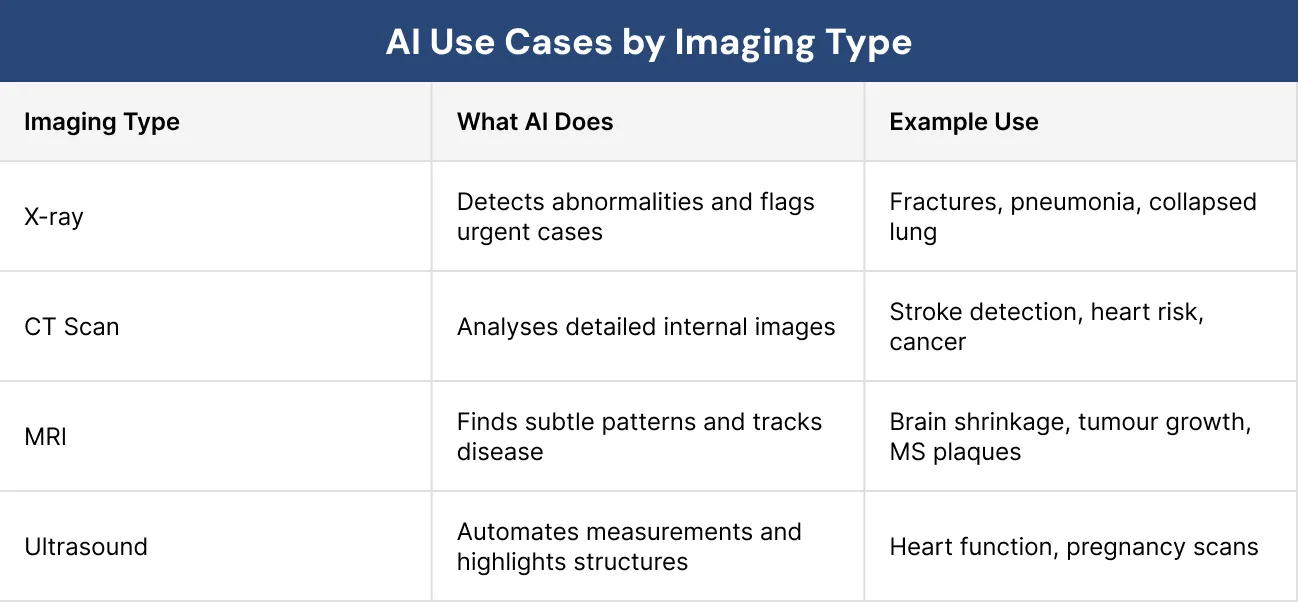
The type of scan decides how to use AI in medical imaging. Each type of scan has a different use and role. AI helps each scan in a unique way.

1. AI in X-ray

X-rays are one of the most used imaging tools. They are used for bones, chest conditions and infections. AI helps doctors by detecting:

  • Fractures
  • Lung infections
  • Early symptoms of illness
  • Abnormal findings like pneumonia or a collapsed lung

Radiologists are under pressure in busy hospitals, AI can support them by:

  • Reducing the chance of missed findings
  • Reducing reporting delays
  • Moving urgent cases at the top of the list
  • Improving consistency in diagnosis

2. AI in CT Scans

CT scans give more detailed images of the body than X-rays. They are often used for internal organs, blood vessels and serious injuries. AI in CT scans helps detect conditions like:

  • Stroke
  • Cancer
  • Heart disease

For example, if a patient goes for a CT scan for some other issue and the scan report also detects calcium deposits in heart arteries to identify heart risk.

In February 2025, around 700,000 women across the country joined a major trial to test how AI can help detect breast cancer earlier. This shows how AI in medical imaging is already being tested at a large scale in UK cancer screening.

3. AI in MRI

MRI scans take longer and produce large amounts of data. They are used for complex areas like the brain, spine and heart.

AI in MRI helps detect small patterns that are hard to check through other types of scans. It can:

  • Track tumour growth
  • Measure brain shrinkage
  • Identify early symptoms of illness like Alzheimer’s

For example, in multiple sclerosis, AI can track small spots in the brain and show the stages of disease over time. This helps doctors plan a better treatment that aligns with the current condition.

4. AI in Ultrasound

Ultrasound is mostly used in pregnancy scans and heart imaging because it is safe and quick. AI helps measure things such as cardiac function and organ size. It can also help explain images by showing important parts of the scan.

This saves time and helps doctors make faster decisions, especially in emergencies or busy hospitals. AI can perform better than doctors in some cases. For example, a model from Stanford showed strong results in detecting pneumonia.
AI Use Cases by Imaging Type

The Benefits of AI in Medical Imaging

The following are the benefits of AI in medical imaging:

1. Improved Accuracy

The human eye may miss very small patterns. AI can help see these patterns and helps in accurate diagnosis.

For example, doctors can have different opinions about how serious a case is. AI helps make them agree at a point.

2. Faster Results

AI can reduce the time to read the scans and give faster results.

Did You Know?

AI can help detect urgent cases faster, such as stroke or brain bleeding.

For example:

  • Chest X-ray prioritisation can reduce report time
  • Stroke detection systems can alert doctors within minutes
  • Some programmes show up to 44% faster diagnosis in stroke cases

3. Better Workflow

AI saves the time of radiologists and helps them focus on complex cases instead of routine work. It can automate tasks like:

  • Sorting images
  • Highlighting important areas
  • Suggesting report text

4. Early Diagnosis

AI can detect disease at early stages that can save lives and reduce treatment costs. It can detect sooner:

  • Lung cancer
  • Heart disease risk
  • Alzheimer’s disease

5. Personalised Care

AI can use imaging, lab results and medical history all together. This helps doctors understand the disease and risks better and leads to the right treatment. AI can show:

  • Tumour growth
  • How a patient responds to treatment

6. Better Patient Experience

AI helps in shorter duration of scans that reduce stress. In MRI, scans can be up to 75% quicker. This is comforting because many patients feel anxiety during scans. Nearly one in three patients experience this.

What Are the Risks of AI in Medical Imaging

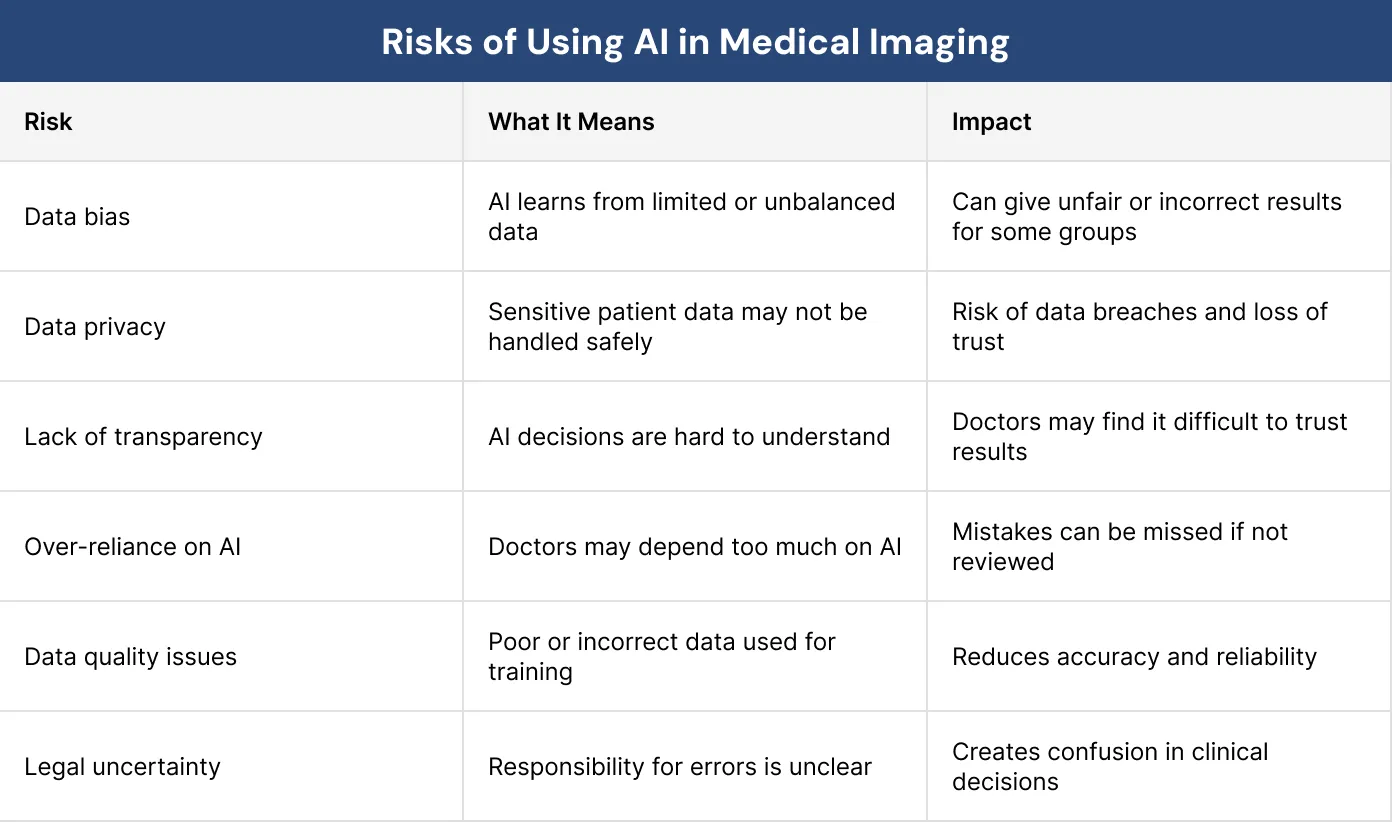
There are some risks of using AI in medical imaging, such as:

1. Bias in Data

Biased data means biased results because AI learns from data. If most data comes from one group of people, the AI may become biased for others. Biased data also leads to a wrong diagnosis.

2. Data Privacy

Patient data is very sensitive and needs privacy. AI systems should have more data to protect patient’s privacy. In the UK, rules like GDPR require data that must be used anonymously with the patient’s consent.
Risks of Using AI in Medical Imaging

If AI does not handle this data properly, it can lead to data breaches. Hospitals must remove personal details when training AI models. If data is leaked, it can harm patients’ dignity and break the law. It can also reduce patient trust.

3. Lack of Transparency

Some AI systems are not easy to understand. It also creates problems when results are wrong. Doctors may not know how AI diagnoses diseases. This makes it harder to trust the results.

4. Over Reliance on AI

There is a risk that doctors may depend too much on AI. Human judgement is still very important in diagnosis. A mistake that is not noticed can cause serious effects on patients.

5. Data Quality Issues

AI systems need high quality data. Low quality data reduces accuracy and AI will learn incorrect patterns if:

  • Images are unclear
  • Labels are wrong

What Challenges Do Hospitals Face When Using AI

AI is a helpful tool but hospitals also face some challenges when using AI, these are:

1. System Integration

System integration is a big problem for hospitals. AI tools must connect with systems like:

  • PACS for storing images
  • EHR for patient records
  • RIS for radiology workflow

Note:

If AI systems do not connect well with hospital systems, they can slow down doctors instead of helping.

If these systems do not connect in the right way, doctors may have to switch between tools. Instead of helping, this slows down clinical work.

2. Need for Strong IT Systems

Hospitals also need strong IT systems. Many hospitals still use older systems that do not connect easily with AI tools. That is why these cannot give fast access to early diagnosis and delay treatment as well.

3. High Costs

The high cost of AI tools is another challenge. Hospitals with low budgets find it difficult to pay for software, hardware and maintenance of AI tools.

4. Training Staff

Hospitals also face challenges of training staff. Many doctors and radiologists do not fully understand how AI works. If they are not trained enough to use AI tools correctly, they can’t provide better services.

5. The Use of Legacy Systems

Many hospitals still use conventional systems that were not built for AI. They may not support new technologies and data formats. They can also make integration harder and slower.

6. Data Cleaning

Some hospitals often neglect data cleaning. That is also a big challenge because AI needs clean and accurate data.

If data is not clean, the system will learn incorrect patterns. This can reduce accuracy and create risk for patients.

All these challenges show that AI is not just about technology. It also depends on systems, people and proper planning.

What Is Auto Prioritisation

Auto prioritisation means AI pushes urgent cases to the top.

Why Does It Matter

AI detects serious conditions like stroke or bleeding in the brain. It then prioritises urgent scans and moves these cases to the top of the list. This helps doctors review them first and it also helps patients get faster treatment, which can reduce delays and support better recovery.

The use of AI in medical imaging can reduce chest X-ray reporting time by up to 77%.

What Laws Apply to AI in Medical Imaging in the UK

AI in medical imaging is not just focused on technology. In the UK, systems must follow strict rules to protect patients’ data, medical device regulations and clinical safety standards.

These rules include:

  • GDPR
  • UK Data Protection Act
  • MHRA medical device rules

Medical Device Regulations

AI tools used in imaging are often treated as medical devices.

Does AI Need Approval Before Use

Yes, medical device rules make sure AI tools are tested and approved before they are used. This process checks:

  • Safety of patients
  • Accuracy in results
  • Performance of tools
  • Reliability of tools

Approval can take time. This is one reason why AI adoption is slower in real hospitals compared to research labs.

Who Is Responsible if AI Makes a Mistake

The most asked legal questions are about the responsibility of AI mistakes. This area is still developing in law and clear guidelines are still needed. AI is only a support tool and responsibility usually stays with the clinician.

There is a confusion if AI gives wrong information and a doctor follows it, who is at fault? That is why doctors must review results before making decisions.

Why Is Transparency Important in AI

Transparency is crucial in AI to improve safety and trust. It is hard to trust the system or explain results to patients when doctors don’t understand how AI reaches decisions.

UK regulators are encouraging explainable AI. This means systems should clearly show the process of making decisions.

Ethical Concerns in AI Imaging

Many people have some ethical concerns about AI imaging. These are:

1. Is AI Fair for All Patients

No, especially when AI is trained on limited data. This can give unfair results that lead to wrong treatment. That is the reason it may not work well for every group.

2. Does AI Affect the Relationships of Doctors With Patients

Yes, AI affects the relationships of doctors with patients. Many people think doctors overly rely on AI. They don’t understand that there are many benefits of AI in medical imaging. AI can save doctors time because they don’t need repeated tasks and may spend more time talking to patients.

Should Hospitals Build or Buy AI Tools

Healthcare sectors must decide how to adopt AI in imaging. They can buy ready made tools for fast results or build their own tools for full control. If they want a balance in their system, they can partner with AI experts. Each option has its own risks and costs, such as:

  • Buying is faster but less flexible
  • Building is powerful but costly and slow
  • Partnering gives support and faster delivery

Why Does AI Need Continuous Monitoring

AI systems must be monitored over time because AI performance can change and data patterns can shift.

Hospitals must track model performance, errors, updates and audit logs. If something goes wrong, the system should be able to go back to an earlier version. This ensures safety and follows the rules.

The Future of AI in Medical Imaging

In the future, AI may help doctors find diseases with predictive diagnostics. This system may detect diseases even before symptoms appear. It may give more personalised treatment with the use of genetic information and scan results together.

New tools in medical imaging are being developed every day. These tools may:

  • Predict the risk of diseases
  • Support targeted therapies
  • Help with real time diagnosis
  • Support remote radiology services
  • Use agent based AI to assist with follow ups and workflow tasks
  • Improve patient management
  • Reduce hospital workload

Real Life Example

Some NHS hospitals in the UK use AI in medical imaging to find strokes on CT scans. AI checks the scan quickly if a patient comes in with stroke symptoms. It alerts doctors if it sees signs of a blockage or bleeding in the brain.

This is how AI helps doctors review the case faster. They start the treatment quickly without wasting time. This early diagnosis helps reduce serious damage. It also helps patients recover better.

Conclusion

AI in medical imaging is very beneficial for both doctors and patients at the same time. It helps doctors diagnose diseases faster with accuracy. It also supports better patient care and saves time.

AI in medical imaging is not a perfect tool and has some risks. These are:

  • Biased data
  • Patient’s privacy
  • False results

The UK imaging and radiology department is building strong rules to cope with these issues. There should be a balance between the role of doctors and the role of AI in medical imaging and AI in radiology. AI should not replace doctors; rather, it should help them.

With the right and careful human guidance AI can make healthcare safer, faster and more effective. A better future is ahead where humans and AI work together.

Concise Medico understands how complex AI, imaging and clinical decisions can feel without the right guidance.

Contact us today to get the right support for your medical imaging needs.
Struggling with slow imaging reports or missed findings in your workflow?

AI solutions can improve accuracy, speed and patient outcomes. We have helped organisations streamline imaging processes effectively.
Contact us today and speak with our team to explore the right AI solution for your needs.

Struggling with slow imaging reports or missed findings in your workflow?

AI solutions can improve accuracy, speed and patient outcomes. We have helped organisations streamline imaging processes effectively.
Contact us today and speak with our team to explore the right AI solution for your needs.

FAQs

What is AI in medical imaging?2026-05-06T11:17:54+00:00

AI in medical imaging uses computer systems to analyse scans like X-rays, CT, and MRI. It learns from large datasets to detect disease, measure changes, and highlight risks. It supports doctors, not replaces them. Radiologists still review results and make final decisions, helping improve accuracy, reduce errors, and enhance patient care.

How is AI used in medical imaging?2026-05-06T11:18:09+00:00

AI detects abnormalities, prioritises urgent cases, and supports diagnosis. It finds fractures in X-rays, detects strokes in CT scans, and tracks tumours in MRI. It also automates tasks like sorting images and suggesting reports. Integrated into systems like PACS and EHR, it helps doctors work faster and improves workflow.

What are the benefits of AI in medical imaging?2026-05-06T11:18:24+00:00

AI improves accuracy, speed, and consistency in diagnosis. It enables early detection of diseases like cancer and heart conditions, reduces reporting time, and prioritises urgent cases. It also improves patient experience with faster scans and supports personalised care by combining imaging with patient data.

What are the risks of AI in medical imaging?2026-05-06T11:18:52+00:00

AI can have risks such as data bias, where limited datasets affect accuracy. Data privacy is a concern under laws like GDPR. Some systems lack transparency, making decisions hard to explain. Over-reliance on AI can also be risky if doctors do not properly review results.

Is AI in medical imaging safe in the UK?2026-05-06T11:19:05+00:00

AI in medical imaging is regulated in the UK under GDPR, the UK Data Protection Act, and MHRA rules. These ensure systems are tested, secure, and reliable. Hospitals must protect patient data. AI is considered safe when used under human supervision, with doctors responsible for final decisions.

Can AI replace radiologists?2026-05-06T11:19:24+00:00

AI cannot replace radiologists. It supports them by analysing images and highlighting risks. However, it lacks clinical judgement and human understanding. Radiologists interpret results and make final decisions. Studies show that combining AI with human expertise gives better outcomes than either alone.

What is the future of AI in medical imaging?2026-05-06T11:19:39+00:00

AI may soon predict disease before symptoms appear and combine imaging with genetic data for personalised treatment. Future tools may support real-time diagnosis and remote radiology. AI can also reduce hospital workload and improve patient management, helping doctors deliver better healthcare outcomes.

Share This Article!

What if diseases could be detected earlier, faster and with fewer errors? AI in medical imaging is making this possible.

Hospitals are now using smarter tools in medical imaging. These tools are more advanced and faster because of artificial intelligence. Many people now ask:

  • What is AI in medical imaging
  • Is it safe
  • Can it replace doctors

AI makes things easier for patients and doctors. It helps patients with faster scans and less stress. It also helps doctors find disease earlier and reduces mistakes.

Globally, about 85% of healthcare organisations were using AI by late 2024 and medical imaging was one of the most common areas where it was used.

AI in medical imaging also comes with some risks and legal rules in the UK. People are concerned about data privacy and responsibility for errors.

Key Takeaways

    • AI in medical imaging improves accuracy, speed and consistency, especially in high-volume settings like CT and X-ray reporting
    • AI in radiology works best when integrated into systems like PACS, RIS and EHR, not as a separate tool
    • One of the main benefits of AI in medical imaging is early detection, helping identify diseases like cancer, stroke and Alzheimer’s at an earlier stage
  • Understanding how AI is used in medical imaging shows that human expertise remains essential, as radiologists review AI outputs and make final clinical decisions
  • The use of AI in medical imaging must be managed carefully because risks like data bias, privacy concerns and lack of transparency can affect patient safety
  • UK regulations like GDPR and MHRA help ensure AI applications in medical imaging are safe, secure and compliant before use
  • Successful AI in medical imaging implementation depends on clean data, proper staff training and strong system integration

What Is AI in Medical Imaging

AI in medical imaging means computer systems are used to read and understand scans like X-rays, CT scans and MRI.

These systems use deep learning and machine learning to study thousands of images. Then they learn patterns. For example, AI can detect small changes in the brain or lungs. AI in medical imaging works with doctors and radiologists to make the final decision.

Why Is Medical Imaging So Important

Medical imaging is often the first step in diagnosis. A scan can show complex things that happen inside the body, such as:

  • A small tumour can be found early
  • Brain shrinkage can show signs of Alzheimer’s disease
  • Broken bones can be confirmed quickly
  • Heart problems can be detected before symptoms become serious

The Role of AI in Radiology

The role of AI in radiology is very critical because radiologists provide clinical judgement, experience and human understanding.

Artificial intelligence will not replace radiologists but radiologists who use AI will replace those who do not. – Curt Langlotz, Director of AIMI Center, Stanford

AI lacks human judgment and only provides data and patterns. The best results come when AI in radiology is used.

How AI in Medical Imaging Works

AI in medical imaging works in a few simple steps. These include:

1. Learn From Scans

AI first learns from thousands of scans that are already labelled by doctors. A scan may be marked as normal or showing disease. This helps the system learn what to look for.

2. Finding Patterns

After learning, AI starts finding patterns. Some patterns are too small for the human eye to notice. AI looks at shapes, textures and small changes in images.

3. Comparing New Scans

Next, AI compares new scans with previous learning. When a new patient scan enters the system, the system checks it against past data. Then it detects if the scan has the same patterns.

4. Highlighting Risks

Then, AI highlights risks and marks areas that may need attention. For example, it may show a possible tumour, a fracture or signs of disease.

5. The Final Decision

After reviewing the scan the radiologist makes the final decision. Timely review helps them start the right treatment earlier.

How Doctors Use AI Is in Medical Imaging

The type of scan decides how to use AI in medical imaging. Each type of scan has a different use and role. AI helps each scan in a unique way.

1. AI in X-ray

X-rays are one of the most used imaging tools. They are used for bones, chest conditions and infections. AI helps doctors by detecting:

  • Fractures
  • Lung infections
  • Early symptoms of illness
  • Abnormal findings like pneumonia or a collapsed lung

Radiologists are under pressure in busy hospitals, AI can support them by:

  • Reducing the chance of missed findings
  • Reducing reporting delays
  • Moving urgent cases at the top of the list
  • Improving consistency in diagnosis

2. AI in CT Scans

CT scans give more detailed images of the body than X-rays. They are often used for internal organs, blood vessels and serious injuries. AI in CT scans helps detect conditions like:

  • Stroke
  • Cancer
  • Heart disease

For example, if a patient goes for a CT scan for some other issue and the scan report also detects calcium deposits in heart arteries to identify heart risk.

In February 2025, around 700,000 women across the country joined a major trial to test how AI can help detect breast cancer earlier. This shows how AI in medical imaging is already being tested at a large scale in UK cancer screening.

3. AI in MRI

MRI scans take longer and produce large amounts of data. They are used for complex areas like the brain, spine and heart.

AI in MRI helps detect small patterns that are hard to check through other types of scans. It can:

  • Track tumour growth
  • Measure brain shrinkage
  • Identify early symptoms of illness like Alzheimer’s

For example, in multiple sclerosis, AI can track small spots in the brain and show the stages of disease over time. This helps doctors plan a better treatment that aligns with the current condition.

4. AI in Ultrasound

Ultrasound is mostly used in pregnancy scans and heart imaging because it is safe and quick. AI helps measure things such as cardiac function and organ size. It can also help explain images by showing important parts of the scan.

This saves time and helps doctors make faster decisions, especially in emergencies or busy hospitals. AI can perform better than doctors in some cases. For example, a model from Stanford showed strong results in detecting pneumonia.

AI Use Cases by Imaging Type

The Benefits of AI in Medical Imaging

The following are the benefits of AI in medical imaging:

1. Improved Accuracy

The human eye may miss very small patterns. AI can help see these patterns and helps in accurate diagnosis.

For example, doctors can have different opinions about how serious a case is. AI helps make them agree at a point.

2. Faster Results

AI can reduce the time to read the scans and give faster results.

Did You Know?

AI can help detect urgent cases faster, such as stroke or brain bleeding.

For example:

  • Chest X-ray prioritisation can reduce report time
  • Stroke detection systems can alert doctors within minutes
  • Some programmes show up to 44% faster diagnosis in stroke cases

3. Better Workflow

AI saves the time of radiologists and helps them focus on complex cases instead of routine work. It can automate tasks like:

  • Sorting images
  • Highlighting important areas
  • Suggesting report text

4. Early Diagnosis

AI can detect disease at early stages that can save lives and reduce treatment costs. It can detect sooner:

  • Lung cancer
  • Heart disease risk
  • Alzheimer’s disease

5. Personalised Care

AI can use imaging, lab results and medical history all together. This helps doctors understand the disease and risks better and leads to the right treatment. AI can show:

  • Tumour growth
  • How a patient responds to treatment

6. Better Patient Experience

AI helps in shorter duration of scans that reduce stress. In MRI, scans can be up to 75% quicker. This is comforting because many patients feel anxiety during scans. Nearly one in three patients experience this.

What Are the Risks of AI in Medical Imaging

There are some risks of using AI in medical imaging, such as:

1. Bias in Data

Biased data means biased results because AI learns from data. If most data comes from one group of people, the AI may become biased for others. Biased data also leads to a wrong diagnosis.

2. Data Privacy

Patient data is very sensitive and needs privacy. AI systems should have more data to protect patient’s privacy. In the UK, rules like GDPR require data that must be used anonymously with the patient’s consent.

Risks of Using AI in Medical Imaging

If AI does not handle this data properly, it can lead to data breaches. Hospitals must remove personal details when training AI models. If data is leaked, it can harm patients’ dignity and break the law. It can also reduce patient trust.

3. Lack of Transparency

Some AI systems are not easy to understand. It also creates problems when results are wrong. Doctors may not know how AI diagnoses diseases. This makes it harder to trust the results.

4. Over Reliance on AI

There is a risk that doctors may depend too much on AI. Human judgement is still very important in diagnosis. A mistake that is not noticed can cause serious effects on patients.

5. Data Quality Issues

AI systems need high quality data. Low quality data reduces accuracy and AI will learn incorrect patterns if:

  • Images are unclear
  • Labels are wrong

What Challenges Do Hospitals Face When Using AI

AI is a helpful tool but hospitals also face some challenges when using AI, these are:

1. System Integration

System integration is a big problem for hospitals. AI tools must connect with systems like:

  • PACS for storing images
  • EHR for patient records
  • RIS for radiology workflow

Note:

If AI systems do not connect well with hospital systems, they can slow down doctors instead of helping.

If these systems do not connect in the right way, doctors may have to switch between tools. Instead of helping, this slows down clinical work.

2. Need for Strong IT Systems

Hospitals also need strong IT systems. Many hospitals still use older systems that do not connect easily with AI tools. That is why these cannot give fast access to early diagnosis and delay treatment as well.

3. High Costs

The high cost of AI tools is another challenge. Hospitals with low budgets find it difficult to pay for software, hardware and maintenance of AI tools.

4. Training Staff

Hospitals also face challenges of training staff. Many doctors and radiologists do not fully understand how AI works. If they are not trained enough to use AI tools correctly, they can’t provide better services.

5. The Use of Legacy Systems

Many hospitals still use conventional systems that were not built for AI. They may not support new technologies and data formats. They can also make integration harder and slower.

6. Data Cleaning

Some hospitals often neglect data cleaning. That is also a big challenge because AI needs clean and accurate data.

If data is not clean, the system will learn incorrect patterns. This can reduce accuracy and create risk for patients.

All these challenges show that AI is not just about technology. It also depends on systems, people and proper planning.

What Is Auto Prioritisation

Auto prioritisation means AI pushes urgent cases to the top.

Why Does It Matter

AI detects serious conditions like stroke or bleeding in the brain. It then prioritises urgent scans and moves these cases to the top of the list. This helps doctors review them first and it also helps patients get faster treatment, which can reduce delays and support better recovery.

The use of AI in medical imaging can reduce chest X-ray reporting time by up to 77%.

What Laws Apply to AI in Medical Imaging in the UK

AI in medical imaging is not just focused on technology. In the UK, systems must follow strict rules to protect patients’ data, medical device regulations and clinical safety standards.

These rules include:

  • GDPR
  • UK Data Protection Act
  • MHRA medical device rules

Medical Device Regulations

AI tools used in imaging are often treated as medical devices.

Does AI Need Approval Before Use

Yes, medical device rules make sure AI tools are tested and approved before they are used. This process checks:

  • Safety of patients
  • Accuracy in results
  • Performance of tools
  • Reliability of tools

Approval can take time. This is one reason why AI adoption is slower in real hospitals compared to research labs.

Who Is Responsible if AI Makes a Mistake

The most asked legal questions are about the responsibility of AI mistakes. This area is still developing in law and clear guidelines are still needed. AI is only a support tool and responsibility usually stays with the clinician.

There is a confusion if AI gives wrong information and a doctor follows it, who is at fault? That is why doctors must review results before making decisions.

Why Is Transparency Important in AI

Transparency is crucial in AI to improve safety and trust. It is hard to trust the system or explain results to patients when doctors don’t understand how AI reaches decisions.

UK regulators are encouraging explainable AI. This means systems should clearly show the process of making decisions.

Ethical Concerns in AI Imaging

Many people have some ethical concerns about AI imaging. These are:

1. Is AI Fair for All Patients

No, especially when AI is trained on limited data. This can give unfair results that lead to wrong treatment. That is the reason it may not work well for every group.

2. Does AI Affect the Relationships of Doctors With Patients

Yes, AI affects the relationships of doctors with patients. Many people think doctors overly rely on AI. They don’t understand that there are many benefits of AI in medical imaging. AI can save doctors time because they don’t need repeated tasks and may spend more time talking to patients.

Should Hospitals Build or Buy AI Tools

Healthcare sectors must decide how to adopt AI in imaging. They can buy ready made tools for fast results or build their own tools for full control. If they want a balance in their system, they can partner with AI experts. Each option has its own risks and costs, such as:

  • Buying is faster but less flexible
  • Building is powerful but costly and slow
  • Partnering gives support and faster delivery

Why Does AI Need Continuous Monitoring

AI systems must be monitored over time because AI performance can change and data patterns can shift.

Hospitals must track model performance, errors, updates and audit logs. If something goes wrong, the system should be able to go back to an earlier version. This ensures safety and follows the rules.

The Future of AI in Medical Imaging

In the future, AI may help doctors find diseases with predictive diagnostics. This system may detect diseases even before symptoms appear. It may give more personalised treatment with the use of genetic information and scan results together.

New tools in medical imaging are being developed every day. These tools may:

  • Predict the risk of diseases
  • Support targeted therapies
  • Help with real time diagnosis
  • Support remote radiology services
  • Use agent based AI to assist with follow ups and workflow tasks
  • Improve patient management
  • Reduce hospital workload

Real Life Example

Some NHS hospitals in the UK use AI in medical imaging to find strokes on CT scans. AI checks the scan quickly if a patient comes in with stroke symptoms. It alerts doctors if it sees signs of a blockage or bleeding in the brain.

This is how AI helps doctors review the case faster. They start the treatment quickly without wasting time. This early diagnosis helps reduce serious damage. It also helps patients recover better.

Conclusion

AI in medical imaging is very beneficial for both doctors and patients at the same time. It helps doctors diagnose diseases faster with accuracy. It also supports better patient care and saves time.

AI in medical imaging is not a perfect tool and has some risks. These are:

  • Biased data
  • Patient’s privacy
  • False results

The UK imaging and radiology department is building strong rules to cope with these issues. There should be a balance between the role of doctors and the role of AI in medical imaging and AI in radiology. AI should not replace doctors; rather, it should help them.

With the right and careful human guidance AI can make healthcare safer, faster and more effective. A better future is ahead where humans and AI work together.

Concise Medico understands how complex AI, imaging and clinical decisions can feel without the right guidance.

Contact us today to get the right support for your medical imaging needs.
Struggling with slow imaging reports or missed findings in your workflow?

AI solutions can improve accuracy, speed and patient outcomes. We have helped organisations streamline imaging processes effectively.
Contact us today and speak with our team to explore the right AI solution for your needs.

Struggling with slow imaging reports or missed findings in your workflow?

AI solutions can improve accuracy, speed and patient outcomes. We have helped organisations streamline imaging processes effectively.
Contact us today and speak with our team to explore the right AI solution for your needs.

FAQs

What is AI in medical imaging?2026-05-06T11:17:54+00:00

AI in medical imaging uses computer systems to analyse scans like X-rays, CT, and MRI. It learns from large datasets to detect disease, measure changes, and highlight risks. It supports doctors, not replaces them. Radiologists still review results and make final decisions, helping improve accuracy, reduce errors, and enhance patient care.

How is AI used in medical imaging?2026-05-06T11:18:09+00:00

AI detects abnormalities, prioritises urgent cases, and supports diagnosis. It finds fractures in X-rays, detects strokes in CT scans, and tracks tumours in MRI. It also automates tasks like sorting images and suggesting reports. Integrated into systems like PACS and EHR, it helps doctors work faster and improves workflow.

What are the benefits of AI in medical imaging?2026-05-06T11:18:24+00:00

AI improves accuracy, speed, and consistency in diagnosis. It enables early detection of diseases like cancer and heart conditions, reduces reporting time, and prioritises urgent cases. It also improves patient experience with faster scans and supports personalised care by combining imaging with patient data.

What are the risks of AI in medical imaging?2026-05-06T11:18:52+00:00

AI can have risks such as data bias, where limited datasets affect accuracy. Data privacy is a concern under laws like GDPR. Some systems lack transparency, making decisions hard to explain. Over-reliance on AI can also be risky if doctors do not properly review results.

Is AI in medical imaging safe in the UK?2026-05-06T11:19:05+00:00

AI in medical imaging is regulated in the UK under GDPR, the UK Data Protection Act, and MHRA rules. These ensure systems are tested, secure, and reliable. Hospitals must protect patient data. AI is considered safe when used under human supervision, with doctors responsible for final decisions.

Can AI replace radiologists?2026-05-06T11:19:24+00:00

AI cannot replace radiologists. It supports them by analysing images and highlighting risks. However, it lacks clinical judgement and human understanding. Radiologists interpret results and make final decisions. Studies show that combining AI with human expertise gives better outcomes than either alone.

What is the future of AI in medical imaging?2026-05-06T11:19:39+00:00

AI may soon predict disease before symptoms appear and combine imaging with genetic data for personalised treatment. Future tools may support real-time diagnosis and remote radiology. AI can also reduce hospital workload and improve patient management, helping doctors deliver better healthcare outcomes.

Go to Top