Part 35 CPR Explained: Rules for Medical Expert Witnesses in the UK

Published On: April 16th, 2026|Total Views: 2|Daily Views: 2|15.2 min read|3049 words|

TABLE OF CONTENT

Do you know what could happen if a judge ignores an expert opinion in court?

You may be surprised but it happens frequently. The medical report contains evidence and information that does not follow the rules set by the court. In the UK, these rules are set out under CPR 35.

CPR 35 guides how expert opinions should be presented in court. It explains the expectations of the court from an expert witness and the value their opinion carries.

When courts are under pressure, clear and reliable expert evidence becomes even more important. UK data shows that in magistrates’ courts, 379,437 cases were still waiting in December 2025. This was the highest number since 2019.

A medical expert witness opinion only matters if it is clear, fair and properly structured. A strong case can become weak if their opinion is weak. These experts help in cases such as:

  • Personal injury
  • Medical negligence
  • Whiplash claims

Key Takeaways

  • CPR Part 35 must always be followed. A medical expert witness can still be ignored by the court if the report does not meet the rules
  • The main duty under CPR 35 is to the court, not to the client. This is one of the most important expert witness rules in UK civil cases
  • A strong medical expert report should be clear, balanced and well structured. It should include qualifications, facts, assumptions, evidence used and clear conclusions
  • Good expert evidence must be independent and based on full evidence. Courts do not want one-sided opinions or reports that sound like legal arguments
  • Under Practice Direction 35 and CPR Part 35, experts should be honest about any limits, missing records or uncertain points in the case
  • Medical expert witnesses in the UK must follow court deadlines, answer proper written questions and stay ready for cross-examination when needed
  • The real purpose of expert evidence under CPR 35 is to help the court understand complex medical facts clearly, not to help one side win the case

What Is CPR Part 35?

CPR Part 35 (or Part 35 of the Civil Procedure Rules) refers to the rules that control how expert evidence is used in civil cases in England and Wales. This is why courts treat CPR Part 35 very seriously. Experts are obliged to follow these rules. It applies to all experts, including:

  • Doctors
  • Paramedics
  • Clinical specialists

The main goal of CPR 35 is to make sure expert evidence helps the court, not any party involved in a case.

It is a capital mistake to theorise before one has data.

– Arthur Conan Doyle, Author & Physician

It exists so that judges can understand complex issues through opinions that are clear, independent and relevant. Under CPR 35, expert evidence should be:

  • Reliable
  • Independent
  • Useful

Without CPR 35, expert evidence could become biased, less trustworthy and harder for the court to rely on.

What Is the Real Purpose of Expert Evidence?

The real purpose of expert evidence under CPR 35 is explained as:

  • Expert evidence is not used to win the case, it is used to explain the truth
  • Medical cases can involve complex details. The judge relies on expert witnesses to understand these details properly
  • If the expert remains honest and clear, the court can make a fair decision
  • If the expert becomes biased, the process under CPR 35 breaks down

The Most Important Rule Under CPR 35

The most important rule under CPR 35 is that the expert must work for the court, not for the client. This means the expert must always remain independent. The court expects honesty from experts. It does not matter even if one party pays the expert, the opinion must stay fair and unbiased.

Note:

The expert’s duty is to the court, not to the client.

If an expert starts acting like an advocate to support one side, the report loses value. Judges may ignore the report completely due to bias. This principle is frequently used in CPR 35 because it is the basis of expert evidence.

What Is the Duty of a Medical Expert Witness?

A medical expert witness’s duty is to explain medical facts to the court in a clear way. The role is not to win the case but to help the judge understand the key issues such as:

  • Injuries
  • Treatments
  • Outcomes

Many legal cases involve medical questions that a judge cannot answer alone. This is where expert evidence becomes important.

Example

This example will help you to know the role of expert witness under CPR 35. In a whiplash injury claim, the court needs to know:

  • If the injury is real
  • How serious it is
  • How long recovery may take

A medical expert provides an opinion that is based on knowledge and evidence. The opinion must be honest and based on facts. It should not be altered just to support the person who hired the expert.
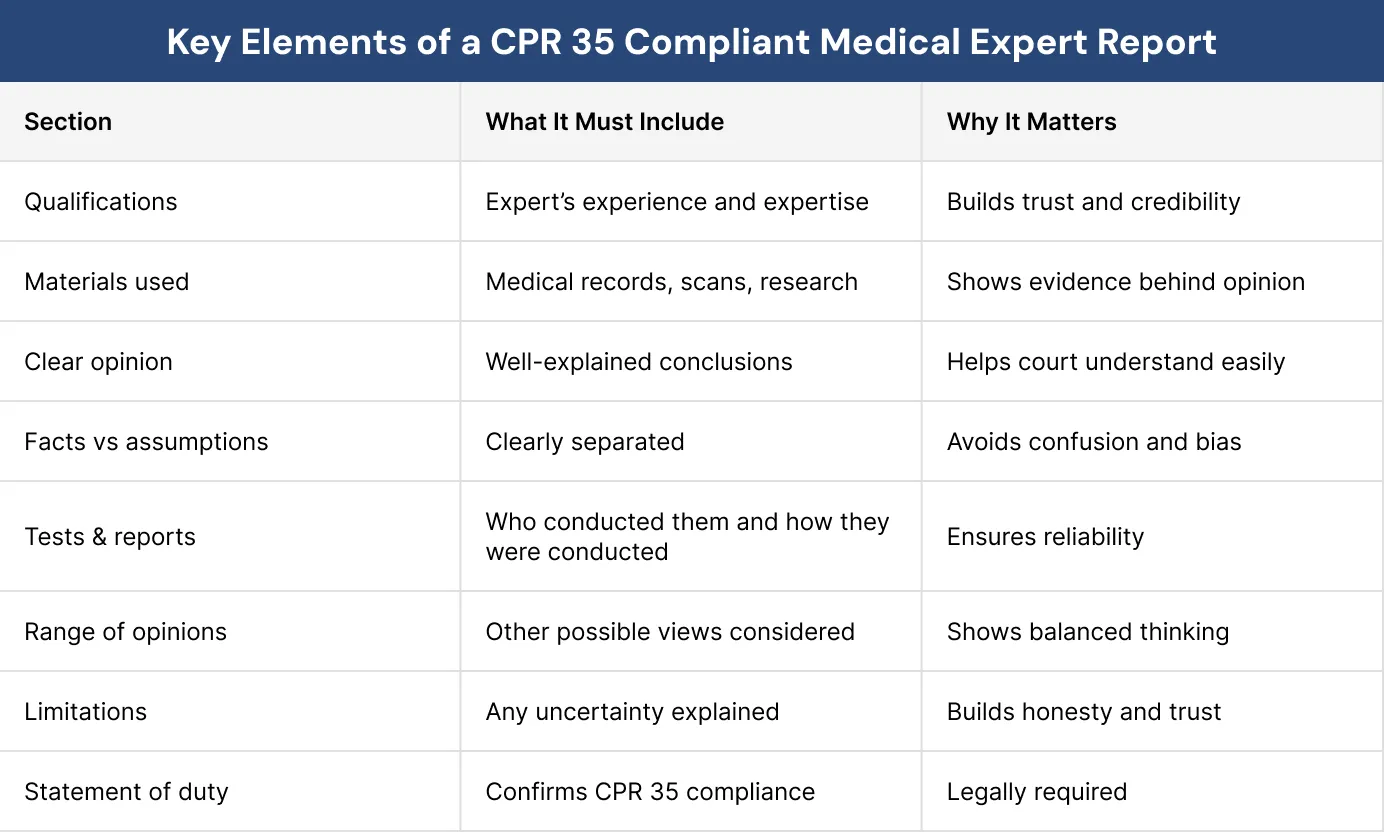
Key Elements of a CPR 35 Compliant Medical Expert Report

The Importance of Independence

Courts depend on expert witnesses to explain a case with technical details. If the expert is biased, the whole case becomes weak. This is why CPR 35 places such a strong focus on independence.

Data shows that the Crown Court cases may reach 100,000 by 2028. When courts are dealing with so many cases, they need more expert opinions to help judges understand complex medical cases.

Do Experts Always Need Court Permission?

Yes, expert evidence usually requires permission from the court. This rule helps to control unwanted reports. It also helps stop cases that have many expert opinions. This increases cost and creates confusion.

The party must explain why the expert needs permission. The court also asks details about the expert’s field and the issues they will address.

In many cases, the court allows only one expert per issue, especially smaller claims. This helps keep the process simple and fair under expert witness Civil Procedure Rules​.

Why Is Only One Expert Sometimes Allowed?

The court allows only one expert so both parties use the same expert. This is called a single joint expert. This expert acts for both parties. This helps reduce disagreement and avoid extra costs.

The court does this to reduce costs and disputes. There is a higher chance of conflict when two parties have separate experts. Each expert may support a different view. This can make the case longer and more complex.

A single joint expert helps the court focus on the facts rather than competing arguments. Both parties are usually responsible for paying the expert. This provides one neutral opinion and also encourages fairness. It is important to note that the expert’s duty is to the court , not to any of the parties.

Can Expert Reports Be Used by Other Parties?

Yes, once an expert report is shared, it can be used by any party. This rule may seem unusual but it ensures fairness. It prevents one side from controlling important evidence.

For example, if one party submits a strong medical report, the other side can rely on it if it supports their argument.

This makes the process more open and balanced. It also encourages experts to remain neutral, knowing their report is not limited to one side.

Can Experts Work Together

Yes, experts can work together under CPR Part 35.

They may be asked to meet and discuss their opinions. This helps show where they agree and where they disagree. After that, they prepare a joint statement for the court.

The statement sets out the main points of agreement and disagreement. This helps narrow the issues before trial and saves court time. Experts do not have to change their views but they must take part in a fair and professional discussion.

What Must a Medical Expert Report Include?

A medical expert report must include certain elements of Practice Direction 35. Without these, the report is incomplete. These are as follows:

1. Clear Structure

A medical expert report must follow a clear structure. This is not optional. The court expects every report to include specific details.

2. Qualifications and Experience

The report must explain who the expert is. It must show qualifications and experience. This helps the court understand why the opinion matters.

3. Materials List

It must also list the materials used. This can include medical records, scans or research papers. Without this, the opinion has no foundation.

4. Clear Opinion

The report must clearly explain the opinion. If the opinion is not certain, that must be stated. Guesswork is not accepted.

5. Clear Facts

Facts and assumptions must be separated. The expert must explain which facts come from personal knowledge and which come from external sources.

6. Test Reports

If test reports are used, they must explain which doctor carried them out and whether they were supervised.

7. Mention Different Opinions

If different opinions exist in the case, the report must mention them. It must also explain why one opinion was chosen over others.

8. Understand the Duty

The report must confirm that the expert understands the duty to the court and has followed CPR Part 35.

CPR 35 Main Focus: Structure

CPR 35 focuses heavily on structure because:

  • Structure helps the court understand the report quickly
  • Most legal cases involve information that is not necessary. A well structured report saves time and reduces confusion
  • It also shows professionalism. A clear format makes the report more reliable and easier to trust
  • CPR 35 provides this structure to ensure consistency. Every expert report follows the same basic format, making it easier to compare and evaluate

This is one of the reasons why CPR 35 is seen as essential guidance.

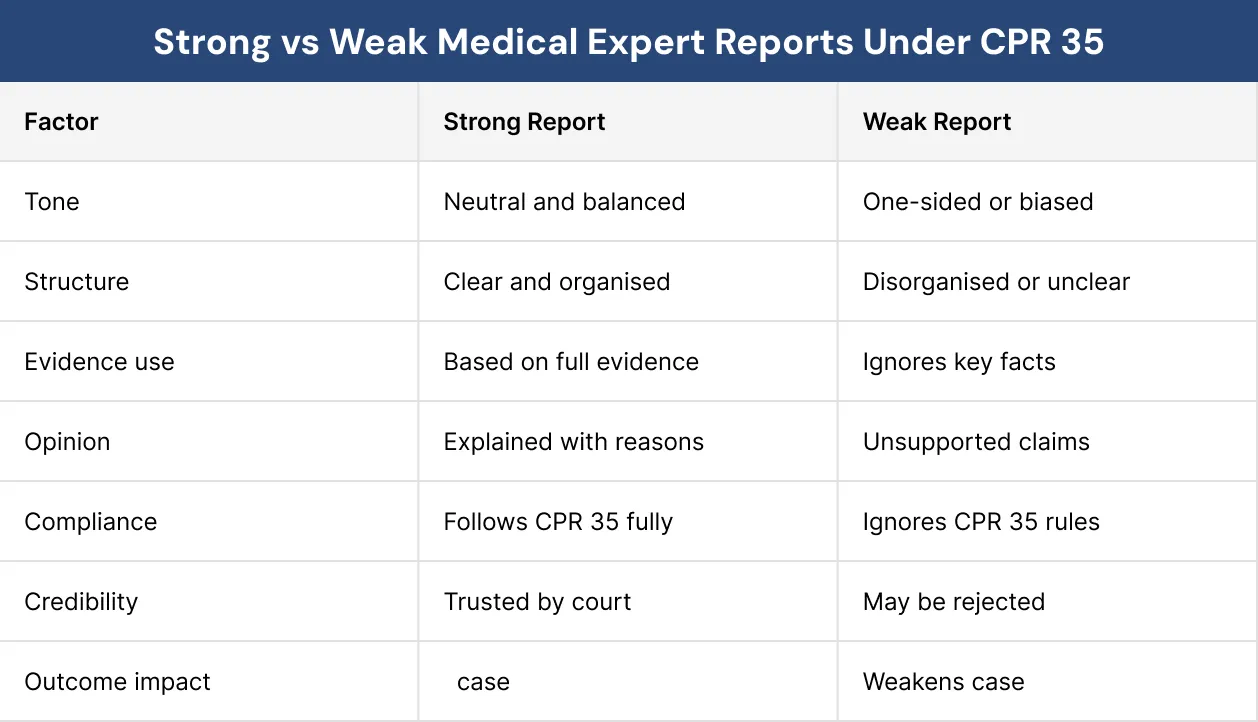
What Makes a Strong Medical Expert Report?

A strong report follows CPR 35 closely. It includes all required sections such as:

  • A strong report is not just about medical knowledge. It is about clarity, balance and structure
  • A good report explains the facts in simple terms. It avoids complex language that may confuse the court. Judges are not medical professionals, so the report must be easy to follow
  • It also shows both sides of the argument. If there are different medical opinions, they must be discussed
  • The conclusions must be clear and supported by evidence. There should be no sudden claims or unsupported statements

What Makes a Weak Expert Report?

A weak report often shows clear signs. It may ignore important facts or fail to consider all evidence. It may also sound one sided, as if written to support a specific argument.

Sometimes, the report may lack structure. Key details such as qualifications or sources may be missing. In worse cases, the expert may act like an advocate rather than an independent professional.

The case of Pal v Damen showed this clearly. The court rejected one expert report because it failed to follow CPR 35.

This example shows that even experts can make mistakes if they ignore the rules.
The Role of Experts Honesty About Limitations

Medical experts are expected to be clear about what they do not know. This may feel uncomfortable but it is necessary. Courts value honesty more than certainty. If the evidence is incomplete or unclear, the expert must mention it.

For example, if medical records are missing or limited, this report should clearly state it. The expert should also explain that the opinion may change if any further information becomes available later.

This does not make the report weaker. It actually makes it much more credible. It shows that the expert is being careful, honest and realistic.

Contrarily, overconfidence can harm credibility. If a report makes strong claims without enough support, the court may question it more closely.

How Do Medical Reports Work in Whiplash Cases?

The rules for the medical reports are stricter in whiplash claims.

Whiplash claims are common in the UK. In most cases, only one medical report is allowed. It must follow fixed cost rules. This helps control costs and it also prevents the misuse of expert evidence.

If another report for whiplash claim is needed, the court must give permission first. The extra report must also meet strict conditions. These rules help keep the process fair, clear and efficient in common injury claims.

Can Court Question Experts After Submitting a Report?

Yes, but only to a limited extent.

After an expert submits a report, the other side can usually send written questions to clarify what the report means. These questions must be reasonable and must relate only to the report. They are not meant to start a fresh argument or introduce new issues. In most cases, they can only be asked once and within a set time limit.

If the expert does not reply properly, the court can take that seriously. It may limit how much weight is given to the evidence and in some cases, the expert’s fees may not be recoverable. This rule helps keep expert reporting clear, fair and accountable.

How Should Medical Experts Prepare for Court?

The following steps help a medical expert to be prepared for a case:

  • Experts should keep detailed records of all materials they review. This helps them explain their reasoning clearly
  • Reports should be written in plain language. Short sentences and simple explanations make it easier for the court to understand
  • Experts should also be ready for cross-examination. This means explaining their opinion clearly and answering questions confidently
  • Professional distance must be maintained at all times. The expert is not part of the legal team
  • Training can also help, especially for those new to expert witness work

What Happens if an Expert Ignores Court Directions?

Ignoring court directions can cause serious problems. Experts must follow deadlines and instructions set by the court. Reports must be submitted on time. If the court asks for clarification or attendance, the expert must respond.

Important:

A medical expert’s report may be disregarded in court if it does not follow CPR 35.

Failure to do this can lead to consequences. The court may refuse to accept the expert’s evidence. This can weaken the case for the party relying on that expert.

It can also affect the expert’s professional reputation. Courts remember experts who fail to comply. This is why discipline and time management are important in expert work.

What Happens When a Medical Expert Report Does Not Follow CPR 35?

If a report does not meet the requirements, the court may reduce its importance or ignore it completely. This does not just affect the expert. It affects the entire case.

In some situations, the court may refuse to allow the expert evidence at all. This can weaken the legal argument and reduce the chances of success.

The case of Pal v Damen showed this clearly. The surgeon’s expert report failed to meet the basic requirements. It lacked balance and proper reasoning. Because of this, the court gave it no weight. This shows that structure and compliance matter just as much as knowledge.

Why Are Fees Strictly Controlled for Experts?

Expert witnesses are paid for their time but there are strict rules. The most important rule is that payment must not depend on the outcome of the case. This means no success based or contingency fees.

If an expert is paid based on winning, their independence becomes questionable. Their opinion may appear biased.

The court wants expert evidence to be neutral. Fixed or standard fees help maintain this balance.

In some cases, the court may even limit how much of the expert’s fee can be recovered from the other party.

What Is the Role of an Assessor in Court?

Sometimes the court appoints an assessor. An assessor is not the same as an expert witness. The assessor works directly with the court. Their role is to assist the judge in understanding technical matters.

They may prepare a report or attend the trial. Their input helps the court deal with complex issues.

For example, in a medical case involving detailed surgical procedures, an assessor with medical experience may help the judge understand the technical details. The court decides how much the assessor is involved. Their cost is also controlled by the court.

Case Study

Pal v Damen is a real case that happened in 2016 in the UK. Following are the details:

Background

This case study is about a patient Lisa Pal who had cosmetic breast implant surgery in Belgium. She claimed medical negligence during her surgery that caused her problems.

Findings

The case came to the UK court. Both sides brought civil procedure rules expert witnesses to explain Belgian law. The first expert gave a clear and balanced report and he looked at all the documents. He also explained his opinion step by step under CPR 35. The second expert report was one sided and did not properly review the evidence. It also ignored CPR 35 rules.

Results

The judge trusted the first expert and the second expert’s report was ignored because it did not support CPR 35. After all this process, the claimant was able to continue the case against the surgeon. This also shows that the court does not accept an expert report if it is not fair, independent and well structured.

Conclusion

CPR Part 35 not only serves as a court rule but it also protects fairness in court. Courts take help from expert witnesses for this purpose.

Medical expert witnesses should be very careful because their opinion can have emotional and financial impacts on a person’s life.

If you hire an expert who follows CPR 35, the court will place trust in your evidence. It will show that the work of the expert hired by you is careful and professional as a Civil Procedure Rules expert witness. Your case despite being strong can become weak if the expert evidence is not as per CPR 35.

It is clear that medical knowledge alone is not enough. A good expert witness must also be clear, honest and unbiased.

Concise Medico understands that CPR 35 is not always easy, especially in medical cases. That is where the right support can make a difference.

Contact us today for expert legal and medical support to give your case the right direction.

Struggling to understand CPR 35 or worried your expert report may not meet court standards?

We help ensure medical expert reports are clear, compliant and trusted in court.
Contact us today to get clear guidance and make sure your expert report meets court standards.

Struggling to understand CPR 35 or worried your expert report may not meet court standards?

We help ensure medical expert reports are clear, compliant and trusted in court.
Contact us today to get clear guidance and make sure your expert report meets court standards.

FAQs

What is CPR Part 35 in simple terms?2026-04-16T05:03:06+00:00

CPR Part 35 is a rule that explains how expert evidence should be used in civil court cases in England and Wales. It ensures that expert opinions are fair, clear and helpful to the court.

Can a medical expert support the client’s case?2026-04-16T05:03:29+00:00

A medical expert can present an opinion but it must be independent. The expert’s duty is to the court, not to the client. Supporting a case unfairly can reduce the value of the evidence.

What happens if an expert report is not compliant?2026-04-16T05:03:52+00:00

If a report does not follow CPR 35, the court may ignore it or give it very little weight. This can weaken the case significantly.

Are multiple experts allowed in a case?2026-04-16T05:04:15+00:00

Sometimes but the court often limits expert evidence. In many cases, only one expert is allowed for each issue to keep the process simple and fair.

Do experts need to attend court?2026-04-16T05:04:47+00:00
Share This Article!

Do you know what could happen if a judge ignores an expert opinion in court?

You may be surprised but it happens frequently. The medical report contains evidence and information that does not follow the rules set by the court. In the UK, these rules are set out under CPR 35.

CPR 35 guides how expert opinions should be presented in court. It explains the expectations of the court from an expert witness and the value their opinion carries.

When courts are under pressure, clear and reliable expert evidence becomes even more important. UK data shows that in magistrates’ courts, 379,437 cases were still waiting in December 2025. This was the highest number since 2019.

A medical expert witness opinion only matters if it is clear, fair and properly structured. A strong case can become weak if their opinion is weak. These experts help in cases such as:

  • Personal injury
  • Medical negligence
  • Whiplash claims

Key Takeaways

  • CPR Part 35 must always be followed. A medical expert witness can still be ignored by the court if the report does not meet the rules
  • The main duty under CPR 35 is to the court, not to the client. This is one of the most important expert witness rules in UK civil cases
  • A strong medical expert report should be clear, balanced and well structured. It should include qualifications, facts, assumptions, evidence used and clear conclusions
  • Good expert evidence must be independent and based on full evidence. Courts do not want one-sided opinions or reports that sound like legal arguments
  • Under Practice Direction 35 and CPR Part 35, experts should be honest about any limits, missing records or uncertain points in the case
  • Medical expert witnesses in the UK must follow court deadlines, answer proper written questions and stay ready for cross-examination when needed
  • The real purpose of expert evidence under CPR 35 is to help the court understand complex medical facts clearly, not to help one side win the case

What Is CPR Part 35?

CPR Part 35 (or Part 35 of the Civil Procedure Rules) refers to the rules that control how expert evidence is used in civil cases in England and Wales. This is why courts treat CPR Part 35 very seriously. Experts are obliged to follow these rules. It applies to all experts, including:

  • Doctors
  • Paramedics
  • Clinical specialists

The main goal of CPR 35 is to make sure expert evidence helps the court, not any party involved in a case.

It is a capital mistake to theorise before one has data.

– Arthur Conan Doyle, Author & Physician

It exists so that judges can understand complex issues through opinions that are clear, independent and relevant. Under CPR 35, expert evidence should be:

  • Reliable
  • Independent
  • Useful

Without CPR 35, expert evidence could become biased, less trustworthy and harder for the court to rely on.

What Is the Real Purpose of Expert Evidence?

The real purpose of expert evidence under CPR 35 is explained as:

  • Expert evidence is not used to win the case, it is used to explain the truth
  • Medical cases can involve complex details. The judge relies on expert witnesses to understand these details properly
  • If the expert remains honest and clear, the court can make a fair decision
  • If the expert becomes biased, the process under CPR 35 breaks down

The Most Important Rule Under CPR 35

The most important rule under CPR 35 is that the expert must work for the court, not for the client. This means the expert must always remain independent. The court expects honesty from experts. It does not matter even if one party pays the expert, the opinion must stay fair and unbiased.

Note:

The expert’s duty is to the court, not to the client.

If an expert starts acting like an advocate to support one side, the report loses value. Judges may ignore the report completely due to bias. This principle is frequently used in CPR 35 because it is the basis of expert evidence.

What Is the Duty of a Medical Expert Witness?

A medical expert witness’s duty is to explain medical facts to the court in a clear way. The role is not to win the case but to help the judge understand the key issues such as:

  • Injuries
  • Treatments
  • Outcomes

Many legal cases involve medical questions that a judge cannot answer alone. This is where expert evidence becomes important.

Example

This example will help you to know the role of expert witness under CPR 35. In a whiplash injury claim, the court needs to know:

  • If the injury is real
  • How serious it is
  • How long recovery may take

A medical expert provides an opinion that is based on knowledge and evidence. The opinion must be honest and based on facts. It should not be altered just to support the person who hired the expert.

Key Elements of a CPR 35 Compliant Medical Expert Report

The Importance of Independence

Courts depend on expert witnesses to explain a case with technical details. If the expert is biased, the whole case becomes weak. This is why CPR 35 places such a strong focus on independence.

Data shows that the Crown Court cases may reach 100,000 by 2028. When courts are dealing with so many cases, they need more expert opinions to help judges understand complex medical cases.

Do Experts Always Need Court Permission?

Yes, expert evidence usually requires permission from the court. This rule helps to control unwanted reports. It also helps stop cases that have many expert opinions. This increases cost and creates confusion.

The party must explain why the expert needs permission. The court also asks details about the expert’s field and the issues they will address.

In many cases, the court allows only one expert per issue, especially smaller claims. This helps keep the process simple and fair under expert witness Civil Procedure Rules​.

Why Is Only One Expert Sometimes Allowed?

The court allows only one expert so both parties use the same expert. This is called a single joint expert. This expert acts for both parties. This helps reduce disagreement and avoid extra costs.

The court does this to reduce costs and disputes. There is a higher chance of conflict when two parties have separate experts. Each expert may support a different view. This can make the case longer and more complex.

A single joint expert helps the court focus on the facts rather than competing arguments. Both parties are usually responsible for paying the expert. This provides one neutral opinion and also encourages fairness. It is important to note that the expert’s duty is to the court , not to any of the parties.

Can Expert Reports Be Used by Other Parties?

Yes, once an expert report is shared, it can be used by any party. This rule may seem unusual but it ensures fairness. It prevents one side from controlling important evidence.

For example, if one party submits a strong medical report, the other side can rely on it if it supports their argument.

This makes the process more open and balanced. It also encourages experts to remain neutral, knowing their report is not limited to one side.

Can Experts Work Together

Yes, experts can work together under CPR Part 35.

They may be asked to meet and discuss their opinions. This helps show where they agree and where they disagree. After that, they prepare a joint statement for the court.

The statement sets out the main points of agreement and disagreement. This helps narrow the issues before trial and saves court time. Experts do not have to change their views but they must take part in a fair and professional discussion.

What Must a Medical Expert Report Include?

A medical expert report must include certain elements of Practice Direction 35. Without these, the report is incomplete. These are as follows:

1. Clear Structure

A medical expert report must follow a clear structure. This is not optional. The court expects every report to include specific details.

2. Qualifications and Experience

The report must explain who the expert is. It must show qualifications and experience. This helps the court understand why the opinion matters.

3. Materials List

It must also list the materials used. This can include medical records, scans or research papers. Without this, the opinion has no foundation.

4. Clear Opinion

The report must clearly explain the opinion. If the opinion is not certain, that must be stated. Guesswork is not accepted.

5. Clear Facts

Facts and assumptions must be separated. The expert must explain which facts come from personal knowledge and which come from external sources.

6. Test Reports

If test reports are used, they must explain which doctor carried them out and whether they were supervised.

7. Mention Different Opinions

If different opinions exist in the case, the report must mention them. It must also explain why one opinion was chosen over others.

8. Understand the Duty

The report must confirm that the expert understands the duty to the court and has followed CPR Part 35.

CPR 35 Main Focus: Structure

CPR 35 focuses heavily on structure because:

  • Structure helps the court understand the report quickly
  • Most legal cases involve information that is not necessary. A well structured report saves time and reduces confusion
  • It also shows professionalism. A clear format makes the report more reliable and easier to trust
  • CPR 35 provides this structure to ensure consistency. Every expert report follows the same basic format, making it easier to compare and evaluate

This is one of the reasons why CPR 35 is seen as essential guidance.

What Makes a Strong Medical Expert Report?

A strong report follows CPR 35 closely. It includes all required sections such as:

  • A strong report is not just about medical knowledge. It is about clarity, balance and structure
  • A good report explains the facts in simple terms. It avoids complex language that may confuse the court. Judges are not medical professionals, so the report must be easy to follow
  • It also shows both sides of the argument. If there are different medical opinions, they must be discussed
  • The conclusions must be clear and supported by evidence. There should be no sudden claims or unsupported statements

What Makes a Weak Expert Report?

A weak report often shows clear signs. It may ignore important facts or fail to consider all evidence. It may also sound one sided, as if written to support a specific argument.

Sometimes, the report may lack structure. Key details such as qualifications or sources may be missing. In worse cases, the expert may act like an advocate rather than an independent professional.

The case of Pal v Damen showed this clearly. The court rejected one expert report because it failed to follow CPR 35.

This example shows that even experts can make mistakes if they ignore the rules.

The Role of Experts Honesty About Limitations

Medical experts are expected to be clear about what they do not know. This may feel uncomfortable but it is necessary. Courts value honesty more than certainty. If the evidence is incomplete or unclear, the expert must mention it.

For example, if medical records are missing or limited, this report should clearly state it. The expert should also explain that the opinion may change if any further information becomes available later.

This does not make the report weaker. It actually makes it much more credible. It shows that the expert is being careful, honest and realistic.

Contrarily, overconfidence can harm credibility. If a report makes strong claims without enough support, the court may question it more closely.

How Do Medical Reports Work in Whiplash Cases?

The rules for the medical reports are stricter in whiplash claims.

Whiplash claims are common in the UK. In most cases, only one medical report is allowed. It must follow fixed cost rules. This helps control costs and it also prevents the misuse of expert evidence.

If another report for whiplash claim is needed, the court must give permission first. The extra report must also meet strict conditions. These rules help keep the process fair, clear and efficient in common injury claims.

Can Court Question Experts After Submitting a Report?

Yes, but only to a limited extent.

After an expert submits a report, the other side can usually send written questions to clarify what the report means. These questions must be reasonable and must relate only to the report. They are not meant to start a fresh argument or introduce new issues. In most cases, they can only be asked once and within a set time limit.

If the expert does not reply properly, the court can take that seriously. It may limit how much weight is given to the evidence and in some cases, the expert’s fees may not be recoverable. This rule helps keep expert reporting clear, fair and accountable.

How Should Medical Experts Prepare for Court?

The following steps help a medical expert to be prepared for a case:

  • Experts should keep detailed records of all materials they review. This helps them explain their reasoning clearly
  • Reports should be written in plain language. Short sentences and simple explanations make it easier for the court to understand
  • Experts should also be ready for cross-examination. This means explaining their opinion clearly and answering questions confidently
  • Professional distance must be maintained at all times. The expert is not part of the legal team
  • Training can also help, especially for those new to expert witness work

What Happens if an Expert Ignores Court Directions?

Ignoring court directions can cause serious problems. Experts must follow deadlines and instructions set by the court. Reports must be submitted on time. If the court asks for clarification or attendance, the expert must respond.

Important:

A medical expert’s report may be disregarded in court if it does not follow CPR 35.

Failure to do this can lead to consequences. The court may refuse to accept the expert’s evidence. This can weaken the case for the party relying on that expert.

It can also affect the expert’s professional reputation. Courts remember experts who fail to comply. This is why discipline and time management are important in expert work.

What Happens When a Medical Expert Report Does Not Follow CPR 35?

If a report does not meet the requirements, the court may reduce its importance or ignore it completely. This does not just affect the expert. It affects the entire case.

In some situations, the court may refuse to allow the expert evidence at all. This can weaken the legal argument and reduce the chances of success.

The case of Pal v Damen showed this clearly. The surgeon’s expert report failed to meet the basic requirements. It lacked balance and proper reasoning. Because of this, the court gave it no weight. This shows that structure and compliance matter just as much as knowledge.

Why Are Fees Strictly Controlled for Experts?

Expert witnesses are paid for their time but there are strict rules. The most important rule is that payment must not depend on the outcome of the case. This means no success based or contingency fees.

If an expert is paid based on winning, their independence becomes questionable. Their opinion may appear biased.

The court wants expert evidence to be neutral. Fixed or standard fees help maintain this balance.

In some cases, the court may even limit how much of the expert’s fee can be recovered from the other party.

What Is the Role of an Assessor in Court?

Sometimes the court appoints an assessor. An assessor is not the same as an expert witness. The assessor works directly with the court. Their role is to assist the judge in understanding technical matters.

They may prepare a report or attend the trial. Their input helps the court deal with complex issues.

For example, in a medical case involving detailed surgical procedures, an assessor with medical experience may help the judge understand the technical details. The court decides how much the assessor is involved. Their cost is also controlled by the court.

Case Study

Pal v Damen is a real case that happened in 2016 in the UK. Following are the details:

Background

This case study is about a patient Lisa Pal who had cosmetic breast implant surgery in Belgium. She claimed medical negligence during her surgery that caused her problems.

Findings

The case came to the UK court. Both sides brought civil procedure rules expert witnesses to explain Belgian law. The first expert gave a clear and balanced report and he looked at all the documents. He also explained his opinion step by step under CPR 35. The second expert report was one sided and did not properly review the evidence. It also ignored CPR 35 rules.

Results

The judge trusted the first expert and the second expert’s report was ignored because it did not support CPR 35. After all this process, the claimant was able to continue the case against the surgeon. This also shows that the court does not accept an expert report if it is not fair, independent and well structured.

Conclusion

CPR Part 35 not only serves as a court rule but it also protects fairness in court. Courts take help from expert witnesses for this purpose.

Medical expert witnesses should be very careful because their opinion can have emotional and financial impacts on a person’s life.

If you hire an expert who follows CPR 35, the court will place trust in your evidence. It will show that the work of the expert hired by you is careful and professional as a Civil Procedure Rules expert witness. Your case despite being strong can become weak if the expert evidence is not as per CPR 35.

It is clear that medical knowledge alone is not enough. A good expert witness must also be clear, honest and unbiased.

Concise Medico understands that CPR 35 is not always easy, especially in medical cases. That is where the right support can make a difference.

Contact us today for expert legal and medical support to give your case the right direction.

Struggling to understand CPR 35 or worried your expert report may not meet court standards?

We help ensure medical expert reports are clear, compliant and trusted in court.
Contact us today to get clear guidance and make sure your expert report meets court standards.

Struggling to understand CPR 35 or worried your expert report may not meet court standards?

We help ensure medical expert reports are clear, compliant and trusted in court.
Contact us today to get clear guidance and make sure your expert report meets court standards.

FAQs

What is CPR Part 35 in simple terms?2026-04-16T05:03:06+00:00

CPR Part 35 is a rule that explains how expert evidence should be used in civil court cases in England and Wales. It ensures that expert opinions are fair, clear and helpful to the court.

Can a medical expert support the client’s case?2026-04-16T05:03:29+00:00

A medical expert can present an opinion but it must be independent. The expert’s duty is to the court, not to the client. Supporting a case unfairly can reduce the value of the evidence.

What happens if an expert report is not compliant?2026-04-16T05:03:52+00:00

If a report does not follow CPR 35, the court may ignore it or give it very little weight. This can weaken the case significantly.

Are multiple experts allowed in a case?2026-04-16T05:04:15+00:00

Sometimes but the court often limits expert evidence. In many cases, only one expert is allowed for each issue to keep the process simple and fair.

Do experts need to attend court?2026-04-16T05:04:47+00:00
Go to Top