TABLE OF CONTENT
What do criminal injuries solicitors do when someone gets hurt due to a violent crime in the UK?
A violent crime does not only hurt people physically but also affects their mental peace. It affects daily life activities of a victim and may bring financial issues for them. That’s why the UK government has a Criminal Injuries Compensation Authority (CICA). It manages claims to compensate the innocent victims.
Data shows that in the UK, violence against the person assaults hit 2.1 million cases in 2022/23. That’s a huge number of people dealing with violent crimes. It’s exactly why claims with CICA matter so much.
In the UK, many people feel lost and confused when they face violence. They do not know what step can help them.
When you feel hopeless after being injured in an act of violence. In this situation, criminal injuries solicitors can help you.
The best way out is always through.
– Robert Frost, Poet
Criminal injuries solicitors help you to understand your rights. They guide you at every step to bring relief and help you manage difficult situations. This shows how important criminal injuries lawyers are in such cases.
Understanding Crime and Criminal Injury
Before looking at CICA claims, it is important to understand what a crime and violent crime mean and what is criminal injury. These form the basis of a compensation claim.
1. What Is a Crime
A crime is an act of breaking the law that can harm a person, property or society.
2. The Violent Crime
The act of violent crime involves force that causes fear, injury or harm to a person. This includes:
- Assault
- Abuse
- Threat
3. The Criminal Injury
A criminal injury is harm as a result of a violent crime. This can be:
- Physical injury
- Psychological impact such as anxiety, trauma or shock
The Role of CICA Scheme
CICA is a UK govt. Scheme that supports victims of violent crime. It plays a crucial role in supporting these victims in the UK.
CICA matters because it gives support to innocent people who have been harmed in a violent crime. This means they may be able to claim compensation. It is also important because it follows UK government rules. That is why it helps to build trust.
A person who is hurt because of a violent crime can ask for support through the Criminal Injuries Compensation Authority. Criminal injuries solicitors help them get support.
This is where legal support becomes important but many people do not apply for CICA claims because some:
- Do not know about it
- Think it is not easy
- Feel the process is stressful
What Types of Injuries CICA Scheme Cover
Not all crimes but many violent crimes are covered under the CICA scheme. These cases involve physical or psychological harm to a person. Some common examples include:
- Assault (ABH, GBH): physical attacks that cause injury
- Sexual abuse: including assault and exploitation
- Domestic violence: injuries caused by family member
- Terrorism: injuries caused during terror-related incidents
- Human trafficking: forced movement or exploitation
- Fatal claims: when a person dies due to a violent crime
Each case is assessed based on the harm caused and the available evidence.
How Criminal Injuries Solicitors Help People
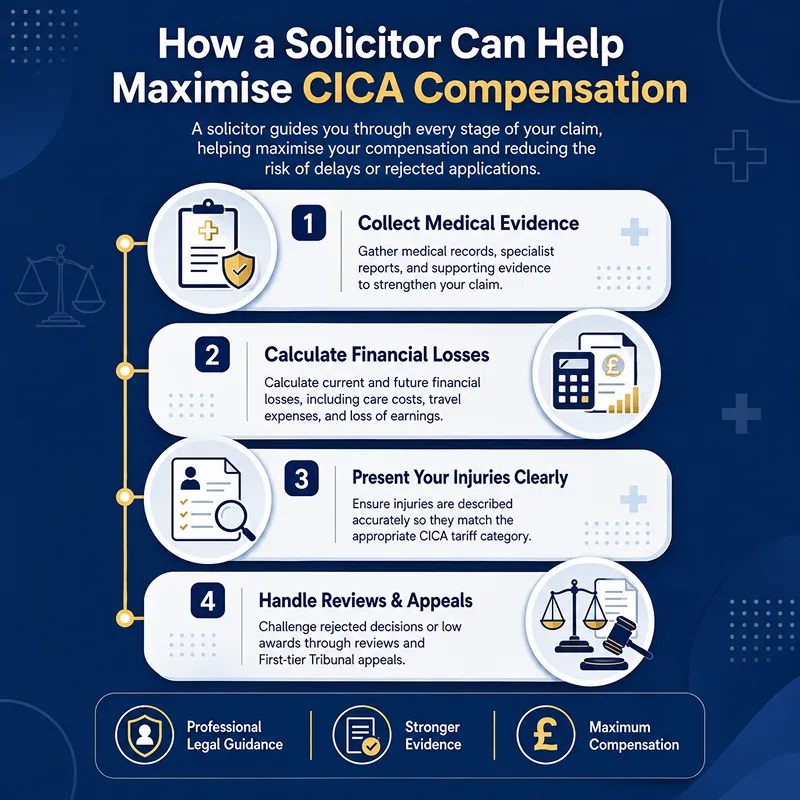
Criminal injuries solicitors help people apply for compensation through the CICA. They guide the whole process, not just filling in forms.
They gather evidence to check if a person is eligible for compensation. They prepare a strong and clear claim and deal with any delays or issues.
Many people try to apply without CICA solicitors but this can lead to rejection because of:
- Missing documents
- Wrong details
- Late submission
CICA lawyers help avoid these problems.
Who Can Make a CICA Claim
If you are injured because of an act of criminal activity in the UK, you can make a CICA claim. A few things have to line up first:
There are some key conditions:
- You need to report the incident to the police
- Stick to the deadline for making a claim
- Work with the authorities throughout the process
Talking to a CICA lawyer clears up any confusion and lets you know exactly where you stand.
Family members aren’t left out either. Sometimes, if someone dies as a result of a crime, their relatives can make a claim too.

What About Non-UK Citizens
Most of the time, this scheme is for people living in the UK. Still, some non-UK citizens do qualify but there are some specific rules for that, set by the government.
Reasons Behind People’s Struggle With CICA Claims
The process may look simple at first but it can become difficult. This is why support matters because:
- Forms can feel confusing
- Evidence may be missing
- Time limits may pass without knowing
- Some people also feel emotional stress
- Reliving the incident again and again is not easy
- There is also the issue of understanding legal terms
- Many people feel unsure what to write or how to explain their situation
CICA Claims Solicitors Make Your Journey Easier
A CICA solicitor does not just help with paperwork, this also saves time. The following steps explain the importance of CICA solicitors:
- They provide clarity
- They explain what is needed
- They collect medical records
- They speak to authorities if required
- They also make sure deadlines are not missed
- If a claim is rejected, they can help with an appeal
Do You Have to Pay a Solicitor
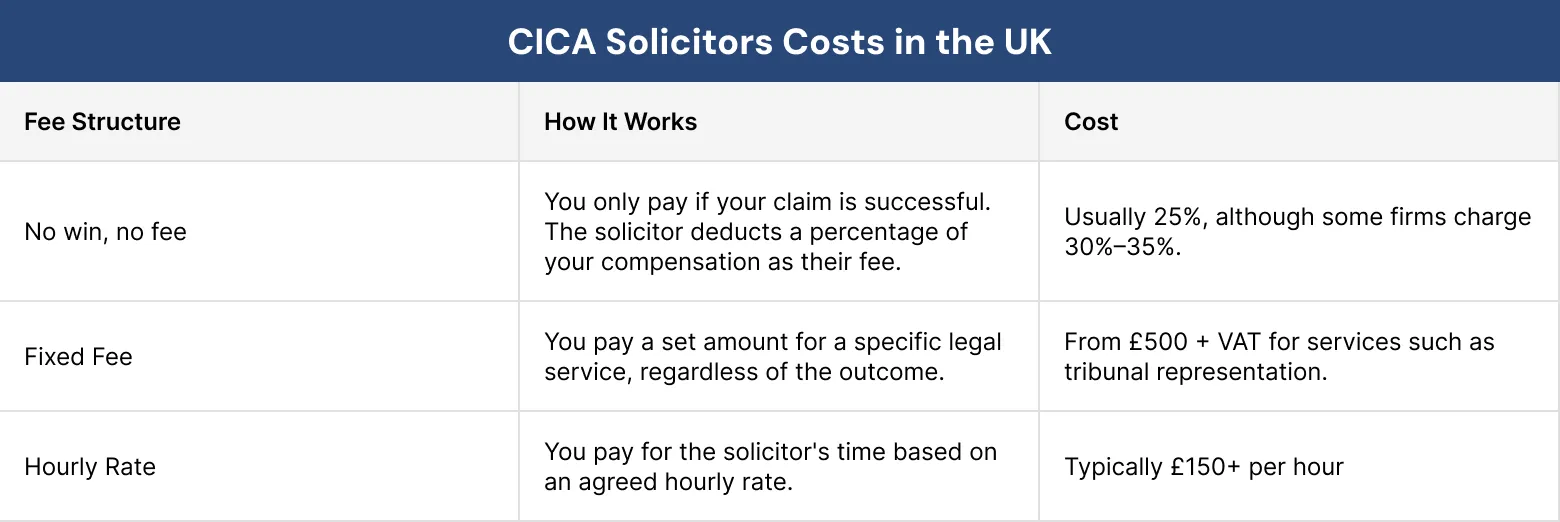
You can make a CICA without a solicitor. There is no legal requirement to hire a lawyer. However, solicitors may charge a fee if you choose to use their services. Some only charge you if they win your case
Many people choose legal support to reduce mistakes and improve the chances of success.
The Tariff System in CICA Claims
The CICA scheme uses a tariff system to decide how much compensation a person may receive. This system is set by the UK government and follows fixed rules. It means each type of injury has a set value based on its seriousness.
The tariff is divided into different levels such as:
- Minor injuries have lower amounts
- More serious injuries have higher amounts
For example, a small physical injury may fall in a lower band, while long-term psychological harm may fall in a higher band.
1. What Happens if a Person Have Multiple Injuries
In many cases, a person may have more than one injury. The scheme does consider multiple injuries but it does not simply add all amounts together. Usually, the highest value injury is paid in full and other injuries may be added at a reduced rate.
2. How Compensation Is Decided
The decision is made using medical evidence, police reports and other supporting documents. According to CICA guidelines, the focus is on the impact of the injury, not just the incident itself.
The tariff system helps keep the process fair and consistent. It ensures that similar cases are treated in a similar way. This makes it easier to understand what a claim may be worth and how decisions are made.
3. What Is the Compensation Range
In most cases, the compensation minimum range is around £1,000. In very serious cases maximum range can be up to £500,000.
Most common claims fall in the middle range, often between £1,000 to £11,000 for minor to moderate injuries and higher amounts for serious, long-term or multiple injuries
The exact amount depends on:
- Type of injury
- Severity of harm
- Impact on daily life
In simple terms, the more serious and lasting the injury, the higher the compensation may be.
The Role of Evidence in CICA Claims
Evidence plays a key role in CICA claims. A claim can become weak if evidence is not clear.
There are also some other elements that help to make a successful claim, such as:
- Police reports
- Medical records
- Witness statements
Many people do not know what to include or how to present the claim. Criminal injuries solicitors understand what is needed and they make sure nothing important is missed.

You Don’t Need the Offender to be Caught
A claim can still be made even if the offender is not identified or convicted. The CICA scheme is designed to support victims based on evidence, not just court outcomes. When the offender is not identified or convicted, the CICA scheme still considers the claim based on available evidence, a claim can still be considered.
How CICA Scheme Works
The CICA scheme follows strict rules and guidelines. According to CICA guidelines, each claim is reviewed based on evidence. CICA scheme works on following
1. Time Limit to Make a Claim
The CICA scheme requires claims to be made within two years from the date of the incident. In some cases, this time limit can be extended.
For example, if the victim was a child and the incident was reported to the police before their 18th birthday, they can usually apply until their 20th birthday.
2. What Happens if the Time Limit Is Missed
If the time limit is missed, the claim may be rejected. However, exceptions exist in special cases. Still, it is always safer to act early.
Time limits create pressure but they also ensure cases are handled in a timely way. Delays make it harder to gather evidence. That is why early action is important.
The Process of Making a CICA Claim
At the start, the process of making a CICA claim may feel long. It becomes easier to understand when you follow the steps.
The following are the steps that help in making a CICA claim:
1. Report the Incident
The first step is to report the crime to the police as soon as possible. Reporting still helps in some cases even if it is late. The police usually give you a crime reference number that is used in a claim.
2. Seek Medical Help
Medical treatment is not only for recovery, it is also for records. These records show that a violent crime caused you the injury. Even small injuries should be checked. These records support the claim later.
In many cases, mental health support is also important. This includes:
- Counselling
- Therapy
3. Start the CICA Application
The application is usually done online. Basic details are required such as:
- Personal information
- Incident details
- Injury description
Many people feel confused when providing information, such as:
- Some write too little
- Some miss key details
- Some are unsure how to explain what happened
A criminal injuries solicitor is there to support you. Their help makes this part strong and clear when making a CICA claim.
4. Submit Supporting Evidence
After the application, evidence must be added. If something is missing, the case may be delayed. A criminal injuries solicitor collects and organises all this properly.
5. Wait for Decision
Once everything is submitted, the case is reviewed. This stage takes some time, sometimes even months. The authority checks all details. They may also contact police or doctors. A clear and complete application reduces delays.
6. Receive the Outcome
There are three possible outcomes after the decision:
- The claim is either accepted or rejected
- Compensation is offered if claim is accepted
- Reasons are given If claim is rejected
What to do if a Claim Is Rejected
Many people think rejection of a claim is final. A criminal injuries solicitor can explain the reason for rejection and guide you some steps. The following steps can be taken:
1. Review Stage
The first step is to request a review after rejection. This must usually be done within a set time. New evidence can be added and errors can be corrected.
2. Appeal Stage
If the review is not successful, the case can go to an independent tribunal. This stage involves a deeper review of the case.
3. Important Points
- Strong evidence improves appeal success
- Clear explanation of impact is important
- Deadlines must be followed carefully
Many successful claims come after review or appeal when the case is better prepared.
Common Mistakes That Cause Problems
Mistakes are common but they can affect the outcome. The following are the mistakes you should avoid when claiming from CICA:
- One common issue is delay. Waiting too long to apply for a claim
- Another issue is missing evidence. Without proof, the case becomes weak
- Some people also give unclear information. This makes it hard to understand the situation
- In some cases, people do not follow up and the case stays pending
Criminal injuries solicitors help avoid these mistakes.
How Solicitors Increase the Chances of Success
A strong claim is not only about truth, it is also about clarity and structure. Solicitors know how to present the case properly. This improves the chances of success because:
- They write clear descriptions
- They link evidence to the injury
- They explain the impact
- They understand how the authority reviews cases
Preparing Before Applying
Start preparing by collecting all details about the incident. Some small steps make a big difference later. Following are the steps:
- Write down what happened including date, time and location of the incident
- Keep all medical records safe
- Stay in contact with the police if needed
- Avoid guessing information. Only include what is accurate. If unsure, seek help early
Recovery Beyond Compensation
Compensation is not only about money. It is also about recognition of harm. It helps:
- Cover costs
- Medical care
- Lost income
- Support recovery in a deeper way
Knowing that action was taken can bring some peace. CICA solicitors support both the legal and emotional side.
Why Choosing a Criminal Injuries Solicitor Matters
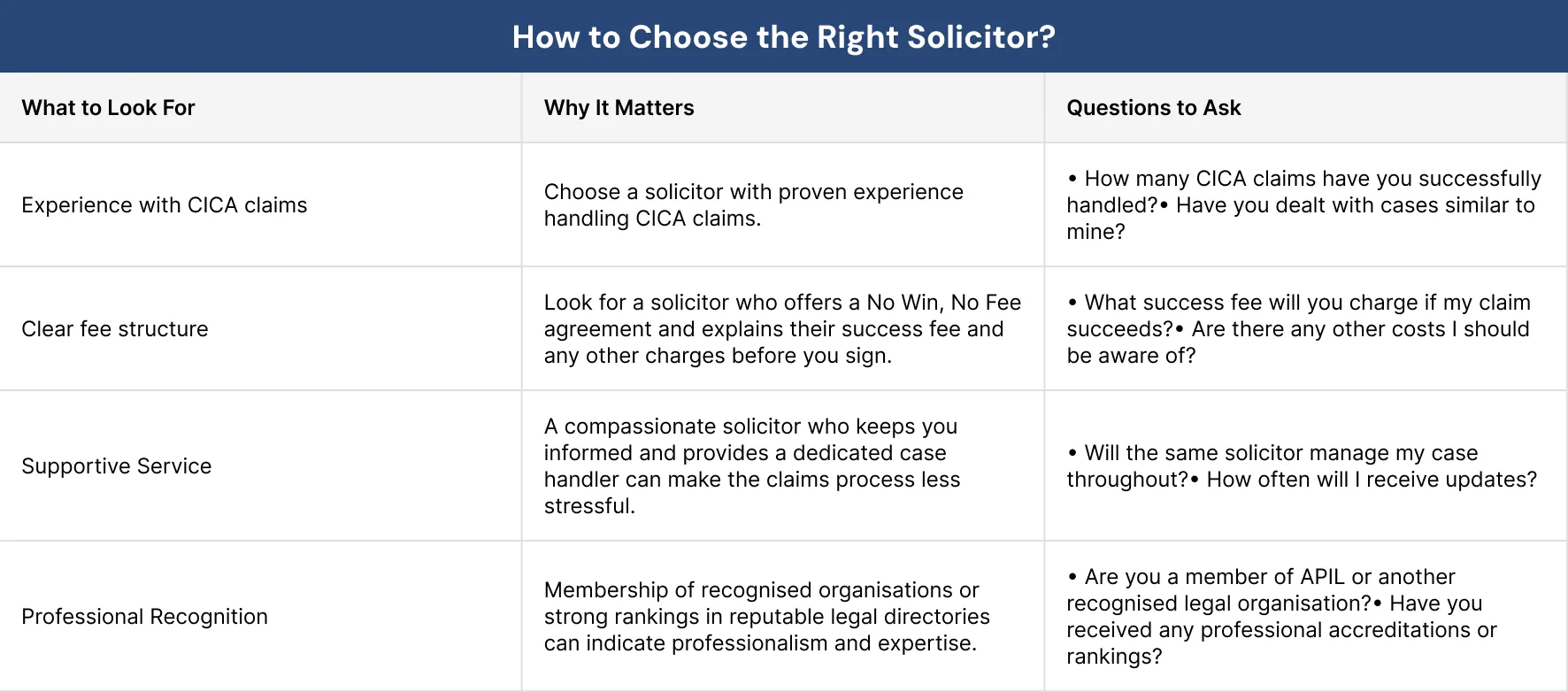
Different criminal injuries solicitors do not have the same experience. Choosing the right criminal injuries solicitor is important because:
- Some may not specialise in CICA claims
- Some may not fully understand the process
A criminal injuries solicitor explains things simply and responds on time. They also keep communication clear and care about the case.
Signs of a Good Criminal Injuries Solicitor
A good criminal injuries solicitor does not rush and listens carefully. They:
- Ask the right questions
- Check details properly
- Explain each step in simple words
A criminal injuries solicitor does not create confusion. There are no hidden steps in the process and it feels clear and guided.
Emotional Side of the CICA Process
Despite being a legal process, the CICA process has an emotional side as well. This is because it involves real people’s experiences. Support matters because some cases involve:
- Shock
- Fear
- Loss
A good criminal injuries solicitor understands the situation behind the case. They work with patience and make the process more human.
Case Study
This case happened in the UK. Following are the details of this case:
1. Background
This case study is about a young woman Emma. She was attacked by a former partner. She claimed that the incident caused both physical injuries and emotional distress.
2. Findings
At first, the application was made without proper guidance of a criminal injuries solicitor. The case was weak and at risk of being rejected because important details were missing.
A criminal injuries solicitor was hired later. He reviewed the case and explained the situation clearly in the claim. Not just what happened but how it affected daily life.
3. Results
The claim was accepted after review. That was in the range of £3,000 to £11,000, based on standard CICA injury bands. The compensation was awarded based on both:
- Physical harm
- Psychological harm
4. Lesson
This case shows that a true story alone is not always enough. It must be explained clearly with proper evidence. With the right support, even delayed or weak claims can become strong and successful.
Conclusion
The pain and stress after a violent incident can make the support process feel difficult. Sometimes you stay silent, thinking that you are alone in this journey.
After an incident you do not know what you should do next to find the right support. It does not matter how hard the situation is, the CICA scheme supports innocent victims at every step.
The CICA lawyers present the claim in a strong way. It helps gather the right evidence and offers financial support. This is how criminal injuries solicitors provide fair outcomes.
When you take early action with the right support of criminal injuries solicitors, it unfolds the process in a clear and easy way. It helps reduce stress and gives you surety. This first small step helps you move forward with confidence.
Concise Medico understands how important clear and reliable medical evidence is in building a strong and successful CICA claim.
Contact us today and start your claim journey with the best criminal injuries solicitors.

FAQs
What do criminal injuries solicitors do when someone gets hurt due to a violent crime in the UK?
A violent crime does not only hurt people physically but also affects their mental peace. It affects daily life activities of a victim and may bring financial issues for them. That’s why the UK government has a Criminal Injuries Compensation Authority (CICA). It manages claims to compensate the innocent victims.
Data shows that in the UK, violence against the person assaults hit 2.1 million cases in 2022/23. That’s a huge number of people dealing with violent crimes. It’s exactly why claims with CICA matter so much.
In the UK, many people feel lost and confused when they face violence. They do not know what step can help them.
When you feel hopeless after being injured in an act of violence. In this situation, criminal injuries solicitors can help you.
The best way out is always through.
– Robert Frost, Poet
Criminal injuries solicitors help you to understand your rights. They guide you at every step to bring relief and help you manage difficult situations. This shows how important criminal injuries lawyers are in such cases.
Understanding Crime and Criminal Injury
Before looking at CICA claims, it is important to understand what a crime and violent crime mean and what is criminal injury. These form the basis of a compensation claim.
1. What Is a Crime
A crime is an act of breaking the law that can harm a person, property or society.
2. The Violent Crime
The act of violent crime involves force that causes fear, injury or harm to a person. This includes:
- Assault
- Abuse
- Threat
3. The Criminal Injury
A criminal injury is harm as a result of a violent crime. This can be:
- Physical injury
- Psychological impact such as anxiety, trauma or shock
The Role of CICA Scheme
CICA is a UK govt. Scheme that supports victims of violent crime. It plays a crucial role in supporting these victims in the UK.
CICA matters because it gives support to innocent people who have been harmed in a violent crime. This means they may be able to claim compensation. It is also important because it follows UK government rules. That is why it helps to build trust.
A person who is hurt because of a violent crime can ask for support through the Criminal Injuries Compensation Authority. Criminal injuries solicitors help them get support.
This is where legal support becomes important but many people do not apply for CICA claims because some:
- Do not know about it
- Think it is not easy
- Feel the process is stressful
What Types of Injuries CICA Scheme Cover
Not all crimes but many violent crimes are covered under the CICA scheme. These cases involve physical or psychological harm to a person. Some common examples include:
- Assault (ABH, GBH): physical attacks that cause injury
- Sexual abuse: including assault and exploitation
- Domestic violence: injuries caused by family member
- Terrorism: injuries caused during terror-related incidents
- Human trafficking: forced movement or exploitation
- Fatal claims: when a person dies due to a violent crime
Each case is assessed based on the harm caused and the available evidence.
How Criminal Injuries Solicitors Help People
Criminal injuries solicitors help people apply for compensation through the CICA. They guide the whole process, not just filling in forms.
They gather evidence to check if a person is eligible for compensation. They prepare a strong and clear claim and deal with any delays or issues.
Many people try to apply without CICA solicitors but this can lead to rejection because of:
- Missing documents
- Wrong details
- Late submission
CICA lawyers help avoid these problems.
Who Can Make a CICA Claim
If you are injured because of an act of criminal activity in the UK, you can make a CICA claim. A few things have to line up first:
There are some key conditions:
- You need to report the incident to the police
- Stick to the deadline for making a claim
- Work with the authorities throughout the process
Talking to a CICA lawyer clears up any confusion and lets you know exactly where you stand.
Family members aren’t left out either. Sometimes, if someone dies as a result of a crime, their relatives can make a claim too.

What About Non-UK Citizens
Most of the time, this scheme is for people living in the UK. Still, some non-UK citizens do qualify but there are some specific rules for that, set by the government.
Reasons Behind People’s Struggle With CICA Claims
The process may look simple at first but it can become difficult. This is why support matters because:
- Forms can feel confusing
- Evidence may be missing
- Time limits may pass without knowing
- Some people also feel emotional stress
- Reliving the incident again and again is not easy
- There is also the issue of understanding legal terms
- Many people feel unsure what to write or how to explain their situation
CICA Claims Solicitors Make Your Journey Easier
A CICA solicitor does not just help with paperwork, this also saves time. The following steps explain the importance of CICA solicitors:
- They provide clarity
- They explain what is needed
- They collect medical records
- They speak to authorities if required
- They also make sure deadlines are not missed
- If a claim is rejected, they can help with an appeal
Do You Have to Pay a Solicitor
You can make a CICA without a solicitor. There is no legal requirement to hire a lawyer. However, solicitors may charge a fee if you choose to use their services. Some only charge you if they win your case
Many people choose legal support to reduce mistakes and improve the chances of success.
The Tariff System in CICA Claims
The CICA scheme uses a tariff system to decide how much compensation a person may receive. This system is set by the UK government and follows fixed rules. It means each type of injury has a set value based on its seriousness.
The tariff is divided into different levels such as:
- Minor injuries have lower amounts
- More serious injuries have higher amounts
For example, a small physical injury may fall in a lower band, while long-term psychological harm may fall in a higher band.
1. What Happens if a Person Have Multiple Injuries
In many cases, a person may have more than one injury. The scheme does consider multiple injuries but it does not simply add all amounts together. Usually, the highest value injury is paid in full and other injuries may be added at a reduced rate.
2. How Compensation Is Decided
The decision is made using medical evidence, police reports and other supporting documents. According to CICA guidelines, the focus is on the impact of the injury, not just the incident itself.
The tariff system helps keep the process fair and consistent. It ensures that similar cases are treated in a similar way. This makes it easier to understand what a claim may be worth and how decisions are made.
3. What Is the Compensation Range
In most cases, the compensation minimum range is around £1,000. In very serious cases maximum range can be up to £500,000.
Most common claims fall in the middle range, often between £1,000 to £11,000 for minor to moderate injuries and higher amounts for serious, long-term or multiple injuries
The exact amount depends on:
- Type of injury
- Severity of harm
- Impact on daily life
In simple terms, the more serious and lasting the injury, the higher the compensation may be.
The Role of Evidence in CICA Claims
Evidence plays a key role in CICA claims. A claim can become weak if evidence is not clear.
There are also some other elements that help to make a successful claim, such as:
- Police reports
- Medical records
- Witness statements
Many people do not know what to include or how to present the claim. Criminal injuries solicitors understand what is needed and they make sure nothing important is missed.

You Don’t Need the Offender to be Caught
A claim can still be made even if the offender is not identified or convicted. The CICA scheme is designed to support victims based on evidence, not just court outcomes. When the offender is not identified or convicted, the CICA scheme still considers the claim based on available evidence, a claim can still be considered.
How CICA Scheme Works
The CICA scheme follows strict rules and guidelines. According to CICA guidelines, each claim is reviewed based on evidence. CICA scheme works on following
1. Time Limit to Make a Claim
The CICA scheme requires claims to be made within two years from the date of the incident. In some cases, this time limit can be extended.
For example, if the victim was a child and the incident was reported to the police before their 18th birthday, they can usually apply until their 20th birthday.
2. What Happens if the Time Limit Is Missed
If the time limit is missed, the claim may be rejected. However, exceptions exist in special cases. Still, it is always safer to act early.
Time limits create pressure but they also ensure cases are handled in a timely way. Delays make it harder to gather evidence. That is why early action is important.
The Process of Making a CICA Claim
At the start, the process of making a CICA claim may feel long. It becomes easier to understand when you follow the steps.
The following are the steps that help in making a CICA claim:
1. Report the Incident
The first step is to report the crime to the police as soon as possible. Reporting still helps in some cases even if it is late. The police usually give you a crime reference number that is used in a claim.
2. Seek Medical Help
Medical treatment is not only for recovery, it is also for records. These records show that a violent crime caused you the injury. Even small injuries should be checked. These records support the claim later.
In many cases, mental health support is also important. This includes:
- Counselling
- Therapy
3. Start the CICA Application
The application is usually done online. Basic details are required such as:
- Personal information
- Incident details
- Injury description
Many people feel confused when providing information, such as:
- Some write too little
- Some miss key details
- Some are unsure how to explain what happened
A criminal injuries solicitor is there to support you. Their help makes this part strong and clear when making a CICA claim.
4. Submit Supporting Evidence
After the application, evidence must be added. If something is missing, the case may be delayed. A criminal injuries solicitor collects and organises all this properly.
5. Wait for Decision
Once everything is submitted, the case is reviewed. This stage takes some time, sometimes even months. The authority checks all details. They may also contact police or doctors. A clear and complete application reduces delays.
6. Receive the Outcome
There are three possible outcomes after the decision:
- The claim is either accepted or rejected
- Compensation is offered if claim is accepted
- Reasons are given If claim is rejected
What to do if a Claim Is Rejected
Many people think rejection of a claim is final. A criminal injuries solicitor can explain the reason for rejection and guide you some steps. The following steps can be taken:
1. Review Stage
The first step is to request a review after rejection. This must usually be done within a set time. New evidence can be added and errors can be corrected.
2. Appeal Stage
If the review is not successful, the case can go to an independent tribunal. This stage involves a deeper review of the case.
3. Important Points
- Strong evidence improves appeal success
- Clear explanation of impact is important
- Deadlines must be followed carefully
Many successful claims come after review or appeal when the case is better prepared.
Common Mistakes That Cause Problems
Mistakes are common but they can affect the outcome. The following are the mistakes you should avoid when claiming from CICA:
- One common issue is delay. Waiting too long to apply for a claim
- Another issue is missing evidence. Without proof, the case becomes weak
- Some people also give unclear information. This makes it hard to understand the situation
- In some cases, people do not follow up and the case stays pending
Criminal injuries solicitors help avoid these mistakes.
How Solicitors Increase the Chances of Success
A strong claim is not only about truth, it is also about clarity and structure. Solicitors know how to present the case properly. This improves the chances of success because:
- They write clear descriptions
- They link evidence to the injury
- They explain the impact
- They understand how the authority reviews cases
Preparing Before Applying
Start preparing by collecting all details about the incident. Some small steps make a big difference later. Following are the steps:
- Write down what happened including date, time and location of the incident
- Keep all medical records safe
- Stay in contact with the police if needed
- Avoid guessing information. Only include what is accurate. If unsure, seek help early
Recovery Beyond Compensation
Compensation is not only about money. It is also about recognition of harm. It helps:
- Cover costs
- Medical care
- Lost income
- Support recovery in a deeper way
Knowing that action was taken can bring some peace. CICA solicitors support both the legal and emotional side.
Why Choosing a Criminal Injuries Solicitor Matters
Different criminal injuries solicitors do not have the same experience. Choosing the right criminal injuries solicitor is important because:
- Some may not specialise in CICA claims
- Some may not fully understand the process
A criminal injuries solicitor explains things simply and responds on time. They also keep communication clear and care about the case.
Signs of a Good Criminal Injuries Solicitor
A good criminal injuries solicitor does not rush and listens carefully. They:
- Ask the right questions
- Check details properly
- Explain each step in simple words
A criminal injuries solicitor does not create confusion. There are no hidden steps in the process and it feels clear and guided.
Emotional Side of the CICA Process
Despite being a legal process, the CICA process has an emotional side as well. This is because it involves real people’s experiences. Support matters because some cases involve:
- Shock
- Fear
- Loss
A good criminal injuries solicitor understands the situation behind the case. They work with patience and make the process more human.
Case Study
This case happened in the UK. Following are the details of this case:
1. Background
This case study is about a young woman Emma. She was attacked by a former partner. She claimed that the incident caused both physical injuries and emotional distress.
2. Findings
At first, the application was made without proper guidance of a criminal injuries solicitor. The case was weak and at risk of being rejected because important details were missing.
A criminal injuries solicitor was hired later. He reviewed the case and explained the situation clearly in the claim. Not just what happened but how it affected daily life.
3. Results
The claim was accepted after review. That was in the range of £3,000 to £11,000, based on standard CICA injury bands. The compensation was awarded based on both:
- Physical harm
- Psychological harm
4. Lesson
This case shows that a true story alone is not always enough. It must be explained clearly with proper evidence. With the right support, even delayed or weak claims can become strong and successful.
Conclusion
The pain and stress after a violent incident can make the support process feel difficult. Sometimes you stay silent, thinking that you are alone in this journey.
After an incident you do not know what you should do next to find the right support. It does not matter how hard the situation is, the CICA scheme supports innocent victims at every step.
The CICA lawyers present the claim in a strong way. It helps gather the right evidence and offers financial support. This is how criminal injuries solicitors provide fair outcomes.
When you take early action with the right support of criminal injuries solicitors, it unfolds the process in a clear and easy way. It helps reduce stress and gives you surety. This first small step helps you move forward with confidence.
Concise Medico understands how important clear and reliable medical evidence is in building a strong and successful CICA claim.
Contact us today and start your claim journey with the best criminal injuries solicitors.