TABLE OF CONTENT
- Key Takeaways
- What Are Spinal Surgery Claims?
- Who Is a Spinal Surgery Expert Witness?
- Remember
- Why Expert Witnesses Matter in Spinal Surgery Claims?
- Spinal Surgery Expert Witness Duty to the Court
- Compensation and Claim Valuation (Quantum)
- Key Areas of Expertise in Spinal Surgery Expert Witnesses Practice
- Types of Cases Involving Spinal Surgery Experts
- Did You Know
- Spinal Surgery Types and Their Legal Relevance
- What Challenges Do Spinal Surgery Expert Witnesses Meet?
- Case Study: Motor Vehicle Accident
- Final Words
- FAQs
When spinal injury occurs, have you ever thought about how spinal surgery experts can fix it?
Spine surgery experts play a key role in spinal health. They provide full depth about spinal health and surgical practices.
Their expertise is vital in legal cases with medical error or personal injury. They play an integral role in workplace accident cases. These events can cause spinal injuries or other health issues.
These surgeons have a deep grasp of spinal anatomy and surgery. They also know the possible concerns that can arise. They are called so that they may review medical records. They check if the care given meets the standard of care. After this, they can check if medical standards were met.
Their views in their reports can help decide personal injury claims. They can also affect medical malpractice cases. They can also affect other legal matters.
Research was done in 2021 by the UK Spinal Injury Association. According to this study, around 2,500 people sustain spinal cord injuries each year in the UK. Many of these cases can result in claims for payments.
Not all injuries lead to legal action. However, many need expert testimony.
This blog looks at how spinal surgery experts impact legal results and describes their role.
What Are Spinal Surgery Claims?
Spinal surgery claims are legal cases. People look for rewards for injuries to their spine due to faulty surgeries.
The harshness of these injuries can change. Minor damage to the vertebrae or discs can happen in some cases. Spinal cord injuries may cause paralysis in more severe cases.
A spine surgery claim usually starts when the injured person believes their damage was due to medical faults or negligence. It can also begin if the injury was due to an accident. They look for payments to cover medical costs.
They may also claim for suffering, pain and lost wages. You can also add other damages to the claim.
Why Are These Claims Legally Complex?
Spinal surgery claims are legally confusing for many reasons, such as:
Causation
In many spine surgery claims, figuring out what caused the injury is a main issue. If the injury was due to a past event, medical faults or an accident, it’s hard to know. It is important to figure this out for the claim.
Medical specialists should help explain the link between the injury and the event.
Long-Term Impact and Severity
The lasting effects of spinal injuries can often make it harder to calculate rewards. Figuring out the total lost income and future medical costs is a hard task. It also includes knowing changes in the quality of life. It needs a specialised checking.
Multiple Parties Involved
More than one party may be in charge of many spinal injury cases. For instance, a claim might include the driver at fault in a car accident. Also, it could involve a healthcare provider if medical errors were made. These faults may impact the treatment of the injury.
This can make debt and payment claims difficult to manage.
Who Is a Spinal Surgery Expert Witness?
A spinal surgery expert witness is a skilled medical specialist. They focus on examining spinal injuries and conditions. They also treat and handle these spinal issues.
These professionals are asked to give their qualified view in legal cases. Their proficiency helps the court grasp the medical information of the case.
A spine surgery doctor is a medical expert who knows a lot about how to treat the spine. They are called to provide fair and expert findings in legal situations.
These experts are skilled surgeons who:
- Assess spinal injury cases
- Review surgical outcomes
- Provide opinions on treatment quality
Their task is to help the court grasp medical issues in a clear way.
These witnesses are crucial in workplace accident cases. They are also important in disputes about spinal health or injury. Lawyers, judges and juries make good decisions with their help.
Spine surgery specialists know spinal anatomy and common surgeries.
This includes spinal fusion surgery and the risks involved. Their views can help find out if medical claims are true and they impact the case result.
Related: Brain Injury Expert Witness
Medical Qualifications and Clinical Background
A spinal surgery specialist must have strong medical qualifications to be an expert witness. They also require a solid clinical background. This includes:
Medical Degree
They must have a medical degree and should be highly specialised in:
- Spine trauma
- Chronic diseases
- Surgical techniques
This knowledge helps them evaluate cases precisely. It also allows them to give useful ideas on treatment options.
Specialist Training
Medico-legal knowledge is a big part of an expert witness’s training. This requires knowledge of how to write reports that follow Civil Procedure Rules (CPR).
It also deals with understanding the role of expert testimony in court and the ethical responsibilities of an expert witness.
Besides this, more training is needed in brain surgery, bone surgery or a similar field that focuses on the spine.
Experience
Spine surgery expert witnesses must have:
- Worked in both the NHS and private sectors
- Years of clinical experience in spine surgery
- Experience in treatment methods and possible issues
Board Certification
Many spinal surgical expert witnesses have certifications from reliable, reputable organisations. It can be any professional body or recognised medical board. For example, they may have a Cardiff University Bond Solon Expert Witness Certificate.
These credentials help ensure that the expert meets the required criteria for medico-legal practice.
Why Expert Witnesses Matter in Spinal Surgery Claims?
Spinal surgery cases often have complex medical and technical issues. These issues require expert skills to grasp and solve. These conditions can involve damage from spinal fusion surgery, such as:
- Failed back surgery
- Herniated discs
- Spinal cord injuries or fractures
Expert witnesses have to explain these medical issues to the court. They do this in a way that is clear and specific to the situation.
Legal specialists like solicitors and barristers depend on the expertise of spinal treatment expert witnesses. This helps them make better decisions.
These experts carefully observe whether the treatment was done precisely. They also examine if the injury matches the medical evidence.
They can help prove causation in spine trauma cases. They also assess the long-term effects of injuries. Spinal Surgery Expert Witnesses matter because they:
Offer Specialised Knowledge in Complex Spinal Cases
These specialists help clarify complex surgical methods. They also provide knowledge of spinal conditions. This includes:
- Chronic back pain after surgery
- Disc prolapses and fractures
- Problems from spinal fusion surgery
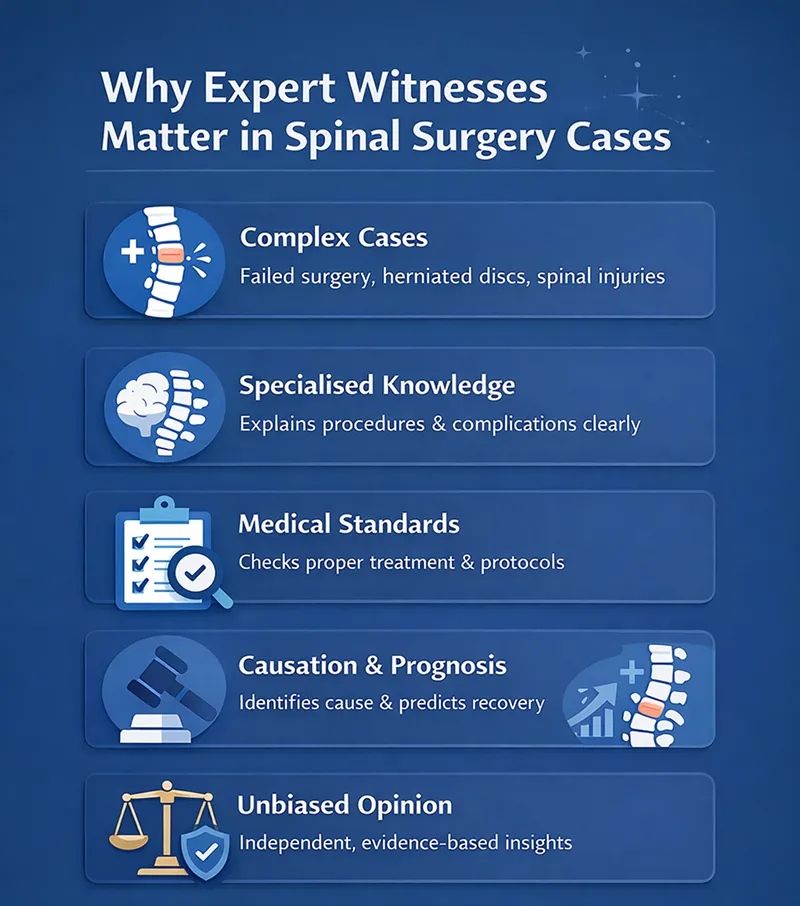
Evaluate Medical Standards
Expert witnesses carefully check the medical methods and practices. These are utilised to help with issues with the spine. They ensure these actions fulfil professional standards. This helps find out if there has been any medical error.
Review Medical Data and Evidence
For an expert witness, one of the initial steps is to review the medical records. In these stages, they also review images and evidence linked to the case. This includes:
- Patient histories
- Diagnostic evaluations, such as MRI or CT scans
- Surgical notes
- Post-surgery reports
Surgeons may also evaluate accident reports or other documents related to the injury. However, this may happen in rare cases.
Assess Causation and Prognosis
Specialists help figure out if the spinal injury was caused by an accident. They:
- Check if it’s due to personal injury or a medical negligence
- Look over the details to determine if it’s due to improper treatment or surgical risk
They also provide a forecast about the patient’s future health and recovery.
Neuropsychological testing also helps in assessing brain injuries, such as in spine surgery cases. It also helps grasp the lasting effects of legal claims.
Write Reports and Give Testimony
After the expert goes through the evidence, they write a clear report. This report explains what they found and what their opinion is. It must be authentic and based on scientific and clinical evidence.
The expert witness may also give testimony in court. They explain complex medical terms in a way that judges and juries can grasp. They must explain their results clearly. This helps both the lawyer and the judge understand them.
For example, if someone is claiming a spinal injury, the professional witness will:
- Explain if the injury matches the accident
- Discuss how the medical details involved were accurate
- The result could have been different with proper treatment
Plan for Cross Examination
The expert witness may go through a cross-examination in court as part of the legal method. During cross examination, the other legal team will ask questions. They will try to inquire if the expert’s findings are valid and correct.
A specialist witness will stay relaxed and confident. They will support their report and explain why they gave their findings. The expert’s ability to stay neutral is important to the process. It is important for them to justify their view under standard terms.
Spinal Surgery Expert Witness Duty to the Court
It is the duty of a spinal surgery expert witness to give an honest and fair opinion to the court. Under UK Civil Procedure Rules (CPR) Part 35, an expert witness must:
Be Independent
They must not be affected by the interests of either party in the case.
Act Impartially
Their core task is to help the court by providing honest and clear medical views.
Follow Guidelines
They must obey the CPR Part 35 regulations. These rules make sure their reports and testimony are fair, clear and meet legal norms.
Compensation and Claim Valuation (Quantum)
Spinal injuries can have an impact on a person’s ability to work, live normally and more. However, compensation is helpful in covering these losses.
The factors considered are:
Permanent Disability
How much the damage affects the person’s ability to live a daily life.
Future Treatment Needs
If the person will require permanent medical treatment in the future.
Loss of Earnings
How much money the person has lost due to the injury.
Care Requirements
The need for personal treatment or aid due to the damage.
Expert Contribution to Injury Calculation
Experts help work out how much income is enough for compensation. They look at how the injury impacts the person’s life. Also, they find out the expenses of care, treatment and lost earnings.
An expert knows more and more about less and less until finally he knows everything about nothing.
– Arthur C. Clarke, Writer
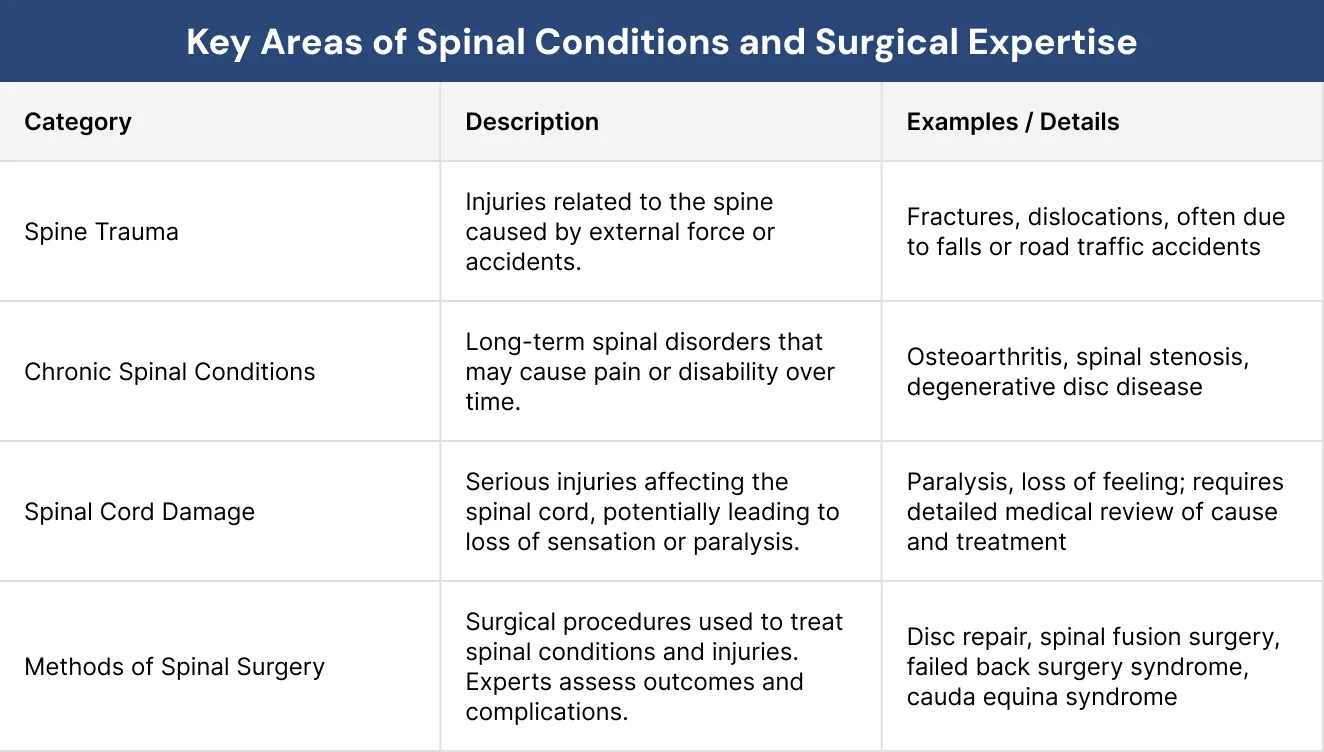
Key Areas of Expertise in Spinal Surgery Expert Witnesses Practice
They have done specific training in brain surgery. They have a deep understanding of spinal cases. This includes both medical and technical aspects. Expert witnesses specialise in the following areas:
- Spine Trauma
- Chronic Spinal Conditions
- Spinal Cord Damage
- Methods of Spinal Surgery
Types of Cases Involving Spinal Surgery Experts
Spinal surgery experts are often engaged in various types of legal cases, including:
Surgical Negligence Cases
These cases occur when patients believe that a surgeon committed errors during surgery, causing damage.
Missed Diagnosis
Long-term damage can occur if a spinal injury or condition is not diagnosed on time.
Delayed Treatment Claims
It claims that the failure to treat a spinal injury quickly results in worsened conditions.
Spinal Fusion Complications
These are the issues arising from spinal fusion surgeries, such as infections or hardware issues.
Implant or Hardware Failure
In such cases, the materials used in spinal surgery do not work. This causes further harm to the patient.
Rehabilitation Failure Cases
After surgery, when proper rehabilitation is not provided or is ineffective, such cases arise.
Spinal Surgery Types and Their Legal Relevance
In legal cases, many types of spinal surgery are commonly discussed, including:
Spinal Fusion Surgery
This is the type of surgery where two or more bones in the spine are fused. Legal cases may involve difficulties or poor results.
Disc Replacement Surgery
In this type of surgery, a damaged disc is replaced with an artificial one. Legal issues can comprise failed implants or complications.
Decompression Surgery
This surgery eases pressure on spinal nerves. Legal claims may include nerve injury or surgical faults.
Laminectomy and Discectomy
In such surgeries, the spinal bone or disc is taken out. In legal cases, complications may include nerve damage or incomplete techniques.
What Challenges Do Spinal Surgery Expert Witnesses Meet?
The role of a spinal surgery professional witness is very important. However, you may have to face many issues with it.
These specialists must cope with complex legal issues and medical details. On occasion, they must also face difficult or conflicting views.
Spine surgery expert witnesses commonly face challenges, such as:
1. Volume records
One of the core challenges for a spinal surgery expert witness is to review a large amount of medical data.
For serious conditions, specialists may need to check thousands of pages of the following:
- Medical records
- Patient histories
- Legal documents
Mr. Niall Craig is an experienced orthospinal expert. He said he had to look through more than 4,300 pages for a case with a spinal cord injury. Dealing with so many papers takes a lot of time. You also need to pay close attention to the details.
2. Time Constraints
To finish reports due to the demand for qualified testimony, spinal surgical experts are often under strict deadlines.
Most professional witnesses also work 24/7 as clinicians. However, most of their time is spent on medico-legal work. As Mr. Craig said, he usually puts in one entire day each week on specialist witness tasks. With law firms or clients, he also takes up to two hours per meeting.
It can be hard to balance these duties with their clinical roles.
3. Managing Legal Professional Goals
When working with lawyers, expert witnesses are under immense pressure. Not all legal professionals are careful about giving all the needed data. Some solicitors may not tell about changes in the case. This can create problems such as delays.
Also, some solicitors may try to force experts into defending their clients’ interests. However, a skilled expert witness will stay unbiased. Experts need to make sure that their reports are based on medical evidence.
4. Cross Examination in Court
Before going to court, many cases settle. However, sometimes an expert witness is called to provide evidence in front of a judge.
Cross examination can be stressful. Solicitors often try to discredit expert's views or reliability.
According to Mr. Craig, it is important to be assured of a properly researched opinion. This is helpful for experts to stay up to date during a cross-examination.
They need to explain their reasoning in simple terms and with logic.
5. Advanced Medical Problems
Often, spinal surgery cases are related to serious medical issues. It's hard to figure out what caused the problem or to check the level of care.
For example, you might have failed back surgery syndrome. That means you have pain that doesn't go away after surgery.
Many things can alter the result, such as:
- Surgical approach
- Post surgery care
- Health conditions
Spinal cord damage and cauda equina syndrome can also result in severe medical conditions and treatment hurdles.
Expert witnesses must carefully examine medical records. They need to provide a strong view that looks at these issues.
Case Study: Motor Vehicle Accident
Dr. Rajesh’s expert medical legal offerings have aided UK law firms and insurance businesses effectively in the following way:
Case
After a motor vehicle accident, a client had a severe complex spinal injury. After the crash, a great dispute occurred. People were discussing whether the injury was caused by the accident or by current aging changes.
Challenge
The injury was caused by many complex spinal problems, with both trauma and age factors. It was difficult to show the precise reason for the injury.
Dr. Rajesh’Solution
Dr. Rajesh utilised orthopedic analysis and checked the client’s imaging. Its purpose was to separate previous situations and related injuries. His expert testimony made the point in court.
Result
When Dr. Rajesh’s opinion as an expert witness was accepted by the court, it brought the following results:
- Final settlement with full medical charges
- Lifetime care has been planned for the client
- Clear causation was set up in the situation
Testimonial
In reaching this large settlement, Dr. Rajesh’s careful analysis and strong court testimony were vital. His knowledge of spinal injuries helped make the case clear.
Final Words
The position of a spinal surgery expert is key in legal cases related to spinal injuries and surgeries. They provide vital knowledge in these cases. They explain complex medical issues in a clear way to courts, legal teams and juries.
Their insights can affect the outcome of personal injury, medical error and other legal cases.
Spine surgery experts make sure courts get clear, unbiased opinions. These views are based on medical facts.
At Concise Medico, we know the value of having a skilled spinal surgery expert witness.
If you need expert opinion in your legal case, contact us today to see how we can assist you.
FAQs
When spinal injury occurs, have you ever thought about how spinal surgery experts can fix it?
Spine surgery experts play a key role in spinal health. They provide full depth about spinal health and surgical practices.
Their expertise is vital in legal cases with medical error or personal injury. They play an integral role in workplace accident cases. These events can cause spinal injuries or other health issues.
These surgeons have a deep grasp of spinal anatomy and surgery. They also know the possible concerns that can arise. They are called so that they may review medical records. They check if the care given meets the standard of care. After this, they can check if medical standards were met.
Their views in their reports can help decide personal injury claims. They can also affect medical malpractice cases. They can also affect other legal matters.
Research was done in 2021 by the UK Spinal Injury Association. According to this study, around 2,500 people sustain spinal cord injuries each year in the UK. Many of these cases can result in claims for payments.
Not all injuries lead to legal action. However, many need expert testimony.
This blog looks at how spinal surgery experts impact legal results and describes their role.
What Are Spinal Surgery Claims?
Spinal surgery claims are legal cases. People look for rewards for injuries to their spine due to faulty surgeries.
The harshness of these injuries can change. Minor damage to the vertebrae or discs can happen in some cases. Spinal cord injuries may cause paralysis in more severe cases.
A spine surgery claim usually starts when the injured person believes their damage was due to medical faults or negligence. It can also begin if the injury was due to an accident. They look for payments to cover medical costs.
They may also claim for suffering, pain and lost wages. You can also add other damages to the claim.
Why Are These Claims Legally Complex?
Spinal surgery claims are legally confusing for many reasons, such as:
Causation
In many spine surgery claims, figuring out what caused the injury is a main issue. If the injury was due to a past event, medical faults or an accident, it’s hard to know. It is important to figure this out for the claim.
Medical specialists should help explain the link between the injury and the event.
Long-Term Impact and Severity
The lasting effects of spinal injuries can often make it harder to calculate rewards. Figuring out the total lost income and future medical costs is a hard task. It also includes knowing changes in the quality of life. It needs a specialised checking.
Multiple Parties Involved
More than one party may be in charge of many spinal injury cases. For instance, a claim might include the driver at fault in a car accident. Also, it could involve a healthcare provider if medical errors were made. These faults may impact the treatment of the injury.
This can make debt and payment claims difficult to manage.
Who Is a Spinal Surgery Expert Witness?
A spinal surgery expert witness is a skilled medical specialist. They focus on examining spinal injuries and conditions. They also treat and handle these spinal issues.
These professionals are asked to give their qualified view in legal cases. Their proficiency helps the court grasp the medical information of the case.
A spine surgery doctor is a medical expert who knows a lot about how to treat the spine. They are called to provide fair and expert findings in legal situations.
These experts are skilled surgeons who:
- Assess spinal injury cases
- Review surgical outcomes
- Provide opinions on treatment quality
Their task is to help the court grasp medical issues in a clear way.
These witnesses are crucial in workplace accident cases. They are also important in disputes about spinal health or injury. Lawyers, judges and juries make good decisions with their help.
Spine surgery specialists know spinal anatomy and common surgeries.
This includes spinal fusion surgery and the risks involved. Their views can help find out if medical claims are true and they impact the case result.
Related: Brain Injury Expert Witness
Medical Qualifications and Clinical Background
A spinal surgery specialist must have strong medical qualifications to be an expert witness. They also require a solid clinical background. This includes:
Medical Degree
They must have a medical degree and should be highly specialised in:
- Spine trauma
- Chronic diseases
- Surgical techniques
This knowledge helps them evaluate cases precisely. It also allows them to give useful ideas on treatment options.
Specialist Training
Medico-legal knowledge is a big part of an expert witness’s training. This requires knowledge of how to write reports that follow Civil Procedure Rules (CPR).
It also deals with understanding the role of expert testimony in court and the ethical responsibilities of an expert witness.
Besides this, more training is needed in brain surgery, bone surgery or a similar field that focuses on the spine.
Experience
Spine surgery expert witnesses must have:
- Worked in both the NHS and private sectors
- Years of clinical experience in spine surgery
- Experience in treatment methods and possible issues
Board Certification
Many spinal surgical expert witnesses have certifications from reliable, reputable organisations. It can be any professional body or recognised medical board. For example, they may have a Cardiff University Bond Solon Expert Witness Certificate.
These credentials help ensure that the expert meets the required criteria for medico-legal practice.
Why Expert Witnesses Matter in Spinal Surgery Claims?
Spinal surgery cases often have complex medical and technical issues. These issues require expert skills to grasp and solve. These conditions can involve damage from spinal fusion surgery, such as:
- Failed back surgery
- Herniated discs
- Spinal cord injuries or fractures
Expert witnesses have to explain these medical issues to the court. They do this in a way that is clear and specific to the situation.
Legal specialists like solicitors and barristers depend on the expertise of spinal treatment expert witnesses. This helps them make better decisions.
These experts carefully observe whether the treatment was done precisely. They also examine if the injury matches the medical evidence.
They can help prove causation in spine trauma cases. They also assess the long-term effects of injuries. Spinal Surgery Expert Witnesses matter because they:
Offer Specialised Knowledge in Complex Spinal Cases
These specialists help clarify complex surgical methods. They also provide knowledge of spinal conditions. This includes:
- Chronic back pain after surgery
- Disc prolapses and fractures
- Problems from spinal fusion surgery

Evaluate Medical Standards
Expert witnesses carefully check the medical methods and practices. These are utilised to help with issues with the spine. They ensure these actions fulfil professional standards. This helps find out if there has been any medical error.
Review Medical Data and Evidence
For an expert witness, one of the initial steps is to review the medical records. In these stages, they also review images and evidence linked to the case. This includes:
- Patient histories
- Diagnostic evaluations, such as MRI or CT scans
- Surgical notes
- Post-surgery reports
Surgeons may also evaluate accident reports or other documents related to the injury. However, this may happen in rare cases.
Assess Causation and Prognosis
Specialists help figure out if the spinal injury was caused by an accident. They:
- Check if it’s due to personal injury or a medical negligence
- Look over the details to determine if it’s due to improper treatment or surgical risk
They also provide a forecast about the patient’s future health and recovery.
Neuropsychological testing also helps in assessing brain injuries, such as in spine surgery cases. It also helps grasp the lasting effects of legal claims.
Write Reports and Give Testimony
After the expert goes through the evidence, they write a clear report. This report explains what they found and what their opinion is. It must be authentic and based on scientific and clinical evidence.
The expert witness may also give testimony in court. They explain complex medical terms in a way that judges and juries can grasp. They must explain their results clearly. This helps both the lawyer and the judge understand them.
For example, if someone is claiming a spinal injury, the professional witness will:
- Explain if the injury matches the accident
- Discuss how the medical details involved were accurate
- The result could have been different with proper treatment
Plan for Cross Examination
The expert witness may go through a cross-examination in court as part of the legal method. During cross examination, the other legal team will ask questions. They will try to inquire if the expert’s findings are valid and correct.
A specialist witness will stay relaxed and confident. They will support their report and explain why they gave their findings. The expert’s ability to stay neutral is important to the process. It is important for them to justify their view under standard terms.
Spinal Surgery Expert Witness Duty to the Court
It is the duty of a spinal surgery expert witness to give an honest and fair opinion to the court. Under UK Civil Procedure Rules (CPR) Part 35, an expert witness must:
Be Independent
They must not be affected by the interests of either party in the case.
Act Impartially
Their core task is to help the court by providing honest and clear medical views.
Follow Guidelines
They must obey the CPR Part 35 regulations. These rules make sure their reports and testimony are fair, clear and meet legal norms.
Compensation and Claim Valuation (Quantum)
Spinal injuries can have an impact on a person’s ability to work, live normally and more. However, compensation is helpful in covering these losses.
The factors considered are:
Permanent Disability
How much the damage affects the person’s ability to live a daily life.
Future Treatment Needs
If the person will require permanent medical treatment in the future.
Loss of Earnings
How much money the person has lost due to the injury.
Care Requirements
The need for personal treatment or aid due to the damage.
Expert Contribution to Injury Calculation
Experts help work out how much income is enough for compensation. They look at how the injury impacts the person’s life. Also, they find out the expenses of care, treatment and lost earnings.
An expert knows more and more about less and less until finally he knows everything about nothing.
– Arthur C. Clarke, Writer
Key Areas of Expertise in Spinal Surgery Expert Witnesses Practice
They have done specific training in brain surgery. They have a deep understanding of spinal cases. This includes both medical and technical aspects. Expert witnesses specialise in the following areas:
- Spine Trauma
- Chronic Spinal Conditions
- Spinal Cord Damage
- Methods of Spinal Surgery
Types of Cases Involving Spinal Surgery Experts
Spinal surgery experts are often engaged in various types of legal cases, including:
Surgical Negligence Cases
These cases occur when patients believe that a surgeon committed errors during surgery, causing damage.
Missed Diagnosis
Long-term damage can occur if a spinal injury or condition is not diagnosed on time.
Delayed Treatment Claims
It claims that the failure to treat a spinal injury quickly results in worsened conditions.
Spinal Fusion Complications
These are the issues arising from spinal fusion surgeries, such as infections or hardware issues.
Implant or Hardware Failure
In such cases, the materials used in spinal surgery do not work. This causes further harm to the patient.
Rehabilitation Failure Cases
After surgery, when proper rehabilitation is not provided or is ineffective, such cases arise.
Spinal Surgery Types and Their Legal Relevance
In legal cases, many types of spinal surgery are commonly discussed, including:
Spinal Fusion Surgery
This is the type of surgery where two or more bones in the spine are fused. Legal cases may involve difficulties or poor results.
Disc Replacement Surgery
In this type of surgery, a damaged disc is replaced with an artificial one. Legal issues can comprise failed implants or complications.
Decompression Surgery
This surgery eases pressure on spinal nerves. Legal claims may include nerve injury or surgical faults.
Laminectomy and Discectomy
In such surgeries, the spinal bone or disc is taken out. In legal cases, complications may include nerve damage or incomplete techniques.
What Challenges Do Spinal Surgery Expert Witnesses Meet?
The role of a spinal surgery professional witness is very important. However, you may have to face many issues with it.
These specialists must cope with complex legal issues and medical details. On occasion, they must also face difficult or conflicting views.
Spine surgery expert witnesses commonly face challenges, such as:
1. Volume records
One of the core challenges for a spinal surgery expert witness is to review a large amount of medical data.
For serious conditions, specialists may need to check thousands of pages of the following:
- Medical records
- Patient histories
- Legal documents
Mr. Niall Craig is an experienced orthospinal expert. He said he had to look through more than 4,300 pages for a case with a spinal cord injury. Dealing with so many papers takes a lot of time. You also need to pay close attention to the details.
2. Time Constraints
To finish reports due to the demand for qualified testimony, spinal surgical experts are often under strict deadlines.
Most professional witnesses also work 24/7 as clinicians. However, most of their time is spent on medico-legal work. As Mr. Craig said, he usually puts in one entire day each week on specialist witness tasks. With law firms or clients, he also takes up to two hours per meeting.
It can be hard to balance these duties with their clinical roles.
3. Managing Legal Professional Goals
When working with lawyers, expert witnesses are under immense pressure. Not all legal professionals are careful about giving all the needed data. Some solicitors may not tell about changes in the case. This can create problems such as delays.
Also, some solicitors may try to force experts into defending their clients’ interests. However, a skilled expert witness will stay unbiased. Experts need to make sure that their reports are based on medical evidence.
4. Cross Examination in Court
Before going to court, many cases settle. However, sometimes an expert witness is called to provide evidence in front of a judge.
Cross examination can be stressful. Solicitors often try to discredit expert's views or reliability.
According to Mr. Craig, it is important to be assured of a properly researched opinion. This is helpful for experts to stay up to date during a cross-examination.
They need to explain their reasoning in simple terms and with logic.
5. Advanced Medical Problems
Often, spinal surgery cases are related to serious medical issues. It's hard to figure out what caused the problem or to check the level of care.
For example, you might have failed back surgery syndrome. That means you have pain that doesn't go away after surgery.
Many things can alter the result, such as:
- Surgical approach
- Post surgery care
- Health conditions
Spinal cord damage and cauda equina syndrome can also result in severe medical conditions and treatment hurdles.
Expert witnesses must carefully examine medical records. They need to provide a strong view that looks at these issues.
Case Study: Motor Vehicle Accident
Dr. Rajesh’s expert medical legal offerings have aided UK law firms and insurance businesses effectively in the following way:
Case
After a motor vehicle accident, a client had a severe complex spinal injury. After the crash, a great dispute occurred. People were discussing whether the injury was caused by the accident or by current aging changes.
Challenge
The injury was caused by many complex spinal problems, with both trauma and age factors. It was difficult to show the precise reason for the injury.
Dr. Rajesh’Solution
Dr. Rajesh utilised orthopedic analysis and checked the client’s imaging. Its purpose was to separate previous situations and related injuries. His expert testimony made the point in court.
Result
When Dr. Rajesh’s opinion as an expert witness was accepted by the court, it brought the following results:
- Final settlement with full medical charges
- Lifetime care has been planned for the client
- Clear causation was set up in the situation
Testimonial
In reaching this large settlement, Dr. Rajesh’s careful analysis and strong court testimony were vital. His knowledge of spinal injuries helped make the case clear.
Final Words
The position of a spinal surgery expert is key in legal cases related to spinal injuries and surgeries. They provide vital knowledge in these cases. They explain complex medical issues in a clear way to courts, legal teams and juries.
Their insights can affect the outcome of personal injury, medical error and other legal cases.
Spine surgery experts make sure courts get clear, unbiased opinions. These views are based on medical facts.
At Concise Medico, we know the value of having a skilled spinal surgery expert witness.
If you need expert opinion in your legal case, contact us today to see how we can assist you.