TABLE OF CONTENT
Ever thought about how life changes after losing a limb? In the UK, the number of amputations that occur is between 5000 and 6000 every year. Amputation changes a person drastically. It affects the person’s mobility, family role, worklife, mental health and overall confidence of a person. It also causes long term expenses for a person. However, if the amputation happens because of someone else’s fault, you can get compensation.
In the UK, amputation claims are there to help an injured person. They help people recover their losses and pay for rehabilitation, prosthetics, transport changes, home changes and all the money lost. In this blog, we will cover:
- What is an amputation claim
- When can you claim an amputation compensation
- Time limit for amputation injury claim
- How to make amputation claim successful
- What strengthen an amputation claim
- How is amputation claim compensation calculated
- How much compensation could be paid for an amputation
- Step by step process of amputation injury claims
What Is an Amputation Claim in the UK?
An amputation claim is a legal claim after a limb or a part of a limb is removed because of someone else’s fault. It is a civil claim made against the person or the company that is responsible for the damage.
An amputation may happen because a person or a company failed to keep you safe even though it was their responsibility. The possible reasons might be a road accident, medical negligence or an accident at work. In such cases, amputation negligence claims are made to get you compensation.
There are usually two parts of an amputation compensation claim. These are general damages and special damages. The general damages include loss of a normal life and the injury and pain experience. Special damages include prosthetics, rehab, loss of money, home and car changes, lost pay and money lost.
The amputation injury claim looks at the following two questions:
- Was the amputation caused by someone else’s fault or breach of duty.
- How does it impact your life and what is the compensation amount based on injury.
When Can You Claim Amputation Compensation?
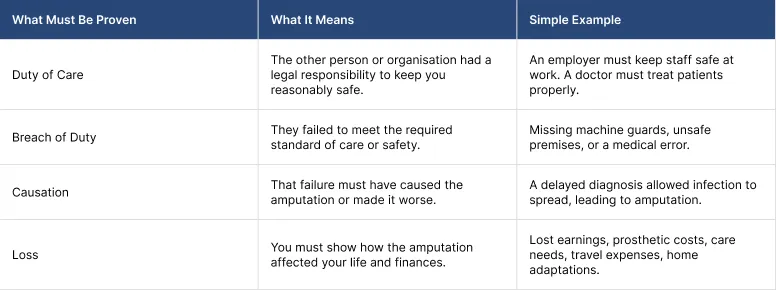
A person can usually claim if the amputation happened because someone else owed a duty of care, breached it and that breach caused the injury that led to amputation. There are three elements that decide if you can claim an amputation compensation. These are:
- Duty
- Breach
- Causation
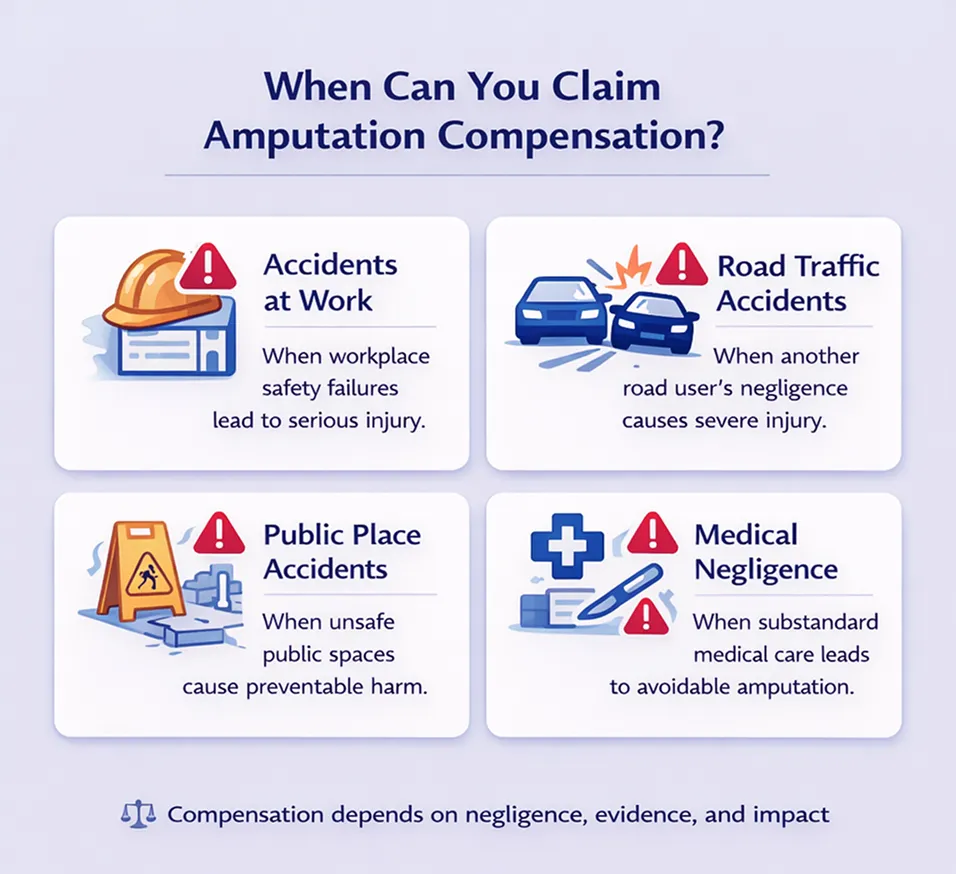
Amputation compensation claims can arise in many settings but most fall into the following common categories
1. Accidents at Work
Workplace amputations can happen in construction, manufacturing, logistics, agriculture and other high risk environments. They can also happen in normal workplaces. It happens usually when safety rules are ignored.
Employers must take reasonable steps to protect workers and to keep the workplace safe. UK health and safety law sets out core duties on employers. These include the duty to ensure health, safety and welfare at work so far as reasonably practicable.
A workplace claim may be possible where the amputation happened after issues such as:
- unsafe machinery or missing guards
- lack of training or poor supervision
- failure to provide proper protective equipment
- unsafe systems of work or poor risk control
- ignored warnings, near misses or known faults
In many workplace cases, the legal focus is on whether the employer’s system was safe enough and whether the risks were controlled properly. You can read more about The Most Common Workplace Injuries.
2. Road Traffic Accidents
A serious crash can cause a traumatic amputation on the spot or a later surgical amputation due to severe damage. A claim may be possible if someone caused the crash through careless driving, speeding, drunk driving, distraction or failure to follow road rules.
Road cases can be complex because insurers may dispute who was at fault. Still, if evidence supports that someone else caused the collision, compensation can cover both the amputation itself and long term costs like care, transport changes and lost income.
3. Public Place Accidents
Amputations can also occur after crush injuries, falls or industrial style incidents in places open to the public. These places can be gyms, malls, events and car parks. These may also include areas adjacent to construction areas or private premises where visitors are allowed.
The Occupiers’ Liability Act 1957 sets out the ‘common duty of care’. It is a duty to take reasonable care to keep visitors safe when they enter the premises.
A claim may arise where a property owner or occupier failed to:
- Fix hazards
- Warn visitors
- Maintain a safe environment
4. Medical Negligence
Amputation can also occur due to medical negligence. Sometimes a limb is removed because doctors made a mistake or they did not treat the problem in time. Amputation negligence claims usually involve an argument that the limb could have been saved or an amputation occurred earlier than it should have.
These cases often involve:
- delayed diagnosis of infection, vascular disease, limb ischaemia, diabetes complications
- poor treatment of wounds leading to severe infection or sepsis
- surgical error affecting blood supply
- failure to monitor properly after surgery
Medical negligence claims are evidence heavy. They often rely on independent expert opinions to show that a reasonable standard of care was not met.
These experts prepare medico-legal reports stating that the poor care caused the amputation outcome.
What Is the Time Limit for Amputation Injury Claims?
In most UK amputation claims, the main time limit is 3 years. However, the start date depends on the type and nature of the case. You usually have 3 years to issue court proceedings:
- from the date of the accident or injury or
- from the date of knowledge, i.e. when you first knew the injury was linked to negligence
Date of knowledge matters most in medical negligence cases. When a person did not know that negligence caused the injury. For example, someone may only learn later that an infection was mismanaged or that earlier treatment was delayed. Then the 3 year limit can start from this date of knowledge and not from when the accident happened.
Besides, there are the following two exceptions in which you get more time:
- Children: the three year period usually runs from the child’s 18th birthday, meaning there is often time until the age of 21 to start the claim in their own name. A parent or adult can sometimes claim earlier as a litigation friend.
- Lack of mental capacity: limitation rules can be different where a person lacks capacity and legal advice is essential because the time limit may not run in the usual way. The 3 year limit may not run in the normal way while the person lacks capacity. If capacity returns, the time limit may start from that point. These cases need early legal advice because the rules can be strict and fact based
Key Point: Even though time limits can sound generous, delay can make a claim harder. Evidence disappears, witnesses forget details, workplaces change and records become harder to obtain. This is why most guidance suggests getting legal advice early, even if the claim is not issued right away.
How to Make an Amputation Claim Successful?
Even where an amputation is real and severe, compensation is not guaranteed. The claim usually succeeds when there is solid proof on the following points:
You can also take legal advice from an expert witness to help you with your amputation claim. Read more about How Expert Witnesses Strengthen Legal Cases.
What Strengthens an Amputation Claim?
What strengthens your amputation claim is strong evidence. It makes a claim clearer and often faster. It also reduces disputes about how the injury happened and how it affects daily life.
A practical evidence set often includes:
- Medical records from emergency care through surgery, rehabilitation and follow up
- Independent medical assessments to confirm diagnosis, treatment needs and long term prognosis
- Accident reporting evidence, such as workplace accident book entries, incident reports or police reports
- Witness details and statements
- Photos or videos of hazards, the accident site or early injuries where appropriate
- A personal timeline of symptoms, treatment steps and how life changed
- Financial records, such as payslips, tax documents, invoices, care receipts, travel costs and prosthetic costs
In many cases, keeping a simple daily or weekly record helps. It shows pain levels, sleep issues, mobility barriers, mood changes and help needed at home. These details matter later when the claim is valued.
How Is Amputation Claim Compensation Calculated
Amputation compensation in the UK is usually discussed as two categories:
- General damages: include loss of independence, limits on walking or self care, hobbies affected, phantom pain, mental health impact.
- Special damages: include lost earnings and pension, care and help at home, prosthetics and replacements, rehab and treatment, travel costs, home and car changes, equipment and other extra costs.
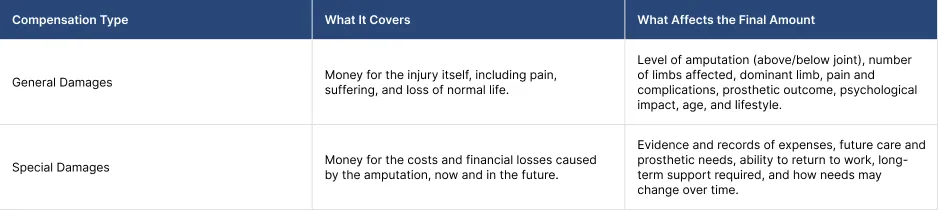
In many serious amputation claims, special damages can be equal to or far higher than general damages, especially for younger claimants with long working lives ahead and repeated prosthetic costs.
How Much Compensation Could Be Paid for an Amputation?
There is no fixed amount. Each case of an amputation claim is different. The value depends on how serious the amputation claim is and how much it changed your life. It also depends on long term costs.
Compensation is often higher when the amputation affects:
- Your work
- Your independence
- Your future medical needs
Younger people may also receive more because costs on their medical needs can last for decades.
Following are the factors that affect the value of an amputation negligence claim:
- The level of amputation and how much function is lost.
- Prosthetic needs and how often replacements are needed.
- Ongoing rehab, pain, phantom limb pain, and mental health impact.
- Care needs at home, mobility support, and transport changes.
- Loss of earnings now and in the future, plus pension loss.
- Home and vehicle adaptations and specialist equipment.
What Is the Process of Amputation Injury Claims?
While each case of an amputation injury claim differs, the structure is often similar. Following is the step by step process for an amputation injury claim.
Step 1:
The first step is to take initial advice and collect early evidence. A solicitor takes an early statement, checks the limitation and starts evidence preservation. In workplace claims, they may seek incident reports and safety records. In medical cases, they request full medical records.
Step 2:
The second step is establishing the liability. The defendant may admit fault, deny fault or argue shared fault. Evidence is gathered to prove how the breach happened and how it caused the amputation.
Step 3:
After establishing the liability, you need medical evidence and prognosis. Independent medical experts assess the claimant’s condition, future treatment needs, prosthetic ability, pain issues and psychological impact. This is crucial in valuing both general and special damages.
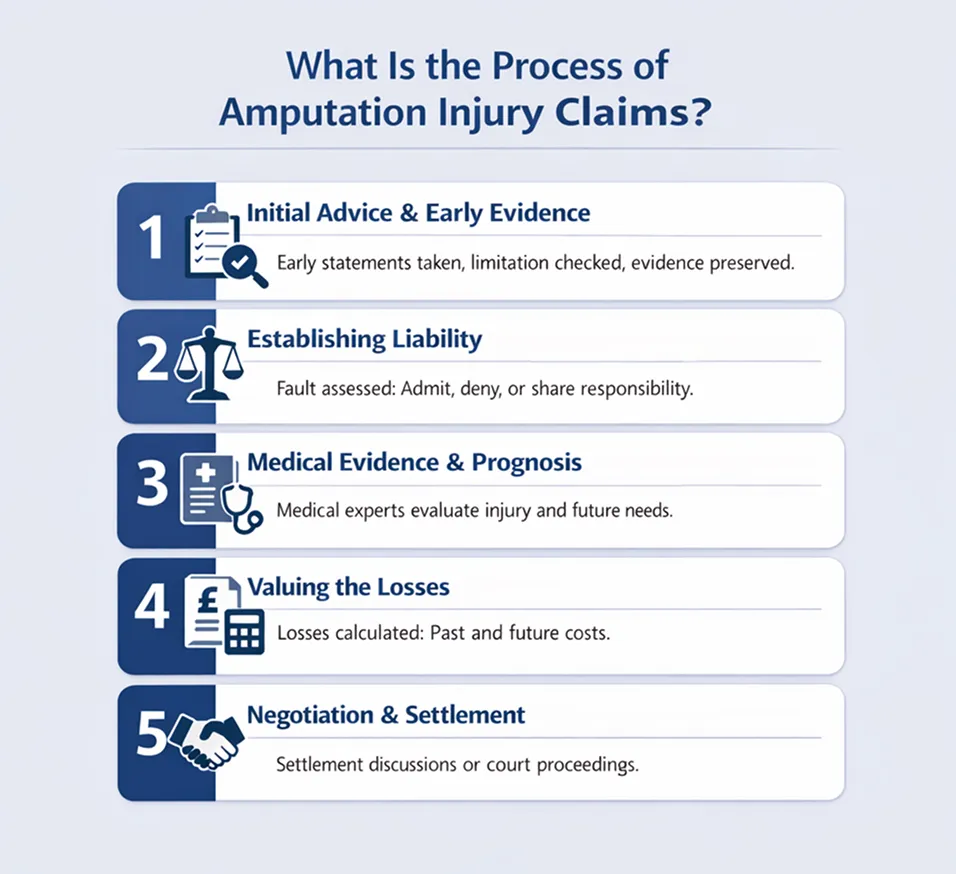
Step 4:
The fourth step is to value the losses. They should be backed with evidence. The solicitor builds a schedule of loss. This includes past losses and future losses, supported by documents and expert reports.
Step 5:
The final step is negotiation and settlement. It may also include court proceedings. Many claims settle through negotiation once evidence is strong. Court proceedings may be used if liability is disputed or if a fair figure cannot be agreed. Even then, many cases settle before trial.
Conclusion
Amputation claims are complex. These are life changing and have a serious impact on people’s work and family lives. What helps you most in an amputation injury claim is strong evidence. The key steps to make your case stronger are:
- Keep a check of the time limit
- Collect the necessary evidence
- Collect medical history
- Documentation of the expenses
- Seek professional help and legal advice
This blog helps you collect general information, it’s not legal advice. Concise Medico understands that there are specific facts and timelines behind every case. We help you get the best value for the general and special damages based on your particular case. Contact us today if you need to make an amputation claim.
FAQs
Ever thought about how life changes after losing a limb? In the UK, the number of amputations that occur is between 5000 and 6000 every year. Amputation changes a person drastically. It affects the person’s mobility, family role, worklife, mental health and overall confidence of a person. It also causes long term expenses for a person. However, if the amputation happens because of someone else’s fault, you can get compensation.
In the UK, amputation claims are there to help an injured person. They help people recover their losses and pay for rehabilitation, prosthetics, transport changes, home changes and all the money lost. In this blog, we will cover:
- What is an amputation claim
- When can you claim an amputation compensation
- Time limit for amputation injury claim
- How to make amputation claim successful
- What strengthen an amputation claim
- How is amputation claim compensation calculated
- How much compensation could be paid for an amputation
- Step by step process of amputation injury claims
What Is an Amputation Claim in the UK?
An amputation claim is a legal claim after a limb or a part of a limb is removed because of someone else’s fault. It is a civil claim made against the person or the company that is responsible for the damage.
An amputation may happen because a person or a company failed to keep you safe even though it was their responsibility. The possible reasons might be a road accident, medical negligence or an accident at work. In such cases, amputation negligence claims are made to get you compensation.
There are usually two parts of an amputation compensation claim. These are general damages and special damages. The general damages include loss of a normal life and the injury and pain experience. Special damages include prosthetics, rehab, loss of money, home and car changes, lost pay and money lost.
The amputation injury claim looks at the following two questions:
- Was the amputation caused by someone else’s fault or breach of duty.
- How does it impact your life and what is the compensation amount based on injury.
When Can You Claim Amputation Compensation?
A person can usually claim if the amputation happened because someone else owed a duty of care, breached it and that breach caused the injury that led to amputation. There are three elements that decide if you can claim an amputation compensation. These are:
- Duty
- Breach
- Causation
Amputation compensation claims can arise in many settings but most fall into the following common categories
1. Accidents at Work
Workplace amputations can happen in construction, manufacturing, logistics, agriculture and other high risk environments. They can also happen in normal workplaces. It happens usually when safety rules are ignored.
Employers must take reasonable steps to protect workers and to keep the workplace safe. UK health and safety law sets out core duties on employers. These include the duty to ensure health, safety and welfare at work so far as reasonably practicable.
A workplace claim may be possible where the amputation happened after issues such as:
- unsafe machinery or missing guards
- lack of training or poor supervision
- failure to provide proper protective equipment
- unsafe systems of work or poor risk control
- ignored warnings, near misses or known faults
In many workplace cases, the legal focus is on whether the employer’s system was safe enough and whether the risks were controlled properly. You can read more about The Most Common Workplace Injuries.
2. Road Traffic Accidents
A serious crash can cause a traumatic amputation on the spot or a later surgical amputation due to severe damage. A claim may be possible if someone caused the crash through careless driving, speeding, drunk driving, distraction or failure to follow road rules.
Road cases can be complex because insurers may dispute who was at fault. Still, if evidence supports that someone else caused the collision, compensation can cover both the amputation itself and long term costs like care, transport changes and lost income.
3. Public Place Accidents
Amputations can also occur after crush injuries, falls or industrial style incidents in places open to the public. These places can be gyms, malls, events and car parks. These may also include areas adjacent to construction areas or private premises where visitors are allowed.
The Occupiers’ Liability Act 1957 sets out the ‘common duty of care’. It is a duty to take reasonable care to keep visitors safe when they enter the premises.
A claim may arise where a property owner or occupier failed to:
- Fix hazards
- Warn visitors
- Maintain a safe environment
4. Medical Negligence
Amputation can also occur due to medical negligence. Sometimes a limb is removed because doctors made a mistake or they did not treat the problem in time. Amputation negligence claims usually involve an argument that the limb could have been saved or an amputation occurred earlier than it should have.
These cases often involve:
- delayed diagnosis of infection, vascular disease, limb ischaemia, diabetes complications
- poor treatment of wounds leading to severe infection or sepsis
- surgical error affecting blood supply
- failure to monitor properly after surgery
Medical negligence claims are evidence heavy. They often rely on independent expert opinions to show that a reasonable standard of care was not met.
These experts prepare medico-legal reports stating that the poor care caused the amputation outcome.
What Is the Time Limit for Amputation Injury Claims?
In most UK amputation claims, the main time limit is 3 years. However, the start date depends on the type and nature of the case. You usually have 3 years to issue court proceedings:
- from the date of the accident or injury or
- from the date of knowledge, i.e. when you first knew the injury was linked to negligence
Date of knowledge matters most in medical negligence cases. When a person did not know that negligence caused the injury. For example, someone may only learn later that an infection was mismanaged or that earlier treatment was delayed. Then the 3 year limit can start from this date of knowledge and not from when the accident happened.
Besides, there are the following two exceptions in which you get more time:
- Children: the three year period usually runs from the child’s 18th birthday, meaning there is often time until the age of 21 to start the claim in their own name. A parent or adult can sometimes claim earlier as a litigation friend.
- Lack of mental capacity: limitation rules can be different where a person lacks capacity and legal advice is essential because the time limit may not run in the usual way. The 3 year limit may not run in the normal way while the person lacks capacity. If capacity returns, the time limit may start from that point. These cases need early legal advice because the rules can be strict and fact based
Key Point: Even though time limits can sound generous, delay can make a claim harder. Evidence disappears, witnesses forget details, workplaces change and records become harder to obtain. This is why most guidance suggests getting legal advice early, even if the claim is not issued right away.
How to Make an Amputation Claim Successful?
Even where an amputation is real and severe, compensation is not guaranteed. The claim usually succeeds when there is solid proof on the following points:
You can also take legal advice from an expert witness to help you with your amputation claim. Read more about How Expert Witnesses Strengthen Legal Cases.
What Strengthens an Amputation Claim?
What strengthens your amputation claim is strong evidence. It makes a claim clearer and often faster. It also reduces disputes about how the injury happened and how it affects daily life.
A practical evidence set often includes:
- Medical records from emergency care through surgery, rehabilitation and follow up
- Independent medical assessments to confirm diagnosis, treatment needs and long term prognosis
- Accident reporting evidence, such as workplace accident book entries, incident reports or police reports
- Witness details and statements
- Photos or videos of hazards, the accident site or early injuries where appropriate
- A personal timeline of symptoms, treatment steps and how life changed
- Financial records, such as payslips, tax documents, invoices, care receipts, travel costs and prosthetic costs
In many cases, keeping a simple daily or weekly record helps. It shows pain levels, sleep issues, mobility barriers, mood changes and help needed at home. These details matter later when the claim is valued.
How Is Amputation Claim Compensation Calculated
Amputation compensation in the UK is usually discussed as two categories:
- General damages: include loss of independence, limits on walking or self care, hobbies affected, phantom pain, mental health impact.
- Special damages: include lost earnings and pension, care and help at home, prosthetics and replacements, rehab and treatment, travel costs, home and car changes, equipment and other extra costs.
In many serious amputation claims, special damages can be equal to or far higher than general damages, especially for younger claimants with long working lives ahead and repeated prosthetic costs.
How Much Compensation Could Be Paid for an Amputation?
There is no fixed amount. Each case of an amputation claim is different. The value depends on how serious the amputation claim is and how much it changed your life. It also depends on long term costs.
Compensation is often higher when the amputation affects:
- Your work
- Your independence
- Your future medical needs
Younger people may also receive more because costs on their medical needs can last for decades.
Following are the factors that affect the value of an amputation negligence claim:
- The level of amputation and how much function is lost.
- Prosthetic needs and how often replacements are needed.
- Ongoing rehab, pain, phantom limb pain, and mental health impact.
- Care needs at home, mobility support, and transport changes.
- Loss of earnings now and in the future, plus pension loss.
- Home and vehicle adaptations and specialist equipment.
What Is the Process of Amputation Injury Claims?
While each case of an amputation injury claim differs, the structure is often similar. Following is the step by step process for an amputation injury claim.
Step 1:
The first step is to take initial advice and collect early evidence. A solicitor takes an early statement, checks the limitation and starts evidence preservation. In workplace claims, they may seek incident reports and safety records. In medical cases, they request full medical records.
Step 2:
The second step is establishing the liability. The defendant may admit fault, deny fault or argue shared fault. Evidence is gathered to prove how the breach happened and how it caused the amputation.
Step 3:
After establishing the liability, you need medical evidence and prognosis. Independent medical experts assess the claimant’s condition, future treatment needs, prosthetic ability, pain issues and psychological impact. This is crucial in valuing both general and special damages.
Step 4:
The fourth step is to value the losses. They should be backed with evidence. The solicitor builds a schedule of loss. This includes past losses and future losses, supported by documents and expert reports.
Step 5:
The final step is negotiation and settlement. It may also include court proceedings. Many claims settle through negotiation once evidence is strong. Court proceedings may be used if liability is disputed or if a fair figure cannot be agreed. Even then, many cases settle before trial.
Conclusion
Amputation claims are complex. These are life changing and have a serious impact on people’s work and family lives. What helps you most in an amputation injury claim is strong evidence. The key steps to make your case stronger are:
- Keep a check of the time limit
- Collect the necessary evidence
- Collect medical history
- Documentation of the expenses
- Seek professional help and legal advice
This blog helps you collect general information, it’s not legal advice. Concise Medico understands that there are specific facts and timelines behind every case. We help you get the best value for the general and special damages based on your particular case. Contact us today if you need to make an amputation claim.