Brain Fog After an Accident: Could It Be a Neurological Injury?

Published On: June 3rd, 2026|Total Views: 1|Daily Views: 1|15.7 min read|3142 words|

TABLE OF CONTENT

When you get brain fog after a car accident, what happens next? Most individuals expect injuries such as cuts, bruises or broken bones. These harms are quite visible. What about the effects that are not easily detected? Brain fog after a car accident is one such situation.

Brain fog after accident is a set of neurological signs that affect how you think, remember and process facts. For example, you might feel slow, confused or as if your mental processes are clouded. It can appear after car crashes, falls, head trauma or even mild concussions.

In addition, mental cloudiness is not just a lack of energy or stress. It may point to a neurological injury, such as a minor brain injury or a mix of neck and brain harm.

However, not all foggy people have a severe disorder. This makes it tricky to understand.

In 2023–24, there were 123,969 hospital visits for head injury in the UK. In other words, roughly once every 4–5 minutes. This points out the average number of injuries that can cause cognitive haze.

In this blog, you’ll learn what mental fog is and why it happens after accidents. You will also explore how it can alter your daily life and when it might reveal a severe neurological injury.

Key Takeaways

  • Brain fog after car accident may be a sign of concussion, whiplash, or nerve injury and should not be brushed aside
  • Brain fog can cause poor focus, slow thinking, memory loss, tiredness, and trouble with daily tasks
  • “What is brain fog?” is a common question, and the answer is that it is a group of thinking and memory problems rather than a disease on its own.
  • Brain fog neurology links these symptoms to how the brain, nerves, neck, and balance system work after trauma.
  • Brain fog after an accident should be checked if symptoms last, get worse, or affect work, sleep, or social life, as early care can aid recovery

What Is Brain Fog?

Brain fog is a phrase used to refer to issues with the ability to think clearly. It does not make up a disease on its own. Instead, it is a warning sign that can take place for many reasons.

Stress, lack of sleep, unhealthy diet or health issues can all lead to mental fatigue.

Brain fog after accident, patients may observe the following:

  • Problems paying attention or staying focused
  • Issues related to short-term memory
  • Having trouble grasping information or thinking slowly
  • Feeling worn out or low on energy
  • Confusion or problems following thoughts
  • Having trouble finding words or wrapping up sentences

Brain fog after accident is often described as the following:

  • It feels like they are thinking through a blur
  • Feeling cognitively slow or exhausted
  • Finding it difficult to keep up with regular discussions or tasks
  • Getting out of focus or lost

It appears mild but cognitive dysfunction can impact daily life. When you are suffering this, simple tasks like reading, deciding or talking with others can feel hard.

Mental dullness often means that your body or mind needs medical attention. For this, things like more sleep, less stress, good food and checking for health issues can help.

Brain fog after an accident is not just a feeling of tiredness. It’s your brain signalling that it needs time, care, and proper rehabilitation to recover fully.

Dr Emma Sinclair, Neurologist, London, UK

What Causes Brain Fog After Car Accident?

Brain fog after car accident hardly ever has a distinct reason. It usually emerges from a blend of physical injuries and emotional stress. Other factors are also involved in it that can blur your thinking and slow your mind.

1. Mild Traumatic Brain Injury (TBI) or Concussion

After an accident, you may notice a cloudiness in your thinking, often called mental cloudiness. This fog doesn’t arise from one single place of origin. It usually arises from a blend of emotional stress and physical injuries.

Mild traumatic brain injury (TBI) or concussions are among the most widespread reasons. Even if nothing hits your head directly, you could still suffer a concussion. The brain moves inside the skull in response to extreme shocks, such as those that occur in car accidents.

This movement can cause damage to the head, lead to inflammation and disturb the signals between brain cells. When this takes place, interaction between different brain regions slows down.

Due to this, memory, focus and thinking speed can all suffer. A person may feel dizzy for days, weeks or even months after suffering even a mild concussion.

2. Neck Injury and Whiplash

Neck injuries, such as whiplash, are another often-ignored cause of cognitive haze. After an accident, when the neck snaps violently forward and backwards, whiplash occurs. This motion can damage muscles, ligaments, joints and nerves in the cervical spine.

Even without a serious head injury, these neck conditions can affect the brain. They cause problems with how it receives information about the body’s position. It results in confusion, dizziness and a sense of mental blur.
Explore: How long can a whiplash injury last
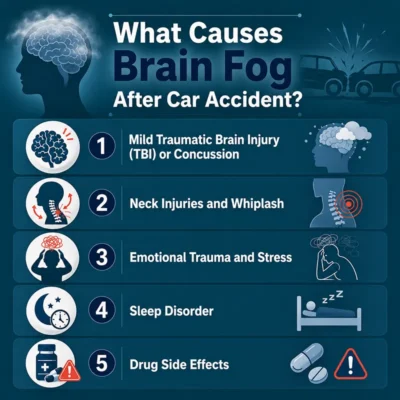
3. Emotional Trauma and Stress

Emotional stress also serves a major role in mental fatigue. When an accident happens, anxiety, shock and emotional trauma are common issues.

If you are under stress, it can impair your memory and you may find it difficult to fall asleep. It also drains your mental energy and causes problems with thought processes. When stress merges with physical injury, mental cloudiness can feel even worse.

4. Sleep Disorder

One more factor of brain fog after car accident is sleep problems. Many accident victims find it hard to fall asleep or stay asleep. If you don’t sleep properly, it prevents the brain from fully recovering.

Therefore, memory becomes weaker, thinking slows, attention is reduced and mental fatigue sets in. Even little sleep problems can make brain fog after car accident much worse.

5. Drug Side Effects

Lastly, drugs that are prescribed after an accident might be another reason. Pain relievers, muscle relaxants or anxiety-relieving drugs can lower memory and slow thinking. It also creates a dull feeling in the mind.

Knowing that these medicines help the body recover but they can also worsen cognitive haze.

Did You Know?

You do not need to hit your head to develop brain fog after an accident. Sudden neck movement from whiplash alone can affect brain and nerve function.

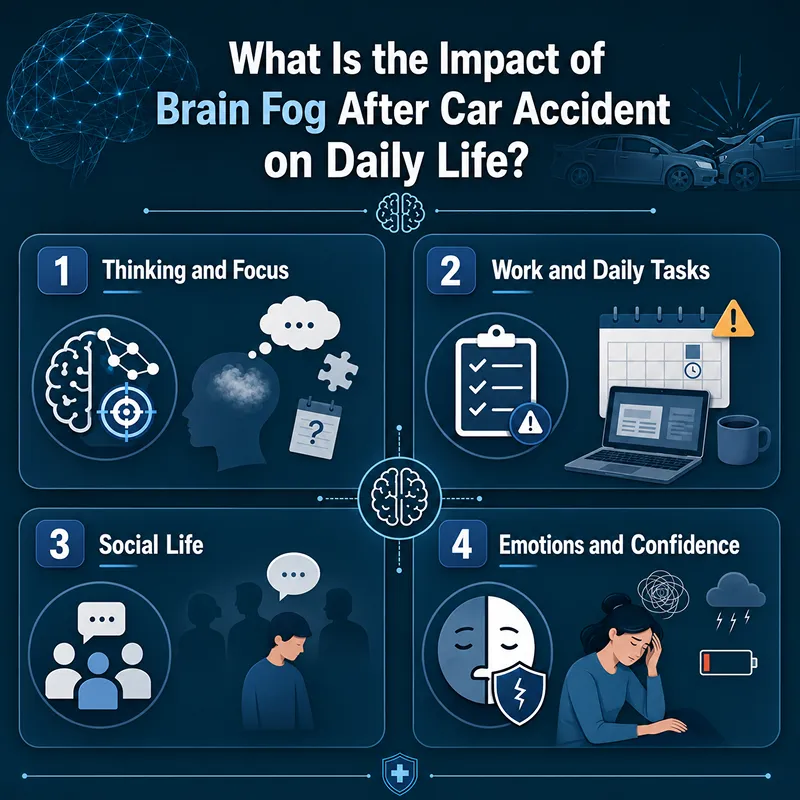
What Is the Impact of Brain Fog After Car Accident on Daily Life?

Brain fog after car accident doesn’t just make it tough to think. It can shape almost everything you do in a day. It can have an impact on mood, social life, work and more.

Thinking and Focus

Thinking issues may be the first thing you notice. You might find it hard to focus on tasks. Besides this, remembering things that just happened can be tricky and making decisions takes longer. Even following a simple conversation can be tiring.

Work and Daily Tasks

Brain fog after car accident can affect everyday duties and work. When you are suffering from mental fatigue, getting things done on time can feel stressful.

In addition, tasks you usually carry out easily can feel overwhelming. You also feel like planning and organising is like climbing a big mountain.

Social Life

It can be hard to talk to others if you have a mind haze issue. Expressing yourself clearly can feel tricky and you might feel shy or avoid social settings. Also, social scenarios that were easy before can feel stressful now.

Emotions and Confidence

This can all have an overall effect on your mood. You might get upset or feel uneasy. Besides this, your confidence in your own thinking can drop and this can make the fog feel worse.

Mental dullness is invisible and some people may not know how hard it is.

The first step to dealing with and clearing the fog is realising how it impacts everyday living.
Could Brain Fog After Car Accident Be a Neurological Injury?

Brain fog after an accident is more than just feeling fatigued or anxious. Many people think it is caused by a lack of sleep or worry. However, it is connected to real changes in the brain.

Accidents that result in a hit to the head, whiplash or both. This can alter how the brain works. This can cause lasting trouble with thinking, memory and emotions. This clarifies that mental cloudiness may indicate a neurological injury rather than just stress.

Brain Activity Changes After a Concussion

A concussion is a mild form of brain injury. It can make the brain duller and less organised. After a concussion, brain areas do not interact well. Also, some parts of the brain may work too poorly and others may try to do too much.

This makes the brain tired and less useful. Besides this, the tasks that used to be easy can feel stressful. Thinking, recalling and paying attention may all take more time.

When the Brain Works Too Much or Too Little

Brain fog after car accident can arise when some parts of the brain are underactive and others are overactive.

1. Hypoactivation

Hypoactivation takes place when some brain areas do not work well. So, the other parts of the brain have to handle all the duties. This extra work makes even simple tasks feel tiring.

Therefore, thinking and memory become tougher and mental energy is used up fast.

2. Hyperactivation

When certain parts of the brain become overactive, hyperactivation takes place. These places take up too much energy and leave the brain feeling drained. Due to this, staying focused becomes difficult and mental effort feels heavy.

When hyperactivation arises along with hypoactivation, it results in lasting mental dullness.

Most Affected Brain Areas

Brain regions commonly affected include the following:

Prefrontal Cortex

This part of the brain is responsible for planning, focus and decision-making.

Hippocampus

The hippocampus is a region of the brain that is important for memory storage.

Thalamus

It filters and processes sensory information.

Basal Ganglia

This component supports movement, habits and cognitive performance.

When there is a breakdown of these systems:

  • Results in unreliable memory
  • Keeping focus becomes difficult
  • Thinking feels slow or overwhelmed

Brain Fog After Car Accident Does Not Emerge Alone

Brain fog usually doesn’t occur on its own. Rather, it is often associated with other symptoms. Many people suffer from headaches, pressure in the head or feeling dizzy.

In addition, they may have trouble with balance or feel very tired. Memory problems, anxiety and depression are also common.

Additionally, some even detect vision changes or reactivity to light. All these symptoms are connected and they show that the brain and nervous system are affected. Mental fog is often part of a more serious problem, not just stress.

Can a Neck Injury Cause Brain Fog After Car Accident?

One of the most crucial causes of brain fog after an accident is often ignored. It is the mixed effect of a concussion and a neck injury.

A car accident often causes whiplash, where the head turns forward and backwards quickly. Two injuries could result from such an action at the same time:

Concussion

When a car accident takes place, many people focus only on apparent injuries. However, even a minor blow or sometimes no direct head impact can result in a concussion. The brain’s ability to deal with information is damaged when it is shaken inside the skull.

This scenario results in mental cloudiness. In this situation, thoughts feel duller, memory can slow down and confusion can set in. Even simple sounds and bright lights can be unpleasant. These changes may seem minor at first, but they often build up to make daily tasks more difficult.

Neck Injury and Cervicogenic Dizziness

Whiplash can harm the neck in addition to the brain. Small nerves and joints in the cervical spine play a crucial role in telling the brain when it is injured. When they are damaged, these signals get mixed up.

Your brain usually gets three main inputs to make sense of movement and balance:

  • Eyes
  • Inner ears
  • Neck nerves

After whiplash, the neck may send inaccurate signals to the brain. Due to this, dizziness occurs, which is a spinning sensation or a general feeling of unease. These sensations can also worsen mental fog, making it harder to focus or think clearly.

Learn more: The lasting effects of whiplash injury

What Are Other Common Symptoms for Brain Fog After Car Accident?

Cognitive haze often develops after an accident. It usually comes with other signs because they are caused by the same brain and nerve disorders.

1. Headaches and Pain

After a concussion or whiplash, headaches are very frequent. You might feel a firm feeling of pressure around your head, like a tension headache.

Some people suffer from migraines, which may include light sensitivity or nausea. Besides this, others develop chronic headaches that come directly from the injury.

Mental fatigue worsens if you are also suffering from pain. This is because your brain uses extra energy when dealing with pain. This leaves less energy for thinking, memory and attention. This may, in the end, make it more difficult to maintain control and awareness.

2. Memory Loss

After a brain or neck injury, memory issues frequently develop. You remember things and process information with vital parts of the brain. These areas are the prefrontal cortex, the hippocampus and the thalamus.

When these areas are damaged, short-term memory can become faulty. You may struggle to remember new information, forget recent conversations or lose track of tasks. All this results in the feeling of mental dullness and makes daily activities more stressful.

3. Fatigue and Mental Exhaustion

One of the most common signs of brain fog after car accident is feeling tired. Sleep can be lost after an accident and your nervous system may be in overdrive. This uses extra energy to cope with stress.

Even if you sleep a lot, you may still feel fatigued because the quality of your sleep is reduced.

Your brain also works harder to process information, which can drain your energy and make mental tasks feel harder.

Why Does Brain Fog After a Car Accident Persist?

Some people recover soon from brain fog after car accident. However, it can last for weeks or even months for others. Continuous symptoms usually mean that the brain and nervous system are still trying to get better.

Several things can cause brain fog after car accident and the brain may still be working poorly after a concussion. Also, neck injuries or problems with posture can continue to confuse the brain.

Besides this, poor sleep can make it harder to heal and emotional stress or anxiety may delay recovery. After an injury, hormonal changes, such as problems with the thyroid or pituitary gland, may also be responsible.

Recovery can seem more stressful and take longer when several systems are affected.

Important Detail!

Brain fog that lasts for weeks or months may point to an underlying neurological issue, not just stress or tiredness. Early assessment can improve recovery.

How Brain Fog After Car Accident Is Evaluated?

A thorough assessment is crucial since brain fog after car accident can come from a variety of sources:

  • TBI or concussion can arise from the brain
  • A cervical nerve disorder occurs in the neck
  • The vestibular system affects the inner ear
  • Emotional or mental factors

Detailed analysis may include:

  • Cognitive testing (processing speed, memory and attention)
  • Balance and sensory testing
  • Neck and soft tissue checkup
  • Emotional and mental health screening

This makes it easier to separate neurological, physical and mixed signs.

What Are the Treatment Approaches for Brain Fog After Car Accident?

Brain fog after car accident can be treated, but recovery frequently calls for a systemic strategy.

1. Vestibular rehabilitation

When balance and dizziness issues are present, this approach is used. It involves eye movement workouts and rebuilding the brain to process sensory signals properly. It also includes head and posture training.

2. Cervical therapy

For whiplash injuries, the following treatments are considered:

  • Reduce muscle tension through manual therapy
  • Mild movement techniques
  • Nerve health recovery

This helps strengthen the interaction between the neck and the brain.

3. Cognitive rehabilitation

For issues with thinking and memory:

  • Concentration training
  • Memory activities
  • Cognitive stimulation exercises

With the help of this, you can promote the efficiency and healing of the brain.

4. Lifestyle and recovery support

Recovery is also facilitated by:

  • Gentle exercise at secure levels
  • Proper diet and hydration
  • Stress reduction strategies
  • Techniques to enhance sleep

These strengthen brain function and help restore energy.

UK Case Study: Brain Fog After Car Accident

Brain fog after car accident can persist, as shown by a recent medical case in the UK. After suffering a concussion, the patient came across:

  • Mental fog
  • A lack of focus
  • Memory loss
  • Tiredness
  • Slow thinking

At first, medical experts believed these to be typical post-concussion signs. However, extra testing showed a hormone problem connected to the brain damage. After standard care, the patient’s focus and mental awareness were enhanced.

This scenario aligns with broader research. Almost 1/3 of adults with mild brain injuries still suffer from post-concussion symptoms months later, according to studies. Some keep dealing with poor focus, fatigue and memory issues long after the accident.

This points out that brain fog after car accident should not be dismissed. It may be a symptom of a real neurological illness that needs proper treatment.

Final Thoughts

If brain fog after car accident happens, it should not be ignored. When any head injury occurs, you may face problems like lack of focus, memory loss, dizziness and slow thinking. This may point to a neurological injury such as a concussion, whiplash disorder or other brain and nerve issues.

While some symptoms go away with time, others might remain and cause issues with daily life, relationships and work. Restoring confidence and mental focus can be assisted by early screening and suitable treatment.

Concise Medico is aware of the issues linked to post-accident cognitive symptoms. We provide support to help people better understand and address these problems.

Contact us today to learn how the right advice and care can support your healing process.

Struggling with brain fog after an accident and unsure what it means?

Our team helps you move from confusion to clarity with expert support and guidance.
We assess possible neurological causes and help you understand your symptoms clearly and safely.
We have helped with post-accident cognitive issues and recovery support across many cases. Reach out today to take the next step toward answers and recovery.
Struggling with brain fog after an accident and unsure what it means?

Our team helps you move from confusion to clarity with expert support and guidance.
We assess possible neurological causes and help you understand your symptoms clearly and safely.
We have helped with post-accident cognitive issues and recovery support across many cases. Reach out today to take the next step toward answers and recovery.

FAQs

What is brain fog?2026-06-03T06:15:41+00:00

Brain fog is not a disease. It is a group of symptoms that affect how your brain works. It can cause poor focus, memory issues, slow thinking, and mental tiredness. Many people notice it after an accident, illness, or stress. It can make daily tasks feel harder than normal.

What is brain fog neurology?2026-06-03T06:16:37+00:00

Brain fog neurology means how brain fog is linked to changes in the brain and nervous system. It often happens when brain signals are affected after injury, like a concussion or whiplash. Doctors study how the memory, attention, and thinking areas of the brain are impacted. This helps explain why brain fog can happen after an accident.

How long does brain fog last after a car accident?2026-06-03T06:17:18+00:00

Brain fog after a car accident may last a few days or weeks in mild cases. If there is a concussion or neck injury, it can last for months. Recovery time depends on injury level, sleep, and treatment. If it stays, medical help is needed.

Is brain fog after a car accident heavy?2026-06-03T06:18:47+00:00

Brain fog after a car accident can be heavy if it is linked to a concussion or neck injury. It may affect memory, focus, and daily tasks. If it lasts or gets worse, it should be checked by a doctor.

Can whiplash cause brain fog?2026-06-03T06:19:24+00:00

Whiplash can cause brain fog after a car accident. It can affect neck nerves and brain signals that control balance and thinking. This may lead to dizziness, confusion, and poor focus.

Share This Article!

When you get brain fog after a car accident, what happens next? Most individuals expect injuries such as cuts, bruises or broken bones. These harms are quite visible. What about the effects that are not easily detected? Brain fog after a car accident is one such situation.

Brain fog after accident is a set of neurological signs that affect how you think, remember and process facts. For example, you might feel slow, confused or as if your mental processes are clouded. It can appear after car crashes, falls, head trauma or even mild concussions.

In addition, mental cloudiness is not just a lack of energy or stress. It may point to a neurological injury, such as a minor brain injury or a mix of neck and brain harm.

However, not all foggy people have a severe disorder. This makes it tricky to understand.

In 2023–24, there were 123,969 hospital visits for head injury in the UK. In other words, roughly once every 4–5 minutes. This points out the average number of injuries that can cause cognitive haze.

In this blog, you’ll learn what mental fog is and why it happens after accidents. You will also explore how it can alter your daily life and when it might reveal a severe neurological injury.

Key Takeaways

  • Brain fog after car accident may be a sign of concussion, whiplash, or nerve injury and should not be brushed aside
  • Brain fog can cause poor focus, slow thinking, memory loss, tiredness, and trouble with daily tasks
  • “What is brain fog?” is a common question, and the answer is that it is a group of thinking and memory problems rather than a disease on its own.
  • Brain fog neurology links these symptoms to how the brain, nerves, neck, and balance system work after trauma.
  • Brain fog after an accident should be checked if symptoms last, get worse, or affect work, sleep, or social life, as early care can aid recovery

What Is Brain Fog?

Brain fog is a phrase used to refer to issues with the ability to think clearly. It does not make up a disease on its own. Instead, it is a warning sign that can take place for many reasons.

Stress, lack of sleep, unhealthy diet or health issues can all lead to mental fatigue.

Brain fog after accident, patients may observe the following:

  • Problems paying attention or staying focused
  • Issues related to short-term memory
  • Having trouble grasping information or thinking slowly
  • Feeling worn out or low on energy
  • Confusion or problems following thoughts
  • Having trouble finding words or wrapping up sentences

Brain fog after accident is often described as the following:

  • It feels like they are thinking through a blur
  • Feeling cognitively slow or exhausted
  • Finding it difficult to keep up with regular discussions or tasks
  • Getting out of focus or lost

It appears mild but cognitive dysfunction can impact daily life. When you are suffering this, simple tasks like reading, deciding or talking with others can feel hard.

Mental dullness often means that your body or mind needs medical attention. For this, things like more sleep, less stress, good food and checking for health issues can help.

Brain fog after an accident is not just a feeling of tiredness. It’s your brain signalling that it needs time, care, and proper rehabilitation to recover fully.

Dr Emma Sinclair, Neurologist, London, UK

What Causes Brain Fog After Car Accident?

Brain fog after car accident hardly ever has a distinct reason. It usually emerges from a blend of physical injuries and emotional stress. Other factors are also involved in it that can blur your thinking and slow your mind.

1. Mild Traumatic Brain Injury (TBI) or Concussion

After an accident, you may notice a cloudiness in your thinking, often called mental cloudiness. This fog doesn’t arise from one single place of origin. It usually arises from a blend of emotional stress and physical injuries.

Mild traumatic brain injury (TBI) or concussions are among the most widespread reasons. Even if nothing hits your head directly, you could still suffer a concussion. The brain moves inside the skull in response to extreme shocks, such as those that occur in car accidents.

This movement can cause damage to the head, lead to inflammation and disturb the signals between brain cells. When this takes place, interaction between different brain regions slows down.

Due to this, memory, focus and thinking speed can all suffer. A person may feel dizzy for days, weeks or even months after suffering even a mild concussion.

2. Neck Injury and Whiplash

Neck injuries, such as whiplash, are another often-ignored cause of cognitive haze. After an accident, when the neck snaps violently forward and backwards, whiplash occurs. This motion can damage muscles, ligaments, joints and nerves in the cervical spine.

Even without a serious head injury, these neck conditions can affect the brain. They cause problems with how it receives information about the body’s position. It results in confusion, dizziness and a sense of mental blur.
Explore: How long can a whiplash injury last

3. Emotional Trauma and Stress

Emotional stress also serves a major role in mental fatigue. When an accident happens, anxiety, shock and emotional trauma are common issues.

If you are under stress, it can impair your memory and you may find it difficult to fall asleep. It also drains your mental energy and causes problems with thought processes. When stress merges with physical injury, mental cloudiness can feel even worse.

4. Sleep Disorder

One more factor of brain fog after car accident is sleep problems. Many accident victims find it hard to fall asleep or stay asleep. If you don’t sleep properly, it prevents the brain from fully recovering.

Therefore, memory becomes weaker, thinking slows, attention is reduced and mental fatigue sets in. Even little sleep problems can make brain fog after car accident much worse.

5. Drug Side Effects

Lastly, drugs that are prescribed after an accident might be another reason. Pain relievers, muscle relaxants or anxiety-relieving drugs can lower memory and slow thinking. It also creates a dull feeling in the mind.

Knowing that these medicines help the body recover but they can also worsen cognitive haze.

Did You Know?

You do not need to hit your head to develop brain fog after an accident. Sudden neck movement from whiplash alone can affect brain and nerve function.

What Is the Impact of Brain Fog After Car Accident on Daily Life?

Brain fog after car accident doesn’t just make it tough to think. It can shape almost everything you do in a day. It can have an impact on mood, social life, work and more.

Thinking and Focus

Thinking issues may be the first thing you notice. You might find it hard to focus on tasks. Besides this, remembering things that just happened can be tricky and making decisions takes longer. Even following a simple conversation can be tiring.

Work and Daily Tasks

Brain fog after car accident can affect everyday duties and work. When you are suffering from mental fatigue, getting things done on time can feel stressful.

In addition, tasks you usually carry out easily can feel overwhelming. You also feel like planning and organising is like climbing a big mountain.

Social Life

It can be hard to talk to others if you have a mind haze issue. Expressing yourself clearly can feel tricky and you might feel shy or avoid social settings. Also, social scenarios that were easy before can feel stressful now.

Emotions and Confidence

This can all have an overall effect on your mood. You might get upset or feel uneasy. Besides this, your confidence in your own thinking can drop and this can make the fog feel worse.

Mental dullness is invisible and some people may not know how hard it is.

The first step to dealing with and clearing the fog is realising how it impacts everyday living.

Could Brain Fog After Car Accident Be a Neurological Injury?

Brain fog after an accident is more than just feeling fatigued or anxious. Many people think it is caused by a lack of sleep or worry. However, it is connected to real changes in the brain.

Accidents that result in a hit to the head, whiplash or both. This can alter how the brain works. This can cause lasting trouble with thinking, memory and emotions. This clarifies that mental cloudiness may indicate a neurological injury rather than just stress.

Brain Activity Changes After a Concussion

A concussion is a mild form of brain injury. It can make the brain duller and less organised. After a concussion, brain areas do not interact well. Also, some parts of the brain may work too poorly and others may try to do too much.

This makes the brain tired and less useful. Besides this, the tasks that used to be easy can feel stressful. Thinking, recalling and paying attention may all take more time.

When the Brain Works Too Much or Too Little

Brain fog after car accident can arise when some parts of the brain are underactive and others are overactive.

1. Hypoactivation

Hypoactivation takes place when some brain areas do not work well. So, the other parts of the brain have to handle all the duties. This extra work makes even simple tasks feel tiring.

Therefore, thinking and memory become tougher and mental energy is used up fast.

2. Hyperactivation

When certain parts of the brain become overactive, hyperactivation takes place. These places take up too much energy and leave the brain feeling drained. Due to this, staying focused becomes difficult and mental effort feels heavy.

When hyperactivation arises along with hypoactivation, it results in lasting mental dullness.

Most Affected Brain Areas

Brain regions commonly affected include the following:

Prefrontal Cortex

This part of the brain is responsible for planning, focus and decision-making.

Hippocampus

The hippocampus is a region of the brain that is important for memory storage.

Thalamus

It filters and processes sensory information.

Basal Ganglia

This component supports movement, habits and cognitive performance.

When there is a breakdown of these systems:

  • Results in unreliable memory
  • Keeping focus becomes difficult
  • Thinking feels slow or overwhelmed

Brain Fog After Car Accident Does Not Emerge Alone

Brain fog usually doesn’t occur on its own. Rather, it is often associated with other symptoms. Many people suffer from headaches, pressure in the head or feeling dizzy.

In addition, they may have trouble with balance or feel very tired. Memory problems, anxiety and depression are also common.

Additionally, some even detect vision changes or reactivity to light. All these symptoms are connected and they show that the brain and nervous system are affected. Mental fog is often part of a more serious problem, not just stress.

Can a Neck Injury Cause Brain Fog After Car Accident?

One of the most crucial causes of brain fog after an accident is often ignored. It is the mixed effect of a concussion and a neck injury.

A car accident often causes whiplash, where the head turns forward and backwards quickly. Two injuries could result from such an action at the same time:

Concussion

When a car accident takes place, many people focus only on apparent injuries. However, even a minor blow or sometimes no direct head impact can result in a concussion. The brain’s ability to deal with information is damaged when it is shaken inside the skull.

This scenario results in mental cloudiness. In this situation, thoughts feel duller, memory can slow down and confusion can set in. Even simple sounds and bright lights can be unpleasant. These changes may seem minor at first, but they often build up to make daily tasks more difficult.

Neck Injury and Cervicogenic Dizziness

Whiplash can harm the neck in addition to the brain. Small nerves and joints in the cervical spine play a crucial role in telling the brain when it is injured. When they are damaged, these signals get mixed up.

Your brain usually gets three main inputs to make sense of movement and balance:

  • Eyes
  • Inner ears
  • Neck nerves

After whiplash, the neck may send inaccurate signals to the brain. Due to this, dizziness occurs, which is a spinning sensation or a general feeling of unease. These sensations can also worsen mental fog, making it harder to focus or think clearly.

Learn more: The lasting effects of whiplash injury

What Are Other Common Symptoms for Brain Fog After Car Accident?

Cognitive haze often develops after an accident. It usually comes with other signs because they are caused by the same brain and nerve disorders.

1. Headaches and Pain

After a concussion or whiplash, headaches are very frequent. You might feel a firm feeling of pressure around your head, like a tension headache.

Some people suffer from migraines, which may include light sensitivity or nausea. Besides this, others develop chronic headaches that come directly from the injury.

Mental fatigue worsens if you are also suffering from pain. This is because your brain uses extra energy when dealing with pain. This leaves less energy for thinking, memory and attention. This may, in the end, make it more difficult to maintain control and awareness.

2. Memory Loss

After a brain or neck injury, memory issues frequently develop. You remember things and process information with vital parts of the brain. These areas are the prefrontal cortex, the hippocampus and the thalamus.

When these areas are damaged, short-term memory can become faulty. You may struggle to remember new information, forget recent conversations or lose track of tasks. All this results in the feeling of mental dullness and makes daily activities more stressful.

3. Fatigue and Mental Exhaustion

One of the most common signs of brain fog after car accident is feeling tired. Sleep can be lost after an accident and your nervous system may be in overdrive. This uses extra energy to cope with stress.

Even if you sleep a lot, you may still feel fatigued because the quality of your sleep is reduced.

Your brain also works harder to process information, which can drain your energy and make mental tasks feel harder.

Why Does Brain Fog After a Car Accident Persist?

Some people recover soon from brain fog after car accident. However, it can last for weeks or even months for others. Continuous symptoms usually mean that the brain and nervous system are still trying to get better.

Several things can cause brain fog after car accident and the brain may still be working poorly after a concussion. Also, neck injuries or problems with posture can continue to confuse the brain.

Besides this, poor sleep can make it harder to heal and emotional stress or anxiety may delay recovery. After an injury, hormonal changes, such as problems with the thyroid or pituitary gland, may also be responsible.

Recovery can seem more stressful and take longer when several systems are affected.

Important Detail!

Brain fog that lasts for weeks or months may point to an underlying neurological issue, not just stress or tiredness. Early assessment can improve recovery.

How Brain Fog After Car Accident Is Evaluated?

A thorough assessment is crucial since brain fog after car accident can come from a variety of sources:

  • TBI or concussion can arise from the brain
  • A cervical nerve disorder occurs in the neck
  • The vestibular system affects the inner ear
  • Emotional or mental factors

Detailed analysis may include:

  • Cognitive testing (processing speed, memory and attention)
  • Balance and sensory testing
  • Neck and soft tissue checkup
  • Emotional and mental health screening

This makes it easier to separate neurological, physical and mixed signs.

What Are the Treatment Approaches for Brain Fog After Car Accident?

Brain fog after car accident can be treated, but recovery frequently calls for a systemic strategy.

1. Vestibular rehabilitation

When balance and dizziness issues are present, this approach is used. It involves eye movement workouts and rebuilding the brain to process sensory signals properly. It also includes head and posture training.

2. Cervical therapy

For whiplash injuries, the following treatments are considered:

  • Reduce muscle tension through manual therapy
  • Mild movement techniques
  • Nerve health recovery

This helps strengthen the interaction between the neck and the brain.

3. Cognitive rehabilitation

For issues with thinking and memory:

  • Concentration training
  • Memory activities
  • Cognitive stimulation exercises

With the help of this, you can promote the efficiency and healing of the brain.

4. Lifestyle and recovery support

Recovery is also facilitated by:

  • Gentle exercise at secure levels
  • Proper diet and hydration
  • Stress reduction strategies
  • Techniques to enhance sleep

These strengthen brain function and help restore energy.

UK Case Study: Brain Fog After Car Accident

Brain fog after car accident can persist, as shown by a recent medical case in the UK. After suffering a concussion, the patient came across:

  • Mental fog
  • A lack of focus
  • Memory loss
  • Tiredness
  • Slow thinking

At first, medical experts believed these to be typical post-concussion signs. However, extra testing showed a hormone problem connected to the brain damage. After standard care, the patient’s focus and mental awareness were enhanced.

This scenario aligns with broader research. Almost 1/3 of adults with mild brain injuries still suffer from post-concussion symptoms months later, according to studies. Some keep dealing with poor focus, fatigue and memory issues long after the accident.

This points out that brain fog after car accident should not be dismissed. It may be a symptom of a real neurological illness that needs proper treatment.

Final Thoughts

If brain fog after car accident happens, it should not be ignored. When any head injury occurs, you may face problems like lack of focus, memory loss, dizziness and slow thinking. This may point to a neurological injury such as a concussion, whiplash disorder or other brain and nerve issues.

While some symptoms go away with time, others might remain and cause issues with daily life, relationships and work. Restoring confidence and mental focus can be assisted by early screening and suitable treatment.

Concise Medico is aware of the issues linked to post-accident cognitive symptoms. We provide support to help people better understand and address these problems.

Contact us today to learn how the right advice and care can support your healing process.

Struggling with brain fog after an accident and unsure what it means?

Our team helps you move from confusion to clarity with expert support and guidance.
We assess possible neurological causes and help you understand your symptoms clearly and safely.
We have helped with post-accident cognitive issues and recovery support across many cases. Reach out today to take the next step toward answers and recovery.
Struggling with brain fog after an accident and unsure what it means?

Our team helps you move from confusion to clarity with expert support and guidance.
We assess possible neurological causes and help you understand your symptoms clearly and safely.
We have helped with post-accident cognitive issues and recovery support across many cases. Reach out today to take the next step toward answers and recovery.

FAQs

What is brain fog?2026-06-03T06:15:41+00:00

Brain fog is not a disease. It is a group of symptoms that affect how your brain works. It can cause poor focus, memory issues, slow thinking, and mental tiredness. Many people notice it after an accident, illness, or stress. It can make daily tasks feel harder than normal.

What is brain fog neurology?2026-06-03T06:16:37+00:00

Brain fog neurology means how brain fog is linked to changes in the brain and nervous system. It often happens when brain signals are affected after injury, like a concussion or whiplash. Doctors study how the memory, attention, and thinking areas of the brain are impacted. This helps explain why brain fog can happen after an accident.

How long does brain fog last after a car accident?2026-06-03T06:17:18+00:00

Brain fog after a car accident may last a few days or weeks in mild cases. If there is a concussion or neck injury, it can last for months. Recovery time depends on injury level, sleep, and treatment. If it stays, medical help is needed.

Is brain fog after a car accident heavy?2026-06-03T06:18:47+00:00

Brain fog after a car accident can be heavy if it is linked to a concussion or neck injury. It may affect memory, focus, and daily tasks. If it lasts or gets worse, it should be checked by a doctor.

Can whiplash cause brain fog?2026-06-03T06:19:24+00:00

Whiplash can cause brain fog after a car accident. It can affect neck nerves and brain signals that control balance and thinking. This may lead to dizziness, confusion, and poor focus.

Go to Top
