TABLE OF CONTENT
Pain Expert Witness Report vs. GP Letter: What Solicitors Really Need for High-Value Claims
Did you know that 26% of adults in the UK suffer from chronic pain? Chronic pain may interfere with the way people live, work and feel healthy. Personal injury and clinical negligence claims may become harder because of such symptoms.
To make a proper assessment of a claim, it is very useful to have good medical evidence. Solicitors should decide whether they need an expert pain report or just a General Practitioner (GP) letter. The expert pain report will be used for high-value claims, while the letter from the GP may be enough for simple GP claims.
The ability to distinguish between the two types of medical evidence is helpful when choosing the right option for making a case. This can strengthen the case and support a fair outcome.
What Is a Pain Expert Witness Report vs. GP Letter?
A pain expert witness report is a detailed report prepared by a pain expert in a legal case. The report explains what caused the pain and how the pain affected the person’s life. The report further looks at the future treatment and ongoing pain management. Such a report gives solicitors and courts complete information about the individual’s case.
The letter from the GP is a short medical letter from a doctor. It briefly tells details about the health and treatment of the individual. It can be used for basic pain cases. However, it cannot provide detailed information like a specialist’s report. Thus, such a letter may not be enough in complicated pain cases.
An expert’s duty is to help the court on matters within their expertise.
Civil Procedure Rules (CPR) Part 35, United Kingdom
What Are the Key Differences Between a Pain Expert Witness Report and a GP Letter?
Both documents have medical data. But their purpose is different. A pain expert witness report is used in a legal process, while a letter from the GP is used for managing the patient’s care. Due to this, the nature of the information provided in the two documents is also different.
The key differences are as follows:
-
Purpose
A pain expert witness report is written for a legal case. A letter from the GP is written to support the health needs of the individual. Even though both of these documents involve medical information, they serve two different purposes. The main difference is that one serves a legal purpose and the other serves a clinical purpose.
-
Independence
The expert pain report is written by an independent pain expert, while the letter from the GP is written by the patient’s doctor. Both have different roles. The pain expert gives an independent expert opinion while the doctor focuses on care and treatment. That is why the expert pain report is used in legal cases.
-
Content
The pain expert witness report presents a full review of the individual’s pain, including the cause of the pain and its effect on their life. The letter from the GP presents an overview of the patient’s health situation. While the expert report provides a full review of the case.
-
Legal Value
A pain expert witness report is written for a legal case. The report complies with all rules for expert evidence. A letter from the GP is written to support the care of the patient. This is not made to be used as expert evidence in court. Due to this, the expert report is more useful for high-value claims.

Why Is a Pain Expert Witness Report More Valuable Than a GP Letter in High-Value Claims?
High-value claims require clear medical evidence. The pain expert witness report provides an unbiased view of the claimant’s pain and needs. It explains the condition and shows the impact of the condition on the claimant’s day-to-day activities. This could help the solicitors present stronger evidence for the claim.
The main reasons are given as follows:
-
Stronger Medical Evidence
The pain expert witness report outlines the cause of the pain and its impact on the claimant’s daily life. The report is based on a complete medical assessment and supporting records. It gives stronger evidence than a letter from a GP.
-
Better Assessment of Future Loss
The pain expert witness report looks at how pain may affect the claimant in the long term. This may include details about future care, treatment costs and any implications for the claimant’s ability to work. A letter from a General Practitioner does not normally consider such aspects.
-
Court-Ready Report
The pain expert witness report is designed to be used in legal cases and meets court standards. The report provides medical information in a structured way. This makes it more credible than a letter from a GP in cases that are of high value.
When Should Solicitors Use a Pain Expert Witness Report Instead of a GP Letter?
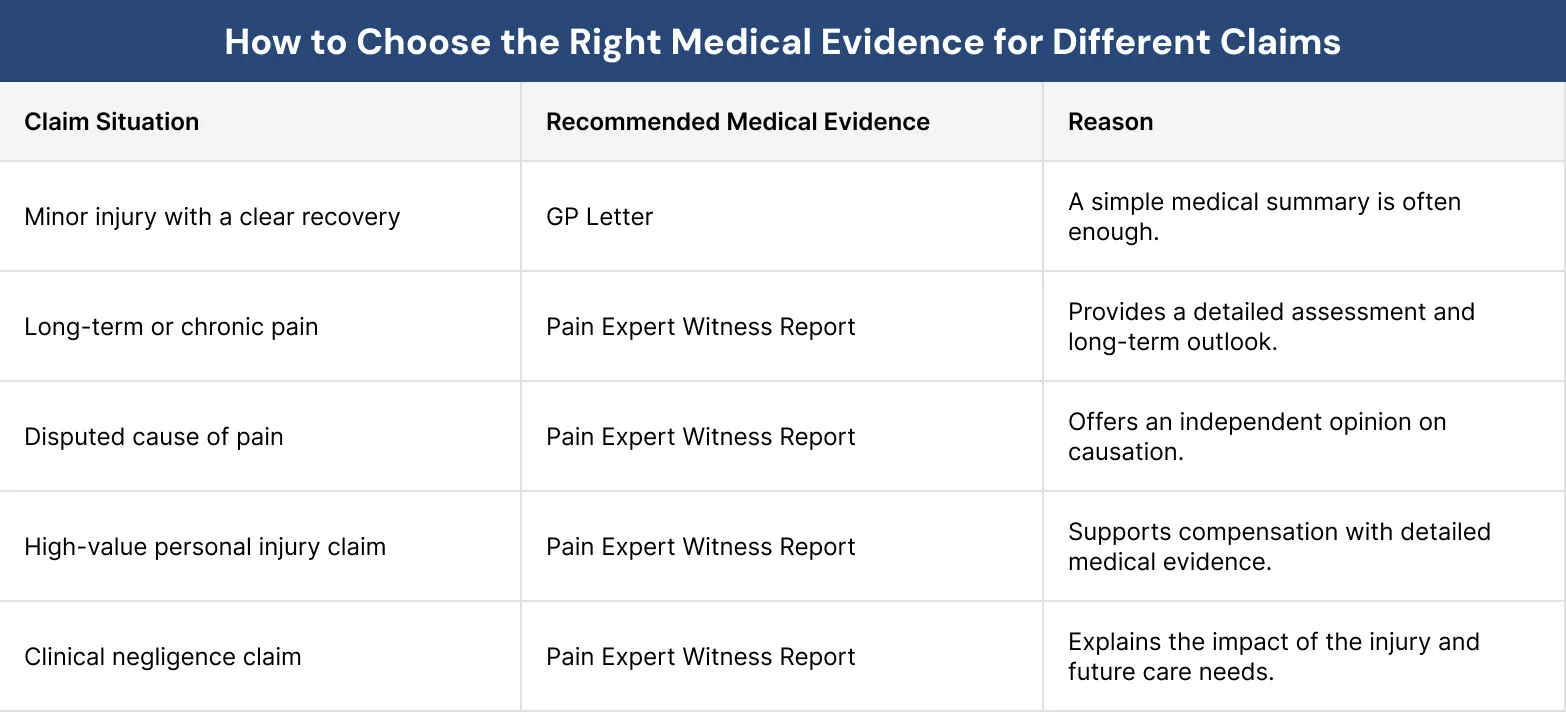
A General Practitioner’s letter will be enough for a simple claim. But some claims require a more detailed medical history. In such cases, it is a must to use a pain expert witness report. Such a report provides a clearer view of the patient’s pain and needs.
The following are some situations where an expert report may be the better choice:
-
Long-Term or Complex Pain
A pain expert witness report is useful when pain lasts longer than expected or becomes more complex. It explains the condition in detail and assesses its long-term effects. This helps support the claim with stronger medical evidence.
-
Disputed Claims
If there is a doubt about the causes of the pain and its severity, a pain expert witness report would be helpful. This provides an independent opinion, based on medical evidence. As these reports help clear up any doubts and support a fair decision.
-
High-Value Cases
Claims that carry high value usually have more compensation and greater attention from lawyers. The Pain Expert Witness Report is one that offers in-depth evidence on the future treatment and effects. This helps solicitors present a stronger case.
What Does a Pain Expert Witness Report Include That a GP Letter Does Not?
The GP’s Letter is an overview of the patient’s condition and treatment, while the pain expert witness report contains specific medical findings relevant to the legal claim.
The following are some of the key details present in the report:
-
Causation Opinion
The report determines whether the pain is caused by the incident. Another factor that is considered is whether another disorder may have had an impact on the symptoms. This helps establish the cause of the injury.
-
Prognosis
The report describes how the injury is likely to change over time. It also highlights the expected recovery and any long-term effects. This helps estimate future needs and the compensation.
-
Treatment Recommendations
The report suggests proper treatment or rehabilitation based on the condition of the claimant. Further medical treatment can also be suggested if needed. This helps in planning for future care.
-
Review of Medical Records
The expert reviews the medical records provided by many healthcare providers. This helps in forming a clear view of the claimant’s health condition. It also ensures that the opinion is based on all available evidence.
How Should Solicitors Decide Between a Pain Expert Witness Report and a GP Letter?
Each document is chosen based on the needs of the claim. The solicitor should consider the nature of the case, what medical evidence is needed and if the case may end up in court.
Below are some of the factors that help in making that decision:
-
Type of Claim
For simple claims, you only need a letter from a GP. But for personal injury claims and clinical negligence claims, a pain expert witness report is needed. The expert pain report provides detailed medical evidence.
-
Complexity of the Injury
A letter from a GP would be suitable if you have an injury that will heal in no time. In case of a serious, ongoing or unexplained pain, a pain expert witness report is the best choice.
-
Court Requirements
If the case is expected to go into court, the need for a better medical case is usually more preferred. The pain expert witness report is written for court purposes and therefore is more suitable than a letter from a GP.
Case Study
A UK claimant suffered from widespread pain after a road traffic accident that was later diagnosed as fibromyalgia. While this information was in the medical records, the defendant argued that it had nothing to do with the accident. To establish causation, the solicitor asked an independent Pain Consultant to produce a medico-legal report.
This expert assessed the medical history of the claimant, proved the causation of the condition due to the accident and provided an opinion on its long-term effects. The result was a six-figure settlement, proving why the pain expert witness report is worth more in the UK than the routine clinical records in high-value claims.
Conclusion
A letter from the GP can be helpful for day-to-day medical care. However, more complicated claims may require more detailed medical records. The pain expert witness report provides an unbiased opinion and a clear review of the claimant’s pain. This report is created for legal cases and helps to support the claim. At Concise Medico, we offer expert pain reports for cases of personal injuries and clinical negligence. Reach out to us if you want to discuss your medico-legal reporting needs.