TABLE OF CONTENT
Medico Legal Reports in 2026: Standards, Structure and Best Practice
The growing number of damage and negligence claims in the UK has been significant for many years now. The 110,000 damage claims in the UK reported in 2025 have also continued to grow. So what makes a claim successful? Well, the answer is a correctly written Medico Legal Report (MLR). You can give expert and credible evidence to the authority, courts and insurers with an MLR. Evidence of this nature may refer to another person sustaining an injury, somebody actually having or suffering from an illness or someone’s mental state.
What Is a Medico Legal Report?
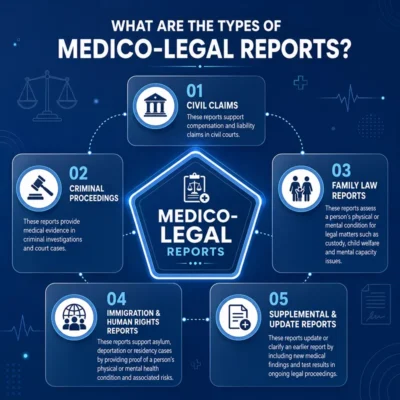
Medico legal report is an objective and fair evaluation made by an expert in medicine. It provides data to assist with legal proceedings. The report consists of information regarding the current state of health, cause(s) and prognosis of the patient’s health condition. This data helps courts and legal practitioners make better decisions. Medico-legal reports can be of several types, as shown below:
What Are The Benefits of Medico-Legal Reports?
The key advantages of the medico legal reports are as follows:
- It offers fair, impartial evidence to help clarify complex medical issues and functional limitations.
- An MLR determine whether an event directly caused the condition or made it worse. It also predicts the probability and time frame of recovery.
- It facilitates the legal process to support an applicant’s case or prepare for settlement discussions.
- It helps in calculating fair compensation.
When Do You Need a Medico-Legal Report?
You may need medical proof or MLR to defend a legal claim. It provides independent medical opinion on the cause, severity and outcome of an injury or illness. These reports are used in personal injury, immigration and clinical negligence. An MLR is also useful in employment and family cases. A medical expert reviews records and evaluates them. The final report helps in the fair judicial and insurance decision-making process.
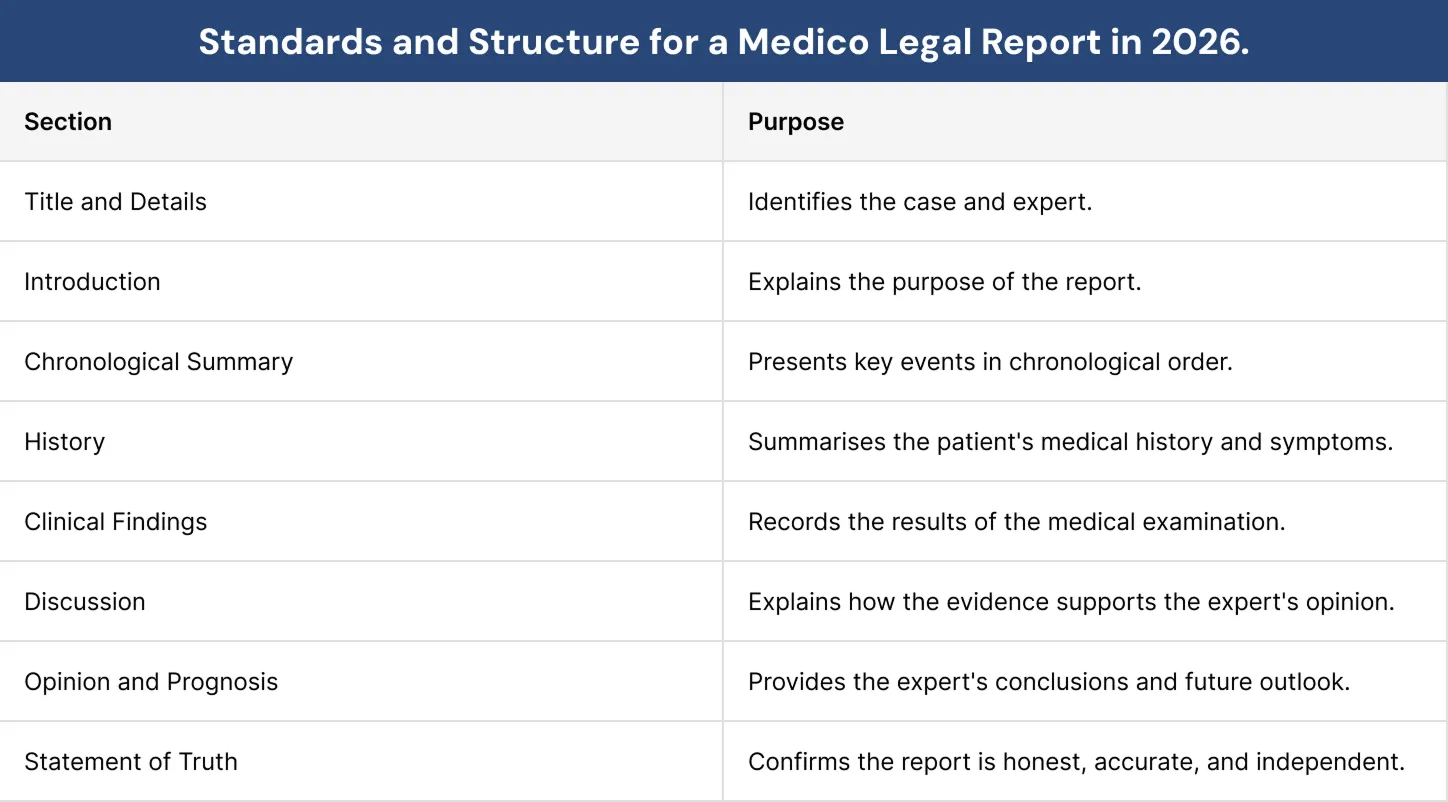
What Should a Medico-Legal Report Include?
A medico legal report should follow a clear and consistent structure. This helps legal authorities understand the expert’s findings easily.
1. Basic Info and Title
A medico legal report should begin with the case title and key information. A typical report includes the expert’s qualifications and the report date. It also includes the names of the person examined and the person requesting the report.
2. Overview or Introduction
This section should present the purpose of the medico legal report. It must describe the questions that the expert was asked to address.
It should also list the documents and medical records reviewed. Include any other proof relevant to the assessment.
3. Summary of Proof
The main events should be listed in a chronological order. A timeline can be helpful to readers when they understand the background to the case. It also shows how the person’s medical condition changed over time.
4. History
The history should include the individual’s description of the incident. It should also cover their medical history and current symptoms. Include details of the medical care they received. Explain how the injury or illness has affected their daily life, work and quality of life.
5. Clinical Findings
This section should present the results of the medical examination. It should include relevant clinical observations and test results. Document all findings in an accurate and objective way.
6. Discussion
The discussion explains whether the medical proof matches the reported events. It compares the person’s account with the medical records. It also explains any differences and the reasons behind the expert’s conclusions.
7. Opinion and Prognosis
It presents the expert’s opinion on the diagnosis, likely cause and prognosis. It also includes any permanent impairment or long term effects helped by the proof. The report may include advice for further care, rehabilitation or additional reviews.
8. Statement of Truth
The report should end with a declaration. It should confirm the expert’s duty to provide an independent opinion. It must also include a Statement of Truth. It confirms that the report is accurate and the expert’s opinion is honest.
Key Standards for a Medico Legal Report in 2026
To write a well-structured report, a clinical expert must follow these standards:
1. Ease of Access
A good report should be easy to understand to non medical readers. Explain medical terms in plain language and avoid unnecessary jargon. It should also explain how the expert came to each conclusion.
2. Objectivity and Neutrality
The report should provide an independent opinion. The opinion should be based on medical records and test results. An ideal report also considers the test results and proof. The expert must be impartial, neutral and must not be an advocate for either side. All conclusions must be based on clinical proof and records.
3. Legal and Ethical Responsibilities
The report should meet all legal and professional needs for the case. It should follow court rules and patient privacy. A medico legal report must also include reporting requirements of the appropriate jurisdiction.
4. Clinical Expertise
The report must be written by a medical expert with a relevant background and expertise. The expert should base their opinion on the best available medical knowledge. They should also follow accepted medical practices. They should do this within their field of expertise.
Best Practices of a Medico Legal Report
When writing a report, you have to adhere to these core principles and best practices:
- Maintain fair and neutral report writing. Discuss medical facts.
- Use simple and clear language to write the report. This ensures that a report is easy to understand for a layman.
- Do not use overly technical medical terms or emotive language.
- Clearly mention your qualification. Also, explain how the review was conducted.
- Present events and medical history in a clear chronological order.
- Document not only the positive but also the negative findings.
- Review the report for accuracy before final submission.
How Can Poor Reporting Affect a Legal Claim?
Poor medico legal reporting can delay court proceedings. It can also affect negotiations or dismiss your case. Let’s discuss them in detail to know how a poor report can affect a legal claim:
1. Case Dismissal
An expert witness report is required to prove injury or negligence. The court may dismiss the case if there is not enough proof. The proof must show that the incident caused the harm or breached the clinical duty of care.
2. Incorrect Compensation
A claimant may receive an unfair settlement if the report lacks important details. It should explain the long term prognosis, ongoing symptoms and future rehabilitation costs.
3. Delays and Higher Costs
Courts or opposing solicitors may challenge the proof. This can happen due to unclear language, factual errors or missing historical information. This results in delayed applications, further court dates and higher legal fees.
4. Loss of Credibility
The primary duty of a medical expert is to the court, not to instruct solicitors or the client. A judge may give little weight to a report if it is biased, unhelped or contradicts the proof. This can result in severe cost penalties for the claiming party.
How Much Do Medico Legal Reports Cost in the UK?
The fees for medico legal reports is not fixed. It depends on the report type, the expert’s qualifications and the difficulty of the case. A standard CPR compliant medico legal report in the UK begins at around £450. However, the actual cost can vary based on the requirements of the case. Complex reports such as clinical negligence claims usually have higher costs. Other reports may require multiple medical record reviews. They may also involve court appearances or emergency preparation. Most medico legal providers offer a tailored quote based on the scope of work.
How to Choose the Right Medico Legal Expert?
Choose a medical expert with relevant clinical experience and a valid medical license. They should have experience preparing reports that meet court requirements. Before you hire an expert, ask to see sample reports. Also, ensure they have experience with similar cases. Check their availability, how long the report will take and fees before committing to their services.
Case Study
A driver suffered a serious spinal injury in a road accident. The case was complex because the person also had age-related changes in the spine. An expert review was needed to find the true cause of the injuries. The expert reviewed medical records, imaging scans and accident details.
A detailed biomechanical assessment was also carried out. The opinion was based on the available medical evidence. The report identified the spinal injuries caused by the accident. It also distinguished them from changes linked to pre-existing degeneration. It clearly explained the differences and their long-term effects. The report helped establish clear causation. It helped secure a settlement that covered medical costs and lifetime care.
Conclusion
A medico legal report is not just medical writing. It demands clarity, structure and neutrality. The quality of the report has a significant impact on the case outcome. It can help courts, solicitors and insurers reach a fair and informed decision. However, a weak report can harm a case and result in unfair settlements.
Concise Medico provides independent CPR compliant medico legal reports. These reports are prepared by expert medical staff across the UK. Contact our team for accurate and reliable medico legal reporting. We provide independent, proof based medical opinions to help your case.