X-ray Expert Witness: When Are They Instructed and What Do They Do?
Did you know the NHS spent £216 million on private companies to interpret X-rays due to shortages of radiologists.
People often assume an X-ray stops being important after they are checked by the doctors or nurses. In reality, X-rays can be misread and injuries can be missed. When this happens, the opinion of an X-ray expert witness can make a real difference in legal cases. They help courts to understand what X-rays show and whether the images support a person’s claim. Their findings can help to explain how an injury happened and how serious it is.
In this guide, you will learn what an X-ray expert witness does, when they are needed and why their evidence is valuable in legal proceedings.
What Is an X-ray Expert Witness?
An X-ray expert witness is a qualified medical expert who reviews X-rays and explains their findings for legal cases. Their duty is to provide an honest opinion based on the medical evidence. They work for the court rather than supporting one side. In many cases, this expert is also a radiology expert witness with specialist training in diagnostic imaging.
Their work helps judges, solicitors, insurers and barristers to understand the injuries that may not be easy to explain. Instead of using complex medical terms, they present their findings in a way that everyone involved in the case can understand.
‘An expert witness should provide independent assistance to the court by way of objective, unbiased opinion.’
Mr Justice Cresswell, The Ikarian Reefer principles
When Are X-ray Expert Witnesses Instructed?
X-ray expert witnesses are called upon for various cases. Some cases focus on proving how an injury happened, while others look at whether a medical mistake caused harm. They are also actively sought for legal proceedings to provide their expert insight.
The following examples show when an x-ray expert witness is instructed:
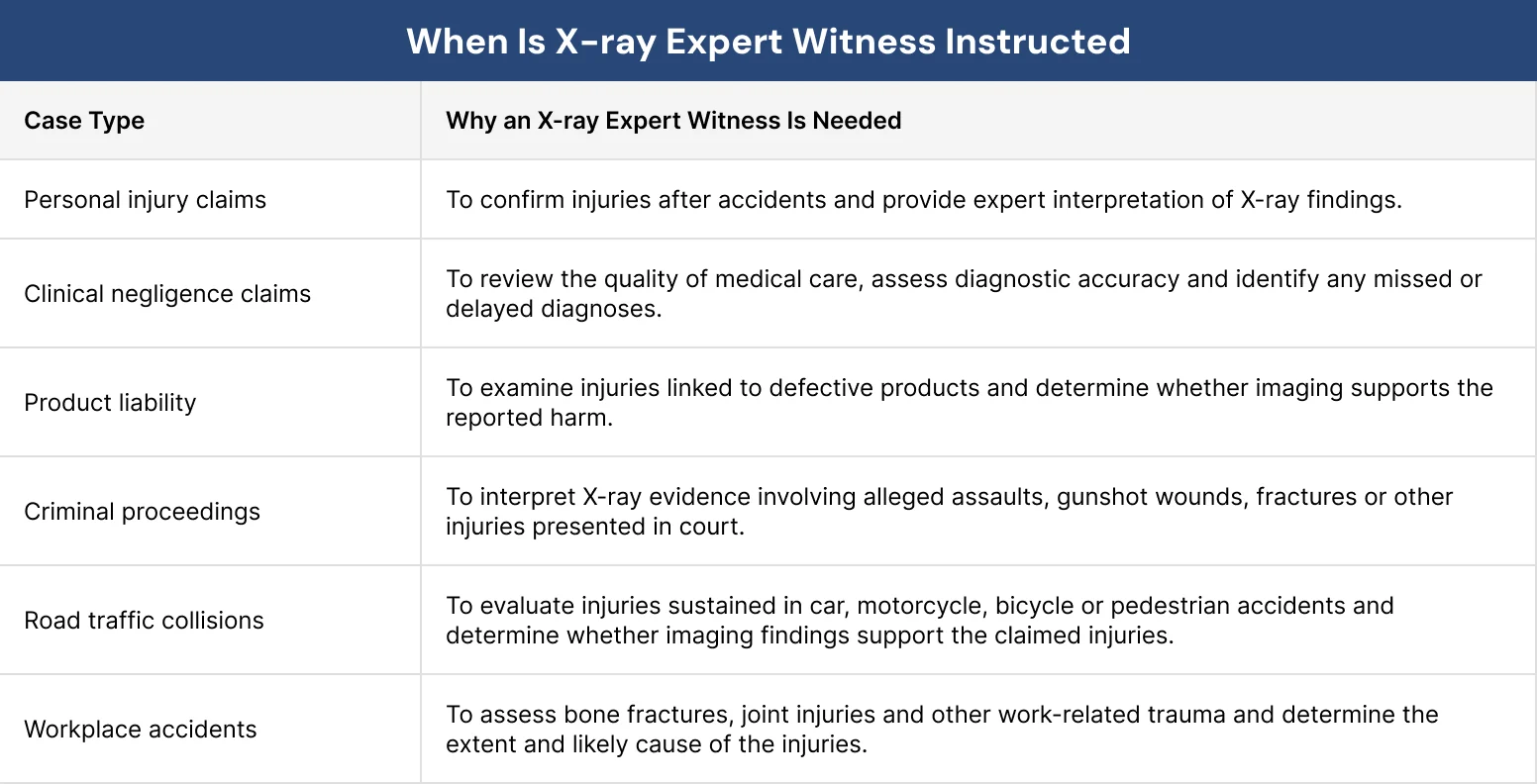
1. Personal Injury Claims
They are instructed to review X-rays after an accident and confirm the type, severity and cause of the injuries resulting from an accident. They determine whether the injury was a result of the accident or related to pre-existing condition. Their opinion helps to support a compensation claim.
2. Clinical Negligence Claims
An x-ray expert witness examines whether the diagnosis, treatment or follow-up care was appropriate based on the x-ray findings. They provide an independent opinion on whether the patient’s care met accepted medical standards or not.
3. Product Liability
A radiology expert witness helps determine if a defective product resulted in an injury. They review x-rays to determine the nature and extent of the injury and whether it is consistent with the reported incident.
4. Criminal Proceedings
An X-ray expert witness may be instructed in criminal cases involving fractures, assault injuries or other physical trauma. They explain the imaging results in simple terms to help the court and the jury understand the medical evidence.
5. Road Traffic Collisions
In cases of road traffic collision compensation, an X-ray expert witness assesses injuries such as broken bones or joint damage. Their findings help determine the extent of the injuries and whether they are consistent with the reported accident. This is often helpful in filing for claims or requiring compensation.
6. Workplace Accidents
X-ray expert witnesses provide their expertise when an employee suffers injuries at work, such as fractures or crush injuries. They review the X-rays to provide an opinion on the injury and its likely cause. It helps determine and shape workplace safety measures and compensation claims by the victim.
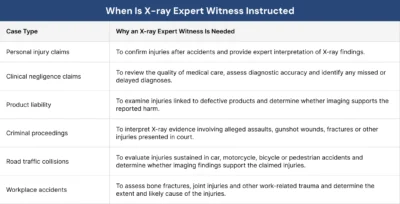
The table below shows the types of cases that require an X-ray expert witness.
What Are The Stages of an X-ray Expert Witness Instructions?
Every X-ray expert witness follows 4 stages of instructions. These stages show how an expert witness works at every stage and what they provide:
1. Early Stage
In the early stages, solicitors hire a specialist to evaluate the X-rays. This helps them to determine whether the legal claim has a strong foundation to move forward.
2. Exchange of Reports
Once formal legal proceedings are officially underway (for instance, under Civil Procedure Rules Part 35), the expert writes official, court-ready reports that show detail of their findings.
3. Joint Statements
If the opposing party also retains a radiology expert, the court mandates that both specialists consult with one another. Together, they create a joint document that clearly shows which points they agree on and which they dispute.
4. Trial/Hearing
In the final phase, experts may be called to the courtroom to present verbal testimony and undergo cross-examination by the opposing legal team.
These stages determine the proceeding of a medico-legal case under a radiology expert witness. Each stage leads to various aspects of what the expert does.
What Does an X-ray Expert Witness Do?
The main job of an X-ray expert witness is to give an independent medico-legal opinion based on imaging evidence. They study X-rays, compare them with medical records, and explain their findings in a clear way. Their duty is to help the court understand the facts, not to support either side.
A radiology expert witness carefully checks whether an injury was correctly diagnosed, whether treatment was appropriate and whether the imaging matches the reported accident or illness. The expert prepares a detailed report that explains the X-ray findings. This report is often used by solicitors and insurers to understand the medical issues before a case reaches court.
If needed, the expert also attends court to answer questions. They explain findings of the X-ray in simple language so everyone involved can understand the evidence.
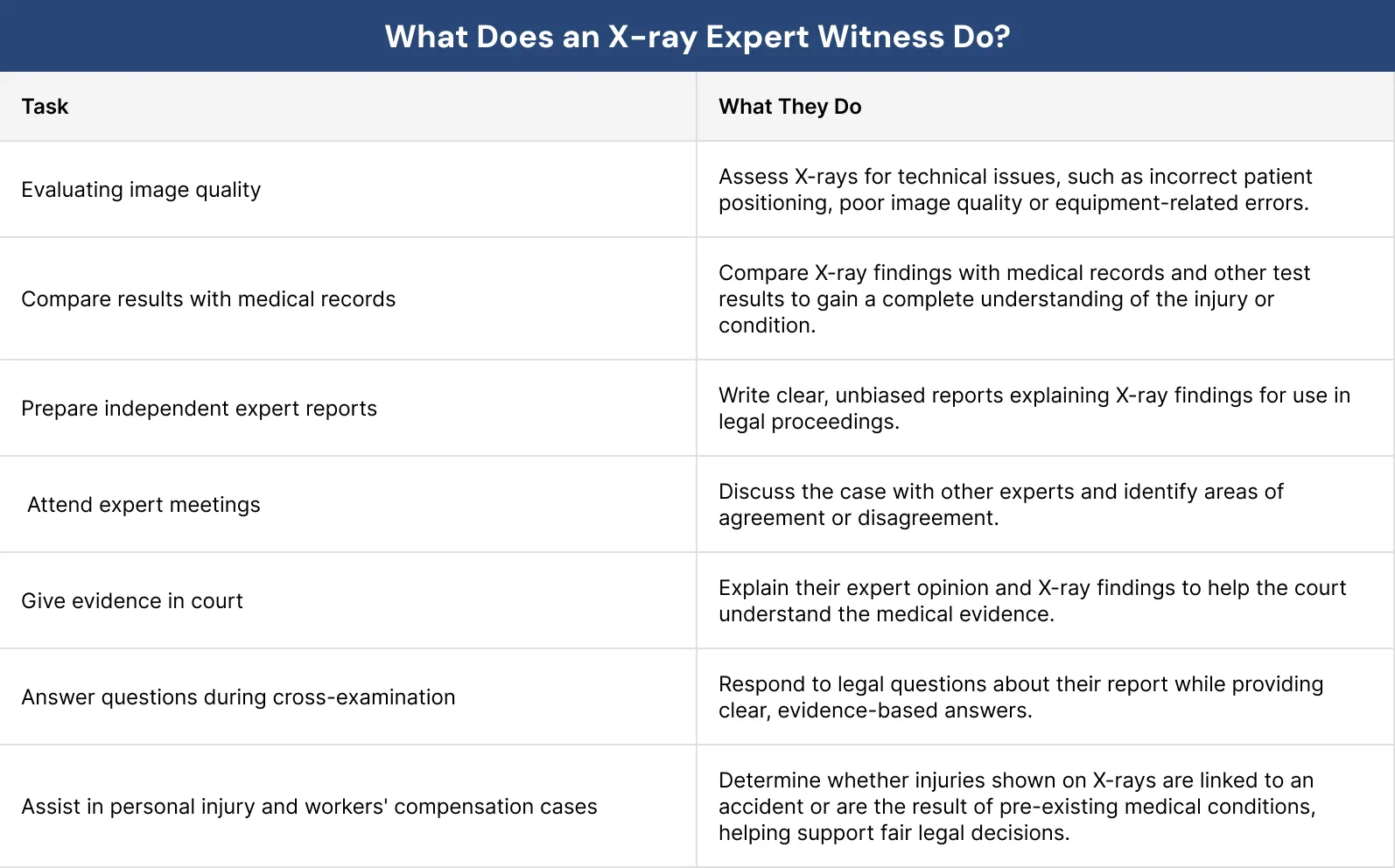
An X-ray expert witness may:
1. Evaluate Image Quality
They look for technical issues, such as incorrect patient positioning, machine errors or poorly captured scans that might make it hard to get an accurate diagnosis.
2. Compare results with medical records
Compare the X-ray findings with the patient’s medical history, clinical notes and other test results. This helps determine the impact of the injury in isolation.
3. Prepare independent expert reports
An x-ray expert witness writes an unbiased report which explains the X-ray findings in clear and simple language. The report provides an expert opinion that can be used as evidence in legal proceedings.
4. Attend expert meetings
Meet with other medical experts to discuss your case and identify areas of agreement or disagreement. These discussions can help narrow the issues before trial.
5. Give evidence in court
Present their expert opinion before the judge and, where applicable, the jury. They explain how the X-ray findings support their conclusions.
6. Answer questions during cross-examination
A radiology expert witness responds to questions from legal teams about their report and expert opinion. They explain their conclusions clearly while remaining objective and evidence-based.
The Missed Fracture: Case Study
A patient attended the emergency department after falling and injuring their face, elbow and wrist. Doctors arranged X-rays to check for broken bones. Although the X-rays showed a wrist fracture, the emergency department incorrectly reported that there was no fracture. The patient was sent home without the right treatment or follow-up care.
Two days later, a radiologist reviewed the same X-rays and a wrist fracture was identified. However, the patient was not recalled for another five weeks. This delay caused prolonged pain, stiffness and reduced movement. The case was later reviewed to understand why the diagnosis had been missed and why there was a delay in recalling the patient.
This shows that even x-ray images can be wrongfully read, leading to missed diagnosis by the doctors. As a result, the role of a radiology expert witness becomes vital in not only reviewing the error, but assisting in claims and compensations as well.
Conclusion
An X-ray expert witness plays a key role in legitimising your claim. Their opinion helps courts to understand the complex X-ray findings and make informed decisions based on reliable medical evidence.
From personal injury and clinical negligence claims to product liability cases, these experts review imaging, assess injuries and explain whether the medical evidence supports the facts of the case. At Concise Medico, our experienced medical experts provide clear and CPR Part 35-compliant reports to support your legal case.