The Most Common Reasons Personal Injury Claims Fail in the UK

Published On: June 9th, 2026|Total Views: 9|Daily Views: 2|17.9 min read|3548 words|

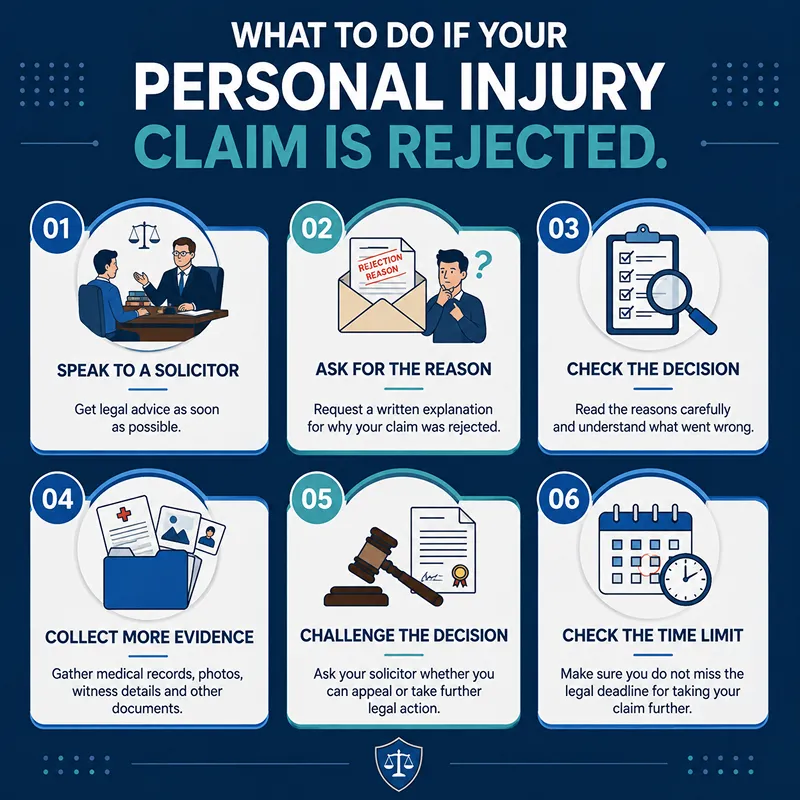
Every year, thousands of people in the UK get hurt because of someone else’s mistake. Many of those people have every right to get compensation.

A car crash, a fall at work and a slip on a wet floor in a market. These happen more than most people realise. Here is the thing: having a right to compensation and actually getting it are two very different things.

A personal injury claim is not always rejected because the case was weak. A personal injury claim can be rejected for reasons the claimant could have easily avoided.

Data found that about 24.62% of personal injury claims did not get compensation. This suggests that nearly one in four failed or were withdrawn.

The insurance industry tries to make people feel embarrassed about claiming. The truth is, if someone else caused the injury, the right solicitor can help you. You should not reject a personal injury first offer without legal advice, because the first offer may not cover the full injury, future treatment, lost income or long-term impact.

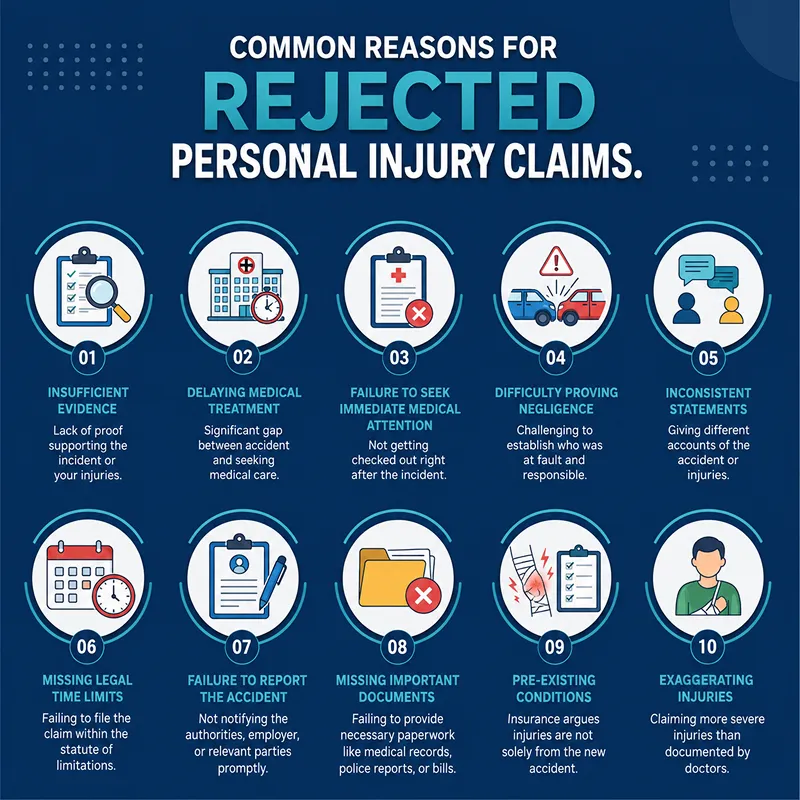
This guide covers the main reasons a personal injury claim can be rejected. Let us look at some of the most common reasons personal injury claims get rejected and how to avoid them.

Key Takeaways

  • A personal injury claim can be rejected if there is weak evidence, missed deadlines, unclear medical records or no proof of fault
  • If you wonder can a personal injury claim be rejected, the answer is yes, even a strong case can fail if it is not handled properly
  • Seeing a doctor quickly, reporting the accident and saving photos, CCTV, witness details and receipts are key mistakes to avoid in a personal injury claim
  • A personal injury case rejection can happen when the claimant waits too long, gives incomplete injury details or does not follow the correct legal process
  • Do not reject a personal injury first offer without legal advice, because early offers may miss future treatment, lost income or long-term injury impact
  • A personal injury claim offer rejected after expert review may lead to fairer compensation if the first offer is too low
  • Strong medical evidence, accurate records and the right solicitor can reduce the risk of rejection and support a clearer claim

1. Can Feeling Embarrassed Stop Someone From Making a Personal Injury Claim?

A personal injury claim can be rejected before it even starts. This can happen when the injured person talks themselves out of claiming.

The insurance industry has run big PR campaigns using phrases like ‘whiplash epidemic’ and ‘cash for crash’ to make legitimate claimants feel like criminals. Tabloid headlines have done the rest. So people prefer to stay quiet. They think others will judge them. They minimise their injuries and say things like ‘it wasn’t that bad.’

Here is also an important truth. If someone else caused the injury, through their negligence or carelessness, the law gives that injured person a legal right to claim.

Solicitors who work in personal injury see people from all walks of life hold back and it often costs them. Do not let stigma stand between the injury and the compensation. In some cases, this hesitation alone can lead to a rejected personal injury claim before the process even begins.

2. Why Is Seeking Medical Help Straight Away So Important?

This is one of the biggest reasons a personal injury claim can be rejected. The person waits to see if the pain goes away. Maybe they think it will get better on its own or they are busy.

However, delaying a doctor visit sends the wrong message to insurers. Insurance companies argue that if the injury was not bad enough to see a doctor about, it probably was not caused by the accident or was not serious to begin with.

Do not delay:

A late doctor visit can make your injury harder to prove.

Medical records are the backbone of any personal injury claim. Without hospital records made at the time of the accident, it becomes very hard to prove the injury happened because of the incident. Insurers will exploit every gap in the medical timeline. They are looking for reasons why a personal injury claim can be rejected.

It is important that claimants have a legal duty to take reasonable steps to help their own recovery. This is called the duty to mitigate losses. That means following all treatment plans, attending appointments and not doing anything that makes the injury worse. Keep a record of every appointment, prescription and piece of medical advice received.

3. Why Should an Accident Be Reported Officially?

A lot of people forget this step entirely. After an accident, the focus is on the injury and the shock of what just happened. Many people fail to officially report the incident to an employer, a local authority, a business or the police. This is one of the ways to have a personal injury claim rejected later on.

An official accident book entry or incident report is a contemporaneous record. That means it was created at the time which is very hard to dispute later. If the claim is for:

  • A workplace injury, it should be logged with the employer that day
  • A fall in a shop or public space, tell the manager and ask for a written record
  • A road traffic accident, the police and insurers both need to be informed

Always ask for a copy of any report made. That document could be vital six months down the line when the defendant tries to say the accident never happened or was not serious.

4. Why Is Collecting Evidence After an Accident So Important?

Evidence disappears fast and marks on the road fade within hours. Witnesses may forget details within days. Damaged property gets repaired or thrown out. Once that evidence is gone, it is hard to get back. This is one of the most common reasons a personal injury claim can be rejected. It is because there is nothing left to prove.

The burden of proof in a personal injury claim always lies with the claimant. That means it is on the injured person to show what happened, where it happened and who was at fault.

Take nothing on its looks; take everything on evidence. There’s no better rule.

– Charles Dickens, English Writer, England

Helpful evidence includes photographs and video from a smartphone or dashcam, witness contact details, weather and road conditions noted at the time. It also includes damaged clothing or broken equipment kept as physical evidence and CCTV footage requested from nearby shops and businesses before it gets deleted.

Save the proof:

Evidence disappears fast. Save photos, reports and witness details early.

If the injuries make it impossible to gather evidence alone, ask someone else at the scene to help. The more evidence gathered at the time, the less work needs to be done later and the harder it is for the other side to dispute what happened.

5. How Can Poor Records Affect a Personal Injury Claim?

Many claimants only tell their doctor about the worst injury that hurts the most right now. However, milder symptoms, psychological distress and the emotional impact of the accident are equally valid parts of a claim. They often get overlooked entirely.

Insurance companies go through medical records carefully. If a symptom was never mentioned to a doctor, it becomes very difficult to claim for it later. This is also a reason why a personal injury claim can be rejected.

Doctors can sometimes make small mistakes in medical notes. For example, they may write the left hand instead of the right hand. This can cause serious problems at trial. Always check your medical notes during the appointment, not weeks later after they have been formally submitted.

A personal injury journal helps to avoid rejected personal injury claims. Keep a daily record of symptoms, pain levels, mobility problems, emotional impact, sleep disruption and how the injury affects work and everyday life.

Save every receipt of hospital parking, taxi fares when unable to drive, takeaways bought because cooking is impossible, physiotherapy costs and even money spent by friends or family members who help during recovery. Every one of those costs is potentially claimable.

Small amounts add up over weeks and months. A few pounds here and there in hospital parking alone can become a meaningful sum over a long recovery. Most claimants lose that money simply by not keeping the receipts.

6. Can a Personal Injury Claim Be Made With a Pre-Existing Condition?

Can a personal injury claim be rejected because of a previous medical history? This is a very common worry and it is mostly unfounded. Many people assume that if they had back pain before the accident or if they had already made a whiplash claim years ago, they cannot claim it again. That is not how the law works.

If the accident made an existing condition worse, for example, a stress-triggered skin condition that flared up badly or a back problem that became significantly more painful. That worsening is claimable.

The key question is not whether the person was already injured. It is whether the accident caused new harm or made existing harm worse. A specialist solicitor will know how to frame this correctly.

7. What Is the Low Velocity Impact (LVI) Argument?

This is a tactic that is becoming more and more common. When a claimant reports injuries from what looks like a minor collision, some insurers use what is known as the low velocity impact (LVI) argument. The idea is that the force of the impact was not strong enough to cause the kind of injuries being claimed. So the insurer argues the injuries must be exaggerated or invented.  At this stage, many claimants start asking, can a personal injury claim be rejected simply because the collision looked minor?

This argument can be defeated but it needs expert help. Specialist personal injury solicitors work with respected medical experts who can prove that even a low-speed collision can cause real, lasting soft tissue injuries. Courts have found in favour of claimants in these cases. However, it is very difficult to challenge this argument without proper legal support.

8. Can Psychological Injuries Be Included in a Personal Injury Claim?

A lot of people think that a personal injury claim needs a visible physical injury. That is not true. Psychological injuries like anxiety, PTSD, depression and emotional trauma are fully compensable under UK law, even in the absence of any physical harm. Cases have been won in court on psychological injury alone.

The key is to report all physical and mental symptoms to a doctor. Insurers will not pay for something that was never documented. If the accident caused nightmares, anxiety attacks or a fear of driving, tell the GP. Get it on record and then tell the solicitor.

9. Can Social Media Affect a Personal Injury Claim?

Facebook, Instagram and Twitter catch people’s attention very quickly. They are treated as public-facing evidence sources by insurance companies and defendant lawyers. Even with a private account, photos and posts can sometimes be accessed and used against the claimant. A single photo of someone smiling at a family gathering or standing at an event, can be used to argue the injury is not as serious as claimed.

The safest approach is to go quiet on social media for the duration of the claim. Do not make  posts about the accident and updates about how recovery is going. This is not about hiding anything. It is about not handing the other side a free argument.

10. What Happens If You Wait Too Long to Start a Claim?

Under the 1980 Limitation Act, most personal injury claims in the UK must be started within three years. That usually starts from the date of the accident. There are also some important exceptions. There are exceptions if the claimant did not know about the injury at the time.

For example, in cases of industrial disease like asbestos exposure, where symptoms appear years later. Then the three years starts from when they became aware. Similarly, the rules are different for people whose mental capacity is affected and for injuries that happened during childhood.

Missing the limitation deadline means losing the right to claim entirely. Then, it does not matter how strong the case is or how serious the injury was. A personal injury claim rejected because of a missed time limit can be very difficult to recover from.

Even within the three year window, delaying causes problems. Evidence becomes harder to gather. Witnesses’ memories fade. Early legal advice helps preserve evidence while it is still fresh. It also ensures the claim is prepared properly and not rushed at the last minute.

UK Personal Injury Claim Time Limits

11. Can You Claim Compensation If You Were Partly at Fault?

Can a personal injury claim be rejected just because the claimant was partly at fault? Not necessarily. This is called contributory negligence.

If the injured person was partly responsible, for example, not wearing a hard hat on a building site. The defendant can argue this but in most cases, it results in a reduction of the compensation, not a full rejection.

Courts usually reduce the compensation based on how much fault is shared. For example, it may be reduced by 25% or 50%. A good solicitor can help reduce how much is taken off.

The important thing is not to assume that partial responsibility means zero compensation. Many people walk away from valid claims because they feel guilty about being partly involved. That is a mistake.

12. Why Is Following the Correct Legal Process Important?

In England and Wales, there is a formal set of steps that must be followed before a personal injury case goes to court. These are called pre action protocols. They exist to make the process fair. They also give both sides a chance to reach a settlement without going to trial. Skipping them or doing them incorrectly can result in the claim being delayed, penalised on costs or not heard by a judge at all. In some cases, it can result in a rejected personal injury claim.

The required steps go in a set order, such as:

  • First, a letter of notification is sent
  • Then a formal letter of claim
  • The defendant must acknowledge it
  • Then follows an investigation period, disclosure of documents, gathering of medical evidence and negotiation
  • If no agreement is reached, court proceedings begin

Both the claimant and defendant have responsibilities at different stages of this process.

This is not something to attempt without professional guidance. Even a small error at an early stage can cause big problems later. A specialist solicitor handles all of this as a matter of routine. It is one of the clearest reasons why having expert legal help from the start matters so much.

13. How Do You Choose the Right Personal Injury Solicitor?

Not every solicitor is the right solicitor for a personal injury claim. Even a good general solicitor may lack the specialist knowledge of this area. This can lead to missed evidence, errors in the pre action process and a lower compensation than the claim may be worth. This can also cause a rejected personal injury claim.

When choosing a solicitor, there are some useful questions to ask, such as:

  • Have they handled a case like this before?
  • What is their track record?
  • How many clients are they currently managing?
  • Will the case be handled personally or passed to a less experienced paralegal?
  • Is funding on a no-win, no-fee basis?
  • How often will updates be provided?

Also look for specific credentials. The Law Society accreditation and regulation by the Solicitors Regulation Authority (SRA) are baseline requirements. Membership of the Association of Personal Injury Lawyers (APIL) is an additional and meaningful signal. It is a voluntary, claimant focused body whose members follow a strict code of conduct designed to help injured people get proper compensation. Where possible, get a recommendation and read former client reviews.

14. Why Is Informal Advice About Personal Injury Claims Risky?

Everyone has an opinion about a personal injury claim. They think their opinion can save you from a rejected personal injury claim. A friend who had a similar accident a few years ago. A family member who thinks they know how much the case is worth. A comment thread on a forum full of people comparing payouts. This kind of informal advice can lead to a rejected personal injury claim.
The value of a claim depends on the specific medical evidence, the financial losses involved and the particular circumstances of the accident. Comparing one claim to another is like comparing one person’s medical diagnosis to someone else’s.

Trust the solicitor to value the claim correctly. If the given answers do not feel right, ask more questions. If the solicitor is still not giving clear answers, find a better one. Try your best to avoid having your personal injury claim rejected.

Do vs Don’t Common Personal Injury Claim Mistakes

15. Why You Should Never Reject a Personal Injury First Offer Without Advice?

When a defendant admits liability, there is sometimes pressure to settle the case quickly. They offer money that sounds reasonable.

To reject a personal injury first offer is almost always the right decision until a solicitor has reviewed it. Quick offers are made early for a reason. Insurers often want to close the case before the full injury impact is clear.

What Special Damages Can Cover in Surgical Negligence Claims

Data found that liability was accepted in 79% of 35,407 claims, while 21% were denied or disputed by the insurers.

Once a settlement is accepted, it is very difficult to go back for more compensation, even if symptoms worsen significantly later. That is why it is so important not to reject a personal injury first offer while:

  • Recovery is still ongoing
  • Doctors have not yet given a full prognosis
  • Treatment is still happening
  • There are multiple injuries being assessed by different specialists
  • Recovery is expected to take more than six months

Future mental health complications are also a valid reason to wait. Psychological consequences of a serious accident can take time to show.

The good solicitor will advise at every stage whether an offer is fair or should be pushed back. The decision to reject a personal injury first offer and negotiate for a better figure is one that a specialist makes every single day. It often results in significantly higher compensation. It also keeps a person away from a rejected personal injury claim.

Think before settling:

A quick offer may be less than your claim is worth.

Case Study

There is a real case that shows how poor legal support can affect a claim. That often results in rejected personal injury claims. An employer was being sued for over £20,000 by a member of staff. He tried to defend the claim using a friend who happened to be a solicitor but she did not specialise in personal injury.

The solicitor made several errors. When a specialist PI (Personal Injury) firm stepped in, they resolved the case for £4,500. This helped save him over £15,000 and protect his business. The difference between a specialist and a generalist was more than fifteen thousand pounds.

Conclusion

A rejected personal injury claim is not always the end but it is far better to avoid that outcome in the first place. Most of the reasons a personal injury claim can be rejected come down to things that could have been handled differently in the first few days and weeks after the accident, such as:

  • Seeing a doctor immediately
  • Reporting the incident officially
  • Gathering evidence at the scene
  • Keeping detailed records
  • Not settling while recovery is still uncertain

The most difficult rejected personal injury claims to reverse are those resulting from missed deadlines, accepted settlements and lost evidence. That is why early legal advice from a solicitor makes a big difference.

Can a personal injury claim be rejected even when the case is strong? Yes, a personal injury claim can be rejected. A strong case handled badly can still fail. A modest case handled by the right specialist can succeed. Choose wisely, act quickly and keep records of everything. Taking these simple steps can significantly reduce the risk of a personal injury claim rejected outcome.

If a first offer has already been received, take a moment before responding. The decision to reject a personal injury first offer and go back for more is often the right one. It should always be made with proper legal guidance. Insurers are experienced at making low offers sound reasonable. A specialist solicitor will see through that immediately.

Getting hurt because of someone else’s negligence is already unfair. A personal injury claim rejected because of an avoidable mistake makes a bad situation worse.

Concise Medico understands what strong medical evidence means for your case, so contact us today to support your personal injury claim with clarity and confidence.

Worried your personal injury claim could get rejected due to missing evidence or small mistakes?

Concise Medico provides clear, reliable medical reports to support your case and strengthen your claim.
Reach out today and get clear, reliable medical evidence quickly to support your claim and avoid costly delays.

Worried your personal injury claim could get rejected due to missing evidence or small mistakes?

Concise Medico provides clear, reliable medical reports to support your case and strengthen your claim.
Reach out today and get clear, reliable medical evidence quickly to support your claim and avoid costly delays.

FAQs

Can a personal injury claim be rejected in the UK?2026-06-09T06:09:37+00:00

Yes, a personal injury claim can be rejected in the UK if there is weak evidence, missed deadlines, unclear medical records or no proof of fault. A claim must show that someone else caused the injury. Early action, proper records and legal support can reduce the risk of personal injury case rejection.

What is the most common reason a personal injury claim gets rejected?2026-06-09T06:10:10+00:00

The most common reason is weak or missing evidence. Without proof, it is hard to show what happened and who was at fault. Photos, witness details, medical records, accident reports and CCTV can support the case. Collecting evidence early is one of the key mistakes to avoid in a personal injury claim.

Can a personal injury claim be rejected if I was partly at fault?2026-06-09T06:19:06+00:00

Not always. If you were partly at fault, the claim may still continue. This is called contributory negligence. The court may reduce the compensation instead of rejecting the full claim. For example, compensation may be reduced by 25% or 50%, depending on how much fault is shared.

Does a delay in medical treatment affect a personal injury claim?2026-06-09T06:19:36+00:00

Yes, delaying medical treatment can weaken a claim. Insurers may argue that the injury was not serious or was not caused by the accident. Medical records help link the injury to the incident. Seeing a doctor quickly, even for minor pain, helps protect the claim.

Can I claim it if I already had a previous injury?2026-06-09T06:20:00+00:00

Yes, you can still claim if you had a previous injury. If the accident made an old condition worse, that worsening may be claimable. The key point is whether the accident caused new harm or made the existing problem worse. Clear medical evidence is needed to prove this.

Should I accept the first settlement offer from an insurer?2026-06-09T06:20:25+00:00

No, you should not accept the first settlement offer without legal advice. Early offers may be lower than the real value of the claim. The full impact of the injury, future treatment, long-term pain or lost income may not be clear yet. A personal injury claim offer rejected after advice may lead to fairer compensation.

Can social media affect my personal injury claim?2026-06-09T06:20:51+00:00

Yes, social media can affect a personal injury claim. Insurers may check posts, photos and activity to question how serious the injury is. Even a simple photo can be used against the claimant. It is safer to avoid posting about the accident or recovery until the claim is finished.

Share This Article!

Every year, thousands of people in the UK get hurt because of someone else’s mistake. Many of those people have every right to get compensation.

A car crash, a fall at work and a slip on a wet floor in a market. These happen more than most people realise. Here is the thing: having a right to compensation and actually getting it are two very different things.

A personal injury claim is not always rejected because the case was weak. A personal injury claim can be rejected for reasons the claimant could have easily avoided.

Data found that about 24.62% of personal injury claims did not get compensation. This suggests that nearly one in four failed or were withdrawn.

The insurance industry tries to make people feel embarrassed about claiming. The truth is, if someone else caused the injury, the right solicitor can help you. You should not reject a personal injury first offer without legal advice, because the first offer may not cover the full injury, future treatment, lost income or long-term impact.

This guide covers the main reasons a personal injury claim can be rejected. Let us look at some of the most common reasons personal injury claims get rejected and how to avoid them.

Key Takeaways

  • A personal injury claim can be rejected if there is weak evidence, missed deadlines, unclear medical records or no proof of fault
  • If you wonder can a personal injury claim be rejected, the answer is yes, even a strong case can fail if it is not handled properly
  • Seeing a doctor quickly, reporting the accident and saving photos, CCTV, witness details and receipts are key mistakes to avoid in a personal injury claim
  • A personal injury case rejection can happen when the claimant waits too long, gives incomplete injury details or does not follow the correct legal process
  • Do not reject a personal injury first offer without legal advice, because early offers may miss future treatment, lost income or long-term injury impact
  • A personal injury claim offer rejected after expert review may lead to fairer compensation if the first offer is too low
  • Strong medical evidence, accurate records and the right solicitor can reduce the risk of rejection and support a clearer claim

1. Can Feeling Embarrassed Stop Someone From Making a Personal Injury Claim?

A personal injury claim can be rejected before it even starts. This can happen when the injured person talks themselves out of claiming.

The insurance industry has run big PR campaigns using phrases like ‘whiplash epidemic’ and ‘cash for crash’ to make legitimate claimants feel like criminals. Tabloid headlines have done the rest. So people prefer to stay quiet. They think others will judge them. They minimise their injuries and say things like ‘it wasn’t that bad.’

Here is also an important truth. If someone else caused the injury, through their negligence or carelessness, the law gives that injured person a legal right to claim.

Solicitors who work in personal injury see people from all walks of life hold back and it often costs them. Do not let stigma stand between the injury and the compensation. In some cases, this hesitation alone can lead to a rejected personal injury claim before the process even begins.

2. Why Is Seeking Medical Help Straight Away So Important?

This is one of the biggest reasons a personal injury claim can be rejected. The person waits to see if the pain goes away. Maybe they think it will get better on its own or they are busy.

However, delaying a doctor visit sends the wrong message to insurers. Insurance companies argue that if the injury was not bad enough to see a doctor about, it probably was not caused by the accident or was not serious to begin with.

Do not delay:

A late doctor visit can make your injury harder to prove.

Medical records are the backbone of any personal injury claim. Without hospital records made at the time of the accident, it becomes very hard to prove the injury happened because of the incident. Insurers will exploit every gap in the medical timeline. They are looking for reasons why a personal injury claim can be rejected.

It is important that claimants have a legal duty to take reasonable steps to help their own recovery. This is called the duty to mitigate losses. That means following all treatment plans, attending appointments and not doing anything that makes the injury worse. Keep a record of every appointment, prescription and piece of medical advice received.

3. Why Should an Accident Be Reported Officially?

A lot of people forget this step entirely. After an accident, the focus is on the injury and the shock of what just happened. Many people fail to officially report the incident to an employer, a local authority, a business or the police. This is one of the ways to have a personal injury claim rejected later on.

An official accident book entry or incident report is a contemporaneous record. That means it was created at the time which is very hard to dispute later. If the claim is for:

  • A workplace injury, it should be logged with the employer that day
  • A fall in a shop or public space, tell the manager and ask for a written record
  • A road traffic accident, the police and insurers both need to be informed

Always ask for a copy of any report made. That document could be vital six months down the line when the defendant tries to say the accident never happened or was not serious.

4. Why Is Collecting Evidence After an Accident So Important?

Evidence disappears fast and marks on the road fade within hours. Witnesses may forget details within days. Damaged property gets repaired or thrown out. Once that evidence is gone, it is hard to get back. This is one of the most common reasons a personal injury claim can be rejected. It is because there is nothing left to prove.

The burden of proof in a personal injury claim always lies with the claimant. That means it is on the injured person to show what happened, where it happened and who was at fault.

Take nothing on its looks; take everything on evidence. There’s no better rule.

– Charles Dickens, English Writer, England

Helpful evidence includes photographs and video from a smartphone or dashcam, witness contact details, weather and road conditions noted at the time. It also includes damaged clothing or broken equipment kept as physical evidence and CCTV footage requested from nearby shops and businesses before it gets deleted.

Save the proof:

Evidence disappears fast. Save photos, reports and witness details early.

If the injuries make it impossible to gather evidence alone, ask someone else at the scene to help. The more evidence gathered at the time, the less work needs to be done later and the harder it is for the other side to dispute what happened.

5. How Can Poor Records Affect a Personal Injury Claim?

Many claimants only tell their doctor about the worst injury that hurts the most right now. However, milder symptoms, psychological distress and the emotional impact of the accident are equally valid parts of a claim. They often get overlooked entirely.

Insurance companies go through medical records carefully. If a symptom was never mentioned to a doctor, it becomes very difficult to claim for it later. This is also a reason why a personal injury claim can be rejected.

Doctors can sometimes make small mistakes in medical notes. For example, they may write the left hand instead of the right hand. This can cause serious problems at trial. Always check your medical notes during the appointment, not weeks later after they have been formally submitted.

A personal injury journal helps to avoid rejected personal injury claims. Keep a daily record of symptoms, pain levels, mobility problems, emotional impact, sleep disruption and how the injury affects work and everyday life.

Save every receipt of hospital parking, taxi fares when unable to drive, takeaways bought because cooking is impossible, physiotherapy costs and even money spent by friends or family members who help during recovery. Every one of those costs is potentially claimable.

Small amounts add up over weeks and months. A few pounds here and there in hospital parking alone can become a meaningful sum over a long recovery. Most claimants lose that money simply by not keeping the receipts.

6. Can a Personal Injury Claim Be Made With a Pre-Existing Condition?

Can a personal injury claim be rejected because of a previous medical history? This is a very common worry and it is mostly unfounded. Many people assume that if they had back pain before the accident or if they had already made a whiplash claim years ago, they cannot claim it again. That is not how the law works.

If the accident made an existing condition worse, for example, a stress-triggered skin condition that flared up badly or a back problem that became significantly more painful. That worsening is claimable.

The key question is not whether the person was already injured. It is whether the accident caused new harm or made existing harm worse. A specialist solicitor will know how to frame this correctly.

7. What Is the Low Velocity Impact (LVI) Argument?

This is a tactic that is becoming more and more common. When a claimant reports injuries from what looks like a minor collision, some insurers use what is known as the low velocity impact (LVI) argument. The idea is that the force of the impact was not strong enough to cause the kind of injuries being claimed. So the insurer argues the injuries must be exaggerated or invented.  At this stage, many claimants start asking, can a personal injury claim be rejected simply because the collision looked minor?

This argument can be defeated but it needs expert help. Specialist personal injury solicitors work with respected medical experts who can prove that even a low-speed collision can cause real, lasting soft tissue injuries. Courts have found in favour of claimants in these cases. However, it is very difficult to challenge this argument without proper legal support.

8. Can Psychological Injuries Be Included in a Personal Injury Claim?

A lot of people think that a personal injury claim needs a visible physical injury. That is not true. Psychological injuries like anxiety, PTSD, depression and emotional trauma are fully compensable under UK law, even in the absence of any physical harm. Cases have been won in court on psychological injury alone.

The key is to report all physical and mental symptoms to a doctor. Insurers will not pay for something that was never documented. If the accident caused nightmares, anxiety attacks or a fear of driving, tell the GP. Get it on record and then tell the solicitor.

9. Can Social Media Affect a Personal Injury Claim?

Facebook, Instagram and Twitter catch people’s attention very quickly. They are treated as public-facing evidence sources by insurance companies and defendant lawyers. Even with a private account, photos and posts can sometimes be accessed and used against the claimant. A single photo of someone smiling at a family gathering or standing at an event, can be used to argue the injury is not as serious as claimed.

The safest approach is to go quiet on social media for the duration of the claim. Do not make  posts about the accident and updates about how recovery is going. This is not about hiding anything. It is about not handing the other side a free argument.

10. What Happens If You Wait Too Long to Start a Claim?

Under the 1980 Limitation Act, most personal injury claims in the UK must be started within three years. That usually starts from the date of the accident. There are also some important exceptions. There are exceptions if the claimant did not know about the injury at the time.

For example, in cases of industrial disease like asbestos exposure, where symptoms appear years later. Then the three years starts from when they became aware. Similarly, the rules are different for people whose mental capacity is affected and for injuries that happened during childhood.

Missing the limitation deadline means losing the right to claim entirely. Then, it does not matter how strong the case is or how serious the injury was. A personal injury claim rejected because of a missed time limit can be very difficult to recover from.

Even within the three year window, delaying causes problems. Evidence becomes harder to gather. Witnesses’ memories fade. Early legal advice helps preserve evidence while it is still fresh. It also ensures the claim is prepared properly and not rushed at the last minute.

UK Personal Injury Claim Time Limits

11. Can You Claim Compensation If You Were Partly at Fault?

Can a personal injury claim be rejected just because the claimant was partly at fault? Not necessarily. This is called contributory negligence.

If the injured person was partly responsible, for example, not wearing a hard hat on a building site. The defendant can argue this but in most cases, it results in a reduction of the compensation, not a full rejection.

Courts usually reduce the compensation based on how much fault is shared. For example, it may be reduced by 25% or 50%. A good solicitor can help reduce how much is taken off.

The important thing is not to assume that partial responsibility means zero compensation. Many people walk away from valid claims because they feel guilty about being partly involved. That is a mistake.

12. Why Is Following the Correct Legal Process Important?

In England and Wales, there is a formal set of steps that must be followed before a personal injury case goes to court. These are called pre action protocols. They exist to make the process fair. They also give both sides a chance to reach a settlement without going to trial. Skipping them or doing them incorrectly can result in the claim being delayed, penalised on costs or not heard by a judge at all. In some cases, it can result in a rejected personal injury claim.

The required steps go in a set order, such as:

  • First, a letter of notification is sent
  • Then a formal letter of claim
  • The defendant must acknowledge it
  • Then follows an investigation period, disclosure of documents, gathering of medical evidence and negotiation
  • If no agreement is reached, court proceedings begin

Both the claimant and defendant have responsibilities at different stages of this process.

This is not something to attempt without professional guidance. Even a small error at an early stage can cause big problems later. A specialist solicitor handles all of this as a matter of routine. It is one of the clearest reasons why having expert legal help from the start matters so much.

13. How Do You Choose the Right Personal Injury Solicitor?

Not every solicitor is the right solicitor for a personal injury claim. Even a good general solicitor may lack the specialist knowledge of this area. This can lead to missed evidence, errors in the pre action process and a lower compensation than the claim may be worth. This can also cause a rejected personal injury claim.

When choosing a solicitor, there are some useful questions to ask, such as:

  • Have they handled a case like this before?
  • What is their track record?
  • How many clients are they currently managing?
  • Will the case be handled personally or passed to a less experienced paralegal?
  • Is funding on a no-win, no-fee basis?
  • How often will updates be provided?

Also look for specific credentials. The Law Society accreditation and regulation by the Solicitors Regulation Authority (SRA) are baseline requirements. Membership of the Association of Personal Injury Lawyers (APIL) is an additional and meaningful signal. It is a voluntary, claimant focused body whose members follow a strict code of conduct designed to help injured people get proper compensation. Where possible, get a recommendation and read former client reviews.

14. Why Is Informal Advice About Personal Injury Claims Risky?

Everyone has an opinion about a personal injury claim. They think their opinion can save you from a rejected personal injury claim. A friend who had a similar accident a few years ago. A family member who thinks they know how much the case is worth. A comment thread on a forum full of people comparing payouts. This kind of informal advice can lead to a rejected personal injury claim.

The value of a claim depends on the specific medical evidence, the financial losses involved and the particular circumstances of the accident. Comparing one claim to another is like comparing one person’s medical diagnosis to someone else’s.

Trust the solicitor to value the claim correctly. If the given answers do not feel right, ask more questions. If the solicitor is still not giving clear answers, find a better one. Try your best to avoid having your personal injury claim rejected.

Do vs Don’t Common Personal Injury Claim Mistakes

15. Why You Should Never Reject a Personal Injury First Offer Without Advice?

When a defendant admits liability, there is sometimes pressure to settle the case quickly. They offer money that sounds reasonable.

To reject a personal injury first offer is almost always the right decision until a solicitor has reviewed it. Quick offers are made early for a reason. Insurers often want to close the case before the full injury impact is clear.

What Special Damages Can Cover in Surgical Negligence Claims

Data found that liability was accepted in 79% of 35,407 claims, while 21% were denied or disputed by the insurers.

Once a settlement is accepted, it is very difficult to go back for more compensation, even if symptoms worsen significantly later. That is why it is so important not to reject a personal injury first offer while:

  • Recovery is still ongoing
  • Doctors have not yet given a full prognosis
  • Treatment is still happening
  • There are multiple injuries being assessed by different specialists
  • Recovery is expected to take more than six months

Future mental health complications are also a valid reason to wait. Psychological consequences of a serious accident can take time to show.

The good solicitor will advise at every stage whether an offer is fair or should be pushed back. The decision to reject a personal injury first offer and negotiate for a better figure is one that a specialist makes every single day. It often results in significantly higher compensation. It also keeps a person away from a rejected personal injury claim.

Think before settling:

A quick offer may be less than your claim is worth.

Case Study

There is a real case that shows how poor legal support can affect a claim. That often results in rejected personal injury claims. An employer was being sued for over £20,000 by a member of staff. He tried to defend the claim using a friend who happened to be a solicitor but she did not specialise in personal injury.

The solicitor made several errors. When a specialist PI (Personal Injury) firm stepped in, they resolved the case for £4,500. This helped save him over £15,000 and protect his business. The difference between a specialist and a generalist was more than fifteen thousand pounds.

Conclusion

A rejected personal injury claim is not always the end but it is far better to avoid that outcome in the first place. Most of the reasons a personal injury claim can be rejected come down to things that could have been handled differently in the first few days and weeks after the accident, such as:

  • Seeing a doctor immediately
  • Reporting the incident officially
  • Gathering evidence at the scene
  • Keeping detailed records
  • Not settling while recovery is still uncertain

The most difficult rejected personal injury claims to reverse are those resulting from missed deadlines, accepted settlements and lost evidence. That is why early legal advice from a solicitor makes a big difference.

Can a personal injury claim be rejected even when the case is strong? Yes, a personal injury claim can be rejected. A strong case handled badly can still fail. A modest case handled by the right specialist can succeed. Choose wisely, act quickly and keep records of everything. Taking these simple steps can significantly reduce the risk of a personal injury claim rejected outcome.

If a first offer has already been received, take a moment before responding. The decision to reject a personal injury first offer and go back for more is often the right one. It should always be made with proper legal guidance. Insurers are experienced at making low offers sound reasonable. A specialist solicitor will see through that immediately.

Getting hurt because of someone else’s negligence is already unfair. A personal injury claim rejected because of an avoidable mistake makes a bad situation worse.

Concise Medico understands what strong medical evidence means for your case, so contact us today to support your personal injury claim with clarity and confidence.

Worried your personal injury claim could get rejected due to missing evidence or small mistakes?

Concise Medico provides clear, reliable medical reports to support your case and strengthen your claim.
Reach out today and get clear, reliable medical evidence quickly to support your claim and avoid costly delays.

Worried your personal injury claim could get rejected due to missing evidence or small mistakes?

Concise Medico provides clear, reliable medical reports to support your case and strengthen your claim.
Reach out today and get clear, reliable medical evidence quickly to support your claim and avoid costly delays.

FAQs

Can a personal injury claim be rejected in the UK?2026-06-09T06:09:37+00:00

Yes, a personal injury claim can be rejected in the UK if there is weak evidence, missed deadlines, unclear medical records or no proof of fault. A claim must show that someone else caused the injury. Early action, proper records and legal support can reduce the risk of personal injury case rejection.

What is the most common reason a personal injury claim gets rejected?2026-06-09T06:10:10+00:00

The most common reason is weak or missing evidence. Without proof, it is hard to show what happened and who was at fault. Photos, witness details, medical records, accident reports and CCTV can support the case. Collecting evidence early is one of the key mistakes to avoid in a personal injury claim.

Can a personal injury claim be rejected if I was partly at fault?2026-06-09T06:19:06+00:00

Not always. If you were partly at fault, the claim may still continue. This is called contributory negligence. The court may reduce the compensation instead of rejecting the full claim. For example, compensation may be reduced by 25% or 50%, depending on how much fault is shared.

Does a delay in medical treatment affect a personal injury claim?2026-06-09T06:19:36+00:00

Yes, delaying medical treatment can weaken a claim. Insurers may argue that the injury was not serious or was not caused by the accident. Medical records help link the injury to the incident. Seeing a doctor quickly, even for minor pain, helps protect the claim.

Can I claim it if I already had a previous injury?2026-06-09T06:20:00+00:00

Yes, you can still claim if you had a previous injury. If the accident made an old condition worse, that worsening may be claimable. The key point is whether the accident caused new harm or made the existing problem worse. Clear medical evidence is needed to prove this.

Should I accept the first settlement offer from an insurer?2026-06-09T06:20:25+00:00

No, you should not accept the first settlement offer without legal advice. Early offers may be lower than the real value of the claim. The full impact of the injury, future treatment, long-term pain or lost income may not be clear yet. A personal injury claim offer rejected after advice may lead to fairer compensation.

Can social media affect my personal injury claim?2026-06-09T06:20:51+00:00

Yes, social media can affect a personal injury claim. Insurers may check posts, photos and activity to question how serious the injury is. Even a simple photo can be used against the claimant. It is safer to avoid posting about the accident or recovery until the claim is finished.

Go to Top