TABLE OF CONTENT
- Key Takeaways
- What Is a Neuropathic Pain Compensation Claim?
- How Does a Pain Expert Witness Prove Causation?
- 1. Reviewing the Timeline
- 2. Checking Your Medical History
- 3. Analysing the Mechanism of Injury
- 4. Reviewing Medical Evidence
- 5. Ruling Out Other Possible Causes
- 6. Assessing the Healing Timeline
- 7. Applying the ‘But-For’ Test
- 8. Considering Material Contribution
- 9. Explaining Persistent Pain
- 10. Providing an Independent Medical Opinion
- Why Is Causation Important in a Neuropathic Pain Compensation Claim?
- Case Study
- Conclusion
- FAQs
- What is the Rehabilitation Code in a personal injury claim?
- Does the Rehabilitation Code affect my compensation?
- Who pays for rehabilitation after a personal injury?
- Can rehabilitation begin before my claim is settled?
- What types of rehabilitation are available after a personal injury?
- Can you claim ESA if you are in rehabilitation?
- How can I strengthen my personal injury rehabilitation claim?
Neuropathic Pain Compensation Claims: How a Pain Expert Witness Proves Causation
How can you prove that your nerve pain was caused by another person’s negligence? This is often the hardest part when claiming compensation for neuropathic pain. Neuropathic pain is very common, with millions of people suffering from it. However, establishing its cause may not be an easy task.
It has been found that about 6% to 8% of the population suffers from neuropathic pain. The job of a pain expert witness is to examine your medical reports and give their independent medical opinion on your case. This evidence can help prove causation and support a stronger neuropathic pain compensation claim.
What Is a Neuropathic Pain Compensation Claim?
A neuropathic pain compensation claim is a legal claim made against the negligent party that led to nerve pain. This pain is characterised by feelings such as a burning sensation, tingling or sharp stabbing pains. Such pain can occur due to an accident, a fall, surgery or medical negligence. If the injury was not your fault, you may be able to claim compensation.
How Does a Pain Expert Witness Prove Causation?
A pain expert witness uses medical evidence to show that your neuropathic pain was caused by the accident or medical negligence rather than another health condition. They review your symptoms, medical records and test results to decide whether there is a clear link between the incident and your nerve pain. Their independent medical opinion is one of the most important pieces of evidence in a neuropathic pain compensation claim.
To prove causation, the expert usually follows these steps:
1. Reviewing the Timeline
This expert looks at how long you have had these symptoms by comparing the date of the incident to when your nerve pain first started. If there is a direct link, it may help prove that the incident caused your condition.
2. Checking Your Medical History
Your medical record is checked to see if there was any case of nerve damage before the accident. The expert also checks if the incident caused a new injury or made an existing condition worse.
3. Analysing the Mechanism of Injury
The expert examines how the incident occurred and if the type of injury was capable of damaging the specific nerves. The position of the injury will be compared to your symptoms to see if there is any medical relation between the two.
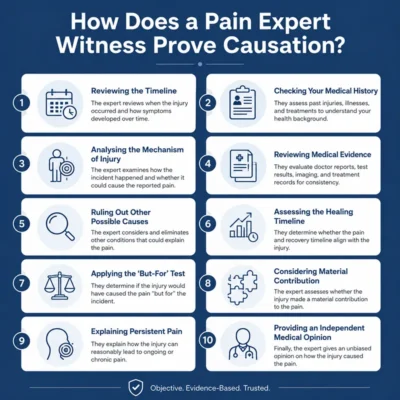
4. Reviewing Medical Evidence
Your MRI, X-rays, nerve studies, EMG findings and any other medical records will be reviewed along with your symptoms. Based on all of these factors, the medical expert gives an opinion and confirms nerve damage where possible.
5. Ruling Out Other Possible Causes
The doctor checks if there is another medical disorder that can be the cause of the symptoms presented. The medical history of the patient is analysed by the physician in order to check if the patient’s symptoms are related to age, diabetes, previous injuries, or any other disease that might lead to nerve pain.
6. Assessing the Healing Timeline
An expert checks if your healing has progressed according to how well your body should heal normally in your case. If you continue experiencing pain even when your tissues have been healed, it means that you may have something else besides an injury inside your body.
7. Applying the ‘But-For’ Test
The expert will ask if the nerve pain would have occurred regardless of the accident or treatment failure. If the answer to this question is no, then it can be assumed that the incident caused your condition.
8. Considering Material Contribution
Some people already have a medical condition before the accident. In such cases, the expert determines if the accident worsened the condition or caused you to experience neuropathic pain. Whether or not other elements played a role in your injuries, the accident remains the main cause of your problems.
9. Explaining Persistent Pain
Pain may continue even though brain images indicate little or no actual injury at all. A pain expert explains how neurological changes, such as central sensitisation, can lead to pain despite recovery from an injury. This helps explain why pain is genuine even though there may be no sign of injury.
10. Providing an Independent Medical Opinion
In the UK, pain expert witnesses must provide an independent and impartial medical opinion as per the Civil Procedure Rules (CPR Part 35). This means that the medical opinion presented by these witnesses is purely based on facts, regardless of who instructed them.
Why Is Causation Important in a Neuropathic Pain Compensation Claim?
Causation means that the nerve pain you have experienced has been caused by the negligence of another person. It is a key part of making a compensation claim for neuropathic pain. In the absence of evidence of causation, your compensation claim will be weak.
There are three main reasons why causation matters in a neuropathic pain compensation claim, which are:
1. Establishes the Link Between Negligence and the Injury
The causation element connects the error to the injury you incurred. This means that your nerve pain could not have occurred if not for their negligent actions. In addition, it is proof that the injury was a probable consequence of their actions.
2. Addresses Delayed Symptoms and Pre-Existing Conditions
A neuropathic pain compensation claim is a difficult one to make since there could be no immediate signs or symptoms of pain. Some individuals may also suffer from illnesses that affect the nervous system. A medical expert evaluates delayed symptoms and pre-existing conditions to determine whether the incident caused the neuropathic pain.
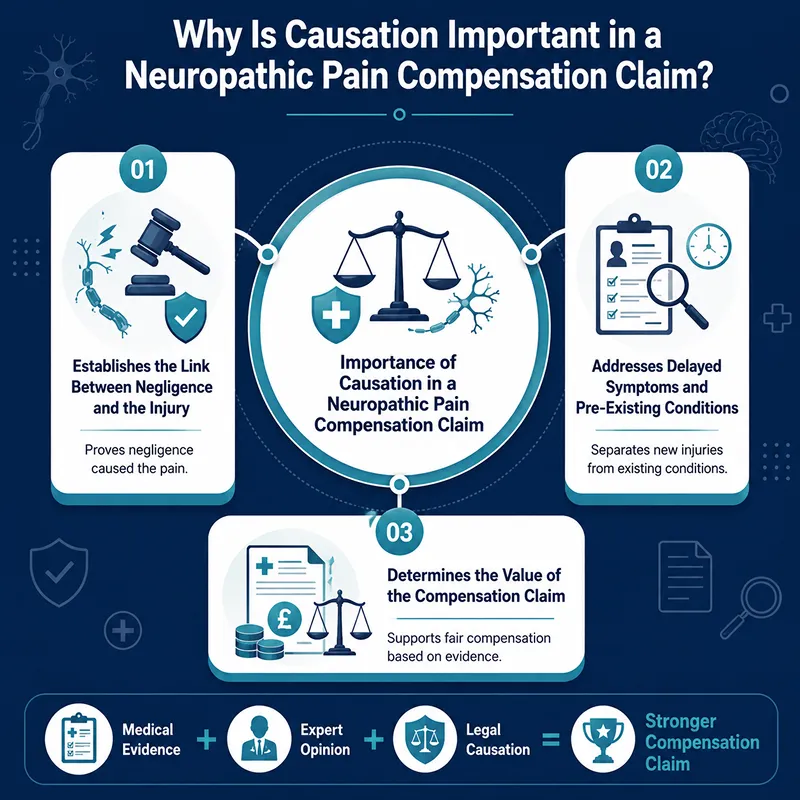
3. Determines the Value of the Compensation Claim
Once causation is proven, it becomes easy to determine the amount of money you may receive. This links the injury to your medical costs, lost income and pain. This helps make sure your payout reflects the full impact of your condition.
Case Study
This is a case of a patient named Mr C who had a hernia operation and after that started experiencing a lot of pain in his groin. His condition did not get any better and medical evidence showed that it was due to the nerve injury that he incurred while undergoing the surgery. An independent expert witness went through his file and testified that the surgery was responsible for causing the neuropathic pain in question. The claim was eventually settled out of court for £120,000. This shows how expert evidence can prove causation in a neuropathic pain compensation claim.
Expert witnesses have an overriding duty to help the court on matters within their expertise.
Civil Procedure Rules (CPR) Part 35, UK
Conclusion
A neuropathic pain compensation claim is not only about proving that you have nerve pain. You must also show that the pain was caused by another person’s negligence. A pain expert witness plays a key role by providing clear medical evidence, proving causation and explaining how the injury affects your life.
At Concise Medico, we provide independent pain expert witness reports for personal injury and medical negligence cases. Our specialists prepare clear, evidence-based reports that help solicitors and courts understand complex pain conditions. Contact us today to discuss your case.