TABLE OF CONTENT
- Key Takeaways
- What Is CRPS?
- What Is the Role of a Pain Consultant Expert Witness in a CRPS Compensation Claim?
- What a Pain Consultant Expert Witness Says About Prognosis?
- How Does Prognosis Affect Your CRPS Compensation Amount?
- How CRPS Compensation Amount Is Calculated?
- How Long Does a CRPS Compensation Claim Take in the UK?
- Case Study
- Conclusion
- FAQs
- How much compensation can you get for CRPS in the UK?
- Does a CRPS diagnosis increase compensation?
- Why is prognosis important in a CRPS compensation claim?
- What does a pain consultant expert witness do in a CRPS claim?
- What evidence is needed to support a CRPS compensation claim?
- Can you claim compensation for CRPS caused by medical negligence?
CRPS Compensation Amounts UK: What a Pain Consultant Expert Witness Says About Prognosis
Complex Regional Pain Syndrome, often called CRPS, can start with a small injury but change a person’s life. The injury may heal but the pain can last for months or years. This is why CRPS compensation depends on strong medical evidence and a clear prognosis.
Data shows that in England, 26% of adults were living with chronic pain in the year 2024. For people with CRPS, the condition can make daily life and work more difficult. This is often reflected in the compensation they may receive.
Many people with CRPS struggle to work, travel, sleep or carry out daily tasks. Some need ongoing treatment for years. Others may never fully recover.
Living with CRPS can raise many questions about compensation. People often want to know how much they could claim and what affects the value of a case. The answer depends on several factors, including the severity of the condition and its long-term effects.
A pain consultant expert witness can play a major role in evidence and prognosis. Their opinion helps decide how serious the condition is and what the future may look like.
Understanding prognosis is important because it can affect every part of a chronic pain compensation claim, from pain and suffering damages to future loss of earnings and care costs.
What Is CRPS?
Complex Regional Pain Syndrome is a long-term pain condition that usually develops after an injury. The pain is often much worse than expected.
The condition can affect an arm, hand, leg, foot or another part of the body. Some people recover within months. Others continue to have symptoms for many years.
CRPS can affect movement, work, relationships and independence. These effects often lead to significant CRPS compensation claims.
Pain is inevitable. Suffering is optional.
– Haruki Murakami
There are two recognised types of CRPS:
CRPS Type 1: It develops without confirmed nerve damage. This is the most common form.
CRPS Type 2: It develops when there is a clear nerve injury.
Both types can cause severe pain and disability. They can also support a chronic pain compensation claim if another person was responsible for the original injury.
What Is the Role of a Pain Consultant Expert Witness in a CRPS Compensation Claim?
A Pain Consultant Expert Witness is a medical specialist. Their opinion can have a significant impact on a Complex Regional Pain Syndrome compensation claim. The expert does not work for the claimant or the insurer. Their role is to provide an independent medical opinion.
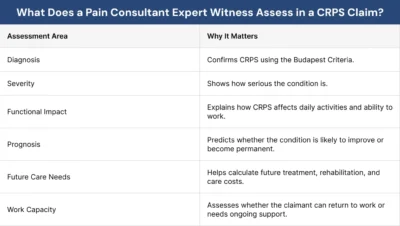
The expert looks at the condition, how severe it is and what may happen in the future. They also explain how CRPS affects work, treatment and daily life. In many cases, their report becomes one of the most important pieces of evidence.
A pain consultant expert witness reviews medical records and examines the claimant. The expert looks at symptoms, treatment history, medication use and daily limitations. The expert assesses how CRPS affects movement, work, sleep and independence.
The expert also considers whether the condition is likely to improve or stay the same. This information helps determine the value of compensation for CRPS. A detailed report can help the court, solicitor or insurer understand the true impact of the condition.
1. Budapest Criteria and Their Importance for Your CRPS Compensation Claim
The Budapest Criteria are medical guidelines used to diagnose CRPS. Pain specialists use these criteria to decide whether a person has the condition or not.
The criteria look at symptoms such as pain, swelling, temperature changes and movement problems. A diagnosis based on the Budapest Criteria is often seen as strong medical evidence. This matters because insurers may question a diagnosis.
A clear diagnosis can strengthen a CRPS claim and support higher compensation where appropriate.
2. Pain Consultant Assessment of CRPS Severity and Functional Impact
A pain consultant does more than measure pain. The consultant looks at how the condition affects daily life. They may ask whether the claimant can walk, drive, dress, cook, work or carry out household tasks.
The consultant also reviews medication and treatment needs. Someone who needs strong pain relief and ongoing therapy may have a more serious condition. The consultant may also assess whether support from family members is needed. All of these factors can affect the value of compensation for CRPS.
Learn more about our medico-legal pain assessments and how pain consultants evaluate diagnosis, severity, prognosis and future care needs.
What a Pain Consultant Expert Witness Says About Prognosis?
Prognosis means the likely future outcome of the condition. The consultant studies treatment records, symptom history and current limitations. They then decide whether the condition is likely to improve, stay stable or get worse.
The consultant may also comment on future work capacity and care needs. This opinion is important because future losses are based on what is expected to happen in the years ahead. For this reason, prognosis often plays a major role in calculating compensation.
How Does Prognosis Affect Your CRPS Compensation Amount?
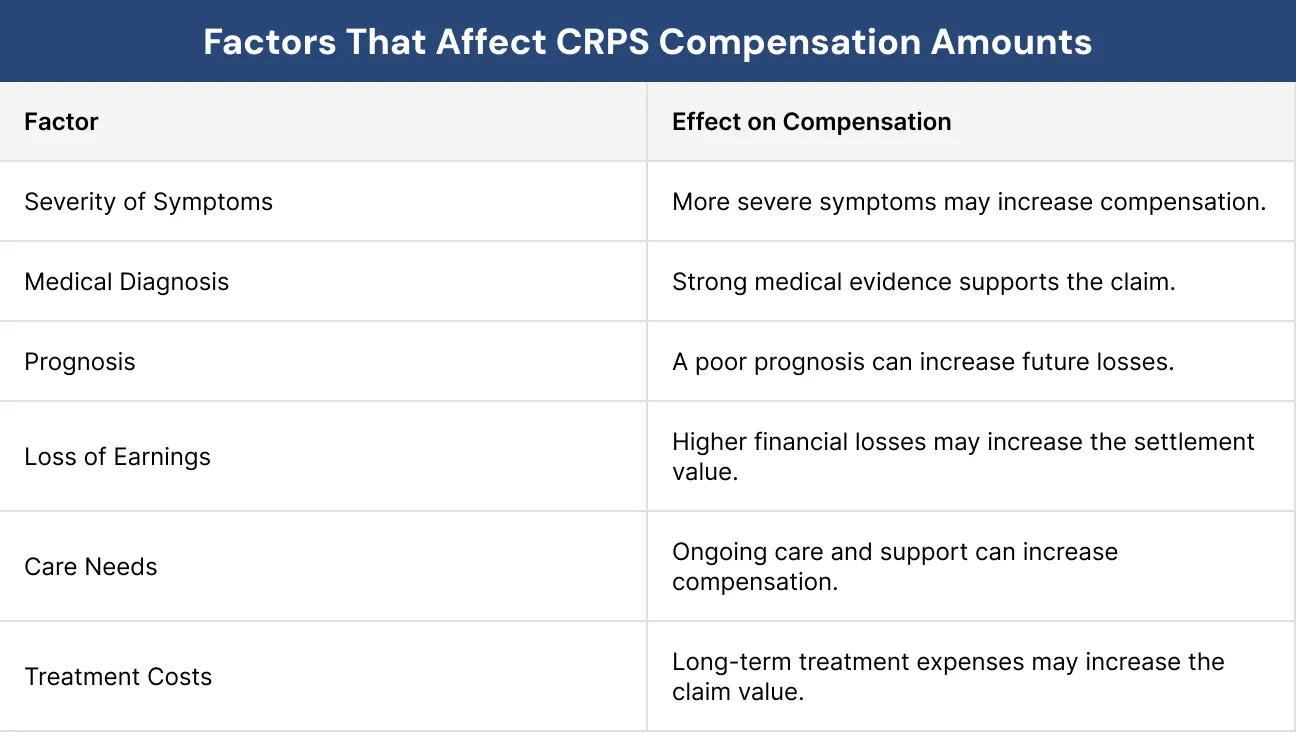
Prognosis is one of the biggest factors that affects your CRPS settlement amount. A pain consultant expert witness assesses the likely long-term outcome of the condition. A person expected to recover may receive less compensation than someone with permanent disability. This is because future losses depend on long-term medical expectations. When future losses increase, compensation usually increases too.
1. Effect of a Favourable Prognosis on Your CRPS Compensation
A favourable prognosis means there is a good chance of improvement. The person may return to work and need less treatment over time. Future care costs may also be lower.
Total compensation amounts for CRPS may be lower when future losses are smaller. The claimant may still receive compensation for pain and suffering. However, future financial losses may not be as high.
2. Impact of a Poor Prognosis on Your CRPS Compensation Claim
A poor prognosis can increase the value of a Complex Regional Pain Syndrome compensation claim because it increases future financial losses. If the condition is expected to last for life, the claimant may need ongoing treatment, care and support, resulting in a higher compensation award. The claimant may never return to work. Treatment may be necessary over a long period of time. Even care from relatives or carers may be necessary.
Some people need to use mobility equipment, home adaptations or specialist equipment. All these future costs can continue for many years. In extreme cases, future losses become the largest part of compensation.
How CRPS Compensation Amount Is Calculated?
The value of compensation you can claim for CRPS in the UK depends on the facts of the case. Important factors include the severity of symptoms, prognosis, ability to work, treatment needs and care requirements.
General damages for CRPS commonly range from around £28,000 to £110,000. Some claims are worth much more.
When future losses are included, settlements can exceed £1 million. This may happen when a person cannot return to work or needs long-term care.
This is why there is no single answer to the question: how much compensation for CRPS? Every case is different.
1. General Damages Amounts for CRPS Compensation
General damages compensate for pain, suffering and loss of amenity. Loss of amenity means losing the ability to enjoy normal life.
A person who can no longer work, travel, play sports or enjoy hobbies may receive more compensation than someone with milder symptoms.
The exact compensation amounts for CRPS depend on the medical evidence and the impact of the condition.
2. Past Financial Losses Claimed as Special Damages
Special damages cover financial losses that have already happened. These may include lost earnings, treatment costs, travel expenses, physiotherapy fees, prescription charges and care costs.
For example, someone who misses a year of work because of CRPS may claim that lost income. Wage slips, receipts, invoices and bank records can help prove these losses. Strong evidence often increases the value of a CRPS compensation claim.
3. Calculation of Future Losses in a CRPS Compensation Claim
Future losses are often the largest part of serious CRPS settlement cases. These losses are based on medical evidence about the future.
If a pain specialist believes a person will never return to work, future earnings losses may be calculated over many years. Future treatment costs may also be included.
Some claimants need ongoing therapy, specialist equipment or home adaptations. Family care can also have financial value. This is why prognosis is so important in a CRPS compensation UK claim.
4. CRPS Compensation Settlement Examples in the UK
Settlement values vary a lot. A person who recovers well may receive compensation for pain, treatment costs and temporary lost earnings. A person with permanent disability may need lifelong care and may never return to work.
In these cases, CRPS settlements can reach six or even seven figures. The difference often comes down to prognosis and future losses.
How Long Does a CRPS Compensation Claim Take in the UK?
A CRPS compensation claim can take anywhere from several months to a few years. The exact timescale depends on the complexity of the case and the claimant’s medical condition. There is no fixed time limit for reaching a final settlement.
One of the biggest reasons for delays is the need to understand the long-term prognosis. Doctors and a Pain Consultant Expert Witness may need time to see whether the condition improves, stays the same or becomes permanent. This helps ensure that future losses are assessed correctly.
If the medical evidence is not yet complete, additional examinations or expert reports may be required. Although this can extend the claims process, it often leads to a fairer outcome. Settling a claim too early may mean future treatment costs, care needs or loss of earnings are not fully included. Waiting until the long-term effects of CRPS are clearer can help ensure the compensation reflects the claimant’s future needs.
Case Study
This case shows how medical prognosis can affect future compensation. The case details are as follows:
In A v. Powys Local Health Board (2017), the High Court considered how future damages should be assessed for a claimant living with a serious long-term disability. The court relied heavily on expert medical evidence when evaluating future care needs, treatment costs and loss of earnings.
A key issue was prognosis. Medical experts provided evidence about the claimant’s long-term condition and future support requirements. This evidence helped the court calculate future financial losses and determine an appropriate compensation award.
The case highlights an important point for anyone pursuing a CRPS compensation claim. Compensation is not based only on current symptoms. It also depends on the likely future impact of the condition. Where medical experts identify long-term disability, future losses can become a significant part of the final settlement.
Conclusion
CRPS can affect every part of life. It can affect work, mobility, independence, relationships and mental wellbeing. These effects can make CRPS compensation claims substantial.
General damages compensate for pain, suffering and loss of amenities. Future losses often make up the largest part of a settlement. This is where prognosis becomes so important.
A pain consultant expert witness helps assess diagnosis, severity, treatment needs, work capacity and future outcomes. Their opinion helps determine whether a claimant is likely to recover or face permanent disability.
When medical evidence shows long-term or lifelong effects, compensation awards can increase significantly. Strong evidence, a clear diagnosis and an accurate prognosis are often the key factors behind successful chronic pain compensation and Complex Regional Pain Syndrome compensation claims.
Concise Medico understands that prognosis plays a key role in CRPS compensation and that clear, independent medical evidence is essential for valuing a claim fairly.
Contact us today to learn how our pain consultant experts can provide clear medical evidence to support your case.