TABLE OF CONTENT
Understand the Personal Injury Claim Time Limit UK
How long do you have to make a personal injury claim after an accident? This is an important question because around 3 million people are estimated to suffer injuries in accidents in the UK each year. Yet, only around 20% make a personal injury claim, even though some may have a legal right to compensation. The time limit can depend on the type of accident and injury. In most cases, you have three years to start a claim. This guide explains the key deadlines, special rules and what to do if you think your personal injury claim time limit has passed.
What Is the Personal Injury Claim Time Limit in the UK?
The personal injury claim time limit in the UK is usually three years. That means you must take legal action against an injury or accident within three years from when it happens. There could be different claim time limits depending on the type of claim and when you first knew about the cause of the injury. The personal injury claim time limit is set by the Limitation Act 1980. If you miss the deadline, you may lose your right to seek compensation. The rules can also differ for children, people who lack mental capacity and some special types of injury.
1. Time Limits for Different Personal Injury Claims
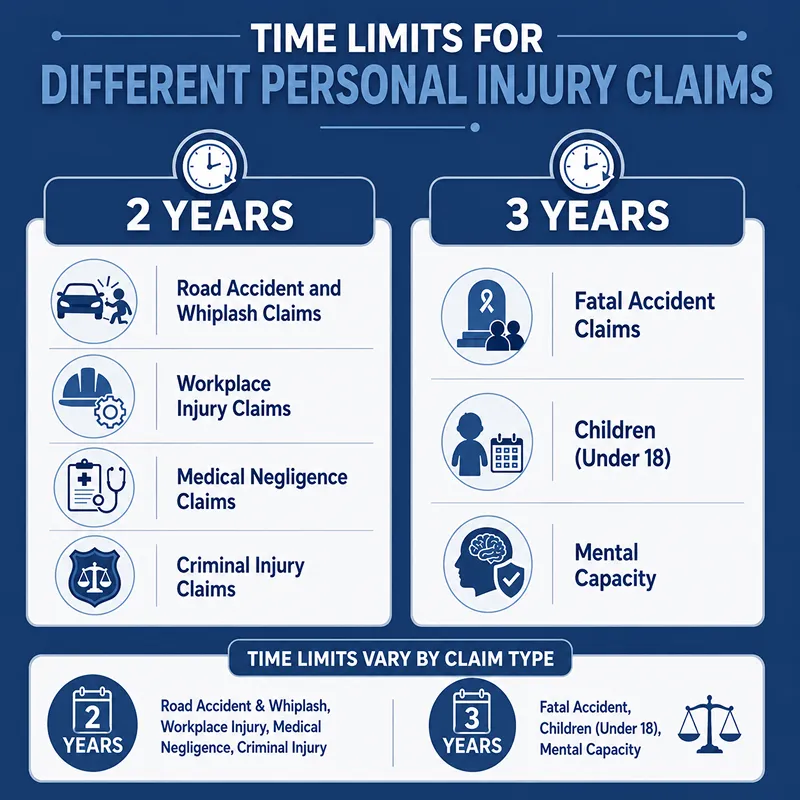
The personal injury claim time limit can change based on the type of injury. The main time limits are set out below:
-
Road Accident and Whiplash Claims
Most car-related road accident claims have a three-year time limit. The clock often starts on the date of the accident. This also applies to many whiplash injury claims. You must usually start court action before the three years end.
-
Workplace Injury Claims
Most workplace injury claims also have a three-year limit. This period can start from the day of the accident. For some work-related illnesses, it may start from the date you knew or should have known that your illness was linked to your work.
-
Medical Negligence Claims
Personal injury claims for medical negligence usually have a time limit of three years. This could either be counted from the day you had your medical treatment or the date you first knew that the treatment may have caused harm.
-
Criminal Injury Claims
Injury cases brought about by the Criminal Injuries Compensation Authority (CICA) usually have a shorter time limit of 2 years. This is different from the usual personal injury claim time limit, so it is important to check the rules that apply to your case.
-
Fatal Accident Claims
Dependents will usually have three years in which to file their claim. The time may start from the date of death or from the date they discover the cause of death.
-
Children (Under 18)
For children, the 3-year limit does not begin until the child turns 18 years old. This means they have until their 21st birthday to start a claim.
-
Mental Capacity
If a person lacks mental capacity, the time limit is paused unless and until they recover capacity. This means that the three-year rule does not apply until they have regained their mental capabilities.
Can You Claim After the Personal Injury Claim Time Limit Has Passed?
No, as in most cases you cannot file a claim after the personal injury claim time limit has passed. Failure to meet the deadline can make a successful claim difficult. So you may lose your right to ask for compensation. However, some exceptions may apply.
Key Exceptions and Rules
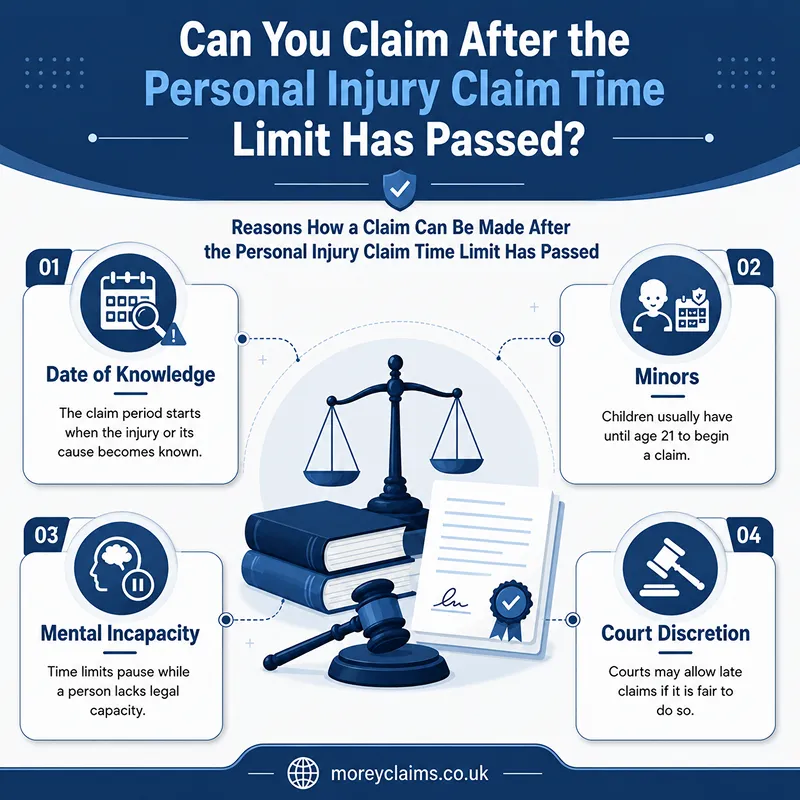
The main exceptions to the personal injury claim time limit are explained below:
-
Date of Knowledge
The time limit starts when you discover the injury or link it to the cause, rather than the accident date.
-
Minors
Time limits for children do not begin until they turn 18, giving them until age 21 to act.
-
Mental Incapacity
Deadlines are paused if a person lacks the mental capacity to handle their own legal affairs.
-
Court Discretion
Under rules like Section 33 of the Limitation Act 1980, judges may allow a late personal injury case if fairness and lack of prejudice allow.
How Can You Check Your Personal Injury Claim Deadline?
You can check your deadline by finding the date your limitation period started. For most claims, this is the date of the accident. For some illnesses, it may be the date you first knew that your injury was linked to someone else’s fault. The key dates to check are the date of the accident, the date of knowledge and the date court action must be started. Court proceedings must be formally issued before the deadline. Simply speaking to a solicitor or starting a claim is not enough.
There are strict time limits for starting a case. Personal injury claims generally have a time limit of three years.
GOV.UK
Case Study: Missing the Time Limit for Personal Injury Claim
A woman injured her foot when an airline trolley ran over it during a flight. She asked a solicitor to make a claim, and the airline accepted responsibility. The solicitor believed the personal injury claim time limit was three years and started court action before that date. However, injuries on planes usually have a two-year limit. The claim was therefore out of time and could not continue. The solicitor was later found to be negligent and had to pay compensation. This case shows why it is important to know the correct time limit before making a personal injury claim.
Conclusion
The personal injury claim time limit is usually three years, but this rule does not apply in every case. The deadline can vary for children, mental health patients, CICA cases and court directives. Special rules may also apply to children, people who lack mental capacity and injuries discovered at a later date.
Even if you think your deadline has passed, you should seek legal advice as soon as possible. A legal expert can check the key dates and see if any exception may apply. Waiting can make it harder to gather key proof. Witnesses may forget what happened. Records may also be harder to find. Whiplash injury symptoms can also last for different lengths of time, so early medico-legal advice can help you understand the injury and its likely impact on your right to claim.
So, if you are unsure about your deadline, it is best to get advice as soon as possible. At Concise Medico, we help people understand complex medico-legal issues and reporting linked to personal injury and medical negligence claims. If you need help understanding your claim or the applicable time limit, reach out to us today.