TABLE OF CONTENT
- Key Takeaways
- What is a Personal Injury Trust?
- How Does a Personal Injury Trust Deed Work?
- Who Should Set Up a Personal Injury Trust?
- Time Limit: The 52-Week Rule
- Who Are the Trustees?
- Types of Personal Injury Trusts
- Understanding Tax Rules for Personal Injury Trusts
- What are the common misunderstandings?
- Final Thought
- FAQs
What Exactly is a Personal Injury Trust and How Does it Work?
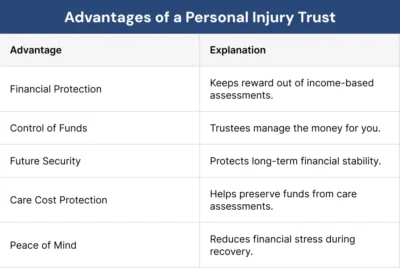
Compensation after an accident or injury often changes a person’s life. It is meant to provide financial support, cover medical costs, replace lost income and help you rebuild your life. However, what many people do not realise is that a large allowance payment can sometimes create unexpected problems. Mostly if you receive income-based on financial support or may need care support in the future. This is where a Personal Injury Trust (PI Trust) becomes very important.
A Personal Injury Trust is a legal arrangement designed to stop your compensation from being counted as part of your personal savings during benefit or care cost assessments. To put it simply, it helps you preserve control over your award and financial support by keeping your calculation outside of your regular income.
In this we’ll explore what a personal injury trust is, how it works, who may need one, how to set it up and the key benefits it can provide.
What is a Personal Injury Trust?
A personal injury trust is a type of legal structure that is used to store payout funds obtained following a personal accident. Managing and securing this money apart from your own accounts is the goal. In most cases the compensation comes from:
- Road traffic accidents
- Workplace accidents
- Medical negligence
- Criminal injury claims
- Industrial diseases
A key point is that there is no single fixed legal type called a Personal Injury Trust. Rather, it is an explanation of a trust that contains compensation for injuries. Depending on the Situation and the underlying legal structure may consist of many kinds of trusts.
Why is a Personal Injury Trust Needed?
The main reason for setting up a Personal Injury Trust is to protect your financial position. Mostly when it comes to Income-based benefits. If you receive financial support such as Universal Credit, Housing Benefit or Employment Support Allowance, your eligibility is usually assessed based on your income savings and overall financial situation. If your savings go above a certain limit your benefits may be reduced or even stopped altogether. However, when your Incentive is placed into a Personal Injury Trust, It is ignored in benefit calculations meaning your entitlement is not affected.
Another important reason is protection from future care costs. If you ever need care provided or funded by your local authority your financial situation will be assessed to decide how much you should contribute. Without a trust, your Reward could be treated as personal wealth and included in this assessment. A Personal Injury Trust helps ensure that your rewards are protected and used for your Recovery care and overall quality of life rather than being counted as general savings.
Finally, a Personal Injury Trust is important because Allowance is not simply extra money. It is intended to cover essential needs such as loss of earnings, medical treatment, Renewal and future care requirements. By placing the money into a trust. It ensures that your compensation is used properly for its intended purpose and is not reduced or lost due to financial reviews or changes in your case.
How Does a Personal Injury Trust Deed Work?
A Personal Injury Trust protects your rewards by keeping it separate from your personal finances. So it is not counted in benefit or financial assessments. A Lawyer usually prepares a trust deed explaining who owns the money, who manages it and how it can be used.
The compensation is placed into a separate trust bank account and managed by trustees, such as you, family members, trusted friends or a Lawyer. The money can still be used for living costs, medical treatment, rehabilitation and housing, while remaining protected for your future needs.
Who Should Set Up a Personal Injury Trust?
A Personal Injury Trust is not Essential for everyone but it is strongly recommended for people who receive Income-based benefits may need benefits in the future or have received a large compensation payment. It is also useful for anyone who wants to protect their financial entitlement and ensure their compensation is kept safe from benefit or care assessments. Even if you are not currently receiving financial support your circumstances may change over time which is why many Legal advisers advise setting up a trust as a protection for long-term financial security.
Time Limit: The 52-Week Rule
A rule in the UK is the 52-week Protection Period . This means your payout is usually ignored in Income-based benefit assessments for the first 12 months after you receive it.
After this period, the money may be counted as personal savings unless it has been placed into a Personal Injury Trust. This is why many people choose to set up a trust within the first year of receiving their payout.
Who Are the Trustees?
The Trustees are the people dependable for managing a Personal Injury Trust and ensuring the payout money is handled properly. Their role is to look after the funds, make decisions in the best interests of the injured person and ensure the money is used correctly for its intended purpose. Guardians also have a legal duty to act carefully responsibly and in the Recipient’s best interest at all times. Typical trustees may include:
- The injured person
- A family member or close friend
- A professional trustee, such as a Lawyer
The responsibilities of trustees include:
- Looking after the money
- Keeping financial records
- Allowing payments
- Making decisions in your best interest
A personal injury trust helps to protect your compensation and supports your recovery after an injury. The money can be used for daily needs, medical care, and improving your quality of life. Its main purpose is to make sure the compensation supports your health, wellbeing, and future financial security. The funds can be used for several important purposes including:
- Medical care
- Private treatment
- Home changes
- Wheelchairs and mobility aids
- Daily expenses
- Lost income support
- Rehabilitation and care
What Happens If You Don’t Use a Trust?
If you do not put your payout into a Personal Injury Trust, it might count as your personal savings. This can affect your financial position and may reduce the support you receive through Income based benefits or care reviews. A trust helps protect your rewards and ensures it remains available for your recovery and future needs. Which is why many legal professionals strongly recommend setting one up.
- Your payout may count as savings
- Financial support could be reduced
- Care costs may increase
- Financial support could stop
Types of Personal Injury Trusts
There are different legal structures depending on the situation:
1. Bare Trust
- Most common type
- Beneficiary has full entitlement
- Simple structure
2. Flexible trust
- Trustees have more control
- Useful for long-term planning
3. Interest in Possession Trust
- Beneficiary receives income from the trust
- Capital is preserved
Understanding Tax Rules for Personal Injury Trusts
Personal injury compensation is usually free from Income Tax and Capital Gains Tax (CGT) when received. However, income or interest generated from investments held within the trust may be taxable depending on the trust type. This means that the money you received for injury awards is generally free from income tax. And you can spend it on your recovery and future needs without having to make major tax deductions. But you also need to know that if the money in the trust is invested and earns interest that interest may be taxed depending on the amount of your interest earned and the situation. For large sums of reward it is wise to seek professional financial advice. This helps ensure the trust is managed correctly and in your best interests.
- Usually tax-free
- Low tax impact
- Investment interest may be taxed
- Professional advice is recommended
What are the common misunderstandings?
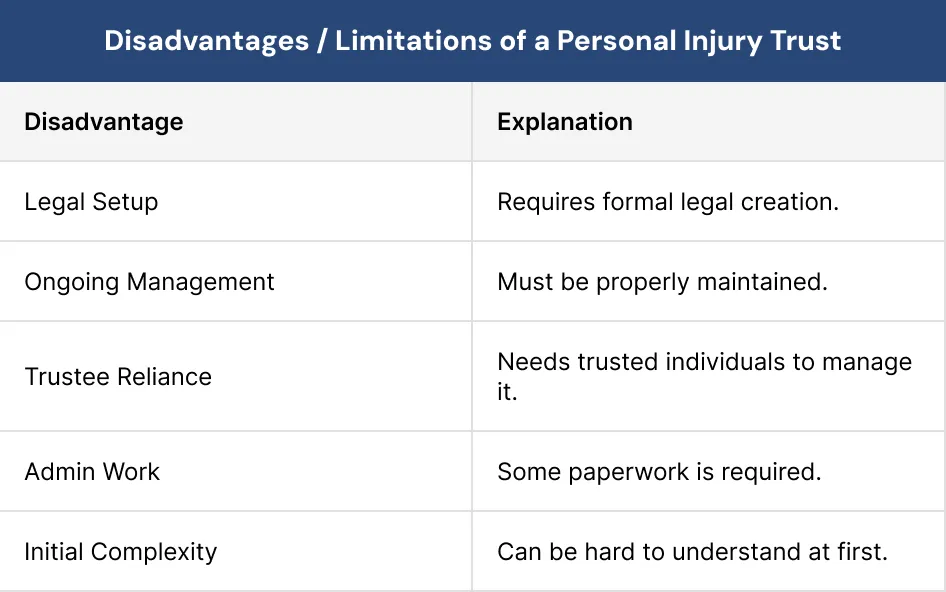
There are several confusions about Personal Injury Trusts that often create confusion. Many people believe they will lose access to their money or that these trusts are only for certain individuals. In reality, a Personal Injury Trust fund is designed to protect your payout while still allowing it to be used for your needs and future support.
- I cannot access my money
You can still use the money for daily needs, medical care, and support costs.
- It is only for disabled people
Anyone receiving an injury payout can set up a Personal Injury Trust.
- It is too complicated
A Personal Injury Trust is usually simple to set up with legal advice.
Final Thought
A Personal Injury Trust is a powerful legal tool designed to protect Payment received after an accident or injury. It ensures your money is not included in Income-based benefit assessments, protects your financial security and allows you to use your compensation as intended for your recovery and future overall health. In simple terms a Personal Injury Trust protects your payout by keeping it separate from your personal finances helping to protect your Financial support and financial support.
If you have received a large personal injury trust fund, especially if you currently receive financial support or may need care in the future, setting up a Personal Injury Trust can help protect your money and provide long-term financial security and peace of mind.