How Much Compensation Can You Claim for Surgical Negligence in the UK?

Published On: May 20th, 2026|Total Views: 1|Daily Views: 1|15.7 min read|3135 words|

TABLE OF CONTENT

No one expects it but sometimes surgery meant to help can make things worse. When that happens, confusion comes first, then the questions.

It can be difficult to explain when a treatment results in more harm to your well-being instead of helping you. NHS statistics show that in the period of 2023/24, a total of £2.8 billion was paid in clinical negligence claims. This data explains how serious medical mistakes can become when they affect your health, money and daily life.

Most people trust their doctors and surgeons. They do not expect medical errors to happen during surgery. But when surgery goes wrong, it can leave them feeling scared, stressed and confused. One of their first concerns is often how much compensation they can claim for surgical negligence in the UK.

There is no fixed amount for surgical negligence claims. Some surgical negligence claims may be worth a few thousand pounds and serious cases can reach hundreds of thousands of pounds. This blog covers all this information for you.

Key Takeaways

  • There is no fixed amount for surgical negligence claims, as compensation depends on the level of harm, financial loss and long-term impact on life
  • A successful surgical negligence compensation claim must prove duty of care, breach of duty and that the harm was caused by that breach
  • Surgical negligence compensation is usually divided into general damages for pain and suffering and special damages for financial losses
  • Financial losses such as loss of earnings, future income, care costs and medical expenses often increase how much compensation for surgical negligence can be claimed
  • Strong evidence like medical records, expert reports and financial documents is essential to support a wrong site surgical negligence compensation claim or any serious case
  • Most claims must be made within three years, so early action is important to protect your legal rights and maximise compensation
  • Real cases show that serious surgical negligence claims can reach hundreds of thousands of pounds, especially where long-term health and work are affected

What Is Surgical Negligence

Surgical negligence is when a surgeon makes a mistake while performing surgery or treating a patient. This causes harm that could have been avoided if proper care was given.

Three conditions must be met to win a case for surgical negligence. (1) A duty of care must exist. This implies that the surgeon had an obligation to provide proper treatment. (2) There should be a breach of duty. This implies that the level of treatment provided was below the medical standard. (3) Harm should be caused as a result of negligence.

They are all part of a medical negligence case. You may not claim for surgical negligence if any one of these is missing.

What Types of Surgical Errors Can Lead to a Surgical Negligence Claim

Surgical errors may occur in different ways. They range from minor errors to very serious ones. Common surgical mistakes that result in surgical negligence claims include:

  • Operating on the wrong body part
  • Leaving surgical instruments inside the body
  • Unnecessary surgeries

Wrong medication or poor care after surgery may also cause harm. Some surgical mistakes are so serious that they are termed as never events.

Every patient harmed is one too many.

– NHS England

Never events are serious and preventable mistakes. That should not happen if proper safety standards are followed. Surgery on the wrong body part or leaving surgical objects inside the body is an example. They must never happen.

These types of surgical errors get you compensation for surgical negligence.

How Common Are Surgical Negligence Claims

Surgical negligence claims are not very common. Only a small percentage of operations lead to claims. However, this does not mean errors are rare. It only means not all errors lead to surgical negligence compensation claims.

Some people may not be aware of their rights. Others may not have enough evidence. This is why awareness is important.

Causes of Surgical Negligence Claim

Following are the causes of surgical negligence:

  • Poor training leading to mistakes during surgery
  • Poor communication between staff can also cause serious errors
  • Lack of proper planning before surgery can increase risk
  • Failure to sterilise equipment can lead to infection
  • Wrong diagnosis leading to unnecessary surgery

Most errors are linked to human mistakes or system failures.

How to Prevent Surgical Errors

A number of surgical mistakes can actually be avoided.

Following considerations can help:

  • Careful checking of medical records is crucial
  • Good communication among physicians can decrease errors
  • Sterilisation and hygiene must be followed strictly
  • Reviewing procedure notes is important
  • Good teamwork in the operating theatre is necessary

These steps prevent surgical errors and protect you.

What Do Patients Want After a Surgical Error

After a surgical error, people usually need more than just compensation. They want clear answers and proper support. They also want to feel that their harm has been taken seriously.

Research shows that many people want to understand what actually happened. They want to know the reason for the surgical error. They may also expect an apology. Especially when the mistake has affected their health, trust or daily life.

In some cases, apology laws can protect surgeons when they express regret or sympathy. This means an apology does not always count as admitting legal fault. It can still help people feel heard and respected.

Can a Claim Be Made Against the NHS or Private Hospitals

Yes, a person can claim against both the NHS and private healthcare.

If the treatment was given by the NHS, the claim is usually handled by NHS Resolution. This is the government body that deals with NHS negligence claims.

If the treatment was private, the claim is usually made against the private hospital or surgeon.

How Much Compensation Can Be Claimed for a Surgical Negligence Claim

A lot of people have this question. The fact is there is no fixed amount for surgical negligence compensation claims in the UK. The amount depends on how serious the injury is, how long it lasts and how much financial loss has been caused.

Some minor surgical negligence claims may only cover small financial losses. More serious cases can reach tens or hundreds of thousands of pounds. In very severe cases, compensation can even exceed one million pounds.

For example, serious brain injuries can lead to compensation between around £300,000 and £500,000. Amputation cases may also reach over £200,000.

The goal of compensation is not to punish the surgeon. It aims to put the person back in the position they would have been in, if the mistake had not happened.
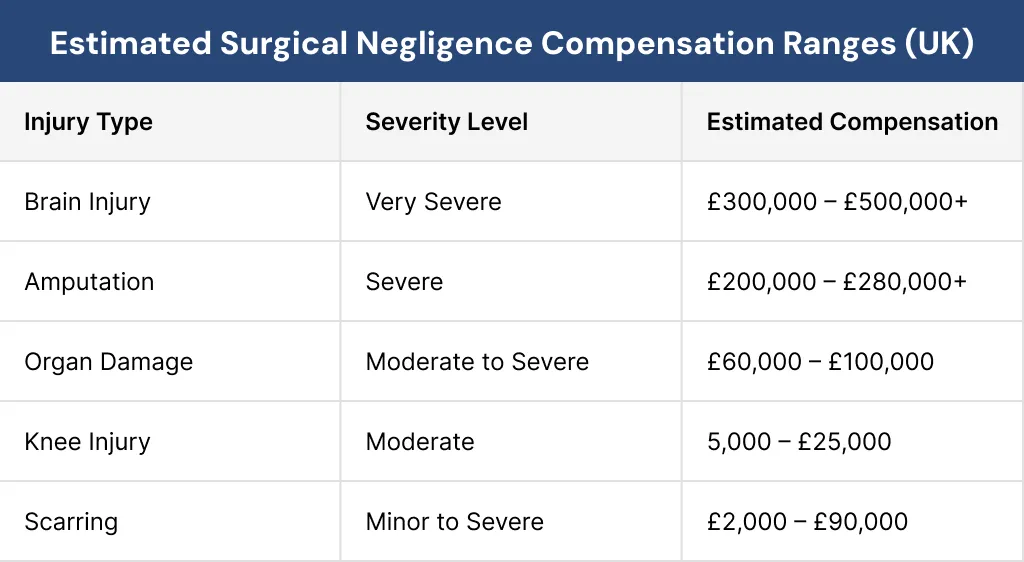
Estimated Surgical Negligence Compensation Ranges (UK)

What Is the Average Compensation for a Surgical Negligence Claim

An overall average amount for surgical negligence claims does not really exist.

NHS claims may average around £50,000. However, this figure is not always accurate because some cases are minor, while others are very serious. This means the amounts can change a lot.

For example, minor injuries may result in a few thousand pounds. Severe injuries may reach hundreds of thousands or more. Every case is different. Thus, it is suggested to focus on individual circumstances rather than average figures.

How Is Surgical Negligence Compensation Calculated

This compensation is usually divided into two parts. These can be termed as general damages and special damages. Both parts together form the final compensation amount. The details are given below:

1. General Damages

General damages cover the physical and emotional impact of the injury. This includes pain, mental stress and loss of enjoyment in life. For example, if a person can no longer enjoy hobbies or daily activities, this is covered.

The amount depends on how severe the injury is, how long recovery takes and whether the condition is permanent. For example, losing mobility or vision will lead to higher compensation than a temporary injury.

2. Special Damages

Special damages are often the biggest part of compensation in serious cases. They cover all financial losses caused by negligence.

This may include loss of earnings if the person cannot work. It can also include future income loss if the person cannot return to the same job. Other costs may include medical care, rehabilitation, travel to hospital and changes to the home.

In some cases, care and support costs are also included, especially if long-term help is needed. It is important to keep records of all expenses, as proof is required to claim these damages.

What Can Special Damages Cover in Surgical Claims

Special damages are very detailed. They look at real-life impact.

  • Loss of earnings is one of the most common claims. This includes both past and future income.
  • Travel costs may also be included. Regular hospital visits can add up over time.
  • Medical expenses are also covered. This includes treatment, medication and therapy.
  • Home changes may be needed. For example, ramps, rails or accessible bathrooms.
  • Car changes may be required if mobility is affected.
  • In some cases, mental health support is needed. This can also be included in the claim.

Even small costs can be added if they are linked to the injury. Keeping records is very important.
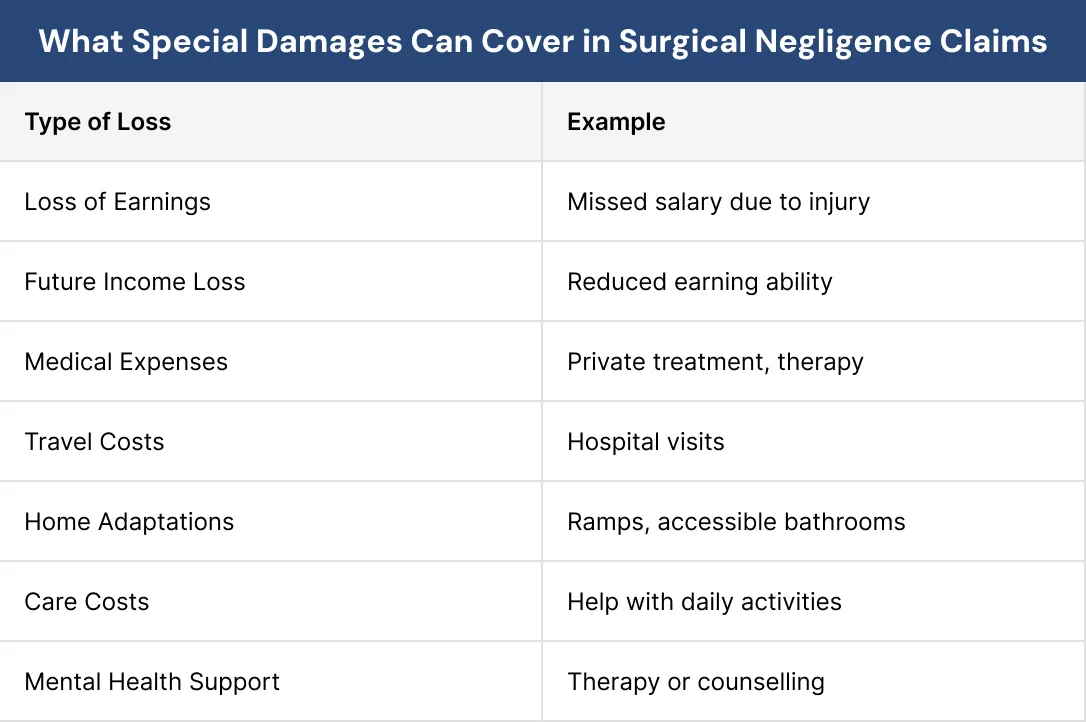
What Special Damages Can Cover in Surgical Negligence Claims

Can Compensation Include Future Losses in Surgical Claims

Yes, future losses are often included. If a person cannot return to the same job, future income loss is calculated. If working hours are reduced, this is also included.

Future care costs may also be added. This is common in serious injury cases. Long-term treatment or therapy may also be required. These future costs are estimated carefully to ensure fair compensation.

Can Emotional Distress Be Claimed in Surgical Claims

Claiming emotional distress in surgical negligence claims can sometimes prove to be difficult. In the majority of these cases, the focus is on the financial loss and physical damage suffered.

However, if there is evidence of personal impact, such as loss of dignity or reputation, then some compensation may be awarded through surgical negligence claims.

Can Compensation Cover Long-Term Life Changes in Surgical Claims

Yes, compensation can cover long-term impact. If the injury affects daily life, work or independence, these factors are included in the surgical negligence claims. For example, a person may need home adjustments, mobility aids or long-term care.

In some surgical negligence claims, ongoing payments may be arranged for life. This ensures the person can manage their condition without financial stress.

What Factors Affect the Compensation Amount in Surgical Negligence Claim

Following factors determines the compensation amount for a surgical negligence claim:

  • The most important factor is the level of harm caused. More serious injuries lead to higher compensation.
  • Another important factor is financial loss. If the injury affects work or income, the claim value increases.
  • Evidence also plays a key role. Strong medical records and expert opinions help prove the case.
  • Time is also important. Claims must be made within the legal time limit, usually within three years.
  • Insurance cover of the surgeon may also affect how compensation is paid.
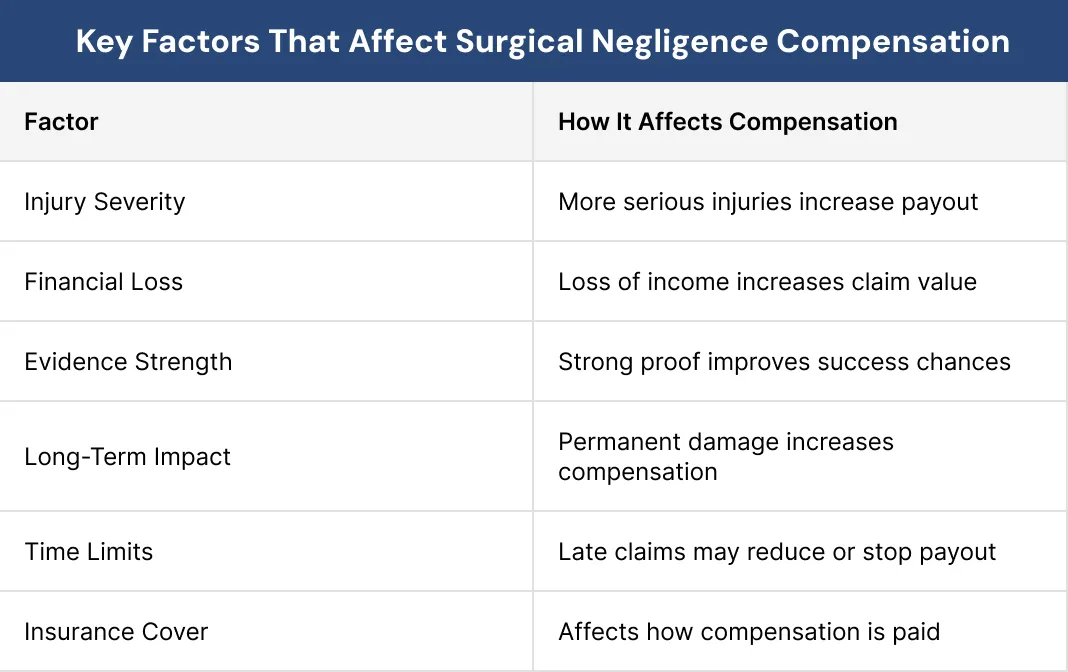
Key Factors That Affect Surgical Negligence Compensation

How Does Financial Loss Affect Compensation in Surgical Claims

Many people think compensation is mainly for pain.

That is not always true. In serious cases, financial loss becomes the biggest part. If a person cannot work, income stops. If the injury is permanent, future earnings are also lost. Pension contributions and career growth may also be affected.

Key Insight:

In serious cases, lost income can increase compensation a lot.

Some people need help with daily tasks like cooking, cleaning or moving around. Medical costs can also rise, especially if private treatment is needed. All these factors affect the claim value.

What Are Compensation Guidelines for Surgical Negligence Claims

In the UK, compensation for injuries is often guided by Judicial College Guidelines. These provide ranges for different types of injuries.

For example, very severe brain injuries may reach hundreds of thousands of pounds. Loss of limbs also leads to high compensation. Smaller injuries have lower ranges.

These guidelines are helpful but they are not fixed. Each case is still unique. It is always best to contact an expert in the field like Concise Medico.

Should a Compensation Calculator Be Used for Surgical Claims

Many websites offer compensation calculators. These tools can give a rough idea of what a claim might be worth.

However, they are not always accurate. They do not consider all factors, such as long-term impact or detailed financial loss. They also cannot assess evidence or legal strength.

A calculator may be useful for a quick estimate but proper legal advice is always better.

Real Life Example

This real case helps explain surgical negligence claims. A person underwent an operation known as a gastric bypass procedure. It is performed on those who wish to lose weight.

An error was made during the operation. The surgeon accidentally stapled a wrong part of the stomach, thus blocking the blood flow to that particular part.

Consequently, the patient suffered severely. Six additional operations had to be done to fix the damage. He remained in the hospital for two months. Food intake was made difficult. Life was turned upside down. Work became difficult and health started getting worse.

In the end, early retirement became necessary. After a long legal process, the case settled for £345,000.

This example shows that the biggest part of compensation was not just pain. It was a loss of earnings and long-term life impact. This is common in serious claims.

What Evidence Is Needed to Make a Surgical Negligence Claim

Medical records are one of the most important pieces of evidence. These show what treatment was given and what went wrong.

Other useful evidence includes surgeon notes, hospital communication and witness statements. In some cases, photos or scans may also be used.

Pro Tip:

Keep medical records, receipts, and payslips safe. They can help prove your claim.

A medical expert may also review the case and provide a report. Good evidence helps prove both breach of duty and causation. They are essential for the claim.

What Makes a Strong Surgical Negligence Claim

The shortest answer is evidence. Proof is essential for a good claim.

First, there should be proof that the medical experts did not act within proper standards. Then, there should also be proof that the surgeon’s actions led to an injury.

Medical records are crucial in this process. Expert statements can further clarify issues. Financial evidence is equally important. This can include salary slips, bills and receipts.

Step by Step Process of Making a Surgical Claim

Understanding the process can make things easier.

The first step is getting legal advice. This helps understand if the case is valid. Next, evidence is collected. Medical records and expert opinions are reviewed. Then the claim is prepared and sent to the responsible party.

Negotiations usually follow. Many cases settle without going to court. If no agreement is reached, the case may go to court. The process may take time but careful handling gets you better results.

How Long Do You Have to Make a Surgical Claim

For the majority of claims, it is required that the claim is made within three years. Time limit generally begins from the date of the operation or when the individual realises the negligence.

There are some exceptions to this rule. For minors, the claim can be filed upon reaching the age of 18. Individuals with mental disabilities may have their timeframe suspended.

Time Limit:

Most claims have a 3-year limit. Waiting too long can harm your case.

One should never wait too long to file a claim, as there may be complications with providing evidence. Not doing so may make your claim invalid.

What Happens if a Child Is Affected During Surgery

Children cannot make legal claims themselves. A parent or guardian can act on their behalf.

Compensation is usually held in trust until the child turns 18. If no claim is made earlier, the child can claim after turning 18. Time limits vary in these cases, so early advice is important.

Can You Claim for Surgery Done Abroad

Yes, a claim may still be possible if surgery was done abroad. However, the process can be more complex.

Different laws may apply. Extra documents may be needed. Translation and international legal support may also be required. These cases may take longer but they are still possible.

How Long Does a Surgical Claim Take

The time needed to settle a claim can vary. Simple cases may be resolved within a few months, especially if the other side accepts responsibility.

More complex cases can take years. This usually happens when there is a dispute or expert evidence is needed. Although it may feel slow, careful preparation is important to get the right compensation.

What Role Does a Solicitor Play in Surgical Claim

Solicitors help guide the claim from start to finish. They collect evidence, speak to experts and calculate the value of the claim. They also negotiate with the other side to reach a fair settlement.

In many cases, claims are handled on a ‘No Win No Fee’ basis. This means there is no upfront cost and fees are only paid if the claim is successful. This makes the process more accessible for many people.

Why Early Advice Is Important in Surgical Claims

Getting legal advice early can make a big impact. Mistakes at the beginning can reduce the value of a surgical negligence claim or even stop it completely.

Early advice helps understand the strength of the case and the possible compensation. It also helps collect evidence while it is still available. Taking early action can protect the chances of a successful claim.

Final Thoughts

Surgical negligence may cause a number of effects. Physical pain is only one aspect, others include financial loss, emotional stress and long-term life changes.

A surgical negligence compensation claim helps you in the process of recovery and restoring balance. The compensation claim does not seek to punish anybody. Instead, it ensures justice.

It is important to note that there is no fixed amount for surgical negligence claims. Every case is unique. Surgical negligence compensation depends on the amount of injury, losses and overall consequences of the issue.

Understanding surgical negligence compensation claims and knowing your rights will be extremely useful in such a situation. To those who face this issue, right guidance and proper evidence can help move forward with confidence.

Concise Medicolegal Experts understand these problems caused by surgical negligence and helps turn medical evidence into clear support for your case. Contact us today to understand your options and start building a stronger case for the compensation you deserve.

Worried about how much compensation you can claim after a surgical mistake?

Reach out to take the first step towards securing the compensation you may be entitled to. We help turn complex medical evidence into clear, strong support for your case.

Worried about how much compensation you can claim after a surgical mistake?

Reach out to take the first step towards securing the compensation you may be entitled to. We help turn complex medical evidence into clear, strong support for your case.

FAQs

How much compensation for surgical negligence can be claimed in the UK?2026-05-20T05:47:37+00:00

There is no fixed amount. Compensation depends on injury severity, recovery time and financial loss. Minor cases may receive a few thousand pounds, while serious cases can reach hundreds of thousands or more. Courts consider both general damages for pain and special damages for financial losses.

Can I make a claim for a wrong site surgical negligence compensation claim?2026-05-20T05:48:14+00:00

Yes, if surgery was done on the wrong body part, a claim can be made. This is a serious “never event.” To succeed, you must prove duty of care, breach and avoidable harm. These cases often result in higher compensation due to severe and long-term impact.

What factors affect the amount of surgical negligence compensation?2026-05-20T05:48:50+00:00

Compensation depends on injury severity, financial losses and long-term impact. Loss of earnings, medical costs and future care needs increase value. Strong evidence, such as medical records and expert reports, is essential. Each case is assessed individually, so amounts vary.

How long do I have to make a surgical negligence claim?2026-05-20T05:49:25+00:00

Most claims must be made within three years from the surgery date or when negligence is discovered. For children, the limit starts at age 18. Exceptions apply for mental incapacity. Acting early helps collect evidence and improves chances of success.

What evidence is needed for a surgical negligence claim?2026-05-20T05:49:58+00:00

You need strong evidence such as medical records, hospital reports and expert opinions. Financial proof like payslips, receipts and bills supports compensation claims. Photos, scans and witness statements may also help. Evidence is essential to prove both the mistake and the harm caused.

Share This Article!

No one expects it but sometimes surgery meant to help can make things worse. When that happens, confusion comes first, then the questions.

It can be difficult to explain when a treatment results in more harm to your well-being instead of helping you. NHS statistics show that in the period of 2023/24, a total of £2.8 billion was paid in clinical negligence claims. This data explains how serious medical mistakes can become when they affect your health, money and daily life.

Most people trust their doctors and surgeons. They do not expect medical errors to happen during surgery. But when surgery goes wrong, it can leave them feeling scared, stressed and confused. One of their first concerns is often how much compensation they can claim for surgical negligence in the UK.

There is no fixed amount for surgical negligence claims. Some surgical negligence claims may be worth a few thousand pounds and serious cases can reach hundreds of thousands of pounds. This blog covers all this information for you.

Key Takeaways

  • There is no fixed amount for surgical negligence claims, as compensation depends on the level of harm, financial loss and long-term impact on life
  • A successful surgical negligence compensation claim must prove duty of care, breach of duty and that the harm was caused by that breach
  • Surgical negligence compensation is usually divided into general damages for pain and suffering and special damages for financial losses
  • Financial losses such as loss of earnings, future income, care costs and medical expenses often increase how much compensation for surgical negligence can be claimed
  • Strong evidence like medical records, expert reports and financial documents is essential to support a wrong site surgical negligence compensation claim or any serious case
  • Most claims must be made within three years, so early action is important to protect your legal rights and maximise compensation
  • Real cases show that serious surgical negligence claims can reach hundreds of thousands of pounds, especially where long-term health and work are affected

What Is Surgical Negligence

Surgical negligence is when a surgeon makes a mistake while performing surgery or treating a patient. This causes harm that could have been avoided if proper care was given.

Three conditions must be met to win a case for surgical negligence. (1) A duty of care must exist. This implies that the surgeon had an obligation to provide proper treatment. (2) There should be a breach of duty. This implies that the level of treatment provided was below the medical standard. (3) Harm should be caused as a result of negligence.

They are all part of a medical negligence case. You may not claim for surgical negligence if any one of these is missing.

What Types of Surgical Errors Can Lead to a Surgical Negligence Claim

Surgical errors may occur in different ways. They range from minor errors to very serious ones. Common surgical mistakes that result in surgical negligence claims include:

  • Operating on the wrong body part
  • Leaving surgical instruments inside the body
  • Unnecessary surgeries

Wrong medication or poor care after surgery may also cause harm. Some surgical mistakes are so serious that they are termed as never events.

Every patient harmed is one too many.

– NHS England

Never events are serious and preventable mistakes. That should not happen if proper safety standards are followed. Surgery on the wrong body part or leaving surgical objects inside the body is an example. They must never happen.

These types of surgical errors get you compensation for surgical negligence.

How Common Are Surgical Negligence Claims

Surgical negligence claims are not very common. Only a small percentage of operations lead to claims. However, this does not mean errors are rare. It only means not all errors lead to surgical negligence compensation claims.

Some people may not be aware of their rights. Others may not have enough evidence. This is why awareness is important.

Causes of Surgical Negligence Claim

Following are the causes of surgical negligence:

  • Poor training leading to mistakes during surgery
  • Poor communication between staff can also cause serious errors
  • Lack of proper planning before surgery can increase risk
  • Failure to sterilise equipment can lead to infection
  • Wrong diagnosis leading to unnecessary surgery

Most errors are linked to human mistakes or system failures.

How to Prevent Surgical Errors

A number of surgical mistakes can actually be avoided.

Following considerations can help:

  • Careful checking of medical records is crucial
  • Good communication among physicians can decrease errors
  • Sterilisation and hygiene must be followed strictly
  • Reviewing procedure notes is important
  • Good teamwork in the operating theatre is necessary

These steps prevent surgical errors and protect you.

What Do Patients Want After a Surgical Error

After a surgical error, people usually need more than just compensation. They want clear answers and proper support. They also want to feel that their harm has been taken seriously.

Research shows that many people want to understand what actually happened. They want to know the reason for the surgical error. They may also expect an apology. Especially when the mistake has affected their health, trust or daily life.

In some cases, apology laws can protect surgeons when they express regret or sympathy. This means an apology does not always count as admitting legal fault. It can still help people feel heard and respected.

Can a Claim Be Made Against the NHS or Private Hospitals

Yes, a person can claim against both the NHS and private healthcare.

If the treatment was given by the NHS, the claim is usually handled by NHS Resolution. This is the government body that deals with NHS negligence claims.

If the treatment was private, the claim is usually made against the private hospital or surgeon.

How Much Compensation Can Be Claimed for a Surgical Negligence Claim

A lot of people have this question. The fact is there is no fixed amount for surgical negligence compensation claims in the UK. The amount depends on how serious the injury is, how long it lasts and how much financial loss has been caused.

Some minor surgical negligence claims may only cover small financial losses. More serious cases can reach tens or hundreds of thousands of pounds. In very severe cases, compensation can even exceed one million pounds.

For example, serious brain injuries can lead to compensation between around £300,000 and £500,000. Amputation cases may also reach over £200,000.

The goal of compensation is not to punish the surgeon. It aims to put the person back in the position they would have been in, if the mistake had not happened.

Estimated Surgical Negligence Compensation Ranges (UK)

What Is the Average Compensation for a Surgical Negligence Claim

An overall average amount for surgical negligence claims does not really exist.

NHS claims may average around £50,000. However, this figure is not always accurate because some cases are minor, while others are very serious. This means the amounts can change a lot.

For example, minor injuries may result in a few thousand pounds. Severe injuries may reach hundreds of thousands or more. Every case is different. Thus, it is suggested to focus on individual circumstances rather than average figures.

How Is Surgical Negligence Compensation Calculated

This compensation is usually divided into two parts. These can be termed as general damages and special damages. Both parts together form the final compensation amount. The details are given below:

1. General Damages

General damages cover the physical and emotional impact of the injury. This includes pain, mental stress and loss of enjoyment in life. For example, if a person can no longer enjoy hobbies or daily activities, this is covered.

The amount depends on how severe the injury is, how long recovery takes and whether the condition is permanent. For example, losing mobility or vision will lead to higher compensation than a temporary injury.

2. Special Damages

Special damages are often the biggest part of compensation in serious cases. They cover all financial losses caused by negligence.

This may include loss of earnings if the person cannot work. It can also include future income loss if the person cannot return to the same job. Other costs may include medical care, rehabilitation, travel to hospital and changes to the home.

In some cases, care and support costs are also included, especially if long-term help is needed. It is important to keep records of all expenses, as proof is required to claim these damages.

What Can Special Damages Cover in Surgical Claims

Special damages are very detailed. They look at real-life impact.

  • Loss of earnings is one of the most common claims. This includes both past and future income.
  • Travel costs may also be included. Regular hospital visits can add up over time.
  • Medical expenses are also covered. This includes treatment, medication and therapy.
  • Home changes may be needed. For example, ramps, rails or accessible bathrooms.
  • Car changes may be required if mobility is affected.
  • In some cases, mental health support is needed. This can also be included in the claim.

Even small costs can be added if they are linked to the injury. Keeping records is very important.

What Special Damages Can Cover in Surgical Negligence Claims

Can Compensation Include Future Losses in Surgical Claims

Yes, future losses are often included. If a person cannot return to the same job, future income loss is calculated. If working hours are reduced, this is also included.

Future care costs may also be added. This is common in serious injury cases. Long-term treatment or therapy may also be required. These future costs are estimated carefully to ensure fair compensation.

Can Emotional Distress Be Claimed in Surgical Claims

Claiming emotional distress in surgical negligence claims can sometimes prove to be difficult. In the majority of these cases, the focus is on the financial loss and physical damage suffered.

However, if there is evidence of personal impact, such as loss of dignity or reputation, then some compensation may be awarded through surgical negligence claims.

Can Compensation Cover Long-Term Life Changes in Surgical Claims

Yes, compensation can cover long-term impact. If the injury affects daily life, work or independence, these factors are included in the surgical negligence claims. For example, a person may need home adjustments, mobility aids or long-term care.

In some surgical negligence claims, ongoing payments may be arranged for life. This ensures the person can manage their condition without financial stress.

What Factors Affect the Compensation Amount in Surgical Negligence Claim

Following factors determines the compensation amount for a surgical negligence claim:

  • The most important factor is the level of harm caused. More serious injuries lead to higher compensation.
  • Another important factor is financial loss. If the injury affects work or income, the claim value increases.
  • Evidence also plays a key role. Strong medical records and expert opinions help prove the case.
  • Time is also important. Claims must be made within the legal time limit, usually within three years.
  • Insurance cover of the surgeon may also affect how compensation is paid.
Key Factors That Affect Surgical Negligence Compensation

How Does Financial Loss Affect Compensation in Surgical Claims

Many people think compensation is mainly for pain.

That is not always true. In serious cases, financial loss becomes the biggest part. If a person cannot work, income stops. If the injury is permanent, future earnings are also lost. Pension contributions and career growth may also be affected.

Key Insight:

In serious cases, lost income can increase compensation a lot.

Some people need help with daily tasks like cooking, cleaning or moving around. Medical costs can also rise, especially if private treatment is needed. All these factors affect the claim value.

What Are Compensation Guidelines for Surgical Negligence Claims

In the UK, compensation for injuries is often guided by Judicial College Guidelines. These provide ranges for different types of injuries.

For example, very severe brain injuries may reach hundreds of thousands of pounds. Loss of limbs also leads to high compensation. Smaller injuries have lower ranges.

These guidelines are helpful but they are not fixed. Each case is still unique. It is always best to contact an expert in the field like Concise Medico.

Should a Compensation Calculator Be Used for Surgical Claims

Many websites offer compensation calculators. These tools can give a rough idea of what a claim might be worth.

However, they are not always accurate. They do not consider all factors, such as long-term impact or detailed financial loss. They also cannot assess evidence or legal strength.

A calculator may be useful for a quick estimate but proper legal advice is always better.

Real Life Example

This real case helps explain surgical negligence claims. A person underwent an operation known as a gastric bypass procedure. It is performed on those who wish to lose weight.

An error was made during the operation. The surgeon accidentally stapled a wrong part of the stomach, thus blocking the blood flow to that particular part.

Consequently, the patient suffered severely. Six additional operations had to be done to fix the damage. He remained in the hospital for two months. Food intake was made difficult. Life was turned upside down. Work became difficult and health started getting worse.

In the end, early retirement became necessary. After a long legal process, the case settled for £345,000.

This example shows that the biggest part of compensation was not just pain. It was a loss of earnings and long-term life impact. This is common in serious claims.

What Evidence Is Needed to Make a Surgical Negligence Claim

Medical records are one of the most important pieces of evidence. These show what treatment was given and what went wrong.

Other useful evidence includes surgeon notes, hospital communication and witness statements. In some cases, photos or scans may also be used.

Pro Tip:

Keep medical records, receipts, and payslips safe. They can help prove your claim.

A medical expert may also review the case and provide a report. Good evidence helps prove both breach of duty and causation. They are essential for the claim.

What Makes a Strong Surgical Negligence Claim

The shortest answer is evidence. Proof is essential for a good claim.

First, there should be proof that the medical experts did not act within proper standards. Then, there should also be proof that the surgeon’s actions led to an injury.

Medical records are crucial in this process. Expert statements can further clarify issues. Financial evidence is equally important. This can include salary slips, bills and receipts.

Step by Step Process of Making a Surgical Claim

Understanding the process can make things easier.

The first step is getting legal advice. This helps understand if the case is valid. Next, evidence is collected. Medical records and expert opinions are reviewed. Then the claim is prepared and sent to the responsible party.

Negotiations usually follow. Many cases settle without going to court. If no agreement is reached, the case may go to court. The process may take time but careful handling gets you better results.

How Long Do You Have to Make a Surgical Claim

For the majority of claims, it is required that the claim is made within three years. Time limit generally begins from the date of the operation or when the individual realises the negligence.

There are some exceptions to this rule. For minors, the claim can be filed upon reaching the age of 18. Individuals with mental disabilities may have their timeframe suspended.

Time Limit:

Most claims have a 3-year limit. Waiting too long can harm your case.

One should never wait too long to file a claim, as there may be complications with providing evidence. Not doing so may make your claim invalid.

What Happens if a Child Is Affected During Surgery

Children cannot make legal claims themselves. A parent or guardian can act on their behalf.

Compensation is usually held in trust until the child turns 18. If no claim is made earlier, the child can claim after turning 18. Time limits vary in these cases, so early advice is important.

Can You Claim for Surgery Done Abroad

Yes, a claim may still be possible if surgery was done abroad. However, the process can be more complex.

Different laws may apply. Extra documents may be needed. Translation and international legal support may also be required. These cases may take longer but they are still possible.

How Long Does a Surgical Claim Take

The time needed to settle a claim can vary. Simple cases may be resolved within a few months, especially if the other side accepts responsibility.

More complex cases can take years. This usually happens when there is a dispute or expert evidence is needed. Although it may feel slow, careful preparation is important to get the right compensation.

What Role Does a Solicitor Play in Surgical Claim

Solicitors help guide the claim from start to finish. They collect evidence, speak to experts and calculate the value of the claim. They also negotiate with the other side to reach a fair settlement.

In many cases, claims are handled on a ‘No Win No Fee’ basis. This means there is no upfront cost and fees are only paid if the claim is successful. This makes the process more accessible for many people.

Why Early Advice Is Important in Surgical Claims

Getting legal advice early can make a big impact. Mistakes at the beginning can reduce the value of a surgical negligence claim or even stop it completely.

Early advice helps understand the strength of the case and the possible compensation. It also helps collect evidence while it is still available. Taking early action can protect the chances of a successful claim.

Final Thoughts

Surgical negligence may cause a number of effects. Physical pain is only one aspect, others include financial loss, emotional stress and long-term life changes.

A surgical negligence compensation claim helps you in the process of recovery and restoring balance. The compensation claim does not seek to punish anybody. Instead, it ensures justice.

It is important to note that there is no fixed amount for surgical negligence claims. Every case is unique. Surgical negligence compensation depends on the amount of injury, losses and overall consequences of the issue.

Understanding surgical negligence compensation claims and knowing your rights will be extremely useful in such a situation. To those who face this issue, right guidance and proper evidence can help move forward with confidence.

Concise Medicolegal Experts understand these problems caused by surgical negligence and helps turn medical evidence into clear support for your case. Contact us today to understand your options and start building a stronger case for the compensation you deserve.

Worried about how much compensation you can claim after a surgical mistake?

Reach out to take the first step towards securing the compensation you may be entitled to. We help turn complex medical evidence into clear, strong support for your case.

Worried about how much compensation you can claim after a surgical mistake?

Reach out to take the first step towards securing the compensation you may be entitled to. We help turn complex medical evidence into clear, strong support for your case.

FAQs

How much compensation for surgical negligence can be claimed in the UK?2026-05-20T05:47:37+00:00

There is no fixed amount. Compensation depends on injury severity, recovery time and financial loss. Minor cases may receive a few thousand pounds, while serious cases can reach hundreds of thousands or more. Courts consider both general damages for pain and special damages for financial losses.

Can I make a claim for a wrong site surgical negligence compensation claim?2026-05-20T05:48:14+00:00

Yes, if surgery was done on the wrong body part, a claim can be made. This is a serious “never event.” To succeed, you must prove duty of care, breach and avoidable harm. These cases often result in higher compensation due to severe and long-term impact.

What factors affect the amount of surgical negligence compensation?2026-05-20T05:48:50+00:00

Compensation depends on injury severity, financial losses and long-term impact. Loss of earnings, medical costs and future care needs increase value. Strong evidence, such as medical records and expert reports, is essential. Each case is assessed individually, so amounts vary.

How long do I have to make a surgical negligence claim?2026-05-20T05:49:25+00:00

Most claims must be made within three years from the surgery date or when negligence is discovered. For children, the limit starts at age 18. Exceptions apply for mental incapacity. Acting early helps collect evidence and improves chances of success.

What evidence is needed for a surgical negligence claim?2026-05-20T05:49:58+00:00

You need strong evidence such as medical records, hospital reports and expert opinions. Financial proof like payslips, receipts and bills supports compensation claims. Photos, scans and witness statements may also help. Evidence is essential to prove both the mistake and the harm caused.

Go to Top