TABLE OF CONTENT
The Role of Neuropsychological Testing in Brain Injury Claims UK
Brain injuries can change how you think, work and cope with daily life. Some of these changes may not be clear from a scan or a physical check. In UK brain injury claims, neuropsychology testing provides objective evidence of cognitive functioning and helps inform clinical and medico-legal opinions. It uses structured tests to evaluate essential brain functions.
This blog explains the role of neuropsychological testing in UK brain injury claims. You will learn what the tests involve, what they show and how they can support your brain injury claim.
What Is Neuropsychological Testing?
Neuropsychological testing checks how a brain injury alters your thinking and behaviour. It also looks at how these changes affect your daily life. These tests are often used by neuropsychologists after a brain injury. They identify changes that scans or physical exams might miss. After performing and reviewing the tests, your scores are compared with data from people of similar age and background. This helps find your strengths and weaknesses.
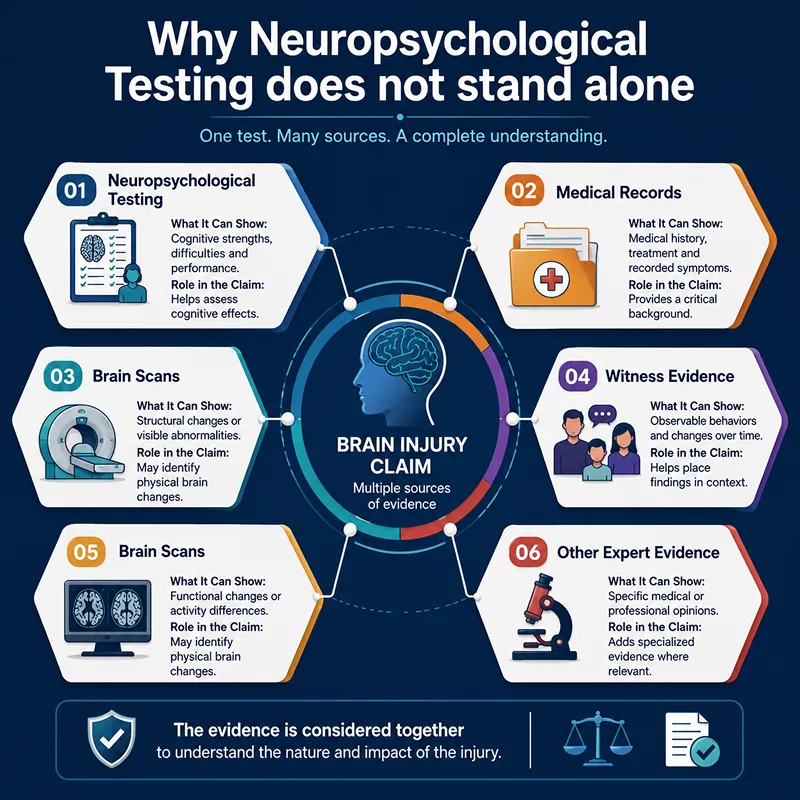
In a brain injury claim, the results are useful evidence. However, neuropsychological testing alone does not diagnose brain injury. Its results add to your medical history, symptoms and other clinical proof.
Role of Neuropsychological Testing in Brain Injury Claims in the UK
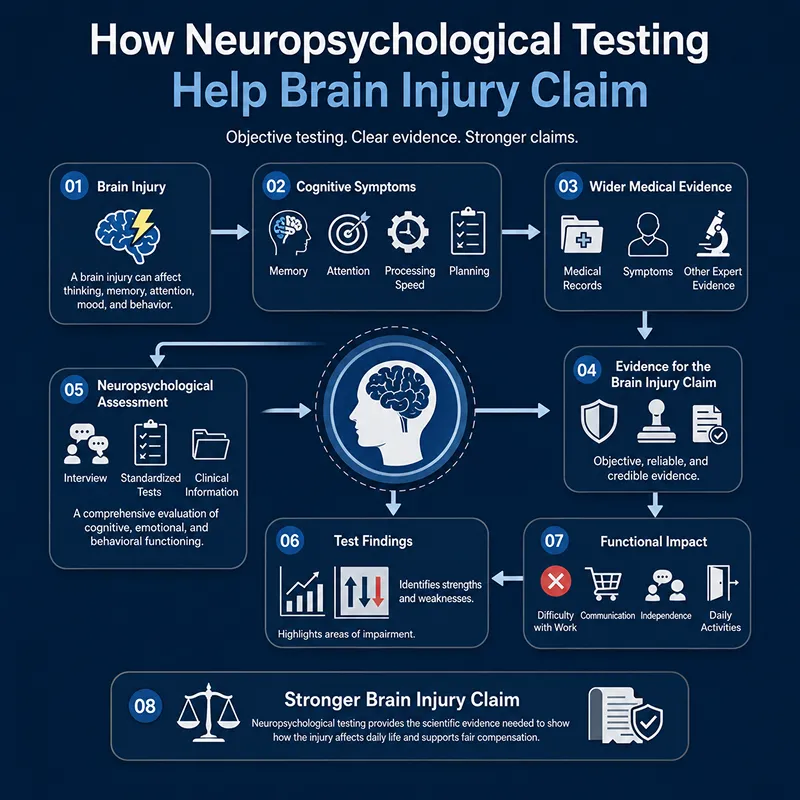
Neuropsychological testing plays an important role in brain injury claims in the UK by providing objective evidence of cognitive difficulties. It identifies impairments that are not always clear from medical examinations alone and shows how they affect the claimant’s daily functioning. Test results also complement medical records and other expert evidence when assessing the effects of a brain injury. This makes neuropsychological testing an important part of the wider evidence used to understand the claimant’s condition, functional limitations and the impact of the injury on their life. Neuropsychological testing can support a brain injury claim in several important ways, as explained below:
1. Identifying Cognitive Impairment
Test results can help identify the nature and extent of cognitive difficulties following a brain injury. They reveal issues with your:
- Memory
- Attention
- Processing speed
- Executive function
2. Functional Impact of Brain Injury
The findings can also help demonstrate how cognitive difficulties affect the claimant’s daily functioning. These difficulties may affect:
- Your independence
- Your ability to work
- Your ability to do home tasks
- Your ability to communicate
- Your quality of life
This can help explain how the injury affects the claimant’s everyday activities and ability to function independently.
3. Supporting Evidence in a Brain Injury Claim
Neuropsychological testing can complement other medical evidence in a brain injury claim. It provides information about the claimant’s cognitive difficulties and their impact on daily functioning. These findings can help the expert explain the claimant’s difficulties and their effects to the court. They may also contribute to recommendations for rehabilitation and other support.
4. Understanding the Limits of Testing
Neuropsychology testing should not be used alone as proof of a brain injury. It should be considered alongside your medical history, symptoms and other evidence. This helps provide a more complete picture of the claimant’s condition and its impact.
What Tests Are Used in a Neuropsychological Assessment?
Multiple tests are used in a neuropsychological evaluation. Each test checks a different brain function and is based on your symptoms and needs. Common neuropsychology tests include:
- Memory tests measure how well you learn and recall information.
- Attention tests calculate how well you focus, follow instructions and stay attentive.
- Executive function tests assess planning, reasoning, problem-solving and decision-making.
- Language tests assess your ability to understand and use words.
- Processing speed tests note how fast you process information and respond.
- Visuospatial tests check how your brain handles visual information like shapes, distances and space.
- Emotional and behavioural tests assess changes in mood, behaviour, emotional regulation and how these affect everyday functioning.
- Motor function tests measure coordination, speed and movement control.
A neuropsychologist may use many tests in one session, depending on the person’s needs. The results are then collectively reviewed. This gives a clearer picture of your mental strengths and weaknesses.
What Does a Neuropsychological Exam Involve?
A neuropsychological exam follows an organised process that involves more than just written or computer-based tasks. The specialist also considers your background, symptoms and performance while testing. The process of a neuropsychology exam is explained below:
1. The Testing Process
The test usually starts with a detailed interview. The neuropsychologist asks about:
- The accident
- Your recovery
- Your current difficulties
- How the brain injury affects your daily life
- Your medical records
You then complete the tests chosen for your case. A neuropsychology assessment can take several hours. More complex neuropsychological rehabilitation cases may need more than one session. The neuropsychologist also notes factors that affect your performance. These include tiredness, pain, anxiety and sleep issues.
2. Interpreting the Results
One test score is not enough to confirm your condition. The neuropsychologist checks if the results match your medical history and symptoms. They verify if the results are reliable. This helps decide whether the findings support their expert opinion. The neuropsychologist then explains your results in simple terms.
“The diverse ways executive difficulties present themselves mean that assessment and rehabilitation are not straightforward.”
– Headway
When Is Neuropsychological Testing Used After a Brain Injury?
Neuropsychological testing is used when a brain injury causes concerns about memory, attention, concentration, behaviour or other cognitive functions. An assessment is often recommended when these difficulties affect daily activities, work or rehabilitation.
Testing may take place during the early stages of recovery, once the patient is medically stable, or later when persistent problems need further assessment. The timing depends on the symptoms, stage of recovery and purpose of the assessment. Further testing can also be used when symptoms continue, change or require reassessment over time.
Can Neuropsychological Testing Prove a Brain Injury?
No. Neuropsychological testing provides evidence about cognitive functioning. It does not, on its own, establish the presence or cause of a brain injury. Testing can identify cognitive difficulties. It can also show how these difficulties affect daily functioning. However, a person may have a brain injury or ongoing cognitive symptoms even when CT or MRI scans appear normal. Abnormal test results can also have causes unrelated to the injury. For this reason, neuropsychological findings should be considered alongside medical records, clinical history and other relevant evidence. This helps provide a more complete picture of the injury and its impact.
What Are the Limitations of Neuropsychological Testing?
Neuropsychological testing has limits. It gives useful proof, but brain injury is not the only factor that can affect test performance. Other factors such as pain, fatigue, poor sleep or mental health issues influence neuropsychology test scores too. They may make it harder to link a test result to the brain injury alone.
Testing also has limits when a person has a subtle brain injury. Standardised tests may not record every difficulty. For example, they may not show clear changes in behaviour, motivation or the ability to do complex tasks.
Performance can also vary between tests. Your performance reflects your condition, environment and level of fatigue. For this reason, you should not treat a single test score as a complete measure of brain function.
Neuropsychology testing cannot prove that a brain injury caused every symptom you report. Its findings should be considered with other clinical evidence.
Case Study: Assessing Brain Injury Through Neuropsychological Testing
In R v Zhang [2025] EWCA Crim 639, Dr Ying Zhang suffered a brain injury during an incident involving his estranged wife. He later claimed that he had little or no memory of the incident. His defence solicitors instructed a neuropsychologist to assess his memory and cognitive function.
The assessment found some cognitive difficulties. However, the neuropsychologist did not link these findings to the brain injury, anxiety or depression. He considered that Zhang may have had a short period of retrograde amnesia. A longer period of post-traumatic amnesia could not be ruled out.
Zhang sought to rely on this neuropsychological evidence in his appeal. The Court of Appeal refused to admit the proposed fresh evidence and refused leave to appeal against his conviction. The court considered the testing results alongside the other evidence in the case.
The case shows how neuropsychological testing can help assess cognitive problems after a brain injury. However, test results are only one part of the evidence. They should be considered alongside medical history, neurological findings and other evidence.
Conclusion
Neuropsychology testing gives valuable evidence in UK brain injury claims. It can identify cognitive difficulties and explain their effect on work, independence and daily life. A neuropsychological test may reveal issues missed by a physical examination or routine brain scan. However, neuropsychological testing alone cannot prove a brain injury. Its findings are most useful when considered with medical records, clinical history, symptoms and other evidence. This gives the court a clearer picture of the injury and its impact.