How Long Will Your Personal Injury Case Take? Understanding High Court Procedures and Medical Expert Evidence in the UK

Published On: May 29th, 2026|Total Views: 1|Daily Views: 1|13.9 min read|2783 words|

TABLE OF CONTENT

The time required to make a personal injury claim becomes a key question after an accident. This largely depends on the nature of your injuries, supporting evidence and liability issues.

Personal injury claims remain common in the UK. Ministry of Justice data showed around 110,000 damage claims in England and Wales during 2025.

Claim times vary from a few months to many years. It is even possible to wait several years for a claim outcome when High Court processes and medical experts’ opinions are involved. The time limit for personal injury claims is another key issue for many people after an accident.

Quick Insight

A personal injury claim is not delayed for one reason only. It is usually a mix of medical evidence, legal checks, and insurance negotiations.

Key Takeaways:

A personal injury claim usually takes time because it follows multiple legal and medical stages. Most claims in the UK take between several months and a few years, depending on complexity.

Key points include:

  • Simple claims can settle in 6–9 months
  • Complex claims may take 2–3 years or more
  • Medical reports play a major role in delays
  • Liability disputes slow down the process
  • High Court involvement increases timelines
  • Early settlement can sometimes risk under-compensation
  • Evidence quality directly affects speed
  • Solicitors help reduce delays by managing evidence properly

What Is The Average Time Limit For A Personal Injury Claim In The UK?

The average time limit for a personal injury claim in the UK ranges from six months to three years, depending on injury type and legal issue.

A minor injury claim may settle quickly if the evidence is clear and both sides agree on fault. However, serious injury claims often take much longer because medical recovery and legal assessment take time.

Understanding the average timeline helps set clear expectations from the start. It also helps people understand the time limit for personal injury claims.

Typical Personal Injury Claim Timelines Based On Complexity

Different types of claims move at different speeds. Simple cases move faster because fewer experts are involved. Complex cases require more investigation, which naturally increases time.
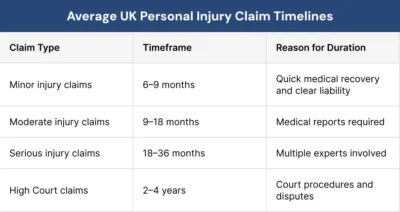
Average UK Personal Injury Claim Timelines

Why Do No Two Claims Take The Same Time

No two claims take the same time, as every case is unique in nature. This is due to the fact that each case is unique in nature. When the liability of the accident is disputed, the claim becomes more delayed.

The healing process is very important for the claim. The time limit for personal injury claims still applies during recovery. The claim can only be finalised once the effects of the injury are known.

What Are the Key Stages That Affect How Long A Personal Injury Claim Takes

The steps for filing a personal injury lawsuit follow a legal method. The time taken for each step depends on the nature of the claim.

In most cases, delays occur due to a lack of evidence or insurance company challenges to liability. Knowing this can help you understand the timeline of a personal injury case. It also explains why the time limit for personal injury claims matters.

1. Establishing Liability In Personal Injury Claims

Establishing liability involves finding out which party is responsible for the accident. It is one of the most crucial processes in a case.

When the issue of liability is resolved at an earlier stage, the process will be faster. However, when insurers dispute liability, it becomes slower due to the need for additional information. This can place pressure on the time limit for personal injury claims.

2. Providing Medical Expert Evidence And Why It Matters

The medical expert evidence plays a vital role in every personal injury case. Experts analyse the injuries and how they impact your everyday life. Without these reports, it becomes difficult to determine an accurate settlement amount.

In complicated cases, several specialists are required. This could range from orthopaedic doctors, neurologists, to even psychologists. Preparing each report takes time and hence impacts the entire process. People should still track the time limit for personal injury claims.

Important Detail

A claim cannot move to final settlement until medical experts confirm both recovery status and long-term impact.

3. Valuing The Claim

Once medical evidence is collected, the valuation is done. Valuation involves consideration of pain, suffering, loss of income and medical bills. This should be done correctly and thus solicitors usually look at cases that occurred before.

Valuing can also take some time because losses incurred should be well-documented. Failure to produce evidence slows down the whole process.

4. Negotiating With Insurance Companies

After the valuation process, negotiation begins between both parties. Insurers often make a lower settlement at first, which results in negotiations. This process is usually lengthy, particularly when dealing with large amounts.

In cases where financial strain exists, interim payments may be considered. These payments help claimants in covering their costs during the claim process. They do not stop the time limit for personal injury claims.

Medical evidence is often the foundation of both claim value and claim duration,”

according to UK medico-legal commentary.

Read More: Will a Personal Injury Trust affect my benefits?

What Are the High Court Procedures And Their Impact On Claim Duration

Not all personal injury claims go to the county court. In some cases, important claims or those with disputes go to the High Court. High Court cases take longer than typical personal injury claims. In the UK, cases involving a serious personal injury or worth over £50,000 are likely to be in the High Court. High-value claims in the High Court may take from 1 to 3 years. Even then, the time limit for personal injury claims remains important.

This is due to the various stages that are involved in such a claim. The stages may involve case management conferences and disclosure. It also includes expert medical witness statements and witness evidence. Further delays can arise from case backlogs.

The more complex the case is, the more time is needed for a resolution. Going to the High Court means a more procedural approach.

Read More: Can A Personal Injury Claim Be Settled Without Going To Court?

1. When A Claim Goes To The High Court

Most likely, an instance will reach the High Court in the event of serious injuries or when there is a significant liability dispute.

This is because such instances involve highly complicated processes that call for legal discussions and expert opinion.

2. Pre-Action Protocol And Early Legal Steps

Before court action starts, there is a pre-action procedure that both parties have to go through. It involves exchanging correspondence and providing evidence. Time is given to insurance companies to answer and investigate. This stage still falls within the time limit for personal injury claims.

This process may take up to several months. It depends on how fast the information is exchanged.

3. Court Timetables And Case Management

A timeline is set out when the claim is brought into court. It involves setting deadlines for evidence, witness statements and hearings. Although this framework helps in organising the case, it may also result in substantial delays.

Scheduling delays occur frequently within the UK legal system, especially when the case is complex. This is why people should know the time limit for personal injury claims early.

4. Final Trial And Judgment

When the case goes to court, each party presents its evidence. Witness testimonies and opinions from medical experts can also be heard. Then comes the final statement.

This step takes up the most time in the entire process, although few cases get here.
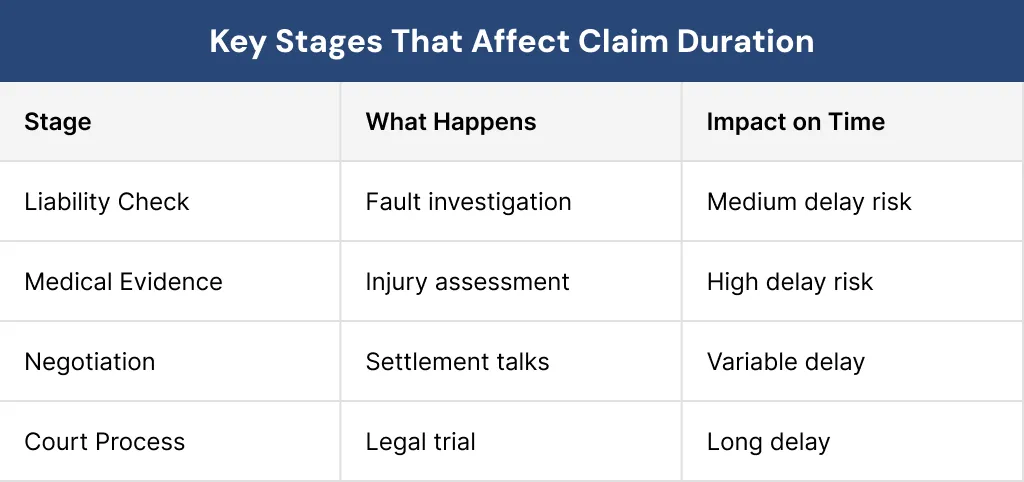
Key Stages That Affect Claim Duration

Case Study: How Long Does A Personal Injury Claim Take After A Workplace Injury?

A case of personal injury occurred in the UK, where a worker suffered a serious injury to one of his fingers after a machine restarted without prior warning while he was at work. The employer later admitted liability since safety procedures had not been followed. Even with the admission of fault, the settlement process took months.

The reason for this delay was that medical professionals had to be allowed time to study the extent of recovery and any future effects that would occur due to the injury. In the end, the victim was awarded compensation worth £55,000. The claim was also started early due to the time limit for personal injury claims.

Medical Expert Evidence And Why It Can Delay A Personal Injury Claim

Medical evidence is one of the most vital factors affecting the duration of a personal injury claim. Although liability might be conceded early in the proceedings, the amount of compensation is usually not settled until doctors fully understand the extent of damage caused by the injury.

The basis for compensation involves the effects of the injury currently and in the future. Early settlement may result in under-compensation if the injuries have not yet stabilised. Still, the time limit for personal injury claims must be followed.

Independent Medical Assessments In Personal Injury Claims

Most injury claims need an independent medical assessment. This is carried out by a qualified expert who reviews your injuries and medical history. Their role is to provide a neutral opinion based on evidence.

The report explains:

  • How the injury happened
  • How serious is it
  • Expected recovery time
  • Long-term impact on work and daily life

This evidence is extremely important because insurers rely heavily on these reports during settlement discussions.

Multiple Medical Experts Can Extend Claim Timelines

All injury claims will need a medical examination by an expert in the field. The role of the expert is to find the nature of your injuries and give their professional opinion.

The report will cover the following areas:

  • The cause of the injury
  • Its seriousness
  • The time needed for full recovery
  • Impact on work and daily living

This information is crucial because insurance companies use it extensively when negotiating settlements.

Why It Matters

A claim may appear straightforward at first. However, complex injuries often require several expert reports before compensation can be calculated fairly.

Disputes Between Medical Experts

Insurers question the results of the medical assessment. They either obtain their own expert opinion or deny the nature of the injury. This leads to more delays as the two parties consider the facts.

Cases that often lead to disputes include:

  • Chronic pain
  • Psychological injury
  • Permanent disability
  • Work-related illness

If there are differences between expert opinions, negotiations become slower. This may affect the time limit for personal injury claims.

What Happens If A Personal Injury Claim Goes To The High Court?

A majority of personal injury claims are settled out of court. Some cases go through the entire process of the legal system due to various reasons.

High Court claims tend to be complicated and involve large sums for compensation, extensive injuries or significant disputes about responsibility for an incident.

The court process is time-consuming, owing to the many legal processes involved. The time limit for personal injury claims still matters during this stage.

Why High Court Cases Take Longer

The High Court handles more severe legal cases. The judges analyse the medical reports, testimonies, and economic damages before making their judgments.

There are extra steps involved, like:

  • Hearings for case management
  • Confession of evidence
  • Expert witness examination
  • Preparation for trial

Every step comes with a deadline and a procedure that prolongs the process.

Court Timetables And Legal Delays

When the court proceedings begin, they follow a certain schedule. Although delays occur quite often in the UK courts.

Examples of common causes include:

  • Court calendar issue
  • Delayed submissions of evidence
  • Availability of expert witnesses
  • Request for more time

This explains why some cases take years rather than months. Long delays can create issues with the time limit for personal injury claims.
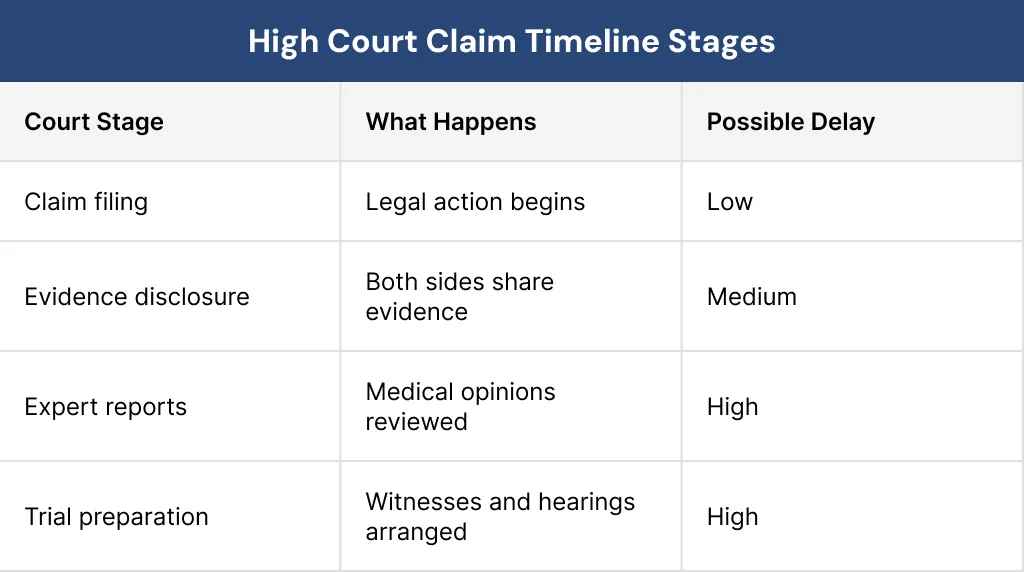
High Court Claim Timeline Stages

Do Most Personal Injury Claims Reach Trial?

No. Most claims are settled before the trial. Settlement discussions continue even after the trial process has begun.

The trial process is reserved for cases where:

  • There is uncertainty regarding liability
  • Settlement amounts are insufficient
  • Medical proof is contradictory

Since lawsuits are costly and time-consuming, insurance firms favour pre-trial settlements. This can help people stay within the time limit for personal injury claims.

What is the Personal Injury Claim Time Limit in the UK

The personal injury claim time limit in the UK is three years. But when it is going to start can vary.

Apart from claim deadlines, many people are also concerned about the personal injury claim time limit in the UK. It is vital, as failure to comply may result in disqualification from filing for compensation.

Standard Three-Year Time Limit

All adults are entitled to three years to file a claim for personal injury.

For instance:

  • Personal injury sustained on 1 June 2026
  • The time limit for filing a claim expires on 1 June 2029

It is advisable to act swiftly, since evidence will be more difficult to obtain as time passes.

Exceptions To The Personal Injury Claim Time Limit

Some claims operate on a different basis. Those involving persons under 18 generally have three years after they turn 21 to file a claim. Claims for medical negligence and industrial diseases sometimes use the “date of knowledge” principle, meaning that the clock starts ticking once the claimant becomes aware of the injury.

These exceptions to the personal injury claim time limit can add further complications to timelines. So, the time limit for personal injury claims should be checked early.
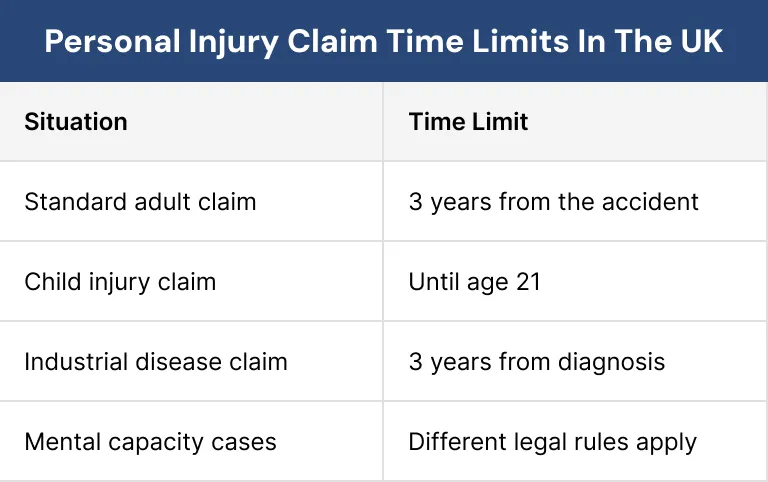
Quick Reminder

Starting a claim early helps preserve evidence, witness statements, and medical records. Waiting too long can weaken a case.

What Are Interim Payments And Early Settlements

Claimants can be under financial stress during the waiting period before compensation is awarded. In such circumstances, interim payments are helpful.

An interim payment involves receiving payment before the settlement of the claim.

When Interim Payments Are Used

Interim payments are more frequent in cases of severe injury when:

  • The claimant is unable to work
  • Rehabilitation expenses are higher
  • Long-term care is needed

They are then deducted from the total compensation package. The time limit for personal injury claims still applies in these cases.

Risks of Settling A Claim Too Early

Settling too soon can cause future problems. If the case has been settled fully and finally, it will not be possible to reopen the case.

In case there are any complications that arise from the settlement in the future, further compensation will not be made. For this reason, Patients should wait for their recovery so that the case becomes clearer.

This factor has the main impact on the duration of a personal injury case settlement. It can also affect the time limit for personal injury claims.

How Solicitors Help Speed Up Personal Injury Claims

An experienced solicitor can help organise evidence and prevent any unnecessary delay. They are responsible for all communication with the insurance company, the doctor and the court. Without the right legal help, it will be difficult for the claimant to organise documentation. Good legal support can help meet the time limit for personal injury claims.

1. Faster Evidence Gathering

Solicitors help in collecting:

  • Medical records
  • Witness statements
  • Financial report
  • Accident reports

Rapid evidence gathering can help with claim processing. It can also help people meet the time limit for personal injury claims.

2. Managing Medical Experts Efficiently

The legal team also organises for the client to attend medicals and obtain specialist reports. This prevents delays or incomplete information.

Effective organisation is critical in the High Court and injury cases. Effective organisation is critical in the High Court and injury cases. It is important to note the time limit for personal injury claims.

Conclusion

The duration of a personal injury claim is not always easy to predict since each case will have its own unique journey. Some claims will resolve quickly, whereas others will drag on for years, depending on liability arguments, medical evidence or High Court procedures.

Medical expert evidence is still one of the key determinants that will impact your timeline. It can also influence the time limit for personal injury claims. More significant injuries will clearly need more thorough assessment before arriving at an appropriate compensation settlement.

Concise Medico appreciates the value of medical evidence and proper claims support from start to finish. If you would like additional advice regarding injury assessments or medico-legal reports, please feel free to contact us.

Worried about delays in your personal injury case or unsure what happens next?

Concise Medico supports claimants and legal professionals with clear medical reporting and injury assessments across the UK. Reach out today if you want help to simplify complex claims with structured medico-legal evidence and expert support.


Worried about delays in your personal injury case or unsure what happens next?

Concise Medico supports claimants and legal professionals with clear medical reporting and injury assessments across the UK. Reach out today if you want help to simplify complex claims with structured medico-legal evidence and expert support.

FAQs

How Long Does A Personal Injury Claim Take In The UK?2026-05-29T06:58:12+00:00

Most UK personal injury claims take between 6 months and 3 years. Minor injuries with clear liability usually settle faster. Serious injuries and disputed claims often take much longer because of medical evidence and court procedures.

Why Do Personal Injury Claims Take So Long?2026-05-29T06:58:56+00:00

Claims often take time because insurers investigate liability carefully. Medical experts also need time to assess injuries fully. If court proceedings begin, legal schedules and evidence reviews can extend timelines further.

What Is The Personal Injury Claim Time Limit in the UK?2026-05-29T06:59:30+00:00

In most cases, the time limit for personal injury claims is three years from the accident date. Some exceptions apply for children and industrial disease claims. Starting early helps protect important evidence.

Do All Personal Injury Claims Go To Court?2026-05-29T07:00:30+00:00

No. Most personal injury claims settle outside court through negotiation. However, severe injuries or disputed liability cases may require court proceedings if an agreement cannot be reached.

Can Medical Reports Delay A Personal Injury Claim?2026-05-29T07:01:11+00:00

Yes. Medical reports are one of the biggest causes of delay in complex claims. Doctors may need time to assess long-term recovery before compensation can be valued properly.

What Happens If Liability Is Disputed?2026-05-29T07:02:12+00:00

If liability is disputed, both sides must gather more evidence. This can include witness statements, CCTV footage, and expert reports. These investigations often increase how long does a personal injury claim to settle.

Share This Article!

The time required to make a personal injury claim becomes a key question after an accident. This largely depends on the nature of your injuries, supporting evidence and liability issues.

Personal injury claims remain common in the UK. Ministry of Justice data showed around 110,000 damage claims in England and Wales during 2025.

Claim times vary from a few months to many years. It is even possible to wait several years for a claim outcome when High Court processes and medical experts’ opinions are involved. The time limit for personal injury claims is another key issue for many people after an accident.

Quick Insight

A personal injury claim is not delayed for one reason only. It is usually a mix of medical evidence, legal checks, and insurance negotiations.

Key Takeaways:

A personal injury claim usually takes time because it follows multiple legal and medical stages. Most claims in the UK take between several months and a few years, depending on complexity.

Key points include:

  • Simple claims can settle in 6–9 months
  • Complex claims may take 2–3 years or more
  • Medical reports play a major role in delays
  • Liability disputes slow down the process
  • High Court involvement increases timelines
  • Early settlement can sometimes risk under-compensation
  • Evidence quality directly affects speed
  • Solicitors help reduce delays by managing evidence properly

What Is The Average Time Limit For A Personal Injury Claim In The UK?

The average time limit for a personal injury claim in the UK ranges from six months to three years, depending on injury type and legal issue.

A minor injury claim may settle quickly if the evidence is clear and both sides agree on fault. However, serious injury claims often take much longer because medical recovery and legal assessment take time.

Understanding the average timeline helps set clear expectations from the start. It also helps people understand the time limit for personal injury claims.

Typical Personal Injury Claim Timelines Based On Complexity

Different types of claims move at different speeds. Simple cases move faster because fewer experts are involved. Complex cases require more investigation, which naturally increases time.

Average UK Personal Injury Claim Timelines

Why Do No Two Claims Take The Same Time

No two claims take the same time, as every case is unique in nature. This is due to the fact that each case is unique in nature. When the liability of the accident is disputed, the claim becomes more delayed.

The healing process is very important for the claim. The time limit for personal injury claims still applies during recovery. The claim can only be finalised once the effects of the injury are known.

What Are the Key Stages That Affect How Long A Personal Injury Claim Takes

The steps for filing a personal injury lawsuit follow a legal method. The time taken for each step depends on the nature of the claim.

In most cases, delays occur due to a lack of evidence or insurance company challenges to liability. Knowing this can help you understand the timeline of a personal injury case. It also explains why the time limit for personal injury claims matters.

1. Establishing Liability In Personal Injury Claims

Establishing liability involves finding out which party is responsible for the accident. It is one of the most crucial processes in a case.

When the issue of liability is resolved at an earlier stage, the process will be faster. However, when insurers dispute liability, it becomes slower due to the need for additional information. This can place pressure on the time limit for personal injury claims.

2. Providing Medical Expert Evidence And Why It Matters

The medical expert evidence plays a vital role in every personal injury case. Experts analyse the injuries and how they impact your everyday life. Without these reports, it becomes difficult to determine an accurate settlement amount.

In complicated cases, several specialists are required. This could range from orthopaedic doctors, neurologists, to even psychologists. Preparing each report takes time and hence impacts the entire process. People should still track the time limit for personal injury claims.

Important Detail

A claim cannot move to final settlement until medical experts confirm both recovery status and long-term impact.

3. Valuing The Claim

Once medical evidence is collected, the valuation is done. Valuation involves consideration of pain, suffering, loss of income and medical bills. This should be done correctly and thus solicitors usually look at cases that occurred before.

Valuing can also take some time because losses incurred should be well-documented. Failure to produce evidence slows down the whole process.

4. Negotiating With Insurance Companies

After the valuation process, negotiation begins between both parties. Insurers often make a lower settlement at first, which results in negotiations. This process is usually lengthy, particularly when dealing with large amounts.

In cases where financial strain exists, interim payments may be considered. These payments help claimants in covering their costs during the claim process. They do not stop the time limit for personal injury claims.

Medical evidence is often the foundation of both claim value and claim duration,”

according to UK medico-legal commentary.

Read More: Will a Personal Injury Trust affect my benefits?

What Are the High Court Procedures And Their Impact On Claim Duration

Not all personal injury claims go to the county court. In some cases, important claims or those with disputes go to the High Court. High Court cases take longer than typical personal injury claims. In the UK, cases involving a serious personal injury or worth over £50,000 are likely to be in the High Court. High-value claims in the High Court may take from 1 to 3 years. Even then, the time limit for personal injury claims remains important.

This is due to the various stages that are involved in such a claim. The stages may involve case management conferences and disclosure. It also includes expert medical witness statements and witness evidence. Further delays can arise from case backlogs.

The more complex the case is, the more time is needed for a resolution. Going to the High Court means a more procedural approach.

Read More: Can A Personal Injury Claim Be Settled Without Going To Court?

1. When A Claim Goes To The High Court

Most likely, an instance will reach the High Court in the event of serious injuries or when there is a significant liability dispute.

This is because such instances involve highly complicated processes that call for legal discussions and expert opinion.

2. Pre-Action Protocol And Early Legal Steps

Before court action starts, there is a pre-action procedure that both parties have to go through. It involves exchanging correspondence and providing evidence. Time is given to insurance companies to answer and investigate. This stage still falls within the time limit for personal injury claims.

This process may take up to several months. It depends on how fast the information is exchanged.

3. Court Timetables And Case Management

A timeline is set out when the claim is brought into court. It involves setting deadlines for evidence, witness statements and hearings. Although this framework helps in organising the case, it may also result in substantial delays.

Scheduling delays occur frequently within the UK legal system, especially when the case is complex. This is why people should know the time limit for personal injury claims early.

4. Final Trial And Judgment

When the case goes to court, each party presents its evidence. Witness testimonies and opinions from medical experts can also be heard. Then comes the final statement.

This step takes up the most time in the entire process, although few cases get here.

Key Stages That Affect Claim Duration

Case Study: How Long Does A Personal Injury Claim Take After A Workplace Injury?

A case of personal injury occurred in the UK, where a worker suffered a serious injury to one of his fingers after a machine restarted without prior warning while he was at work. The employer later admitted liability since safety procedures had not been followed. Even with the admission of fault, the settlement process took months.

The reason for this delay was that medical professionals had to be allowed time to study the extent of recovery and any future effects that would occur due to the injury. In the end, the victim was awarded compensation worth £55,000. The claim was also started early due to the time limit for personal injury claims.

Medical Expert Evidence And Why It Can Delay A Personal Injury Claim

Medical evidence is one of the most vital factors affecting the duration of a personal injury claim. Although liability might be conceded early in the proceedings, the amount of compensation is usually not settled until doctors fully understand the extent of damage caused by the injury.

The basis for compensation involves the effects of the injury currently and in the future. Early settlement may result in under-compensation if the injuries have not yet stabilised. Still, the time limit for personal injury claims must be followed.

Independent Medical Assessments In Personal Injury Claims

Most injury claims need an independent medical assessment. This is carried out by a qualified expert who reviews your injuries and medical history. Their role is to provide a neutral opinion based on evidence.

The report explains:

  • How the injury happened
  • How serious is it
  • Expected recovery time
  • Long-term impact on work and daily life

This evidence is extremely important because insurers rely heavily on these reports during settlement discussions.

Multiple Medical Experts Can Extend Claim Timelines

All injury claims will need a medical examination by an expert in the field. The role of the expert is to find the nature of your injuries and give their professional opinion.

The report will cover the following areas:

  • The cause of the injury
  • Its seriousness
  • The time needed for full recovery
  • Impact on work and daily living

This information is crucial because insurance companies use it extensively when negotiating settlements.

Why It Matters

A claim may appear straightforward at first. However, complex injuries often require several expert reports before compensation can be calculated fairly.

Disputes Between Medical Experts

Insurers question the results of the medical assessment. They either obtain their own expert opinion or deny the nature of the injury. This leads to more delays as the two parties consider the facts.

Cases that often lead to disputes include:

  • Chronic pain
  • Psychological injury
  • Permanent disability
  • Work-related illness

If there are differences between expert opinions, negotiations become slower. This may affect the time limit for personal injury claims.

What Happens If A Personal Injury Claim Goes To The High Court?

A majority of personal injury claims are settled out of court. Some cases go through the entire process of the legal system due to various reasons.

High Court claims tend to be complicated and involve large sums for compensation, extensive injuries or significant disputes about responsibility for an incident.

The court process is time-consuming, owing to the many legal processes involved. The time limit for personal injury claims still matters during this stage.

Why High Court Cases Take Longer

The High Court handles more severe legal cases. The judges analyse the medical reports, testimonies, and economic damages before making their judgments.

There are extra steps involved, like:

  • Hearings for case management
  • Confession of evidence
  • Expert witness examination
  • Preparation for trial

Every step comes with a deadline and a procedure that prolongs the process.

Court Timetables And Legal Delays

When the court proceedings begin, they follow a certain schedule. Although delays occur quite often in the UK courts.

Examples of common causes include:

  • Court calendar issue
  • Delayed submissions of evidence
  • Availability of expert witnesses
  • Request for more time

This explains why some cases take years rather than months. Long delays can create issues with the time limit for personal injury claims.

High Court Claim Timeline Stages

Do Most Personal Injury Claims Reach Trial?

No. Most claims are settled before the trial. Settlement discussions continue even after the trial process has begun.

The trial process is reserved for cases where:

  • There is uncertainty regarding liability
  • Settlement amounts are insufficient
  • Medical proof is contradictory

Since lawsuits are costly and time-consuming, insurance firms favour pre-trial settlements. This can help people stay within the time limit for personal injury claims.

What is the Personal Injury Claim Time Limit in the UK

The personal injury claim time limit in the UK is three years. But when it is going to start can vary.

Apart from claim deadlines, many people are also concerned about the personal injury claim time limit in the UK. It is vital, as failure to comply may result in disqualification from filing for compensation.

Standard Three-Year Time Limit

All adults are entitled to three years to file a claim for personal injury.

For instance:

  • Personal injury sustained on 1 June 2026
  • The time limit for filing a claim expires on 1 June 2029

It is advisable to act swiftly, since evidence will be more difficult to obtain as time passes.

Exceptions To The Personal Injury Claim Time Limit

Some claims operate on a different basis. Those involving persons under 18 generally have three years after they turn 21 to file a claim. Claims for medical negligence and industrial diseases sometimes use the “date of knowledge” principle, meaning that the clock starts ticking once the claimant becomes aware of the injury.

These exceptions to the personal injury claim time limit can add further complications to timelines. So, the time limit for personal injury claims should be checked early.

Quick Reminder

Starting a claim early helps preserve evidence, witness statements, and medical records. Waiting too long can weaken a case.

What Are Interim Payments And Early Settlements

Claimants can be under financial stress during the waiting period before compensation is awarded. In such circumstances, interim payments are helpful.

An interim payment involves receiving payment before the settlement of the claim.

When Interim Payments Are Used

Interim payments are more frequent in cases of severe injury when:

  • The claimant is unable to work
  • Rehabilitation expenses are higher
  • Long-term care is needed

They are then deducted from the total compensation package. The time limit for personal injury claims still applies in these cases.

Risks of Settling A Claim Too Early

Settling too soon can cause future problems. If the case has been settled fully and finally, it will not be possible to reopen the case.

In case there are any complications that arise from the settlement in the future, further compensation will not be made. For this reason, Patients should wait for their recovery so that the case becomes clearer.

This factor has the main impact on the duration of a personal injury case settlement. It can also affect the time limit for personal injury claims.

How Solicitors Help Speed Up Personal Injury Claims

An experienced solicitor can help organise evidence and prevent any unnecessary delay. They are responsible for all communication with the insurance company, the doctor and the court. Without the right legal help, it will be difficult for the claimant to organise documentation. Good legal support can help meet the time limit for personal injury claims.

1. Faster Evidence Gathering

Solicitors help in collecting:

  • Medical records
  • Witness statements
  • Financial report
  • Accident reports

Rapid evidence gathering can help with claim processing. It can also help people meet the time limit for personal injury claims.

2. Managing Medical Experts Efficiently

The legal team also organises for the client to attend medicals and obtain specialist reports. This prevents delays or incomplete information.

Effective organisation is critical in the High Court and injury cases. Effective organisation is critical in the High Court and injury cases. It is important to note the time limit for personal injury claims.

Conclusion

The duration of a personal injury claim is not always easy to predict since each case will have its own unique journey. Some claims will resolve quickly, whereas others will drag on for years, depending on liability arguments, medical evidence or High Court procedures.

Medical expert evidence is still one of the key determinants that will impact your timeline. It can also influence the time limit for personal injury claims. More significant injuries will clearly need more thorough assessment before arriving at an appropriate compensation settlement.

Concise Medico appreciates the value of medical evidence and proper claims support from start to finish. If you would like additional advice regarding injury assessments or medico-legal reports, please feel free to contact us.

Worried about delays in your personal injury case or unsure what happens next?

Concise Medico supports claimants and legal professionals with clear medical reporting and injury assessments across the UK. Reach out today if you want help to simplify complex claims with structured medico-legal evidence and expert support.

Worried about delays in your personal injury case or unsure what happens next?

Concise Medico supports claimants and legal professionals with clear medical reporting and injury assessments across the UK. Reach out today if you want help to simplify complex claims with structured medico-legal evidence and expert support.

FAQs

How Long Does A Personal Injury Claim Take In The UK?2026-05-29T06:58:12+00:00

Most UK personal injury claims take between 6 months and 3 years. Minor injuries with clear liability usually settle faster. Serious injuries and disputed claims often take much longer because of medical evidence and court procedures.

Why Do Personal Injury Claims Take So Long?2026-05-29T06:58:56+00:00

Claims often take time because insurers investigate liability carefully. Medical experts also need time to assess injuries fully. If court proceedings begin, legal schedules and evidence reviews can extend timelines further.

What Is The Personal Injury Claim Time Limit in the UK?2026-05-29T06:59:30+00:00

In most cases, the time limit for personal injury claims is three years from the accident date. Some exceptions apply for children and industrial disease claims. Starting early helps protect important evidence.

Do All Personal Injury Claims Go To Court?2026-05-29T07:00:30+00:00

No. Most personal injury claims settle outside court through negotiation. However, severe injuries or disputed liability cases may require court proceedings if an agreement cannot be reached.

Can Medical Reports Delay A Personal Injury Claim?2026-05-29T07:01:11+00:00

Yes. Medical reports are one of the biggest causes of delay in complex claims. Doctors may need time to assess long-term recovery before compensation can be valued properly.

What Happens If Liability Is Disputed?2026-05-29T07:02:12+00:00

If liability is disputed, both sides must gather more evidence. This can include witness statements, CCTV footage, and expert reports. These investigations often increase how long does a personal injury claim to settle.

Go to Top
