What Is a Medico-Legal Pain Assessment and How Does It Support Personal Injury Claims?

Published On: July 8th, 2026|Total Views: 3|Daily Views: 3|8.7 min read|1720 words|

TABLE OF CONTENT

What Is a Medico-Legal Pain Assessment and How Does It Support Personal Injury Claims?

Can you provide proof of the pain you’re feeling? The answer is yes but it’s not that simple and easy in personal injury cases.

A pain assessment is a major medical process carried out in UK injury cases. It is centred on assessing for pain in a well organised and unbiased manner. It helps lay out what a victim is really going through right after an accident.

A medico-legal pain analysis is a planned medical review conducted by an independent expert. It is applied in personal injury claims to identify pain, its cause and its lasting effect.

A medico-legal pain evaluation is an unbiased medical analysis that clarifies a person’s injury related pain for legal reasons.

This method is not about treatment but rather it is concerned with evidence. It helps courts, solicitors and insurers make reasonable and accurate judicial choices.

Pain caused by an accident can impact many aspects of life. Moving around can become challenging and job performance may suffer. Besides this, sleep and mental well-being can also be influenced. That is the reason that a detailed medical review is necessary.

In short, it connects medical details with legal judgements. It explains what the injury refers to in everyday life and guarantees that discomfort is properly documented in a claim.

This is specifically relevant in the UK civil justice system. In this framework, personal injury claims constitute a major part of damage cases. From January to March 2026, total damage claims were recorded at 28,000. Thus, personal injury related cases revealed a drop of 23%, reducing the figure to 11,000 cases.

In this blog, you will learn how medico-legal pain checks are conducted and why they are necessary. You will also explore how they assist with personal injury claims.

Key Takeaways

  • A pain assessment gives independent medical evidence that helps show how an injury affects daily life and supports a personal injury claim
  • Assessing for pain involves reviewing medical records, injury details, symptoms, and the impact of pain on work and everyday tasks
  • An assessment of pain helps experts explain the cause of symptoms, expected recovery, and any future treatment needs
  • Experts assess for pain through medical history reviews, physical examinations, and evaluations of how pain affects function and well-being
  • Understanding what is chronic pain can help explain why some symptoms continue long after the original injury has healed
  • When asking how we assess pain, the answer includes medical evidence, physical findings, patient reports, and expert clinical judgement

What Is a Medico-Legal Pain Assessment?

A medico-legal pain assessment is a medical care study done by an external expert. It is utilised in legal cases, not for regular medical treatment.

A pain evaluation is a health checkup done by an unbiased expert for legal concerns. It helps express how injuries harm a person and it is not used primarily for the recovery of the patient but to offer proof in a claim.

Experts review injury information, health data files and lasting effects to develop a clear understanding of the disease. A pain review gives an impartial assessment of the level of pain and how it impacts everyday life.

The most important thing in the assessment of pain is to believe the patient.

Professor Paul Watson, Consultant in Pain Management

Why Pain Assessments Matter in Personal Injury Claims?

In personal injury cases, a pain assessment acts to define injury level of severity. It sets out how the accident led to continued problems.

It relates the injury right away to the incident and this is vital for the proof of the claim. Insurers rely on this proof when deciding on compensation.

A pain review also helps discover a permanent solution. It sums up how the injury is related to your work, ability to function and daily life.

It will guarantee unbiased decision making and reduce any disputes between both sides.

Learn more: Personal injury claims new rules

Why It Matters!

A medico-legal pain assessment does more than record symptoms. It helps prove how an injury affects daily life, work, and wellbeing, giving insurers and legal teams clear evidence when assessing compensation.

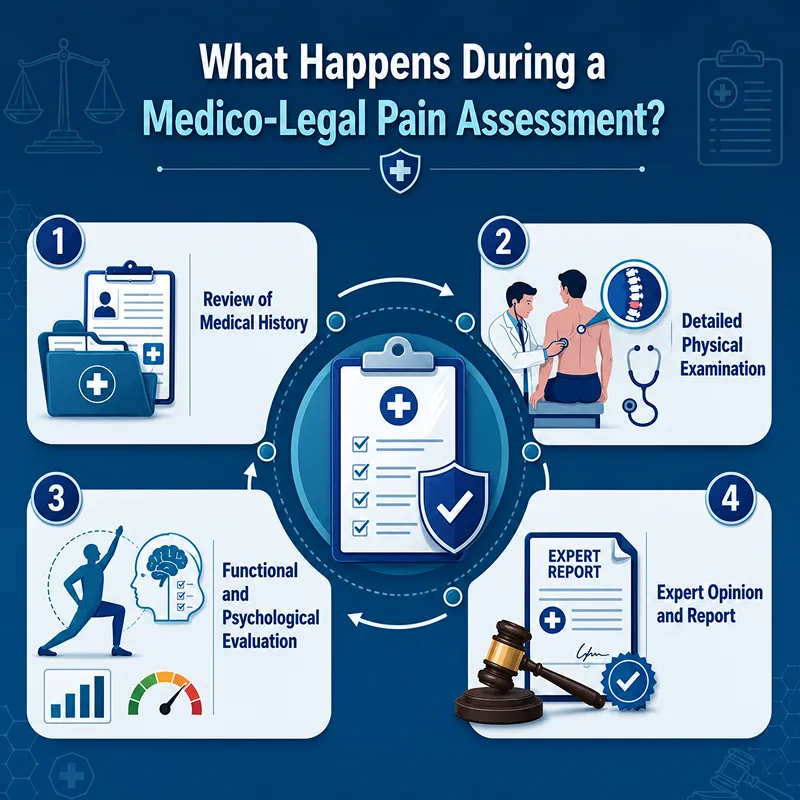
What Happens During a Medico-Legal Pain Assessment?

Now let’s look at what takes place inside the process to assess for pain in a medico-legal scenario.

Before the testing process starts, the expert gets ready by going over paperwork and reviewing the case history:

1. Review of Medical History

The expert inspects medical files, scans and past medical treatments. This helps create background knowledge of the case.

This phase suggests a clear assessment of signs and injury records.

2. Detailed Physical Examination

The expert inspects mobility, strength level and physical limits. They look at how the body reacts to physical stress or activity.

This phase of the test reveals how the damage impacts performance in real life.

3. Functional and Psychological Evaluation

This part examines how pain impacts everyday activities. It covers work skills, sleep and mental health.

Most people suffer from stress, anxiety or mood shifts, and even trauma or PTSD linked to chronic injury pain. A thorough account of such mental health issues is also addressed in the analysis.
What Happens During a Medico-Legal Pain Assessment?

4. Expert Opinion and Report

The specialist drafts a full report on the topic. It covers the diagnosis, cause of injury and healing approach.

The document is utilised in legal negotiations and helps lay out the full effect of the injury in basic terms.

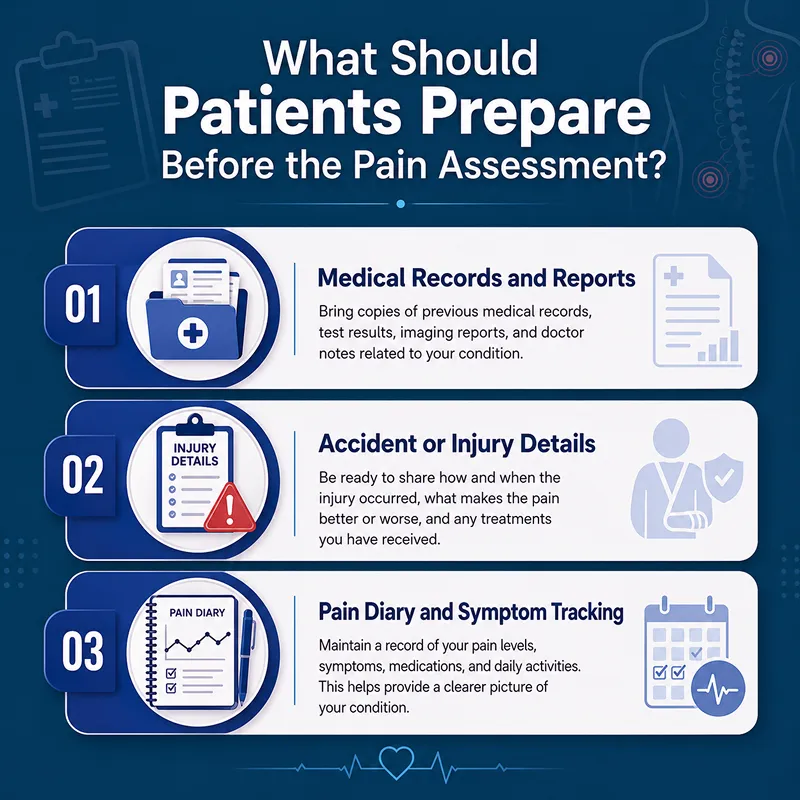
What Should Patients Prepare Before the Pain Assessment?

Before going in, proper planning is essential for a seamless pain evaluation method:

1. Medical Records and Reports

Patients should gather all health care records. These typically consist of scanned images, GP notes and written instructions.

2. Accident or Injury Details

Specific information about how and where the injury took place is important. This involves identifying dates and early symptoms.

3. Pain Diary and Symptom Tracking

A diary helps keep track of everyday symptoms. It reveals how the diagnosis develops over time.

This promotes the assessment process and improves precision.
Quick Tip!

Before your assessment, keep a simple pain diary. Note when symptoms worsen, how pain affects daily tasks, and any treatment you receive. Small details can help create a more accurate report.

How a Medico-Legal Pain Assessment Supports Your Claim?

This study gives solid medical proof for injury claims. It sums up how the injury impacts life and job duties.

It helps legal experts know the full case and analyse the claim well. It also assists in dealings with insurers by offering clear, evidence-based medical records. This helps avoid conflict and speeds up the claim review process. It also allows insurers to properly measure the severity of the injury and calculate fair compensation.

This assessment of pain defines healing time, treatment needs and future impacts. The results help ensure fair compensation in personal injury claims. It also promotes initial rehabilitation plans for improved recovery results.

Who Conducts Medico-Legal Pain Assessments?

These reviews are done by skilled medical field experts. They are unbiased and trained in injury cases.

They may be defined as pain specialists, orthopaedic advisors, or neurologists. Experts are often called in for assessing serious injury cases where signs are ongoing or unclear.

At times, specialists assess the pain level where injuries impact various body organs or result in nerve damage.

In simple words, these experts assist in figuring out how pain changes the body and mind.

Benefits of a Medico-Legal Pain Assessment

This assessment aids both patients and legal staff. It provides a concise and unbiased medical view.

It promotes fair compensation and a more effective treatment strategy. Also, it makes sure injuries are properly explained.

The assessment of pain helps reveal the real level of discomfort. Medical professionals often ask how pain should be evaluated in real-life cases and this process gives a logical response.

It also helps explain cases of prolonged disorders resulting in chronic pain, where signs persist even after apparent recovery.

Case Study: How a Pain Assessment Helped Secure £26,500 Compensation

A customer was injured in a motor vehicle traffic accident in the UK. He was waiting at traffic lights when a vehicle crashed into him from the rear.

He went through whiplash, a brain injury and psychological issues. The pain impacted his everyday life and emotional health.

A medico-legal pain review was carried out, where medical experts looked at his health status. These comprised a GP, an orthopaedic surgeon and a neurologist. They clarified how severe the injuries were and how they impacted his life.

At the initial stage, the insurer only agreed to a 75% fault. The scenario was subject to conflict. Solid proof was then gathered, which included photos, witness statements and detailed medical records. Afterwards, full fault was agreed upon.

The case had been resolved for £26,500. The initial deal was only £2,500 but it was raised after sufficient evidence was submitted.

This situation points out the worth of a medico-legal assessment of pain. It serves to show injury, support evidence and ensure proper compensation.

Bottom Line

In its conclusion, a medico-legal pain assessment serves an essential role in personal injury claims in the UK. It offers a concise, unbiased overview of how an injury changes a person’s routine life and overall health.

It is not a standard medical treatment procedure. Instead, it puts an emphasis on evidence, which helps link medical data with fair legal decisions. This guarantees that every detail of pain and hardship is effectively written down and understood.

A careful assessment also lowers the risk of neglecting crucial information. It promotes fair compensation by concisely proving the real impact of pain on work, routine tasks and quality of life.

Concise Medico is aware of the critical significance of precise and organised medico-legal pain evaluations. We also provide professional support in this domain.

Contact us today to benefit from our expert advice and help with your case.

Struggling to prove the impact of your pain after an injury?

Our team helps with expert medico-legal assessments and clear evidence to support your claim.
We have helped with numerous personal injury cases by providing independent, detailed reports that support fair outcomes. Reach us today.

Struggling to prove the impact of your pain after an injury?

Our team helps with expert medico-legal assessments and clear evidence to support your claim.
We have helped with numerous personal injury cases by providing independent, detailed reports that support fair outcomes. Reach us today.

FAQs

What is chronic pain?2026-07-08T06:19:09+00:00

Chronic pain is pain that lasts for more than three months or continues beyond the expected healing period. It can affect daily activities, work, sleep, and mental well-being, even when the original injury has healed.

How do we assess pain?2026-07-08T06:19:39+00:00

To understand how we assess pain, medical experts review a patient’s medical history, symptoms, treatment records, and daily limitations. They may also carry out physical examinations and use pain scales to evaluate the severity and impact of the condition.

How do personal injury claims work in the UK?2026-07-08T06:20:14+00:00

A personal injury claim begins when someone suffers an injury due to another party’s negligence. The claimant gathers evidence, such as medical records, accident reports, and witness statements, to support the claim. An independent medical assessment is usually arranged to evaluate the injury and its impact. The parties may then negotiate a settlement, but if an agreement cannot be reached, the case may proceed to court for a decision.

What is the average payout for a personal injury claim in the UK?2026-07-08T06:20:38+00:00

There is no fixed average payout because compensation depends on the type and severity of the injury, recovery time, financial losses, and future care needs. Minor injuries may result in relatively modest awards, while serious or long-term injuries can attract significantly higher compensation. A medico-legal report helps determine the value of a claim by providing evidence about the injury and its prognosis.

What pain assessment tool is used in the UK?2026-07-08T06:21:44+00:00

Healthcare professionals in the UK use several pain assessment tools depending on the patient and condition. Common examples include the Numeric Rating Scale (NRS), where patients rate pain from 0 to 10, the Visual Analogue Scale (VAS), and the Brief Pain Inventory (BPI). In medico-legal cases, experts may use these tools alongside medical records, physical examinations, and patient interviews to assess the severity and impact of pain.

Share This Article!

What Is a Medico-Legal Pain Assessment and How Does It Support Personal Injury Claims?

Can you provide proof of the pain you’re feeling? The answer is yes but it’s not that simple and easy in personal injury cases.

A pain assessment is a major medical process carried out in UK injury cases. It is centred on assessing for pain in a well organised and unbiased manner. It helps lay out what a victim is really going through right after an accident.

A medico-legal pain analysis is a planned medical review conducted by an independent expert. It is applied in personal injury claims to identify pain, its cause and its lasting effect.

A medico-legal pain evaluation is an unbiased medical analysis that clarifies a person’s injury related pain for legal reasons.

This method is not about treatment but rather it is concerned with evidence. It helps courts, solicitors and insurers make reasonable and accurate judicial choices.

Pain caused by an accident can impact many aspects of life. Moving around can become challenging and job performance may suffer. Besides this, sleep and mental well-being can also be influenced. That is the reason that a detailed medical review is necessary.

In short, it connects medical details with legal judgements. It explains what the injury refers to in everyday life and guarantees that discomfort is properly documented in a claim.

This is specifically relevant in the UK civil justice system. In this framework, personal injury claims constitute a major part of damage cases. From January to March 2026, total damage claims were recorded at 28,000. Thus, personal injury related cases revealed a drop of 23%, reducing the figure to 11,000 cases.

In this blog, you will learn how medico-legal pain checks are conducted and why they are necessary. You will also explore how they assist with personal injury claims.

Key Takeaways

  • A pain assessment gives independent medical evidence that helps show how an injury affects daily life and supports a personal injury claim
  • Assessing for pain involves reviewing medical records, injury details, symptoms, and the impact of pain on work and everyday tasks
  • An assessment of pain helps experts explain the cause of symptoms, expected recovery, and any future treatment needs
  • Experts assess for pain through medical history reviews, physical examinations, and evaluations of how pain affects function and well-being
  • Understanding what is chronic pain can help explain why some symptoms continue long after the original injury has healed
  • When asking how we assess pain, the answer includes medical evidence, physical findings, patient reports, and expert clinical judgement

What Is a Medico-Legal Pain Assessment?

A medico-legal pain assessment is a medical care study done by an external expert. It is utilised in legal cases, not for regular medical treatment.

A pain evaluation is a health checkup done by an unbiased expert for legal concerns. It helps express how injuries harm a person and it is not used primarily for the recovery of the patient but to offer proof in a claim.

Experts review injury information, health data files and lasting effects to develop a clear understanding of the disease. A pain review gives an impartial assessment of the level of pain and how it impacts everyday life.

The most important thing in the assessment of pain is to believe the patient.

Professor Paul Watson, Consultant in Pain Management

Why Pain Assessments Matter in Personal Injury Claims?

In personal injury cases, a pain assessment acts to define injury level of severity. It sets out how the accident led to continued problems.

It relates the injury right away to the incident and this is vital for the proof of the claim. Insurers rely on this proof when deciding on compensation.

A pain review also helps discover a permanent solution. It sums up how the injury is related to your work, ability to function and daily life.

It will guarantee unbiased decision making and reduce any disputes between both sides.

Learn more: Personal injury claims new rules

Why It Matters!

A medico-legal pain assessment does more than record symptoms. It helps prove how an injury affects daily life, work, and wellbeing, giving insurers and legal teams clear evidence when assessing compensation.

What Happens During a Medico-Legal Pain Assessment?

Now let’s look at what takes place inside the process to assess for pain in a medico-legal scenario.

Before the testing process starts, the expert gets ready by going over paperwork and reviewing the case history:

1. Review of Medical History

The expert inspects medical files, scans and past medical treatments. This helps create background knowledge of the case.

This phase suggests a clear assessment of signs and injury records.

2. Detailed Physical Examination

The expert inspects mobility, strength level and physical limits. They look at how the body reacts to physical stress or activity.

This phase of the test reveals how the damage impacts performance in real life.

3. Functional and Psychological Evaluation

This part examines how pain impacts everyday activities. It covers work skills, sleep and mental health.

Most people suffer from stress, anxiety or mood shifts, and even trauma or PTSD linked to chronic injury pain. A thorough account of such mental health issues is also addressed in the analysis.

What Happens During a Medico-Legal Pain Assessment?

4. Expert Opinion and Report

The specialist drafts a full report on the topic. It covers the diagnosis, cause of injury and healing approach.

The document is utilised in legal negotiations and helps lay out the full effect of the injury in basic terms.

What Should Patients Prepare Before the Pain Assessment?

Before going in, proper planning is essential for a seamless pain evaluation method:

1. Medical Records and Reports

Patients should gather all health care records. These typically consist of scanned images, GP notes and written instructions.

2. Accident or Injury Details

Specific information about how and where the injury took place is important. This involves identifying dates and early symptoms.

3. Pain Diary and Symptom Tracking

A diary helps keep track of everyday symptoms. It reveals how the diagnosis develops over time.

This promotes the assessment process and improves precision.

Quick Tip!

Before your assessment, keep a simple pain diary. Note when symptoms worsen, how pain affects daily tasks, and any treatment you receive. Small details can help create a more accurate report.

How a Medico-Legal Pain Assessment Supports Your Claim?

This study gives solid medical proof for injury claims. It sums up how the injury impacts life and job duties.

It helps legal experts know the full case and analyse the claim well. It also assists in dealings with insurers by offering clear, evidence-based medical records. This helps avoid conflict and speeds up the claim review process. It also allows insurers to properly measure the severity of the injury and calculate fair compensation.

This assessment of pain defines healing time, treatment needs and future impacts. The results help ensure fair compensation in personal injury claims. It also promotes initial rehabilitation plans for improved recovery results.

Who Conducts Medico-Legal Pain Assessments?

These reviews are done by skilled medical field experts. They are unbiased and trained in injury cases.

They may be defined as pain specialists, orthopaedic advisors, or neurologists. Experts are often called in for assessing serious injury cases where signs are ongoing or unclear.

At times, specialists assess the pain level where injuries impact various body organs or result in nerve damage.

In simple words, these experts assist in figuring out how pain changes the body and mind.

Benefits of a Medico-Legal Pain Assessment

This assessment aids both patients and legal staff. It provides a concise and unbiased medical view.

It promotes fair compensation and a more effective treatment strategy. Also, it makes sure injuries are properly explained.

The assessment of pain helps reveal the real level of discomfort. Medical professionals often ask how pain should be evaluated in real-life cases and this process gives a logical response.

It also helps explain cases of prolonged disorders resulting in chronic pain, where signs persist even after apparent recovery.

Case Study: How a Pain Assessment Helped Secure £26,500 Compensation

A customer was injured in a motor vehicle traffic accident in the UK. He was waiting at traffic lights when a vehicle crashed into him from the rear.

He went through whiplash, a brain injury and psychological issues. The pain impacted his everyday life and emotional health.

A medico-legal pain review was carried out, where medical experts looked at his health status. These comprised a GP, an orthopaedic surgeon and a neurologist. They clarified how severe the injuries were and how they impacted his life.

At the initial stage, the insurer only agreed to a 75% fault. The scenario was subject to conflict. Solid proof was then gathered, which included photos, witness statements and detailed medical records. Afterwards, full fault was agreed upon.

The case had been resolved for £26,500. The initial deal was only £2,500 but it was raised after sufficient evidence was submitted.

This situation points out the worth of a medico-legal assessment of pain. It serves to show injury, support evidence and ensure proper compensation.

Bottom Line

In its conclusion, a medico-legal pain assessment serves an essential role in personal injury claims in the UK. It offers a concise, unbiased overview of how an injury changes a person’s routine life and overall health.

It is not a standard medical treatment procedure. Instead, it puts an emphasis on evidence, which helps link medical data with fair legal decisions. This guarantees that every detail of pain and hardship is effectively written down and understood.

A careful assessment also lowers the risk of neglecting crucial information. It promotes fair compensation by concisely proving the real impact of pain on work, routine tasks and quality of life.

Concise Medico is aware of the critical significance of precise and organised medico-legal pain evaluations. We also provide professional support in this domain.

Contact us today to benefit from our expert advice and help with your case.

Struggling to prove the impact of your pain after an injury?

Our team helps with expert medico-legal assessments and clear evidence to support your claim.
We have helped with numerous personal injury cases by providing independent, detailed reports that support fair outcomes. Reach us today.

Struggling to prove the impact of your pain after an injury?

Our team helps with expert medico-legal assessments and clear evidence to support your claim.
We have helped with numerous personal injury cases by providing independent, detailed reports that support fair outcomes. Reach us today.

FAQs

What is chronic pain?2026-07-08T06:19:09+00:00

Chronic pain is pain that lasts for more than three months or continues beyond the expected healing period. It can affect daily activities, work, sleep, and mental well-being, even when the original injury has healed.

How do we assess pain?2026-07-08T06:19:39+00:00

To understand how we assess pain, medical experts review a patient’s medical history, symptoms, treatment records, and daily limitations. They may also carry out physical examinations and use pain scales to evaluate the severity and impact of the condition.

How do personal injury claims work in the UK?2026-07-08T06:20:14+00:00

A personal injury claim begins when someone suffers an injury due to another party’s negligence. The claimant gathers evidence, such as medical records, accident reports, and witness statements, to support the claim. An independent medical assessment is usually arranged to evaluate the injury and its impact. The parties may then negotiate a settlement, but if an agreement cannot be reached, the case may proceed to court for a decision.

What is the average payout for a personal injury claim in the UK?2026-07-08T06:20:38+00:00

There is no fixed average payout because compensation depends on the type and severity of the injury, recovery time, financial losses, and future care needs. Minor injuries may result in relatively modest awards, while serious or long-term injuries can attract significantly higher compensation. A medico-legal report helps determine the value of a claim by providing evidence about the injury and its prognosis.

What pain assessment tool is used in the UK?2026-07-08T06:21:44+00:00

Healthcare professionals in the UK use several pain assessment tools depending on the patient and condition. Common examples include the Numeric Rating Scale (NRS), where patients rate pain from 0 to 10, the Visual Analogue Scale (VAS), and the Brief Pain Inventory (BPI). In medico-legal cases, experts may use these tools alongside medical records, physical examinations, and patient interviews to assess the severity and impact of pain.

Go to Top