TABLE OF CONTENT
What Is Fibromyalgia and Can You Claim Compensation for It?
Fibromyalgia is a complex and long-term pain condition that affects how your nervous system reacts to pain signals. Unlike conditions that can be confirmed through scans or blood tests, it is diagnosed based on symptoms.
This is one reason why a fibromyalgia compensation claim can be legally challenging. However, claims are still possible when they are supported by medical evidence.
If you are wondering about what fibromyalgia is and whether you can claim compensation for it, the answer depends on the cause of your condition and the available evidence.
A fibromyalgia claim in the UK usually arises in two situations:
- After an accident caused by someone else’s negligence
- Following medical negligence (such as delayed diagnosis or misdiagnosis)
Research shows that in the UK an estimated 1.8 million to 2.9 million people are living with fibromyalgia.
What Is Fibromyalgia?
Fibromyalgia is a long-term condition that causes pain across different parts of the body. Many people also have poor sleep, headaches and issues with memory.
While there is no cure, lifestyle changes, therapies and medications can help to manage it.
The condition can affect many people in different ways, with some experiencing mild symptoms and others facing serious issues.
Doctors do not fully understand what causes it, but it is believed to affect the way the brain and nervous system process pain signals. Because symptoms can vary from person to person, diagnosing the condition can take time.
Can You Claim Compensation for It?
Yes, a fibromyalgia compensation claim may be possible if the condition was caused or made worse by negligence of someone else. This could include an accident at work, a road traffic accident or medical negligence.
The success of the fibromyalgia claim will depend on the available evidence.
What Accidents Could Cause Fibromyalgia?
Fibromyalgia may develop or worsen after certain accidents. The most common causes involve accidents in public places, workplace injuries and road traffic accidents. Each case depends on its own facts and evidence.
Although fibromyalgia does not develop after every injury, medical experts recognise that physical trauma can sometimes trigger the condition. This is why some people experience symptoms after an accident.
A fibromyalgia compensation claim may arise when an accident happened because another person failed to take reasonable care. In this case, you must show both negligence and a link between the accident and the condition.
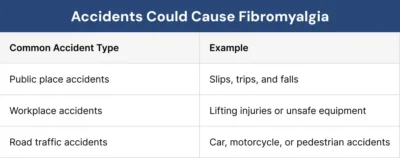
1. Public Place Accidents
Property owners have a duty to keep their visitors safe. If they fail to deal with hazards, accidents can happen.
For example, a person may slip on a wet floor in a supermarket where there are no warning signs.
They may also trip because of broken flooring. In some cases, injuries from these accidents can later be linked to fibromyalgia symptoms.
A fibromyalgia compensation claim may be possible if there is evidence that shows the property owner was negligent.
2. Accidents at Work
Employers have a legal duty to provide a safe workplace. They should offer proper training, maintain equipment and carry out the risk assessments where needed.
Workplace accidents can happen for many reasons. A worker may suffer an injury while lifting heavy items. In some cases, symptoms of chronic pain develop after the injury and later lead to a diagnosis of fibromyalgia.
3. Road Traffic Accidents
Road traffic accidents are one of the most common reasons people seek compensation after an injury. Even those accidents that seem minor at first can lead to long-term pain issues in the future.
Some people develop symptoms of fibromyalgia after suffering whiplash or other soft tissue injuries. While not everyone will experience this, medical proof may show a link between the accident and the condition.
Can I Claim for Fibromyalgia Medical Negligence?
Yes, a fibromyalgia compensation claim may be possible if medical negligence caused unnecessary pain, delayed treatment or made the symptoms worse. The key issue is whether better medical care would likely have led to a better outcome.
For example, a patient may repeatedly report pain, tiredness and issues related to sleep, but their concerns are not properly looked at. If this leads to years of unnecessary suffering, there may be grounds for a fibromyalgia claim.
Medical negligence cases are often more complex than accident claims.
This is because medical experts are usually needed to review the treatment and explain what should have happened.
Read more: Can a Delayed Cancer Diagnosis Be Considered Medical Negligence?
How to Prove Fibromyalgia Was Caused by Negligence?
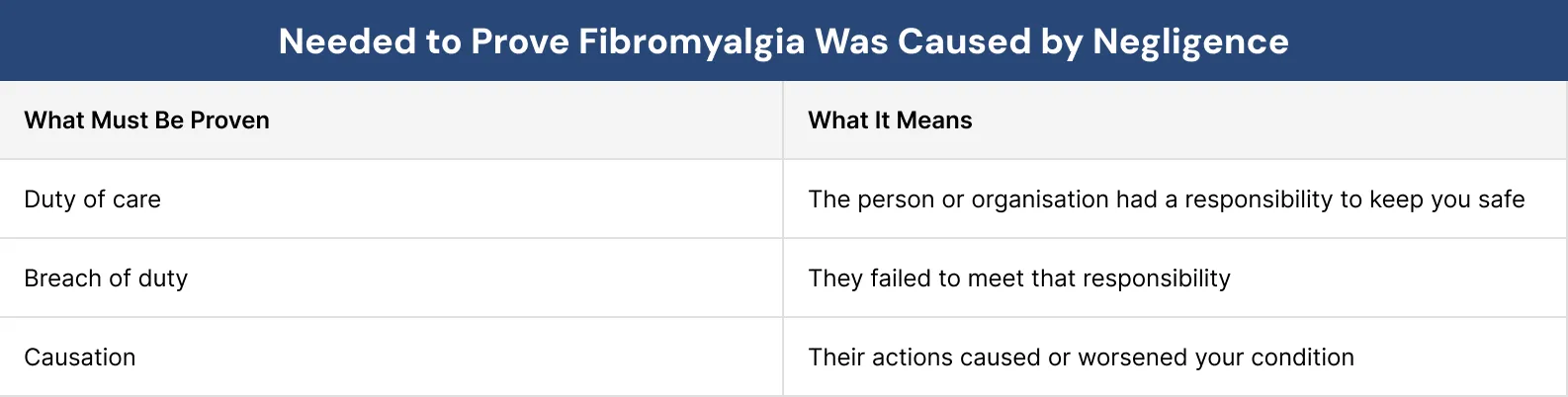
To succeed in a fibromyalgia compensation claim, you must prove more than just having the condition. You also need to show that another person was responsible for causing it or making it worse.
This is where evidence becomes very important. The stronger the evidence, the stronger the case is likely to be.
In most cases, there are three things that need to be proven:
“Fibromyalgia cases require careful correlation between trauma history and symptom onset, supported by consistent clinical documentation.”
— Dr Rebecca Allen, Consultant Rheumatologist (UK)
How Much Can I Receive From A Fibromyalgia Compensation Claim?
One of the most common questions people ask is how much compensation they could receive. The answer to this depends on the facts of the case.
There is no fixed amount for a fibromyalgia compensation claim. Every person experiences the condition differently and the effects can range from mild to severe.
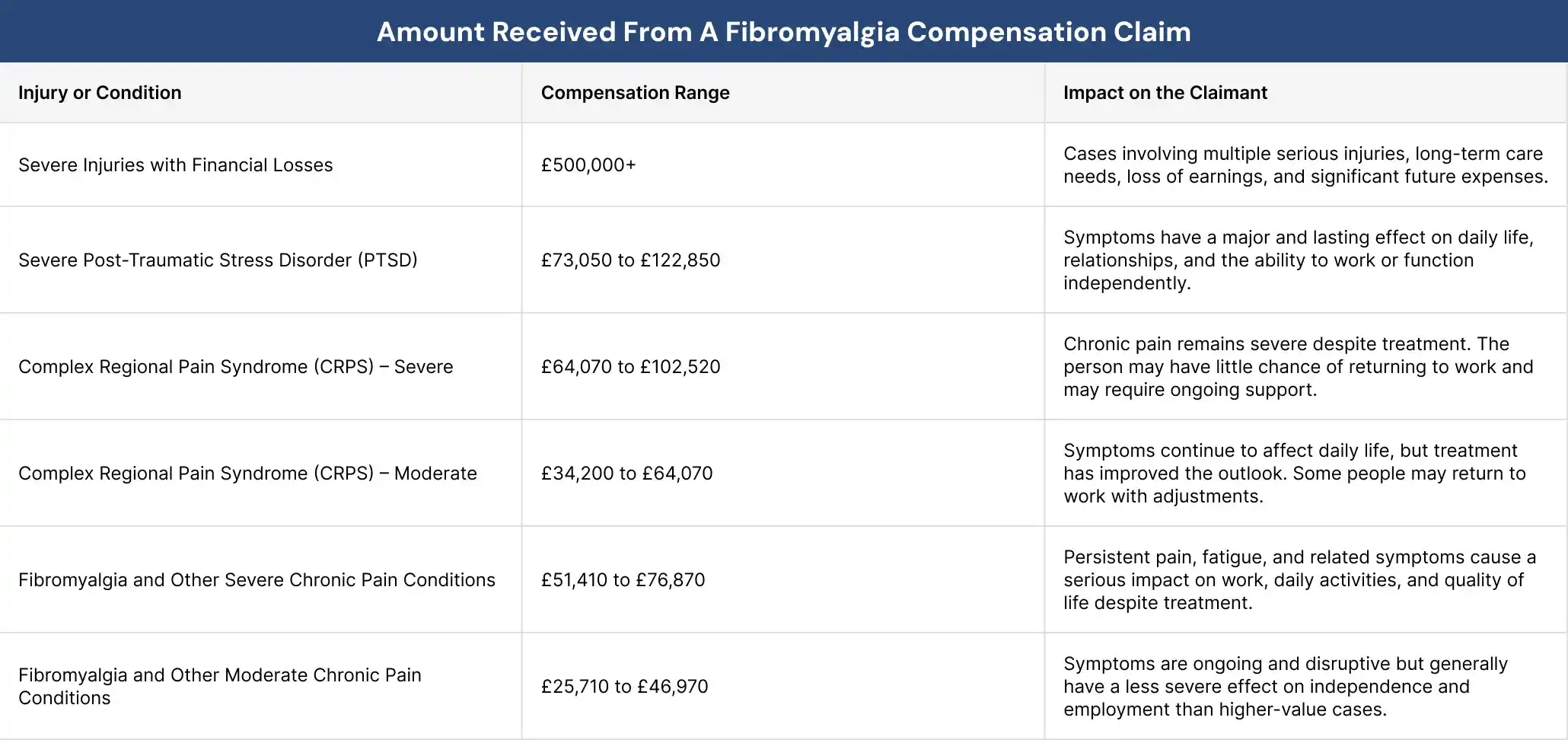
When calculating the amount, several factors are considered. These include the level of pain, the impact on daily life, the effect on work and whether symptoms are likely to continue in the future.
A fibromyalgia claim can include compensation for both physical and financial losses. The figures below are only guideline examples. The final amount will depend on the facts of each case.
Read more: How Much Compensation for Cerebral Palsy Negligence Claims? UK Payout Guide 2026
What Does a Fibromyalgia Settlement Include?
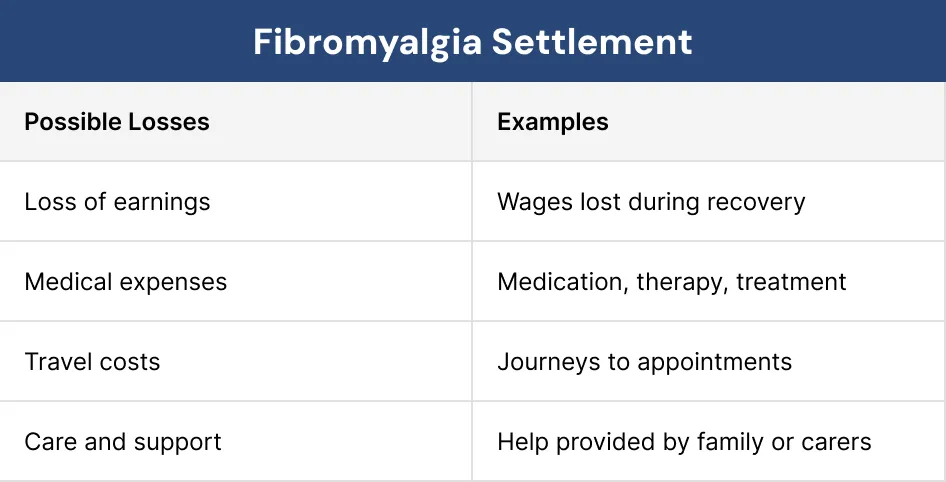
A settlement is designed to cover the losses that were caused by the injury. It is not limited to pain alone.
A fibromyalgia compensation claim may include compensation for the physical symptoms that you have experienced. This is often called pain.
However, it can also help to cover financial losses. For example, if you had to take time off work or pay for treatment, these costs may be included in the settlement.
Many people do not realise how many expenses can be claimed. Depending on the circumstances, a settlement may include the following:
A fibromyalgia claim may also include future losses if your condition is expected to continue affecting your life for many years.
Fibromyalgia Claims Time Limit
If you are thinking about making a fibromyalgia compensation claim, it is important to understand the time limits. In England and Wales, for most personal injury cases, you usually have three years to start your claim.
The three-year period begins from the date of the accident. However, in some cases, it may start from the date you first became aware that your condition was linked to the accident or negligence. This is known as the “date of knowledge”.
Although three years may sound like a long time, it is often best to act sooner rather than later.
Important evidence can become harder to find as time passes. You may forget the details and records may be more difficult to obtain.
Can I Make a No Win No Fee Claim for Fibromyalgia?
Yes, you can make a No Win No Fee claim for fibromyalgia. It allows you to start a claim without paying legal upfront fees. If your claim does not succeed, you do not have to pay the legal fees to your solicitor.
This makes it easier for people to seek legal advice without worrying about large costs. It also means that many solicitors will assess the strength of your case before agreeing to take it on.
Even with a No Win No Fee agreement, a fibromyalgia claim still needs strong evidence. Medical records, accident reports and expert opinions are often needed to support your case.
Many people worry about the cost of making a claim. This is one reason why no-win, no-fee agreements are so popular in the UK.
Fibromyalgia Claim Worth £290,000
This case shows how medical evidence can help to link fibromyalgia symptoms to an accident.
A real UK case involved a woman who faced fibromyalgia after a road traffic accident.
Before the collision, she was healthy and active. During the crash, she suffered from injuries, including neck pain and stiffness.
Initially, doctors expected her to recover within a reasonable period. However, her symptoms became worse. Later medical reports confirmed that she had developed fibromyalgia.
Medical experts linked her condition to the injuries that were sustained in the collision. This helped her to establish the causation in the claim.
The woman pursued a fibromyalgia compensation claim against the at-fault driver’s insurer.
After reviewing the medical evidence and the long-term impact of the condition, the case was settled for £290,000.
The compensation reflected her pain, as well as the wider effect the condition had on her daily life.
Conclusion
Fibromyalgia is a long-term condition that can affect many parts of your life. It can cause ongoing pain, extreme tiredness, sleep issues and difficulties at work or home.
If your condition was caused or made worse by negligence of someone else, you may be able to make a fibromyalgia compensation claim. This could relate to a road traffic accident, an accident at work or a public place accident.
A successful fibromyalgia claim depends on strong evidence. Medical records, expert reports and proof of negligence can all play a key role in supporting your case.
If you believe that negligence contributed to your condition, seeking legal advice early helps you to understand your options. Concise Medico provides detailed medico-legal reports to support your fibromyalgia compensation claims with clear and reliable medical evidence.