TABLE OF CONTENT
CAMHS is a service by the NHS. Its full form is Child and Adolescent Mental Health Service. It caters to the emotional needs and behavioural issues of children and young adults. Their role is more important than ever now since mental health issues are on the rise. In 2021, mental issues were recorded in one in seven young people (age 10-19). In England, every one out of five young people was found to have a mental issue. CAMHS can provide support to these children and adolescents if they are aged 0-18 years. Here is all you need to know.
Understanding CAMHS
Child and Adolescent Mental Health Services consist of a variety of professionals who can cater to the mental health needs of children. They have the necessary training and experience of working with young people. The following people can be included in CAMHS workers:
- Non-mental health specialists. They include:
- GPs
- social workers
- school nurses
- Mental health professionals. They include:
- Psychologists
- Psychiatrists
- Psychotherapists
Structure of CAMHS
It is divided into four tiers from which you can seek help based on the severity of the problem. Each tier provides specialised care for mental health issues. This ensures appropriate assistance for all kinds of issues. Here are the four tiers of this service:
Tier 1:
This tier comprises GPs, volunteers, school nurses, and other healthcare professionals. They promote mental health and give general advice for less severe mental health problems.
Tier 2:
This tier consists of mental health workers and counsellors based in clinics and mental health institutions. These professionals look after common mental health problems such as mild depression or anxiety.
Tier 3:
It consists of mental health professionals who can provide specialised services such as psychotherapists, psychologists, social workers, and mental health nurses. Psychiatrists, etc.. This team caters to more severe disorders.
Tier 4:
It consists of highly tailored treatments, including inpatient units, specialised outpatient teams, and day units, for kids and teens with severe issues.
Learn more about the four tiers of CAMHS.

Issues catered by the service:
You can contact the Child and Adolescent Mental Health Service if you experience any symptoms that are linked to mental health. They will assess your symptoms in detail. They will provide you with a diagnosis. Then, they will prescribe a treatment plan. If you feel any of the following symptoms, you can contact these services:
- Feeling of constant worry
- Low mood, sadness or depression
- Sleep issues
- Issues with managing anger
- Suicidal thoughts and feelings
- Issues with eating (anorexia, bulimia, ARFID, etc.)
- Seeing things that are not there
- Hearing voices
- Problems with the repetition of actions
- Hard to understand feelings after an incident
Role of CAMHS in assessing neurodevelopmental disorders:
Apart from other mental health issues, CAMHS can assess you for neurodevelopmental disorders such as autism, ADHD, etc. For diagnosing these conditions, they can check your child’s history, social interaction and academic performance. They can also carry out standard tests to confirm the diagnosis.
Child and Adolescent Mental Health Service can also help you with diagnosing disorders such as autism.
Know more about CAMHS and autism here.
Case of a child diagnosed by CAMHS:
This case is of a 14-year-old girl. She was brought to Crystal House. This is a special hospital unit in North West London and a part of Child and Adolescent Mental Health Service.. It supports young people aged 13-18. This girl had several conditions:
- Autism
- Fetal Alcohol Syndrome (a condition caused by alcohol exposure before birth)
- A history of trauma (such as neglect or abuse when she was younger)
Her mental health struggles had continued for 9 years. These included:
- Hurting herself
- Suicidal thoughts
- Hearing voices
She got treated in other places before coming to CMHS. Here, she was offered a custom care plan based on her needs. This led to the child being supported better.
How do I refer my child to CAMHS?
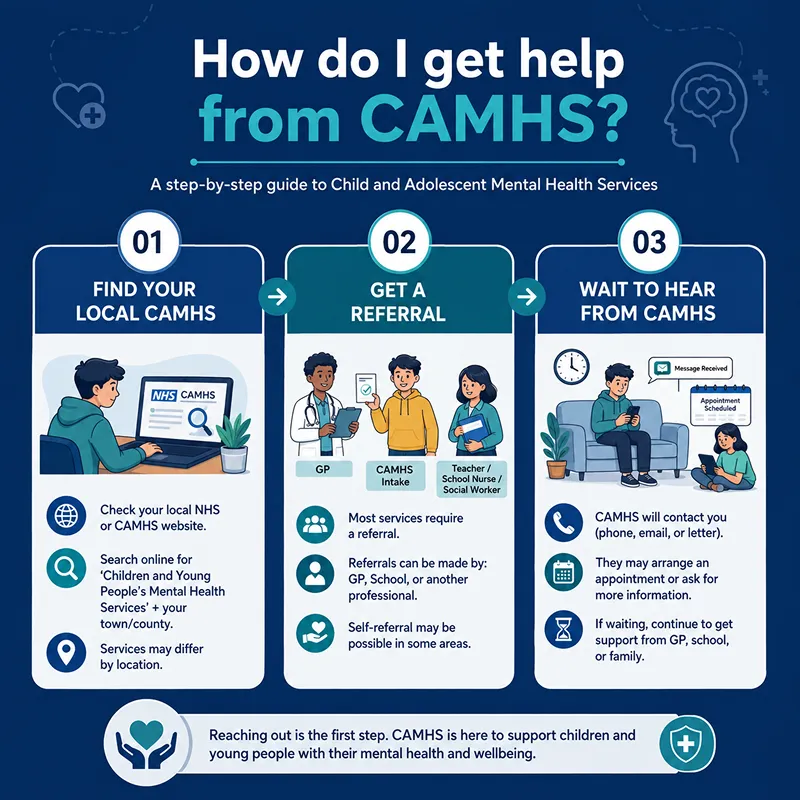
The first step to getting help from this service is getting a referral. It works differently depending on the area you live in. For most areas, websites contain the relevant information. Usually, your referral is given by your doctor, but some services accept the following referrals as well.
- Your school or school counsellor is referring you.
- Your referral comes from a social worker.
- Someone from the youth offending team can refer you (if you’ve been involved with the law)
- You can refer yourself in some areas depending on your age.
Aftermath of the referral:
Once the services receive the referral, they get in touch with you. This is done via:
- Phone
- Letter
They can either set up the first appointment or ask more questions for details. If you prefer, they can send your details to your parents, caregivers or guardians. You can let them know what is best for you.
What happens in the CAMHS assessments?
Once your appointment is confirmed, you will arrive at the location where this service is offered in your area. Here, an assessment will be conducted by a service worker. These assessments can be different based on your location. After this session, some young people are sent to therapy while others can be referred to psychiatrists. Here is a rough idea of how they generally go.
Learn more about Adult Mental health assessments in UK
Who will be with you?
Usually, your parent or guardian is with you on the first appointment. The service worker talks to both of you. They might ask if you want to speak alone to the service worker. They might also speak to your guardian without you present.
What will you talk about?
The first session is usually the formulation session. The service worker tries to make a rapport with you. They talk to you about your family and siblings. They also discuss your hobbies, interests and what brings you to the CAMHS session. This helps them build a connection between your mental health issue and your life story. They also encourage you to ask them as many questions as you like. They discuss the issue at hand and how you feel about it. They, then, educate you on your mental health challenge. This helps you understand the reason for your mental health issue. Finally, they explore your therapy goals and what you want to get out of these goals.
Learn more about Child and Adolescent Psychiatry Approaches.
What questions can be asked?
Your assessment can consist of some questions that can help you explain your issue better. These questions may vary depending on your issue. Here are some of the questions they can ask you:
- At the moment, how are you feeling?
- How long has this feeling lasted?
- Most of the time, how do you feel?
- Is school enjoyable for you?
- How are the relationships in your home life?
- Have you ever tried any effective coping mechanisms before?
- In what way do you want our assistance?
- What do you intend to accomplish by visiting us?
If at any point in assessment, you feel agitated while speaking, the service worker helps you calm down. For instance, they can recommend breathing exercises.
This appointment can last for an hour. After this, the Child Mental Health Services decides if they are best for you. If yes, they can put you on the waiting list for more sessions. If not, then they’ll suggest a service better suited to your needs e.g., school counselling, private therapy, support at home, or other local services.
Types of treatments and support CAMHS offers
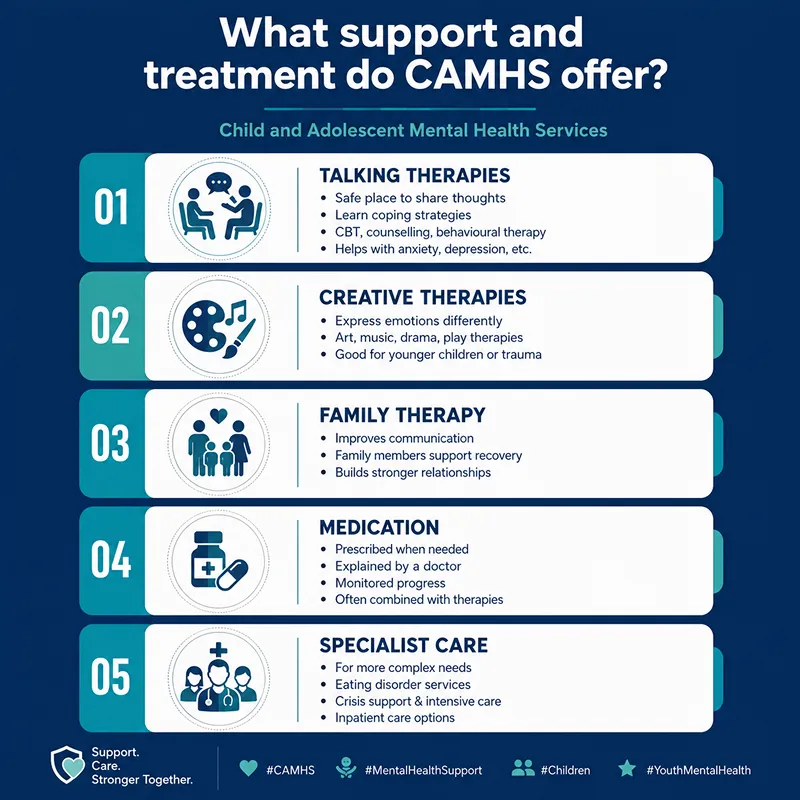
After the initial assessment, Child and Adolescent Mental Health Service creates a treatment plan that is best suited to your needs. It includes your therapy goals, deciding on a plan for any upcoming sessions and coming up with ways to deal with the young person’s difficulties. They offer you a wide range of therapies. Some of these are as follows:
1. Talking therapies
Child mental health services can offer you all kinds of therapies in which you can talk to a therapist about your feelings, thoughts, and behaviour. You can talk to your therapist one-on-one, for instance, about counselling and cognitive behavioural therapy.
Apart from this therapy, you can also get group therapy. This takes place along with a group of young people your age. Another such therapy is family therapy, where the therapist talks to you and your family together.
2. Creative therapies
Creative therapists help you navigate your feelings and manage them better. You can creatively express your feelings instead of speaking about them. This can be especially beneficial if you find it hard to discuss your thoughts and feelings. This kind of therapy includes:
- Painting, drawing or doing crafts
- Playing music or dancing
- Playing games to help open up
3. Medication
Sometimes, service workers can suggest medication. This is necessary in case your mental health issue generates a bodily response. The service worker who is most likely going to be a psychiatrist in this case makes sure the medicine is safe for you. Some of the cases in which medicines can be prescribed are as follows:
- Anxiety
- Depression
- ADHD symptoms
4. Inpatient hospital care:
This means that you will have to stay in the hospital for your treatment. This happens in cases where you need more support than you can get at home. This service is generally provided to you if you are between 13-18 years of age. However, some areas can provide support to you even if you are as young as 10. In the hospital, you are provided with regular help from mental health professionals and a safe space till you recover.
5. Physical Health and Medical Reviews:
Child mental health services support you in monitoring your physical health, which can be disturbed as a result of mental health issues. This includes:
- Nurses checking your blood pressure
- Taking blood samples
- Helping with your eating disorders (making meal plans and checking your weight and health)
6. Crisis Support
If you feel you are really overwhelmed or in danger, you want to hurt yourself or feel like attempting suicide, crisis teams and helplines assist in keeping you safe. They can talk to you, help you calm down and get to your required resources quickly. In cases of such emergencies, immediately call your GPs or call the NHS directly at 111.
Challenges associated with CAMHS
CAMHS is a very valuable service in terms of providing mental health support to young people. It is beneficial not only in diagnosing mental health issues but also in providing a care plan. However, there are challenges that you can face while accessing this service. These challenges may impact the help this service provides to children. Here are some of the challenges that one can face:
1. Long waiting time:
You have to wait for a few weeks before your first appointment. If your issues get worse you can speak to the person who referred you. They can speak to the service to get you urgent help. In cases of emergency, contact your GP or call the NHS directly at 111.
2. Getting out of the age bracket:
Child and Adolescent Mental Health Service is available to you until you are 18 years old. In some cases, you can turn 18 before your first appointment. You will have to transfer to the Adult Mental Health Service (AMHS), which provides support at any age over 18. If you are under treatment and turn 18, then you are treated for some more time, in some cases until you are 25. Else, you CAMHS can transition you to AMHS when you turn 16. This transition should be made as smoothly as possible.

“The transition from Children and Adolescent Mental Health Services (CAMHS) to Adult Mental Health Services (AMHS) is a major concern for many young service users (SU) and their parents/carers. Poorly planned transitions may provoke increased risk of non-adherence to treatment, loss to follow-up, and poorer health outcomes.”
3. Issues being out of the scope of CAMHS
Sometimes, the Child and Adolescent Mental Health Service does not offer treatment to you. It can feel very frustrating. What you can do is ask them to explain why they can’t support you. They will probably provide alternative resources for your help on their own. These resources may include private mental health services, support at home, school or college counselling, etc..
4. Disengaged Children
Some kids find it hard to start speaking to their mental health professional. This can increase the difficulty of providing help to the child. In such situations, parents can explain the entire process to the kids in great detail. In this way, they will feel prepared and in control.
Conclusion:
CAMHS can be helpful to children and young adults in need of mental health support, regardless of its challenges. Your child’s wellbeing matters. Our experts at Concise Medico are ready to help.
FAQs
CAMHS is a service by the NHS. Its full form is Child and Adolescent Mental Health Service. It caters to the emotional needs and behavioural issues of children and young adults. Their role is more important than ever now since mental health issues are on the rise. In 2021, mental issues were recorded in one in seven young people (age 10-19). In England, every one out of five young people was found to have a mental issue. CAMHS can provide support to these children and adolescents if they are aged 0-18 years. Here is all you need to know.
Understanding CAMHS
Child and Adolescent Mental Health Services consist of a variety of professionals who can cater to the mental health needs of children. They have the necessary training and experience of working with young people. The following people can be included in CAMHS workers:
- Non-mental health specialists. They include:
- GPs
- social workers
- school nurses
- Mental health professionals. They include:
- Psychologists
- Psychiatrists
- Psychotherapists
Structure of CAMHS
It is divided into four tiers from which you can seek help based on the severity of the problem. Each tier provides specialised care for mental health issues. This ensures appropriate assistance for all kinds of issues. Here are the four tiers of this service:
Tier 1:
This tier comprises GPs, volunteers, school nurses, and other healthcare professionals. They promote mental health and give general advice for less severe mental health problems.
Tier 2:
This tier consists of mental health workers and counsellors based in clinics and mental health institutions. These professionals look after common mental health problems such as mild depression or anxiety.
Tier 3:
It consists of mental health professionals who can provide specialised services such as psychotherapists, psychologists, social workers, and mental health nurses. Psychiatrists, etc.. This team caters to more severe disorders.
Tier 4:
It consists of highly tailored treatments, including inpatient units, specialised outpatient teams, and day units, for kids and teens with severe issues.
Learn more about the four tiers of CAMHS.

Issues catered by the service:
You can contact the Child and Adolescent Mental Health Service if you experience any symptoms that are linked to mental health. They will assess your symptoms in detail. They will provide you with a diagnosis. Then, they will prescribe a treatment plan. If you feel any of the following symptoms, you can contact these services:
- Feeling of constant worry
- Low mood, sadness or depression
- Sleep issues
- Issues with managing anger
- Suicidal thoughts and feelings
- Issues with eating (anorexia, bulimia, ARFID, etc.)
- Seeing things that are not there
- Hearing voices
- Problems with the repetition of actions
- Hard to understand feelings after an incident
Role of CAMHS in assessing neurodevelopmental disorders:
Apart from other mental health issues, CAMHS can assess you for neurodevelopmental disorders such as autism, ADHD, etc. For diagnosing these conditions, they can check your child’s history, social interaction and academic performance. They can also carry out standard tests to confirm the diagnosis.
Child and Adolescent Mental Health Service can also help you with diagnosing disorders such as autism.
Know more about CAMHS and autism here.
Case of a child diagnosed by CAMHS:
This case is of a 14-year-old girl. She was brought to Crystal House. This is a special hospital unit in North West London and a part of Child and Adolescent Mental Health Service.. It supports young people aged 13-18. This girl had several conditions:
- Autism
- Fetal Alcohol Syndrome (a condition caused by alcohol exposure before birth)
- A history of trauma (such as neglect or abuse when she was younger)
Her mental health struggles had continued for 9 years. These included:
- Hurting herself
- Suicidal thoughts
- Hearing voices
She got treated in other places before coming to CMHS. Here, she was offered a custom care plan based on her needs. This led to the child being supported better.
How do I refer my child to CAMHS?
The first step to getting help from this service is getting a referral. It works differently depending on the area you live in. For most areas, websites contain the relevant information. Usually, your referral is given by your doctor, but some services accept the following referrals as well.
- Your school or school counsellor is referring you.
- Your referral comes from a social worker.
- Someone from the youth offending team can refer you (if you’ve been involved with the law)
- You can refer yourself in some areas depending on your age.
Aftermath of the referral:
Once the services receive the referral, they get in touch with you. This is done via:
- Phone
- Letter
They can either set up the first appointment or ask more questions for details. If you prefer, they can send your details to your parents, caregivers or guardians. You can let them know what is best for you.
What happens in the CAMHS assessments?
Once your appointment is confirmed, you will arrive at the location where this service is offered in your area. Here, an assessment will be conducted by a service worker. These assessments can be different based on your location. After this session, some young people are sent to therapy while others can be referred to psychiatrists. Here is a rough idea of how they generally go.
Learn more about Adult Mental health assessments in UK
Who will be with you?
Usually, your parent or guardian is with you on the first appointment. The service worker talks to both of you. They might ask if you want to speak alone to the service worker. They might also speak to your guardian without you present.
What will you talk about?
The first session is usually the formulation session. The service worker tries to make a rapport with you. They talk to you about your family and siblings. They also discuss your hobbies, interests and what brings you to the CAMHS session. This helps them build a connection between your mental health issue and your life story. They also encourage you to ask them as many questions as you like. They discuss the issue at hand and how you feel about it. They, then, educate you on your mental health challenge. This helps you understand the reason for your mental health issue. Finally, they explore your therapy goals and what you want to get out of these goals.
Learn more about Child and Adolescent Psychiatry Approaches.
What questions can be asked?
Your assessment can consist of some questions that can help you explain your issue better. These questions may vary depending on your issue. Here are some of the questions they can ask you:
- At the moment, how are you feeling?
- How long has this feeling lasted?
- Most of the time, how do you feel?
- Is school enjoyable for you?
- How are the relationships in your home life?
- Have you ever tried any effective coping mechanisms before?
- In what way do you want our assistance?
- What do you intend to accomplish by visiting us?
If at any point in assessment, you feel agitated while speaking, the service worker helps you calm down. For instance, they can recommend breathing exercises.
This appointment can last for an hour. After this, the Child Mental Health Services decides if they are best for you. If yes, they can put you on the waiting list for more sessions. If not, then they’ll suggest a service better suited to your needs e.g., school counselling, private therapy, support at home, or other local services.
Types of treatments and support CAMHS offers
After the initial assessment, Child and Adolescent Mental Health Service creates a treatment plan that is best suited to your needs. It includes your therapy goals, deciding on a plan for any upcoming sessions and coming up with ways to deal with the young person’s difficulties. They offer you a wide range of therapies. Some of these are as follows:
1. Talking therapies
Child mental health services can offer you all kinds of therapies in which you can talk to a therapist about your feelings, thoughts, and behaviour. You can talk to your therapist one-on-one, for instance, about counselling and cognitive behavioural therapy.
Apart from this therapy, you can also get group therapy. This takes place along with a group of young people your age. Another such therapy is family therapy, where the therapist talks to you and your family together.
2. Creative therapies
Creative therapists help you navigate your feelings and manage them better. You can creatively express your feelings instead of speaking about them. This can be especially beneficial if you find it hard to discuss your thoughts and feelings. This kind of therapy includes:
- Painting, drawing or doing crafts
- Playing music or dancing
- Playing games to help open up
3. Medication
Sometimes, service workers can suggest medication. This is necessary in case your mental health issue generates a bodily response. The service worker who is most likely going to be a psychiatrist in this case makes sure the medicine is safe for you. Some of the cases in which medicines can be prescribed are as follows:
- Anxiety
- Depression
- ADHD symptoms
4. Inpatient hospital care:
This means that you will have to stay in the hospital for your treatment. This happens in cases where you need more support than you can get at home. This service is generally provided to you if you are between 13-18 years of age. However, some areas can provide support to you even if you are as young as 10. In the hospital, you are provided with regular help from mental health professionals and a safe space till you recover.
5. Physical Health and Medical Reviews:
Child mental health services support you in monitoring your physical health, which can be disturbed as a result of mental health issues. This includes:
- Nurses checking your blood pressure
- Taking blood samples
- Helping with your eating disorders (making meal plans and checking your weight and health)
6. Crisis Support
If you feel you are really overwhelmed or in danger, you want to hurt yourself or feel like attempting suicide, crisis teams and helplines assist in keeping you safe. They can talk to you, help you calm down and get to your required resources quickly. In cases of such emergencies, immediately call your GPs or call the NHS directly at 111.
Challenges associated with CAMHS
CAMHS is a very valuable service in terms of providing mental health support to young people. It is beneficial not only in diagnosing mental health issues but also in providing a care plan. However, there are challenges that you can face while accessing this service. These challenges may impact the help this service provides to children. Here are some of the challenges that one can face:
1. Long waiting time:
You have to wait for a few weeks before your first appointment. If your issues get worse you can speak to the person who referred you. They can speak to the service to get you urgent help. In cases of emergency, contact your GP or call the NHS directly at 111.
2. Getting out of the age bracket:
Child and Adolescent Mental Health Service is available to you until you are 18 years old. In some cases, you can turn 18 before your first appointment. You will have to transfer to the Adult Mental Health Service (AMHS), which provides support at any age over 18. If you are under treatment and turn 18, then you are treated for some more time, in some cases until you are 25. Else, you CAMHS can transition you to AMHS when you turn 16. This transition should be made as smoothly as possible.

“The transition from Children and Adolescent Mental Health Services (CAMHS) to Adult Mental Health Services (AMHS) is a major concern for many young service users (SU) and their parents/carers. Poorly planned transitions may provoke increased risk of non-adherence to treatment, loss to follow-up, and poorer health outcomes.”
3. Issues being out of the scope of CAMHS
Sometimes, the Child and Adolescent Mental Health Service does not offer treatment to you. It can feel very frustrating. What you can do is ask them to explain why they can’t support you. They will probably provide alternative resources for your help on their own. These resources may include private mental health services, support at home, school or college counselling, etc..
4. Disengaged Children
Some kids find it hard to start speaking to their mental health professional. This can increase the difficulty of providing help to the child. In such situations, parents can explain the entire process to the kids in great detail. In this way, they will feel prepared and in control.
Conclusion:
CAMHS can be helpful to children and young adults in need of mental health support, regardless of its challenges. Your child’s wellbeing matters. Our experts at Concise Medico are ready to help.