The Rise of AI Expert Witnesses: Future of Medico-Legal Practice

Published On: June 15th, 2026|Total Views: 1|Daily Views: 1|18.2 min read|3637 words|

TABLE OF CONTENT

What if AI could transform complex medical information into clear proof that supports a doctor’s defence?

The concept of an AI expert witness may sound like a movie scene. However, it is now linked to the rise of AI in healthcare, law and court work. AI now helps people write, search, plan and sort huge amounts of data. It is also moving into hospitals, research labs, law firms and medico-legal practice.

An AI expert witness is not a machine providing evidence in court. It is better understood as a support tool that may help a human medical expert review records. It can also be used to organise facts and prepare notes in medico-legal cases.

Medico-legal practice is the domain where medicine and law overlap. For example, it covers clinical negligence claims, personal injury cases, disability reports and conflicts about treatment. In these cases, courts often need clear views from qualified medical experts.

However, AI cannot replace that qualified professional. A court needs a real human being who can think, clarify, answer queries and take full accountability for their opinion. AI may aid with speed and sorting data but it cannot carry expert judgement.

AI is also being used more and more in expert witness tasks. A 2025 survey of UK-qualified witnesses found that 20% of them used AI in their job duties. The year before, only around 9.3% said the same thing. That is almost a double increase in just one year.

On the other hand, this rise also highlights key concerns. How should AI be utilised wisely? Who is liable for mistakes? How can judicial bodies trust documents where AI has helped in the process?

In this blog, you’ll learn what an AI expert witness refers to and how AI may help medico-legal work. You will also explore what its boundaries are and why human opinion still counts most.

Key Takeaways

  • AI expert witness tools can help with admin work and data review, but the expert must keep full control of the final opinion
  • AI in healthcare is helping improve diagnosis, care planning, and the use of hospital staff and medical resources
  • Future of AI in healthcare depends on safe use, strong rules, and human review to build trust in medical and legal settings
  • Artificial intelligence expert witness support must never replace clinical skill, court duty, or independent judgement
  • AI in medical practice can support early disease checks and better patient care, but privacy and data safety must stay a top concern

What Is an AI Expert Witness?

An AI expert witness can refer to three common things.

First, it can be defined as AI used as a substitute for a human expert. This is the most secure and most practical use. The tool may help review medical details, create a timeline or list key events.

Secondly, it can indicate a human professional who gives proof about an AI system. For example, a hospital may employ AI to help interpret scans. If a patient later files a claim, the judge may need an expert to clarify how that system operated.

Lastly, it can mean AI-produced outline content used in a report. This is the most harmful use. AI can write concisely and with assurance. However, clear writing does not always mean accurate logic.

An AI expert witness is not a doctor, a nurse or a surgeon. It is also not a legal expert and it does not have a responsibility to the judicial system. This is the reason, it cannot be questioned like a person.

The human specialist must still verify the facts. They must decide what is important and should explain the medical reasoning. They must also sign the report only if they are satisfied with it.

So the main rule is that AI may assist but the human expert will remain responsible.

AI has the potential to assist UK clinicians in presenting complex medical evidence clearly in court, but the ultimate responsibility for clinical judgement will always remain with the human expert.

Dr James Ellison, Consultant Physician & Medico-Legal Advisor, London, UK

How Does the Rise of AI Expert Witnesses Change Healthcare Systems?

The increase in the AI expert witness is related to broader changes in health services. You know that hospitals are busy and patients require quicker care. Staff also have to deal with long files, higher demand and a short time. All such workload can be managed with the help of AI.

It can analyse a large quantity of data. It can also help identify trends in scans, test results and patient notes. You may have seen how it can notify medical experts when a patient may be at risk.

The future of AI in healthcare may consist of prior illness detection. For example, AI may assist in finding symptoms of cancer, sepsis, heart disease or eye disease. It does not take the place of the clinician but it flags details for human review.

AI can also assist hospitals in planning better. It may forecast patient stays, bed needs or staff requirements. This helps administrators use resources more effectively.

Specific care is another domain. AI can assess a patient’s background, test results and risks. It may help recommend treatment options that match the person more closely.

These AI-supported medical decisions carry legal significance in court. If an AI-aided medical decision is reviewed, a human specialist may need to review that choice. They may ask whether the tool was secure, whether it was used correctly and whether the physician relied on it too much.

This is why the AI expert witness interaction is increasing. Medical experts may in the future need to learn about both clinical care and the limits of AI tools.

Why Are AI Expert Witnesses Important in Drug Research and Clinical Trials?

AI expert witnesses are crucial because AI is now utilised in drug research and clinical studies. A drug business may use AI to research a lot of health data. AI can help identify ideas for new medical products. It can also help determine which medicines should be checked first.

If there is a court case, people may ask queries like the following:

  • Was the AI used properly
  • Was the information good
  • Did the AI make a reasonable suggestion
  • Did people verify the AI’s work

This is a situation where an AI expert witness can assist. An AI expert witness clarifies how the AI did its job. They can explain what the AI was looking at. They can also specify what the AI can and cannot perform.

AI can also be utilised in clinical studies. A clinical trial is a way to see if a medication is safe and effective for people.

AI may help select the right people for a standard test. It may group patients by their illness, risk or likelihood of getting better. This can be helpful but it can also cause issues if the AI is unfair or wrong.

For example, AI might miss out on some people by making an error. It might also use weak or unfair information. In a legal scenario, an AI expert witness can clarify if the AI was used safely and fairly.

AI is also used after a prescribed drug is authorised. Industries must monitor for side effects. AI can help interpret reports and find suspicious signs.

If people say a business missed a warning sign, an AI expert witness can speak about what the AI found. They can also determine whether people should have caught the problem sooner.

AI may also help make drugs, can check quality and can identify mistakes. It can help uncover problems before they become severe.

An AI expert witness explains how the AI inspected the process in case it found a factory error in medicine.

The key issue is simple. An AI expert witness does not replace physicians, scientists or legal experts. Their task is to convey the AI clearly.

They help the court figure out how the AI was utilised, what it found and whether people used it in a cautious way. The overall conclusion should still come from a qualified human expert.

Why Is the AI Expert Witness Discussion Increasing in Medico-Legal Practice?

The conversation is growing because medico-legal scenarios are more difficult than before. Many situations require thousands of pages of information. These may come from medical centres, clinics, therapists, drug stores, radiology centres and online apps. A human professional can evaluate them but it requires time.

Related: AI in medical imaging UK

AI can assist with the initial phase of the project. It can arrange documents by year or pull out major incidents. It can also classify notes by subject or help build a clear timeline.

This is useful because skilled workers should spend more time thinking, not just arranging papers.

Courts and law organisations also face stress. So, cases need to proceed more quickly and costs need to be managed. Specialists are typically busy, so AI may help prevent delays.

However, speed is not sufficient. A review must be right, fair and must show the expert’s own opinion.

That is why the AI expert witness should be considered as a helper, not a deciding factor. It can arrange material, suggest a structure or draft simple sections. However, the expert must check every crucial point.

What Challenges Do AI Expert Witnesses Face in Expert Evidence?

The most significant concern is trust. Expert evidence can impact a court’s judgement. It can affect finances, care, reputation and fairness. So it must be precise and unbiased.

AI tools can produce errors. Sometimes they create new facts and at times they create fake sources. Often, they also sound specific when they are wrong. So, this is a severe risk.

The AI expert witness also does not possess clinical judgement. It cannot inspect a patient and understand pain.

Data quality is another issue. AI depends on the data behind it, so if the data is weak, biased or insufficient, the answer may also be poor.

There are also security threats. Medical and legal files are highly confidential. This is because they may contain names, adverse effects, mental health facts, work history and legal advice. Putting these details into unsafe AI tools can lead to damage.

So professionals must use AI wisely. They need to know what tool they are working with, where the data goes and how outputs are verified.

What Is the Court’s View on AI Expert Witnesses and Accountability Concerns?

Courts are careful about AI because it is very necessary. Judges have already witnessed cases where AI tools created bogus cases, false quotes or wrong legal content. In expert evidence, the risk is even higher because the court relies on the expert’s belief.

An expert witness has a distinct duty which is to the court. It is not to the person paying them, not to the lawyer educating them and not to a software tool.

An AI expert witness cannot take that role and it cannot explain itself under inquiry. It cannot accept blame and cannot promise that its answer is based on credible evidence.

So the court will turn its attention to the human professional. If AI helped create a report, the expert must still possess the paper. They must be able to convey the view in plain words. They must be able to show how they proved the truths.

What Ethical Duties Should AI Expert Witnesses Follow?

Morality means doing the correct thing. In medico-legal professions, ethics are vital. A report can alter the final result of a case. So, it can harm a patient, a doctor, an employer or an insurance company.

The AI expert witness idea must carry out the same basic duties as an expert witness. The primary responsibility is independence. The specialist must give their own advice and they must not simply repeat what a lawyer, client or AI tool suggests.

The second task is being truthful. The expert should say no if the evidence is not clear or records are missing. If a tool has limits, the professional should not hide that.

The next duty is proper care. AI overviews can be useful but they may miss crucial details. The expert must check the original files.

The fourth obligation is full disclosure. The expert should know how AI was utilised. They should be clear about the method and keep control of the ultimate opinion. An AI expert witness should never become a quick way around expert responsibility.

What Are the Confidentiality Risks of Using AI Expert Witnesses?

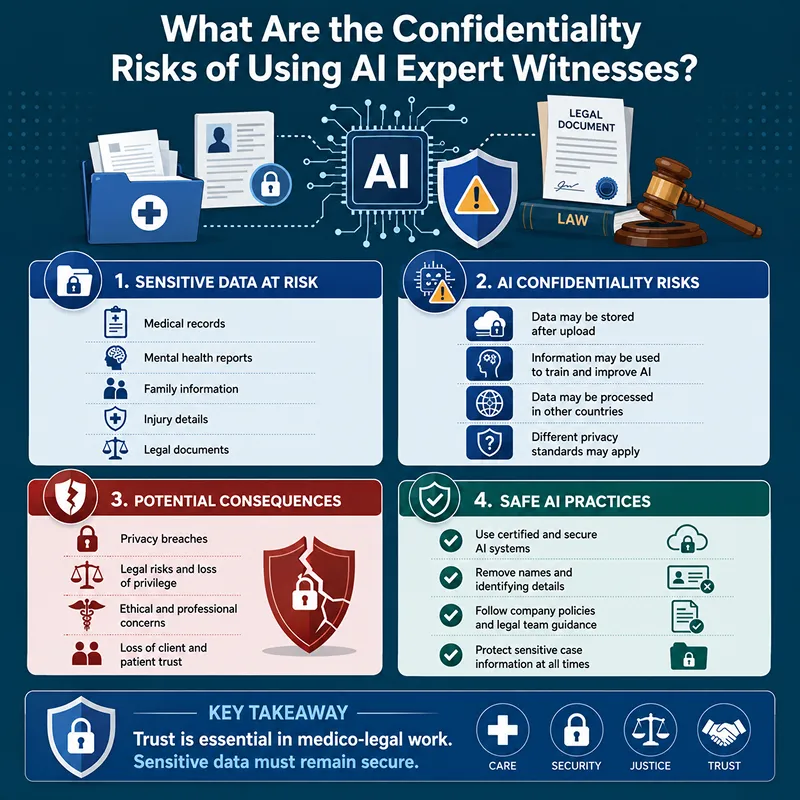
The concept of confidentiality means keeping personal things private. Medico-legal records often contain very sensitive information. They may include medical papers, mental health reports, family background, injury details, work problems and legal documents.

Using an AI expert witness instrument with this data can be unsafe. Some tools may keep the information loaded into them. Some may also use it to improve their systems and may process it in places with different standards.

This can create issues with privacy, medical duty and legal benefits. Researchers should avoid putting private case information into public AI devices. They should use certified and safe systems only.

They should exclude names and identifying data when possible. They should also follow the rules set by their company and legal team. Trust is central to medico-legal work, so patients and clients must know their data is safe.
What Are the Confidentiality Risks of Using AI Expert Witnesses?

Heads Up!

AI can help with admin tasks and summaries, but courts expect expert witnesses to check and fully stand behind every opinion and source used.

Accuracy, Bias and Accountability Risks of Using AI Expert Witnesses

There are also other risks that must be looked at. AI may provide wrong or incomplete responses, particularly if the details are missing or unclear. It might also ignore small but crucial medical details that a human specialist would find.

Bias could also be a factor to consider. For example, AI results might not be equitable or balanced if it was created using insufficient or inconsistent data. Also, even when AI is incorrect, it can at times sound reliable. If specialists don’t carefully review the work, this could confuse them.

Another major problem is accountability. The court must still decide who is at fault if an AI-assisted file contains an error. For this reason, each final decision must be reviewed, confirmed and verified by a human expert.

How Does Regulation Influence AI Expert Witnesses in Healthcare and Law?

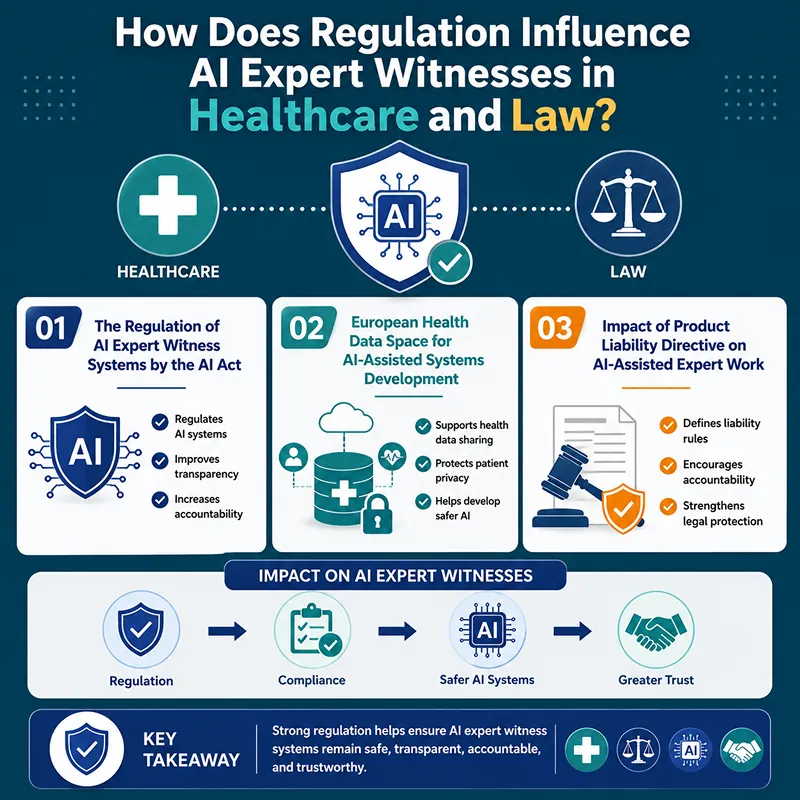
The guidelines for safe use are defined by regulation. This is important because AI has the ability to impact health, rights, finances and legal decisions. Community trust is vital to the future of AI in healthcare. People must be aware that devices are used under human control, verified and monitored.

Here, several European regulations are essential:

The Regulation of AI Expert Witness Systems by the AI Act

One important piece of law about artificial intelligence is the EU AI Act. It uses a risk-free approach. This means that the risk of harm is greater and stricter regulations apply.

Many medical AI devices could be viewed as dangerous systems. This is due to the fact that they may affect patient security, care and evaluation. Risk checks, accurate data, transparent documentation, integrity and human supervision may be necessary for risky systems.

This is crucial for expert work aided by AI since medical AI results could be used as proof in court. To find out if a tool was suitable, safe and used properly, a human expert may be called in.
How Does Regulation Influence AI Expert Witnesses in Healthcare and Law?

European Health Data Space for AI-Assisted Systems Development

In the UK, the European Health Data Space supports the safer sharing and use of health data. People now have more control over their digital health information. Also, it allows the reuse of certain health data for public interest, research and creative projects.

This is crucial for the future of AI in healthcare because good AI requires accurate data. More reliable data can help tools become more precise and fair.

It might be easier to explain proven tools for medico-legal roles. However, dignity needs to be maintained and health records should never be misused.

Impact of Product Liability Directive on AI-Assisted Expert Work

The presence of software and AI systems in the updated EU Product Liability Directive makes it relevant. This suggests that more people could be hurt by a faulty AI product than just the physician or hospital.

The developer, supplier or producer may also be referred to. In the future, experts might need to review the entire system. It includes:

  • Who built the tool
  • Who supplied it
  • Who updated it
  • Who used it
  • Did a defect cause harm

This could increase the value of expert work provided by AI in scenarios that involve AI-supported care.

How Can AI-Assisted Expert Work Improve Medico-Legal Practice?

When used correctly, AI can transform medico-legal tasks. It can assist in creating timelines and breaking down long records. Documents can also be organised by date, therapy, injury or health concern.

Learn more: AI Rehabilitation Therapy

It can assist specialists in finding gaps in records and highlighting trends that merit further research. Besides this, it can make the arranging of reports easier.

Basic writing can also be assisted by AI support. Lawyers, judges and clients may find reports easier to read as a result.

However, AI might ignore a vital detail, so the expert must review the output. It might confuse a message and give unrelated things too much weight.

Proper support is the most effective use. AI provides structure and speed, while human experts provide context and judgement.

What Is the Future of AI-Assisted Expert Work in Medico-Legal Practice?

The future of AI in healthcare is not going to be AI surpassing experts. The ideal future is a blended model. AI manages routine tasks. On the other hand, humans handle reasoning, ethics and final decisions.

A future device may sit inside a safe expert witness service. It may examine records, prepare timelines, compare documents and flag lacking information. It may also help the specialist work more quickly.

However, the professional will still need to read the essential records. They will still be asked to form their own views and will still need to answer queries in court.

AI knowledge will become more significant. Experts will need to understand what AI can do, what it cannot do and when it may be mistaken.

The future of AI in healthcare will also create new types of law-related questions. If AI helps in diagnosis or therapy, experts may need to clarify how that affected care.

The strongest professionals will not blindly rely on AI. They will also not blindly reject it either and will use it with care.

Why It Matters!

The growth of AI in medico-legal work is not only about speed or cost. It is about balancing innovation with patient safety, legal fairness, and expert accountability

Case Study: Using AI Responsibly in a UK Project

A small UK team was asked to review a programme that helps adults learn new skills and find employment. Nearly 31% of UK firms currently use AI in their operations.

The employees had a great deal of basic data to review. They had to review paperwork, conduct interviews, look at survey results and compose a final report.

They used AI to help arrange data, organise papers and draft parts of the document in order to save time. However, some of the details were highly personal. It included reports from people who were unemployed, disabled or had economic difficulties.

The team guaranteed that AI was used cautiously.

Initially, they wrote down every instance in which they used AI. They documented the AI’s actions and verified the results. Individuals were still in charge after that. AI could aid with simple tasks but humans wrote the results and made all the crucial decisions.

Thirdly, they kept details strictly confidential. They didn’t enter personal information into open-source AI programmes.

They then examined every item generated by AI. To ensure that nothing crucial was left out, AI summaries were compared to the original content.

Throughout the project, the team found that certain realities shared by individuals with disabilities were omitted from one AI summary. The mistake was found and fixed by a human examiner.

The team’s contract also outlined rules for the use of AI. These rules made it clear who was responsible for testing the outcomes and how AI could be used.

This case clearly teaches us that while AI can be a helpful tool, human guidance is still vital. People must assess its work, secure personal data and accept responsibility for the results.

Conclusion

AI is a technology, not a person. It can help professionals work more quickly. It can make summaries, check files and organise lots of data. Even written documents may become less difficult to read as a result.

However, AI cannot make major decisions on its own. It cannot comprehend people’s feelings and cannot promise to do the correct thing. It also cannot take liability for mistakes.

In courts and legal cases, confidence is very crucial. People need experts who are honest, clear and trustworthy. The best way ahead is for experts to use AI wisely. The human specialist remains in command.

Concise Medico understands how to merge intelligent tools with actual professional evaluation.

If you want to see how we do that, contact us today.
Worried about unclear medico-legal evidence or keeping pace with AI change?

Our team helps deliver clear, independent expert support built on accuracy and trust.
We have helped with complex medico-legal cases and expert reporting across varied legal matters.
Reach us today!

Worried about unclear medico-legal evidence or keeping pace with AI change?

Our team helps deliver clear, independent expert support built on accuracy and trust.
We have helped with complex medico-legal cases and expert reporting across varied legal matters.
Reach us today!

FAQs

What is an artificial intelligence expert witness?2026-06-15T05:58:12+00:00

An artificial intelligence expert witness is a specialist who explains AI systems, data use, and technical findings in legal cases. They help courts understand how AI tools work, their limits, and whether they were used safely and fairly.

How is AI in medical practice changing healthcare and medico-legal work?2026-06-15T05:59:16+00:00

AI in medical practice supports faster diagnosis, better treatment planning, and improved hospital efficiency. In medico-legal work, it may assist with data review and reporting, but clinical judgement and expert responsibility must remain central.

How much does an expert witness charge in the UK?2026-06-15T05:59:36+00:00

Expert witness fees in the UK vary based on the field, case complexity, and experience of the expert. Charges may range from a few hundred to several thousand pounds for reports, reviews, and court attendance.

What is the best AI for UK legal advice?2026-06-15T05:59:57+00:00

There is no single best AI for UK legal advice. Tools like ChatGPT and legal research platforms can support research and document review, but they should not replace qualified legal professionals or independent expert judgement.

Can AI be a witness?2026-06-15T06:00:21+00:00

AI cannot act as a witness in court because it lacks legal responsibility and professional accountability. AI may support evidence review or report preparation, but a human expert must provide and defend the final opinion.

Share This Article!

What if AI could transform complex medical information into clear proof that supports a doctor’s defence?

The concept of an AI expert witness may sound like a movie scene. However, it is now linked to the rise of AI in healthcare, law and court work. AI now helps people write, search, plan and sort huge amounts of data. It is also moving into hospitals, research labs, law firms and medico-legal practice.

An AI expert witness is not a machine providing evidence in court. It is better understood as a support tool that may help a human medical expert review records. It can also be used to organise facts and prepare notes in medico-legal cases.

Medico-legal practice is the domain where medicine and law overlap. For example, it covers clinical negligence claims, personal injury cases, disability reports and conflicts about treatment. In these cases, courts often need clear views from qualified medical experts.

However, AI cannot replace that qualified professional. A court needs a real human being who can think, clarify, answer queries and take full accountability for their opinion. AI may aid with speed and sorting data but it cannot carry expert judgement.

AI is also being used more and more in expert witness tasks. A 2025 survey of UK-qualified witnesses found that 20% of them used AI in their job duties. The year before, only around 9.3% said the same thing. That is almost a double increase in just one year.

On the other hand, this rise also highlights key concerns. How should AI be utilised wisely? Who is liable for mistakes? How can judicial bodies trust documents where AI has helped in the process?

In this blog, you’ll learn what an AI expert witness refers to and how AI may help medico-legal work. You will also explore what its boundaries are and why human opinion still counts most.

Key Takeaways

  • AI expert witness tools can help with admin work and data review, but the expert must keep full control of the final opinion
  • AI in healthcare is helping improve diagnosis, care planning, and the use of hospital staff and medical resources
  • Future of AI in healthcare depends on safe use, strong rules, and human review to build trust in medical and legal settings
  • Artificial intelligence expert witness support must never replace clinical skill, court duty, or independent judgement
  • AI in medical practice can support early disease checks and better patient care, but privacy and data safety must stay a top concern

What Is an AI Expert Witness?

An AI expert witness can refer to three common things.

First, it can be defined as AI used as a substitute for a human expert. This is the most secure and most practical use. The tool may help review medical details, create a timeline or list key events.

Secondly, it can indicate a human professional who gives proof about an AI system. For example, a hospital may employ AI to help interpret scans. If a patient later files a claim, the judge may need an expert to clarify how that system operated.

Lastly, it can mean AI-produced outline content used in a report. This is the most harmful use. AI can write concisely and with assurance. However, clear writing does not always mean accurate logic.

An AI expert witness is not a doctor, a nurse or a surgeon. It is also not a legal expert and it does not have a responsibility to the judicial system. This is the reason, it cannot be questioned like a person.

The human specialist must still verify the facts. They must decide what is important and should explain the medical reasoning. They must also sign the report only if they are satisfied with it.

So the main rule is that AI may assist but the human expert will remain responsible.

AI has the potential to assist UK clinicians in presenting complex medical evidence clearly in court, but the ultimate responsibility for clinical judgement will always remain with the human expert.

Dr James Ellison, Consultant Physician & Medico-Legal Advisor, London, UK

How Does the Rise of AI Expert Witnesses Change Healthcare Systems?

The increase in the AI expert witness is related to broader changes in health services. You know that hospitals are busy and patients require quicker care. Staff also have to deal with long files, higher demand and a short time. All such workload can be managed with the help of AI.

It can analyse a large quantity of data. It can also help identify trends in scans, test results and patient notes. You may have seen how it can notify medical experts when a patient may be at risk.

The future of AI in healthcare may consist of prior illness detection. For example, AI may assist in finding symptoms of cancer, sepsis, heart disease or eye disease. It does not take the place of the clinician but it flags details for human review.

AI can also assist hospitals in planning better. It may forecast patient stays, bed needs or staff requirements. This helps administrators use resources more effectively.

Specific care is another domain. AI can assess a patient’s background, test results and risks. It may help recommend treatment options that match the person more closely.

These AI-supported medical decisions carry legal significance in court. If an AI-aided medical decision is reviewed, a human specialist may need to review that choice. They may ask whether the tool was secure, whether it was used correctly and whether the physician relied on it too much.

This is why the AI expert witness interaction is increasing. Medical experts may in the future need to learn about both clinical care and the limits of AI tools.

Why Are AI Expert Witnesses Important in Drug Research and Clinical Trials?

AI expert witnesses are crucial because AI is now utilised in drug research and clinical studies. A drug business may use AI to research a lot of health data. AI can help identify ideas for new medical products. It can also help determine which medicines should be checked first.

If there is a court case, people may ask queries like the following:

  • Was the AI used properly
  • Was the information good
  • Did the AI make a reasonable suggestion
  • Did people verify the AI’s work

This is a situation where an AI expert witness can assist. An AI expert witness clarifies how the AI did its job. They can explain what the AI was looking at. They can also specify what the AI can and cannot perform.

AI can also be utilised in clinical studies. A clinical trial is a way to see if a medication is safe and effective for people.

AI may help select the right people for a standard test. It may group patients by their illness, risk or likelihood of getting better. This can be helpful but it can also cause issues if the AI is unfair or wrong.

For example, AI might miss out on some people by making an error. It might also use weak or unfair information. In a legal scenario, an AI expert witness can clarify if the AI was used safely and fairly.

AI is also used after a prescribed drug is authorised. Industries must monitor for side effects. AI can help interpret reports and find suspicious signs.

If people say a business missed a warning sign, an AI expert witness can speak about what the AI found. They can also determine whether people should have caught the problem sooner.

AI may also help make drugs, can check quality and can identify mistakes. It can help uncover problems before they become severe.

An AI expert witness explains how the AI inspected the process in case it found a factory error in medicine.

The key issue is simple. An AI expert witness does not replace physicians, scientists or legal experts. Their task is to convey the AI clearly.

They help the court figure out how the AI was utilised, what it found and whether people used it in a cautious way. The overall conclusion should still come from a qualified human expert.

Why Is the AI Expert Witness Discussion Increasing in Medico-Legal Practice?

The conversation is growing because medico-legal scenarios are more difficult than before. Many situations require thousands of pages of information. These may come from medical centres, clinics, therapists, drug stores, radiology centres and online apps. A human professional can evaluate them but it requires time.

Related: AI in medical imaging UK

AI can assist with the initial phase of the project. It can arrange documents by year or pull out major incidents. It can also classify notes by subject or help build a clear timeline.

This is useful because skilled workers should spend more time thinking, not just arranging papers.

Courts and law organisations also face stress. So, cases need to proceed more quickly and costs need to be managed. Specialists are typically busy, so AI may help prevent delays.

However, speed is not sufficient. A review must be right, fair and must show the expert’s own opinion.

That is why the AI expert witness should be considered as a helper, not a deciding factor. It can arrange material, suggest a structure or draft simple sections. However, the expert must check every crucial point.

What Challenges Do AI Expert Witnesses Face in Expert Evidence?

The most significant concern is trust. Expert evidence can impact a court’s judgement. It can affect finances, care, reputation and fairness. So it must be precise and unbiased.

AI tools can produce errors. Sometimes they create new facts and at times they create fake sources. Often, they also sound specific when they are wrong. So, this is a severe risk.

The AI expert witness also does not possess clinical judgement. It cannot inspect a patient and understand pain.

Data quality is another issue. AI depends on the data behind it, so if the data is weak, biased or insufficient, the answer may also be poor.

There are also security threats. Medical and legal files are highly confidential. This is because they may contain names, adverse effects, mental health facts, work history and legal advice. Putting these details into unsafe AI tools can lead to damage.

So professionals must use AI wisely. They need to know what tool they are working with, where the data goes and how outputs are verified.

What Is the Court’s View on AI Expert Witnesses and Accountability Concerns?

Courts are careful about AI because it is very necessary. Judges have already witnessed cases where AI tools created bogus cases, false quotes or wrong legal content. In expert evidence, the risk is even higher because the court relies on the expert’s belief.

An expert witness has a distinct duty which is to the court. It is not to the person paying them, not to the lawyer educating them and not to a software tool.

An AI expert witness cannot take that role and it cannot explain itself under inquiry. It cannot accept blame and cannot promise that its answer is based on credible evidence.

So the court will turn its attention to the human professional. If AI helped create a report, the expert must still possess the paper. They must be able to convey the view in plain words. They must be able to show how they proved the truths.

What Ethical Duties Should AI Expert Witnesses Follow?

Morality means doing the correct thing. In medico-legal professions, ethics are vital. A report can alter the final result of a case. So, it can harm a patient, a doctor, an employer or an insurance company.

The AI expert witness idea must carry out the same basic duties as an expert witness. The primary responsibility is independence. The specialist must give their own advice and they must not simply repeat what a lawyer, client or AI tool suggests.

The second task is being truthful. The expert should say no if the evidence is not clear or records are missing. If a tool has limits, the professional should not hide that.

The next duty is proper care. AI overviews can be useful but they may miss crucial details. The expert must check the original files.

The fourth obligation is full disclosure. The expert should know how AI was utilised. They should be clear about the method and keep control of the ultimate opinion. An AI expert witness should never become a quick way around expert responsibility.

What Are the Confidentiality Risks of Using AI Expert Witnesses?

The concept of confidentiality means keeping personal things private. Medico-legal records often contain very sensitive information. They may include medical papers, mental health reports, family background, injury details, work problems and legal documents.

Using an AI expert witness instrument with this data can be unsafe. Some tools may keep the information loaded into them. Some may also use it to improve their systems and may process it in places with different standards.

This can create issues with privacy, medical duty and legal benefits. Researchers should avoid putting private case information into public AI devices. They should use certified and safe systems only.

They should exclude names and identifying data when possible. They should also follow the rules set by their company and legal team. Trust is central to medico-legal work, so patients and clients must know their data is safe.

What Are the Confidentiality Risks of Using AI Expert Witnesses?

Heads Up!

AI can help with admin tasks and summaries, but courts expect expert witnesses to check and fully stand behind every opinion and source used.

Accuracy, Bias and Accountability Risks of Using AI Expert Witnesses

There are also other risks that must be looked at. AI may provide wrong or incomplete responses, particularly if the details are missing or unclear. It might also ignore small but crucial medical details that a human specialist would find.

Bias could also be a factor to consider. For example, AI results might not be equitable or balanced if it was created using insufficient or inconsistent data. Also, even when AI is incorrect, it can at times sound reliable. If specialists don’t carefully review the work, this could confuse them.

Another major problem is accountability. The court must still decide who is at fault if an AI-assisted file contains an error. For this reason, each final decision must be reviewed, confirmed and verified by a human expert.

How Does Regulation Influence AI Expert Witnesses in Healthcare and Law?

The guidelines for safe use are defined by regulation. This is important because AI has the ability to impact health, rights, finances and legal decisions. Community trust is vital to the future of AI in healthcare. People must be aware that devices are used under human control, verified and monitored.

Here, several European regulations are essential:

The Regulation of AI Expert Witness Systems by the AI Act

One important piece of law about artificial intelligence is the EU AI Act. It uses a risk-free approach. This means that the risk of harm is greater and stricter regulations apply.

Many medical AI devices could be viewed as dangerous systems. This is due to the fact that they may affect patient security, care and evaluation. Risk checks, accurate data, transparent documentation, integrity and human supervision may be necessary for risky systems.

This is crucial for expert work aided by AI since medical AI results could be used as proof in court. To find out if a tool was suitable, safe and used properly, a human expert may be called in.

How Does Regulation Influence AI Expert Witnesses in Healthcare and Law?

European Health Data Space for AI-Assisted Systems Development

In the UK, the European Health Data Space supports the safer sharing and use of health data. People now have more control over their digital health information. Also, it allows the reuse of certain health data for public interest, research and creative projects.

This is crucial for the future of AI in healthcare because good AI requires accurate data. More reliable data can help tools become more precise and fair.

It might be easier to explain proven tools for medico-legal roles. However, dignity needs to be maintained and health records should never be misused.

Impact of Product Liability Directive on AI-Assisted Expert Work

The presence of software and AI systems in the updated EU Product Liability Directive makes it relevant. This suggests that more people could be hurt by a faulty AI product than just the physician or hospital.

The developer, supplier or producer may also be referred to. In the future, experts might need to review the entire system. It includes:

  • Who built the tool
  • Who supplied it
  • Who updated it
  • Who used it
  • Did a defect cause harm

This could increase the value of expert work provided by AI in scenarios that involve AI-supported care.

How Can AI-Assisted Expert Work Improve Medico-Legal Practice?

When used correctly, AI can transform medico-legal tasks. It can assist in creating timelines and breaking down long records. Documents can also be organised by date, therapy, injury or health concern.

Learn more: AI Rehabilitation Therapy

It can assist specialists in finding gaps in records and highlighting trends that merit further research. Besides this, it can make the arranging of reports easier.

Basic writing can also be assisted by AI support. Lawyers, judges and clients may find reports easier to read as a result.

However, AI might ignore a vital detail, so the expert must review the output. It might confuse a message and give unrelated things too much weight.

Proper support is the most effective use. AI provides structure and speed, while human experts provide context and judgement.

What Is the Future of AI-Assisted Expert Work in Medico-Legal Practice?

The future of AI in healthcare is not going to be AI surpassing experts. The ideal future is a blended model. AI manages routine tasks. On the other hand, humans handle reasoning, ethics and final decisions.

A future device may sit inside a safe expert witness service. It may examine records, prepare timelines, compare documents and flag lacking information. It may also help the specialist work more quickly.

However, the professional will still need to read the essential records. They will still be asked to form their own views and will still need to answer queries in court.

AI knowledge will become more significant. Experts will need to understand what AI can do, what it cannot do and when it may be mistaken.

The future of AI in healthcare will also create new types of law-related questions. If AI helps in diagnosis or therapy, experts may need to clarify how that affected care.

The strongest professionals will not blindly rely on AI. They will also not blindly reject it either and will use it with care.

Why It Matters!

The growth of AI in medico-legal work is not only about speed or cost. It is about balancing innovation with patient safety, legal fairness, and expert accountability

Case Study: Using AI Responsibly in a UK Project

A small UK team was asked to review a programme that helps adults learn new skills and find employment. Nearly 31% of UK firms currently use AI in their operations.

The employees had a great deal of basic data to review. They had to review paperwork, conduct interviews, look at survey results and compose a final report.

They used AI to help arrange data, organise papers and draft parts of the document in order to save time. However, some of the details were highly personal. It included reports from people who were unemployed, disabled or had economic difficulties.

The team guaranteed that AI was used cautiously.

Initially, they wrote down every instance in which they used AI. They documented the AI’s actions and verified the results. Individuals were still in charge after that. AI could aid with simple tasks but humans wrote the results and made all the crucial decisions.

Thirdly, they kept details strictly confidential. They didn’t enter personal information into open-source AI programmes.

They then examined every item generated by AI. To ensure that nothing crucial was left out, AI summaries were compared to the original content.

Throughout the project, the team found that certain realities shared by individuals with disabilities were omitted from one AI summary. The mistake was found and fixed by a human examiner.

The team’s contract also outlined rules for the use of AI. These rules made it clear who was responsible for testing the outcomes and how AI could be used.

This case clearly teaches us that while AI can be a helpful tool, human guidance is still vital. People must assess its work, secure personal data and accept responsibility for the results.

Conclusion

AI is a technology, not a person. It can help professionals work more quickly. It can make summaries, check files and organise lots of data. Even written documents may become less difficult to read as a result.

However, AI cannot make major decisions on its own. It cannot comprehend people’s feelings and cannot promise to do the correct thing. It also cannot take liability for mistakes.

In courts and legal cases, confidence is very crucial. People need experts who are honest, clear and trustworthy. The best way ahead is for experts to use AI wisely. The human specialist remains in command.

Concise Medico understands how to merge intelligent tools with actual professional evaluation.

If you want to see how we do that, contact us today.
Worried about unclear medico-legal evidence or keeping pace with AI change?

Our team helps deliver clear, independent expert support built on accuracy and trust.
We have helped with complex medico-legal cases and expert reporting across varied legal matters.
Reach us today!

Worried about unclear medico-legal evidence or keeping pace with AI change?

Our team helps deliver clear, independent expert support built on accuracy and trust.
We have helped with complex medico-legal cases and expert reporting across varied legal matters.
Reach us today!

FAQs

What is an artificial intelligence expert witness?2026-06-15T05:58:12+00:00

An artificial intelligence expert witness is a specialist who explains AI systems, data use, and technical findings in legal cases. They help courts understand how AI tools work, their limits, and whether they were used safely and fairly.

How is AI in medical practice changing healthcare and medico-legal work?2026-06-15T05:59:16+00:00

AI in medical practice supports faster diagnosis, better treatment planning, and improved hospital efficiency. In medico-legal work, it may assist with data review and reporting, but clinical judgement and expert responsibility must remain central.

How much does an expert witness charge in the UK?2026-06-15T05:59:36+00:00

Expert witness fees in the UK vary based on the field, case complexity, and experience of the expert. Charges may range from a few hundred to several thousand pounds for reports, reviews, and court attendance.

What is the best AI for UK legal advice?2026-06-15T05:59:57+00:00

There is no single best AI for UK legal advice. Tools like ChatGPT and legal research platforms can support research and document review, but they should not replace qualified legal professionals or independent expert judgement.

Can AI be a witness?2026-06-15T06:00:21+00:00

AI cannot act as a witness in court because it lacks legal responsibility and professional accountability. AI may support evidence review or report preparation, but a human expert must provide and defend the final opinion.

Go to Top