TABLE OF CONTENT
How often do you think doctors make mistakes? Every year, thousands of people question their doctors and ask for compensation. Last year, there were 14,428 medical negligence claims in the UK. Out of this large number, only 7,806 actually received any compensation. To judge such claims, a test called the Bolam test is used.
The Bolam test checks if a medical expert has failed in their duty of care. Under the Bolam test, a doctor who meets the standard of a responsible body of medical opinion is not negligent.
In this blog, we will talk about the following:
- What is a Bolam Test?
- Duty of Care
- History of the Bolam test
- Core Principles of Medical Negligence
- Types of medical negligence
- Application of the Bolam Test
- Real-World Example of the Bolam Principle
What Is a Bolam Test
The Bolam test is a legal test used to determine whether a doctor was negligent in their care or not. To measure the care, the treatment process is rigorously compared with the standard treatment. The actions are evaluated to see if they are supported by a responsible body of medical experts in the relevant field.
Example: If the medical expert body considers the process and care acts acceptable, the doctor has not acted negligently. In simple terms, it asks whether other good doctors would have acted the same in this situation.
In practice, it acts as an expert check. The law does not punish doctors for every mistake. It also does not judge the doctors on the basis of perfect outcomes. Instead, it checks whether the choices are acceptable in the eyes of the medical community. This test protects the medical experts from unfair claims and ensures that medical decisions are evaluated fairly.
Duty of Care: What It Means for Healthcare Professionals
Healthcare professionals, including doctors and nurses, must prioritise the well-being of their patients. They are bound to provide the best care.
They must follow the accepted procedure. They should also inform the patient about the multiple possible outcomes of the procedures. This includes informing them about the potential risks. This is called Duty of Care and is a legal duty of a healthcare expert.
The Bolam test is used to check if the legal duty has been breached. If yes, it can lead to a potential negligence claim. Because when an expert does not uphold the standard procedure, it can cause harm, leading towards worry and confusion for the patient and the family.
The History of the Bolam Test
The Bolam test first originated from the legal case of Bolam vs Friern Hospital Management Committee 1957. Mr Bolam was a mental health patient who volunteered for an electro‑convulsive therapy (ECT). During the care, he suffered from serious fractures. He blamed the doctors for carelessness and argued that:
- He was not given prior muscle relaxation
- He was not restrained during the care
- He was not informed about the potential risks
He claimed that he suffered because of the neglect of the doctors. However, the court decided that the doctors were following the standard procedure of the time. According to the court, the care was in line with the accepted practices of other good doctors of the time.
“A doctor is not guilty of neglect if he has acted in accordance with a practice accepted as proper by a responsible body of medical men skilled in that particular art.”
– Bolam v Friern Hospital Management Committee, 1957
Medical Negligence: How It Happens and What It Means
Not every mistake is caused by medical neglect. Similarly, an unexpected bad outcome does not mean the doctors are negligent. We can call it medical neglect if a healthcare expert fails to meet the accepted standard of care, and this failure results in harming the patient.
Poor medical care occurs when a healthcare expert provides care below the accepted standard, and that failure directly results in patient injury.
In legal terms, medical negligence occurs when a healthcare provider does not uphold the expected standard of care, resulting in direct harm to the patient. This principle serves as the foundation for checking clinical claims.
What Constitutes Medical Negligence
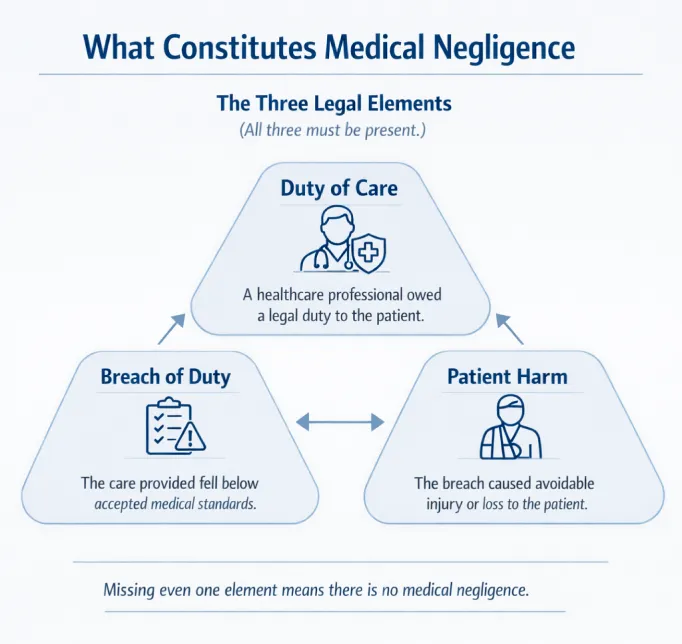
Medical neglect involves three important elements:
- A duty of care was owed by the healthcare expert to the patient.
- The expert breached this duty by acting below the standard of practice.
- The breach directly caused avoidable harm or injury to the patient.
In practice, this means that if a doctor’s actions fall below what other responsible experts would have done, and that shortfall causes actual harm, the law may consider it negligent. Simply having a poor result or an unfortunate complication is not enough on its own. Neglect must show a failure of proper care.
Common situations that may qualify include:
- Failure to diagnose or a delayed diagnosis, where timely intervention could have made a difference.
- Surgical errors or incorrect care that are outside accepted practices.
- Not explaining risks or alternatives so that a patient cannot give informed consent.
- Medication mistakes, such as prescribing the wrong drug or incorrect dosage.
For a more detailed legal perspective on medical negligence claims and the steps to take if you believe you’ve been affected, you can refer to this comprehensive Medical Neglect Solicitor Guide.
Types of Medical Negligence
There are different ways in which poor medical care can occur. Although each case is unique, there are some recognisable categories that can help us understand where failure happened and how harm was caused. It mainly depends upon the type of care involved and the circumstances of the failure.
Once we understand those categories, it becomes easy to check where the care of duty was breached and how the provided care falls below the expert standards.
The following are some of the common types of poor medical care:
1. Misdiagnosis and Delayed Diagnosis
Medical neglect can occur in the diagnosis phase of care if a condition is not diagnosed in the proper way or not identified in time. Many types of illnesses require proper diagnosis on time.
If the diagnosis is delayed or done incorrectly, the medical condition of the patient can get worse. It can also lead to lengthy care. A good doctor will have the diagnosis done in time in an expert way and will prevent the unnecessary spread of the illness.
Wondering how to challenge a diagnosis that caused you harm? Our guide to the legal process for challenging a mental health diagnosis breaks down the steps and what to expect when you take action.
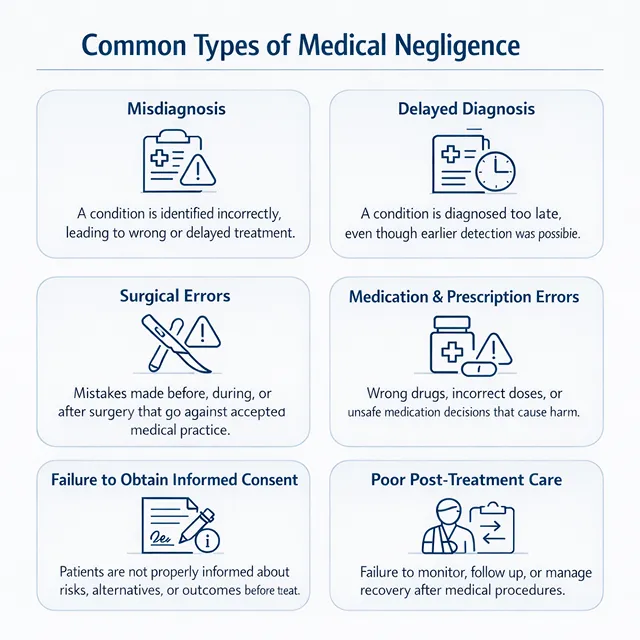
2. Surgical Errors
Poor medical care can also occur during a surgical operation. There are different reasons that could lead to such neglect. These include not monitoring the patient in the proper way or leaving surgical instruments inside the body. Such neglect can cause serious health issues and may lead to additional unnecessary surgeries.
Surgical neglect can also occur before and after the operation.
Example: Failing to check the patient’s medical history or not performing the necessary preoperative tests can amount to neglect. Similarly, failing to properly monitor the patient’s condition after surgery can also cause complications and may affect the recovery process.
The Bolam principle checks these errors by comparing the surgeon’s actions with accepted surgical practices.
3. Medication and Prescription Errors
Another type of medical neglect can occur during medication prescription and management. There are multiple mistakes that can occur during medical prescriptions.
A healthcare provider may prescribe the wrong medications or the wrong dosage that may be too high or too low for the patient. A failure to recognise the potential effects of a medication on a patient can also be poor medical care.
Such types of incidents usually occur because of incomplete patient information and miscommunication.
Medication safety relies on careful checks. The consequences of neglect in this area can be severe. It may lead to a lengthened recovery period and serious health complications. It may even lead to fatalities.
4. Failure to Obtain Informed Consent
It is a patient’s right to know the possible risks, benefits, and other options related to any care their doctor suggests. Just like in the case of Mr. Bolam, if a doctor does not share this important information, and the patient ends up getting hurt, it could lead to a claim of neglect against the doctor.
How the Bolam Test Is Applied in Medical Negligence Cases
In situations involving poor medical care, the Bolam test is employed to check whether there was a breach of duty.
The court uses the Bolam Principle as the legal guideline. The court checks if the actions taken by the healthcare provider align with the common principles and standards within the medical field.
In other words, the Bolam Test checks what other skilled experts with similar training would have done in the same situation. Instead of just looking at whether there was a mistake, the test measures how reasonable the healthcare provider was at making decisions.
Under the Bolam Principle, a healthcare expert may be negligent only if no responsible body of medical experts would support the way they treated the patient.
Following is a step-by-step process of the Bolam test:
Step 1: Identifying the Relevant Standard of Care
During a Bolam test, the primary aim is to calculate the standard of care the patient should expect from a good healthcare expert. The objective is to find out what a qualified healthcare expert with similar training and experience would have done in that situation.
This is done by analysing the care in light of the conventional medical practice, protocols, and established medical guidelines. This allows for an easy and fair comparison of how the healthcare provider should have acted in that specific case.
Step 2: Reviewing Expert Medical Evidence
The second step involves reviewing care by a responsible body of good medical experts. The case is reviewed by independent medical experts. These experts conduct a thorough examination of the actions taken during the care. The actions are evaluated in order to find out whether they align with the accepted standards of practice in a corresponding medical field.
Step 3: Deciding Whether a Breach Occurred
If the actions and decisions of the healthcare provider are supported by the majority of experts, the Bolam test is satisfactory.
In the same sense, if the court finds that the care is not supported by any responsible body of medical experts, the Bolam Test may not be met. In this case, it can be established that the healthcare provider has breached the duty of care.
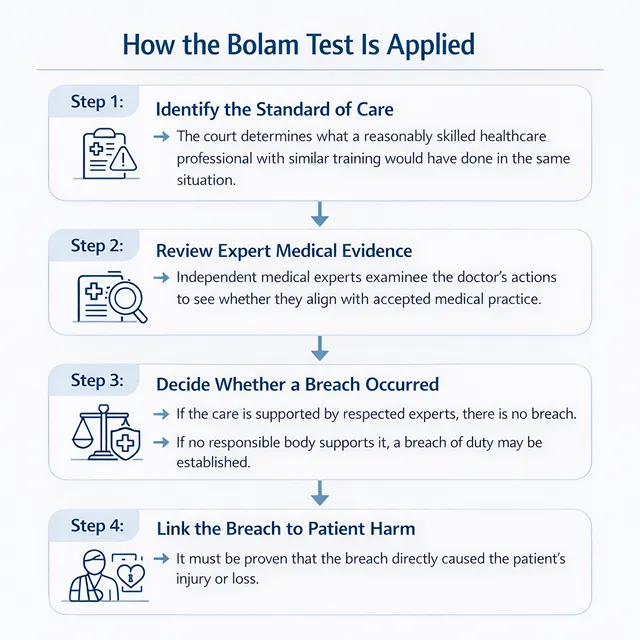
Step 4: Considering Causation
Even if a healthcare provider fails under the Bolam Principle, it must be proved that the breach or neglect was the direct cause of the harm to the patient. A mistake is only negligence when there is a clear link between a breach of duty of care and a patient’s harm.
Case Study: Tarrant v Monkhouse [2025]
Case Overview
Tarrant v Monkhouse was a clinical negligence claim. The claim was made by a patient after complications following bariatric surgery. It was a weight loss surgery. The claimant claimed that post-operative decisions and a balloon dilatation procedure were not justified.
What Actually Happened
After a surgery, the patient suffered serious complications and ongoing health problems. This included a sleeve leak. She also had prolonged hospital stays. She argued that the surgeon failed to provide reasonable post-surgical care. Furthermore, the decision to perform balloon dilation was not justified.
Legal Ruling
During the trial, both parties used expert medical evidence to support their cases. The judge was very critical towards the claimant’s expert. The expert used unclear wording. He also had a weak understanding of the Bolam principle. The judge, however, preferred the defendant’s expert evidence overall.
Outcome
The court dismissed the claim against the surgeon. This highlights the importance of the correct application of the Bolam Principle by expert witnesses. This case proves that serious outcomes alone are not enough. A claim may fail if expert evidence does not persuasively show a breach of accepted professional standards.
Conclusion
It can be difficult to understand what counts as medical neglect and comprehend the use of the Bolam test. The Bolam test does not judge care based on outcomes alone. Instead, the Bolam test checks whether the care is acceptable by a responsible body of good medical experts with similar training and experience.
If you’ve experienced harm from medical care and are unsure whether it counts as neglect, you’re not alone. Concise Medico understands that the Bolam Principle can be complicated, but you don’t have to figure it out by yourself.
Our team is here to guide you, answer your questions, and help you take the next step with confidence. Reach out to us today.
If you think you or a loved one has experienced poor medical care that may have caused harm, you don’t have to figure it out alone.
Whether you’re looking for a medical expert witness report or want to discuss your situation with an experienced team, we can provide supportive, expert guidance tailored to your needs.
If you think you or a loved one has experienced poor medical care that may have caused harm, you don’t have to figure it out alone.
Whether you’re looking for a medical expert witness report or want to discuss your situation with an experienced team, we can provide supportive, expert guidance tailored to your needs.
FAQs
How often do you think doctors make mistakes? Every year, thousands of people question their doctors and ask for compensation. Last year, there were 14,428 medical negligence claims in the UK. Out of this large number, only 7,806 actually received any compensation. To judge such claims, a test called the Bolam test is used.
The Bolam test checks if a medical expert has failed in their duty of care. Under the Bolam test, a doctor who meets the standard of a responsible body of medical opinion is not negligent.
In this blog, we will talk about the following:
- What is a Bolam Test?
- Duty of Care
- History of the Bolam test
- Core Principles of Medical Negligence
- Types of medical negligence
- Application of the Bolam Test
- Real-World Example of the Bolam Principle
What Is a Bolam Test
The Bolam test is a legal test used to determine whether a doctor was negligent in their care or not. To measure the care, the treatment process is rigorously compared with the standard treatment. The actions are evaluated to see if they are supported by a responsible body of medical experts in the relevant field.
Example: If the medical expert body considers the process and care acts acceptable, the doctor has not acted negligently. In simple terms, it asks whether other good doctors would have acted the same in this situation.
In practice, it acts as an expert check. The law does not punish doctors for every mistake. It also does not judge the doctors on the basis of perfect outcomes. Instead, it checks whether the choices are acceptable in the eyes of the medical community. This test protects the medical experts from unfair claims and ensures that medical decisions are evaluated fairly.
Duty of Care: What It Means for Healthcare Professionals
Healthcare professionals, including doctors and nurses, must prioritise the well-being of their patients. They are bound to provide the best care.
They must follow the accepted procedure. They should also inform the patient about the multiple possible outcomes of the procedures. This includes informing them about the potential risks. This is called Duty of Care and is a legal duty of a healthcare expert.
The Bolam test is used to check if the legal duty has been breached. If yes, it can lead to a potential negligence claim. Because when an expert does not uphold the standard procedure, it can cause harm, leading towards worry and confusion for the patient and the family.
The History of the Bolam Test
The Bolam test first originated from the legal case of Bolam vs Friern Hospital Management Committee 1957. Mr Bolam was a mental health patient who volunteered for an electro‑convulsive therapy (ECT). During the care, he suffered from serious fractures. He blamed the doctors for carelessness and argued that:
- He was not given prior muscle relaxation
- He was not restrained during the care
- He was not informed about the potential risks
He claimed that he suffered because of the neglect of the doctors. However, the court decided that the doctors were following the standard procedure of the time. According to the court, the care was in line with the accepted practices of other good doctors of the time.
“A doctor is not guilty of neglect if he has acted in accordance with a practice accepted as proper by a responsible body of medical men skilled in that particular art.”
– Bolam v Friern Hospital Management Committee, 1957
Medical Negligence: How It Happens and What It Means
Not every mistake is caused by medical neglect. Similarly, an unexpected bad outcome does not mean the doctors are negligent. We can call it medical neglect if a healthcare expert fails to meet the accepted standard of care, and this failure results in harming the patient.
Poor medical care occurs when a healthcare expert provides care below the accepted standard, and that failure directly results in patient injury.
In legal terms, medical negligence occurs when a healthcare provider does not uphold the expected standard of care, resulting in direct harm to the patient. This principle serves as the foundation for checking clinical claims.
What Constitutes Medical Negligence
Medical neglect involves three important elements:
- A duty of care was owed by the healthcare expert to the patient.
- The expert breached this duty by acting below the standard of practice.
- The breach directly caused avoidable harm or injury to the patient.
In practice, this means that if a doctor’s actions fall below what other responsible experts would have done, and that shortfall causes actual harm, the law may consider it negligent. Simply having a poor result or an unfortunate complication is not enough on its own. Neglect must show a failure of proper care.
Common situations that may qualify include:
- Failure to diagnose or a delayed diagnosis, where timely intervention could have made a difference.
- Surgical errors or incorrect care that are outside accepted practices.
- Not explaining risks or alternatives so that a patient cannot give informed consent.
- Medication mistakes, such as prescribing the wrong drug or incorrect dosage.
For a more detailed legal perspective on medical negligence claims and the steps to take if you believe you’ve been affected, you can refer to this comprehensive Medical Neglect Solicitor Guide.
Types of Medical Negligence
There are different ways in which poor medical care can occur. Although each case is unique, there are some recognisable categories that can help us understand where failure happened and how harm was caused. It mainly depends upon the type of care involved and the circumstances of the failure.
Once we understand those categories, it becomes easy to check where the care of duty was breached and how the provided care falls below the expert standards.
The following are some of the common types of poor medical care:
1. Misdiagnosis and Delayed Diagnosis
Medical neglect can occur in the diagnosis phase of care if a condition is not diagnosed in the proper way or not identified in time. Many types of illnesses require proper diagnosis on time.
If the diagnosis is delayed or done incorrectly, the medical condition of the patient can get worse. It can also lead to lengthy care. A good doctor will have the diagnosis done in time in an expert way and will prevent the unnecessary spread of the illness.
Wondering how to challenge a diagnosis that caused you harm? Our guide to the legal process for challenging a mental health diagnosis breaks down the steps and what to expect when you take action.
2. Surgical Errors
Poor medical care can also occur during a surgical operation. There are different reasons that could lead to such neglect. These include not monitoring the patient in the proper way or leaving surgical instruments inside the body. Such neglect can cause serious health issues and may lead to additional unnecessary surgeries.
Surgical neglect can also occur before and after the operation.
Example: Failing to check the patient’s medical history or not performing the necessary preoperative tests can amount to neglect. Similarly, failing to properly monitor the patient’s condition after surgery can also cause complications and may affect the recovery process.
The Bolam principle checks these errors by comparing the surgeon’s actions with accepted surgical practices.
3. Medication and Prescription Errors
Another type of medical neglect can occur during medication prescription and management. There are multiple mistakes that can occur during medical prescriptions.
A healthcare provider may prescribe the wrong medications or the wrong dosage that may be too high or too low for the patient. A failure to recognise the potential effects of a medication on a patient can also be poor medical care.
Such types of incidents usually occur because of incomplete patient information and miscommunication.
Medication safety relies on careful checks. The consequences of neglect in this area can be severe. It may lead to a lengthened recovery period and serious health complications. It may even lead to fatalities.
4. Failure to Obtain Informed Consent
It is a patient’s right to know the possible risks, benefits, and other options related to any care their doctor suggests. Just like in the case of Mr. Bolam, if a doctor does not share this important information, and the patient ends up getting hurt, it could lead to a claim of neglect against the doctor.
How the Bolam Test Is Applied in Medical Negligence Cases
In situations involving poor medical care, the Bolam test is employed to check whether there was a breach of duty.
The court uses the Bolam Principle as the legal guideline. The court checks if the actions taken by the healthcare provider align with the common principles and standards within the medical field.
In other words, the Bolam Test checks what other skilled experts with similar training would have done in the same situation. Instead of just looking at whether there was a mistake, the test measures how reasonable the healthcare provider was at making decisions.
Under the Bolam Principle, a healthcare expert may be negligent only if no responsible body of medical experts would support the way they treated the patient.
Following is a step-by-step process of the Bolam test:
Step 1: Identifying the Relevant Standard of Care
During a Bolam test, the primary aim is to calculate the standard of care the patient should expect from a good healthcare expert. The objective is to find out what a qualified healthcare expert with similar training and experience would have done in that situation.
This is done by analysing the care in light of the conventional medical practice, protocols, and established medical guidelines. This allows for an easy and fair comparison of how the healthcare provider should have acted in that specific case.
Step 2: Reviewing Expert Medical Evidence
The second step involves reviewing care by a responsible body of good medical experts. The case is reviewed by independent medical experts. These experts conduct a thorough examination of the actions taken during the care. The actions are evaluated in order to find out whether they align with the accepted standards of practice in a corresponding medical field.
Step 3: Deciding Whether a Breach Occurred
If the actions and decisions of the healthcare provider are supported by the majority of experts, the Bolam test is satisfactory.
In the same sense, if the court finds that the care is not supported by any responsible body of medical experts, the Bolam Test may not be met. In this case, it can be established that the healthcare provider has breached the duty of care.
Step 4: Considering Causation
Even if a healthcare provider fails under the Bolam Principle, it must be proved that the breach or neglect was the direct cause of the harm to the patient. A mistake is only negligence when there is a clear link between a breach of duty of care and a patient’s harm.
Case Study: Tarrant v Monkhouse [2025]
Case Overview
Tarrant v Monkhouse was a clinical negligence claim. The claim was made by a patient after complications following bariatric surgery. It was a weight loss surgery. The claimant claimed that post-operative decisions and a balloon dilatation procedure were not justified.
What Actually Happened
After a surgery, the patient suffered serious complications and ongoing health problems. This included a sleeve leak. She also had prolonged hospital stays. She argued that the surgeon failed to provide reasonable post-surgical care. Furthermore, the decision to perform balloon dilation was not justified.
Legal Ruling
During the trial, both parties used expert medical evidence to support their cases. The judge was very critical towards the claimant’s expert. The expert used unclear wording. He also had a weak understanding of the Bolam principle. The judge, however, preferred the defendant’s expert evidence overall.
Outcome
The court dismissed the claim against the surgeon. This highlights the importance of the correct application of the Bolam Principle by expert witnesses. This case proves that serious outcomes alone are not enough. A claim may fail if expert evidence does not persuasively show a breach of accepted professional standards.
Conclusion
It can be difficult to understand what counts as medical neglect and comprehend the use of the Bolam test. The Bolam test does not judge care based on outcomes alone. Instead, the Bolam test checks whether the care is acceptable by a responsible body of good medical experts with similar training and experience.
If you’ve experienced harm from medical care and are unsure whether it counts as neglect, you’re not alone. Concise Medico understands that the Bolam Principle can be complicated, but you don’t have to figure it out by yourself.
Our team is here to guide you, answer your questions, and help you take the next step with confidence. Reach out to us today.
If you think you or a loved one has experienced poor medical care that may have caused harm, you don’t have to figure it out alone.
Whether you’re looking for a medical expert witness report or want to discuss your situation with an experienced team, we can provide supportive, expert guidance tailored to your needs.
If you think you or a loved one has experienced poor medical care that may have caused harm, you don’t have to figure it out alone.
Whether you’re looking for a medical expert witness report or want to discuss your situation with an experienced team, we can provide supportive, expert guidance tailored to your needs.