TABLE OF CONTENT
How Much Compensation Can You Claim for a Wrist Injury in the UK?
A wrist injury can have major physical, financial and professional complications. If you get injured due to someone else’s negligence, you may be authorised to get wrist injury compensation for it.
This blog answers all your questions related to wrist injury compensation amounts. You can learn to calculate wrist injury compensation and the typical payout ranges. The key factors that affect wrist injury compensation amounts are outlined along with the ways you can make wrist injury claim, giving you a clearer understanding of your legal options.
What Is a Wrist Injury Compensation Claim?
A wrist injury compensation claim is a legal process which lets you seek money if you were injured because of someone else’s negligence.
This negligence could have different sources. An employer might have failed to keep your workplace safe. A driver might have been careless. A property owner may have overlooked a known hazard. Or a healthcare professional may have given you poor treatment that made your condition worse.
The goal of a compensation claim is simple. It aims to put you back in the position you would have been in if the injury had never happened.
But suffering a wrist injury alone does not guarantee wrist injury compensation. You must also prove three things:
- Another person entrusted you a duty of care.
- They breached that duty.
- This breach caused your injury.
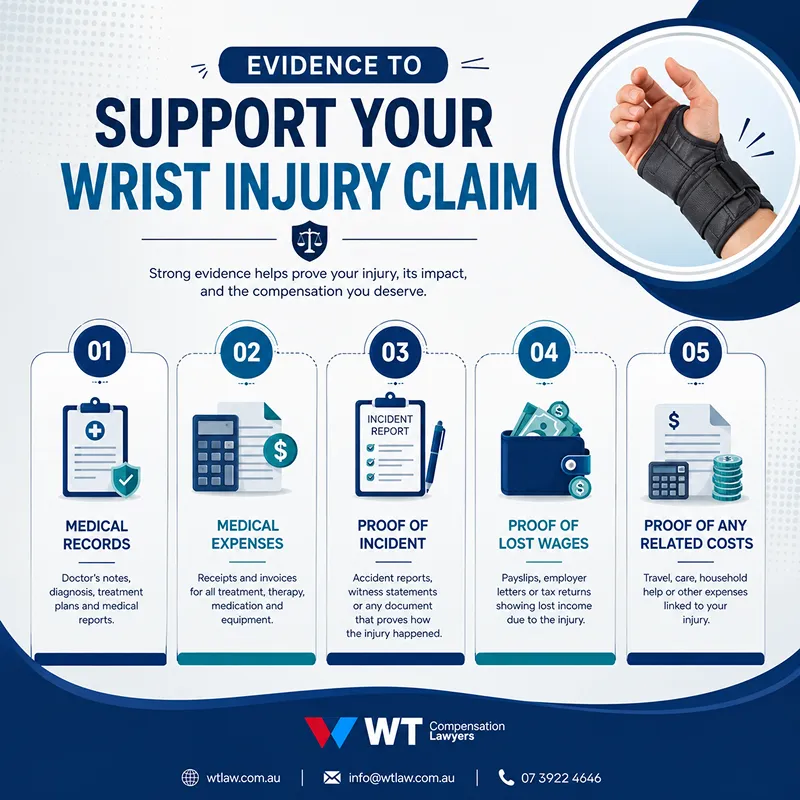
Evidence plays an important role in building the value of your wrist injury claim. This includes medical records, accident reports, witness statements and proof of financial losses. These records can also help establish the correct level of wrist injury compensation.
Who Can Make a Wrist Injury Compensation Claim?
You may be eligible to make a compensation claim for a broken wrist injury if:
- You were injured wholly or partly by another party’s negligence.
- You suffered physical, emotional or financial loss as a result.
- You were injured at work because your employer failed to provide a safe working environment;
- You were injured in a road traffic accident caused by another road user;
- You were injured in a public place where a property owner or occupier failed to manage a foreseeable hazard;
- Negligent medical treatment that caused your wrist injury to worsen.
In most cases, you must start a compensation claim for a broken wrist injury within three years. This time limit starts from the date of the accident or from the date you noticed that negligence caused your injury.
Exceptions may apply to minors and adults with limited mental capacity.
If you are unsure whether you can make a wrist injury claim, keep your evidence safe and get legal advice as soon as possible.
How Much Compensation Can You Claim for a Wrist Injury?
There is no fixed payout for a wrist injury claim. The wrist injury compensation amount you can claim depends on your individual case. Every wrist injury compensation claim is assessed on its own, based on how severe the injury is, its long-term effects and the financial impact on your life.
“The claimant must attach to his particulars of claim a report from the medical practitioner about the claimant’s personal injuries.”
— Civil Procedure Rules, Practice Direction 16, Justice UK
If you are asking how much compensation for wrist injury cases can attract, the answer depends on the severity of the injury, your recovery and your financial losses. A wrist injury compensation calculator can provide an initial estimate, but it cannot determine the final value of your wrist injury compensation.
In England and Wales, wrist injury compensation is generally split into two categories:
General damages
General damages compensate you for the non-financial effects of a wrist injury. These include pain, suffering and loss of comfort. It also includes the injury’s impact on your ability to carry out everyday activities.
Several factors are considered when assessing wrist injury compensation with regard to general damages. These include:
- the type and intensity of the wrist injury
- whether surgery or ongoing medical treatment was required
- the length of your recovery period
- any permanent loss of movement, grip strength or ability
- risk of permanent challenges like chronic pain or arthritis
- effects on your independence, hobbies and overall quality of life
Special damages
Special damages compensate you for the financial losses linked to your wrist injury. As opposed to general damages, they must be supported by evidence. You can use bills, receipts or your medical documents as proof too.
Depending on your situation, you may be able to make a wrist injury claim for:
- loss of earnings during your recovery
- future loss of income, if the injury has affected your ability to work
- medical treatment, prescriptions and rehabilitation costs
- physiotherapy or occupational therapy
- travel expenses for medical appointments
- the cost of care or assistance provided by professionals, friends or family members
- specialist equipment or home adaptations required because of your injury.
In more serious cases, special damages can amount to a larger sum of the overall wrist injury compensation. This applies if an injury has affected your long-term earning capacity or created ongoing care needs. Fully documenting these losses is essential. This helps ensure your wrist injury compensation reflects the true impact of your injury.
Case Study: Arkless v Betsi Cadwaladr University Local Health Board (2016)
In the case of Arkless v Betsi Cadwaladr University Local Health Board [2016] EWHC 330 (QB), the claimant succeeded in a clinical negligence claim after a scaphoid fracture was missed. The parties had agreed damages of £39,000, and the High Court found in the claimant’s favour on breach of duty.
Compensation Amounts by Injury Severity
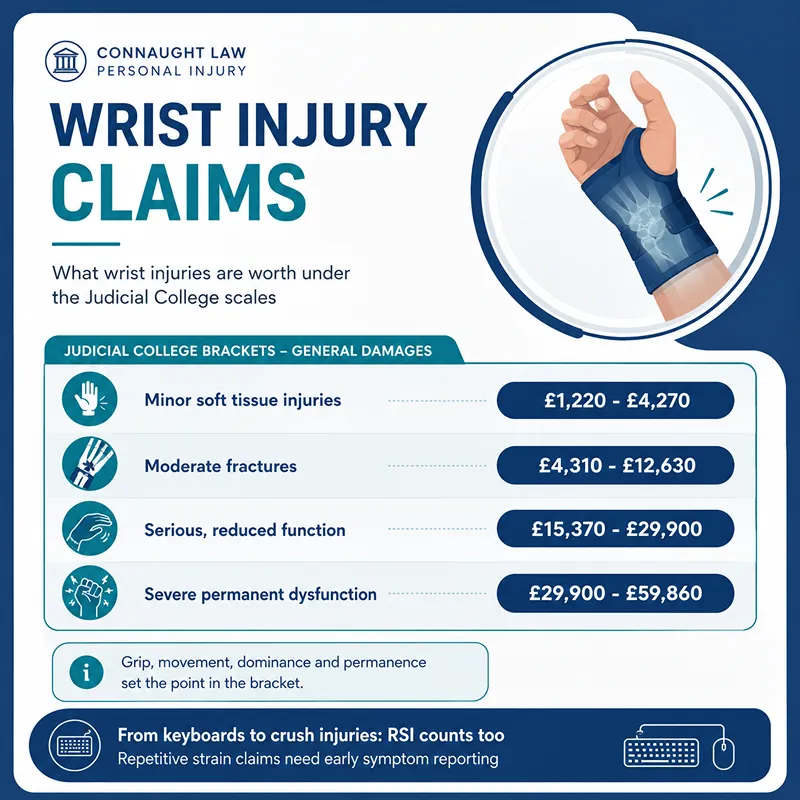
Wrist injury compensation amounts are determined using the Judicial College Guidelines (JCG) in conjunction with independent medical evidence. Generally, the wrist injury compensation directly depends on how severe your wrist injury is. Wrist injuries are divided into three categories that are minor, moderate and severe. The category is determined by the type of injury, recovery time and possibility of long-term problems.
Minor Wrist Injuries
Minor wrist injuries usually involve soft tissue damage or small fractures. These are expected to heal without lasting harm but can still be quite painful. They can also lead to a short-term loss of movement and time off work.
Compensation for minor broken wrist injuries is usually between £1,220 and £4,270, depending on factors such as recovery time, pain levels and any symptoms that remain.
Examples of minor wrist injuries include:
- wrist sprains and strains
- minor ligament or tendon injuries
- hairline or non-displaced fractures
- uncomplicated Colles’ or scaphoid fractures with a full recovery
For minor wrist injuries, your payout tends to reflect a few things. How much pain you felt, how long you took to heal and any small symptoms left behind.
If you heal fully in a short time, your wrist injury compensation amount will likely be lower. This is true when compared to injuries that leave you with lasting problems in how your wrist moves or works.
Moderate Wrist Injuries
Moderate wrist injuries cause more harm. They often need more time to treat and heal. They may receive wrist injury compensation between £4,310 and £12,630, depending on the severity of the injury, treatment required and any ongoing symptoms.
These injuries may heal well. But some signs can stay behind. You may feel stiff or weak. Your grip may not be as strong. You may not be able to move your wrist as far as before.
Examples include:
- displaced fractures requiring manipulation or surgery
- partial ligament tears causing joint instability
- fractures requiring internal fixation with plates or screws
- soft tissue injuries with prolonged recovery and residual symptoms
These injuries can affect your daily life and your job for many months. Because of this, you may get a higher wrist injury compensation amount than for minor injuries.
Your wrist injury compensation may also reflect other things. It may cover the cost of physiotherapy or occupational therapy. It may cover time off work. It may also cover changes to your job role while you heal.
Severe Wrist Injuries
Severe wrist injuries often cause harm that lasts for life. They can also reduce the mobility of your wrist and hand. These injuries often involve complex fractures. And the treatment may require multiple surgeries. Such damages also cause nerve damage, long-term pain or lasting disability. Wrist injury compensation amounts for these injuries can range from £15,370 to £29,900, while the most serious cases may receive awards between £58,110 and £73,050.
You may be experiencing a severe wrist injury if:
- You have complex or multiple broken bones
- You have torn ligaments completely
- You have nerve damage that affects feeling or how your hand works
- You have lost grip strength or movement for good
- Your wrist has lost most or all of its function
These injuries can totally change your life. Many people struggle to return to physical labour. Some seek continued rehabilitation, pain management or long-term care.
In the most serious cases, your payout may cover more. It may cover a drop in what you can earn in the future. It may cover special equipment. It may also cover changes to your home that help you live with more freedom.
As a rule, the worse and longer-lasting your injury, the higher your wrist injury compensation amount may be. But no two wrist injury claims are the same. The final amount will always depend on the medical proof, the facts of your accident and how the injury has affected your life.
How to Claim Wrist Injury Compensation
If you are also suffering from a wrist injury, you can improve your chances of recovering fair wrist injury compensation by taking the right steps early:
- Get Medical Help:
Prioritising your own well-being is necessary. By getting medical help you ensure that you receive suitable care. It also keeps a record of your injuries. This can help you with your compensation claim later.
- Gather Evidence
Gather as much supporting evidence as possible. Where possible, collect:
- pictures of the accident scene;
- pictures of your injury;
- contact details of any witnesses;
- accident reports completed by your employer or the relevant organisation;
- medical records and treatment plans; and
- receipts, invoices and proof of any financial losses resulting from your injury.
Keeping a record of how the injury affects your daily activities can also provide valuable evidence for your wrist injury compensation claim.
- Report the Accident
In case of a wrist injury, you need to contact the right person. If at work, tell your employer. If it was a public area, the manager or person in charge can be informed. By reporting early, you create an official record which can support your wrist injury claim and your wrist injury compensation.
- Consult a Personal Injury Solicitor
An experienced personal injury solicitor can tell you if you have a valid wrist injury claim. They can tell you what you can do by law and get the medical proof you need. They also speak to the other party’s insurance for you. No Win, No Fee agreements are also offered by some law firms. This means you can file a wrist injury compensation claim without paying legal fees in advance.
- Remember the Time Limit
In most cases across England and Wales, you have three years to start your wrist injury claim. This time limit usually begins from the date of the accident. In some cases, it starts from the date you first realised that negligence caused your injury. Different rules may apply to children and people who lack the mental capacity to manage their own legal affairs.
Conclusion
A wrist injury can affect your life for a long time. It may stop you from working, doing daily tasks and living well. If someone else caused your injury by not being careful, you may get paid. This covers both your pain and the money you’ve lost.
You can make informed decisions by understanding how wrist injury compensation amounts are assessed. ConciseMedico helps you choose the right steps from the start. By getting help early, you can ensure your wrist injury claim gets fair value and meets the time limit.