TABLE OF CONTENT
A Complete Guide to Repetitive Strain Injury Claims
Repetitive strain injuries (RSIs) are one of the most common work-related conditions globally. Almost 1 in 50 employees suffers from an RSI condition in the UK. They often develop after months or even years of repeating the same mobility pattern at work. An initial, mild discomfort in your hands, wrists, shoulders or neck can develop into an injury. This can later affect your ability to work, carry out tasks and enjoy your daily life.
However, UK law provides compensation for RSIs when your employer fails to provide a safe working environment. UK employers have a legal duty to protect their workers. They can do this through risk assessment, provision of suitable equipment and measures to prevent workplace injuries.
This guide explains everything you need to know about repetitive strain injury claims. You’ll learn who can make a claim, how to prove employer negligence, the evidence you need and the time limit to follow.
What Is a Repetitive Strain Injury?
A repetitive strain injury is a condition that develops when muscles, tendons, nerves or joints are subjected to repeated pressure for a long period. Unlike a sudden injury caused by an accident, RSI usually develops gradually. The signs often begin with mild discomfort but can become more severe if the underlying cause is left unchecked.
Commonly, repetitive strain injury affects the hands, wrists, fingers, arms, shoulders, neck and elbows. It can happen in any workplace where repeated tasks are performed without rest, support or suitable equipment.
Common workplace causes of RSI include:
- Repetitive typing or prolonged computer use
- Repeated lifting or manual handling
- Continuous use of vibrating tools
- Assembly line or production work
- Poor workstation setup or ergonomics
- Long working hours without regular breaks
Early symptoms may include aching, stiffness, tingling, numbness or weakness in the affected area. As time progresses, the condition worsens and affects every aspect of your daily life.
If these symptoms developed because of an employer’s negligence, you have grounds to pursue a repetitive strain injury claim.
“Repetitive strain injury is less about a single harmful motion and more about the absence of adequate recovery between motions.”
Occupational Health Insight
Can You Make a Repetitive Strain Injury Claim?
You can make a repetitive strain injury claim if your condition developed as a result of your employer. This happens when the employer fails to take reasonable steps to protect your health and safety at work. An RSI alone does not mean you have a valid claim. There must be evidence to show that your employer failed in their legal duty of care, which led to your injury.
Under the Health and Safety at Work Act 1974, employers are legally required to provide a safe work environment to their employees. Employers are bound to identify workplace risks, conduct suitable assessments, provide reliable equipment and take practical steps to reduce the chance of RSI. However, slight negligence by the employer can lead to repetitive strain injury claims.
You may have grounds to make a repetitive strain injury claim if your employer:
- Failed to carry out a workstation or ergonomic assessment
- Did not provide suitable equipment or adjustable workstations
- Expected you to perform repetitive tasks without adequate breaks
- Failed to provide training on safe working practices
- Ignored complaints about pain or discomfort
- Did not rotate repetitive duties where it was reasonably possible
- Failed to act after they became aware of the risk of injury
To make a successful repetitive strain injury claim, you must prove that your RSI was caused or worsened by your work. Medical records, workplace assessments and other supporting evidence are all proof that establishes employer negligence in your RSI.
Often, people assume that an RSI claim cannot be filed if they still work for the same employer. In reality, many repetitive strain injury claims are made while employees are still in the same job. Also, you do not need to suffer from a permanent disability to be eligible to file the claim. If your employer’s negligence led to injury that caused physical, financial or emotional loss, you are entitled to file a claim.
How Do You Prove Employer Negligence?
The most vital part of a successful repetitive strain injury claim is employer negligence. It occurs when an employer fails to reduce known workplace risks to protect you. You will need to show that the negligence led to your injury. Employer negligence can take many forms. This happens when an employer fails to make reasonable changes even when they knew the risks in your role.
Proof that can help prove negligence includes:
1. Risk Assessments
Employers are required to conduct risk assessments to reduce the risks of injury to their employees. When an employer fails to identify and address the risk of RSI, you can file repetitive strain injury compensation claims.
2. Workstation Assessments
Some jobs require long hours at a computer or other machinery in repetitive tasks. Your employer is bound to make reasonable adjustments to protect you from RSI through workstation assessments. When they fail to do so, a repetitive strain injury claim can be filed.
3. Training Records
Jobs that carry risk of RSI require the employer to provide essential safety training and protection. When an employer fails to provide such training, the missing record can be used to file for RSI compensation claims.
4. Work Schedules
Jobs that require long working hours and repetitive tasks should have reasonable schedules. This includes suitable breaks and time off. When these are not provided, a repetitive strain injury claim can be filed.
5. Emails or Written Complaints
It is vital to first convey complaints and concerns to your employer about pain, unsafe conditions or other work-related concerns. When the employer fails to act on these requests, the proof becomes a vital part of a successful claim.
6. Medical Records
Maintain a clear file of all medical records that pertain to your workplace injury. These records can help establish the nature of your injury and its relation to your work. This helps you make a successful repetitive strain injury claim.
7. Witness Statements
Witnesses are vital proof for a successful repetitive strain injury claim. Expert witnesses strengthen your claims regarding the working conditions, tasks you performed and the risks they carried.
8. Photography
Maintain a clear record of your workstation, equipment and working environment in the form of pictures. These provide supporting evidence to your claim.
Amongst the proofs, medical evidence is of primary importance because RSI often develops gradually. A medical expert can assess your symptoms, run a diagnosis, review your work history and explain how your condition developed.
An RSI claim does not rely on any one piece of evidence alone. Medical records, workplace documents, witness evidence and other proofs help explain the cause of an RSI. When your employer fails to make reasonable adjustments after being informed, your claim is likely to succeed.
What Compensation Can You Claim for an RSI?
When your repetitive strain injury claim succeeds, the compensation covers the losses and impact it causes. The amount depends on factors like the severity of your condition, how long it lasts, its effect on your work and daily life and the time needed to recover.
Repetitive strain injury compensation claims are often divided into two main categories: general damages and special damages.
General Damages
General damages compensate for the impact of RSI on your physical and psychological health. This includes:
- Pain and discomfort
- Reduced mobility
- Loss of function
- Difficulty in everyday tasks
- Effect on your quality of life
The claim amount assesses the severity and the duration the injury is expected to last. A long-term condition affects your ability to work and have a normal life for a long time. This results in greater compensation than a minor injury that resolves in less time.
Special Damages
Special damages cover financial losses and expenses caused by your injury. Depending on your condition, these include:
- Lost earnings
- Medical treatment and rehabilitation costs
- Prescription and medication expenses
- Travel costs for a medical appointment
- Need for external care
- Special equipment or other expenses
You must keep a clear record of receipts, payslips, invoices, travel records and other documents that show these losses. As there is no fixed amount for an RSI claim, every case is assessed on its own merits. As a result, the compensation reflects the impact on the individual rather than a standard amount.
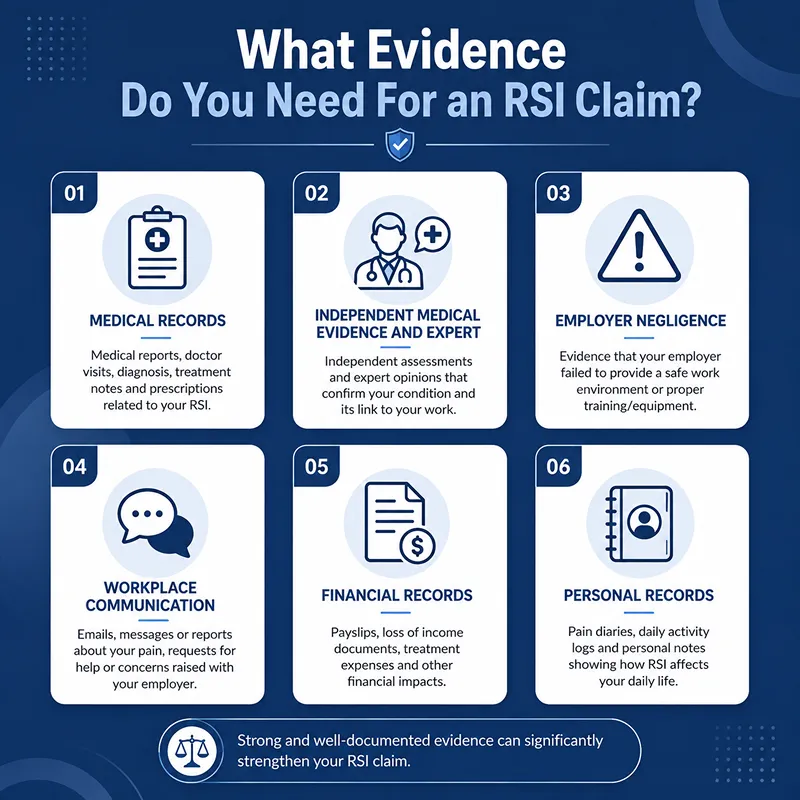
What Evidence Do You Need For an RSI Claim?
Evidence helps build a clear picture of your injury, your working condition and the losses you have experienced. The exact evidence will depend on the severity of your condition and the extent of your claim. You will need the following evidence to make an RSI claim:
1. Medical Records
Medical records confirm your diagnosis and show how your symptoms have developed. These may include GP records, hospital notes, diagnostic results, prescriptions and physiotherapy sessions. These help establish the timeline of your symptoms and the treatments you received.
2. Independent Medical Evidence and Expert
Independent medical evidence provides proof about the nature and severity of your RSI. The independent experts review your medical history, symptoms, treatment and work before forming an opinion. This helps determine how the condition developed and its long-term effect on you.
3. Employer Negligence
Proof that establishes reasonable negligence of your employer is vital. When they fail to make reasonable adjustments to prevent RSI, they are held liable for the injury. This includes assessment, protective gear, training and work schedule shifts. You will need records to prove employer negligence.
4. Workplace Communication
Every communication that informs about RSI symptoms or discusses problems with your working conditions is crucial proof. This includes even a message to your manager about persistent wrist pain or unsuitable equipment for your work. This helps establish that you raised concerns with the employer.
5. Financial Records
If your RSI affected your ability to work, financial documents can help list your financial losses. This includes payslips, records of reduced working hours, receipts of medical treatment, travel expenses and other costs. Keep these documents from the start to calculate your losses clearly.
6. Personal Records
While your own record does not replace medical records, it helps establish how your symptoms affected you over time. This includes details about when the pain occurred, what activities made it worse and how your condition affects your work and daily life.
How Long Do You Have to Make an RSI Claim?
In most cases, you have three years to start a repetitive strain injury claim in the UK. The three-year period begins when you become aware, or should reasonably have become aware, of the injury and its link to your work. RSI develops slowly; you may experience mild pain for months before you realise that it is linked to your job. Hence, the three years are calculated from the date of knowledge rather than the day your symptoms first appeared.
Since the limitation rules can be complex, you should seek legal advice as soon as possible. This will ensure that you are still within the applicable time limit.
Case Study: An RSI Claim Worth £10,000
An airport baggage handler suffered from RSI in his shoulder. This was a result of poor working conditions and repeated lifting of heavy luggage. His job involved luggage management on an aircraft. However, the low ceiling of the place meant he could not stand upright. He often worked alone and carried 30kg in strenuous positions. The employer also set a 30-minute target that added to the pressure.
As a result, the worker developed shoulder pain and was diagnosed with an RSI and partial tear. A claim was filed, and the risk assessment led to the case being settled for £10,000. The case shows how poor conditions, lack of training and an employer’s negligence can result in RSI. In such cases, a claim can be filed and won as well.
Conclusion
Repetitive strain injuries can develop slowly, but their effects can be significant. Persistent pain, reduced movement and poor health can affect both work and daily life. If your RSI was caused or worsened by your employers’ negligence, you may have grounds to make a repetitive strain injury claim. Establishing employer responsibility, suitable medical evidence and records of your losses can all help support your case.
Understanding your rights is often the first step in making a claim. Our qualified solicitors can assess your case and explain the options available to you.