Role of Ultrasound in Cancer Diagnosis and Monitoring
Did you know that cancer has caused 10 million deaths worldwide in 2024? One of the big factors in a person’s chances of survival is the early detection of the disease. It is for this reason that diagnosing the issue is very important.
Ultrasound in cancer diagnosis is an important tool to detect and diagnose many types of cancers. It makes use of high-frequency sound waves to generate images of the body’s internal organs and tissues. The images are then used to spot abnormalities, guide biopsy and assess a tumour’s response to treatment. Ultrasound does not use ionising radiation, which makes it a safe imaging method that can be conducted on demand.
This guide provides details about the use of ultrasound in cancer diagnosis and monitoring. It tells how it helps detect cancer, guide treatment and support patient care.
What Is the Role of Ultrasound In Cancer Diagnosis?
Ultrasound in cancer diagnosis helps doctors examine internal organs and tissues using real-time images. It can identify abnormal masses, assess their size, shape and location and determine whether further testing is needed.
Ultrasound cannot confirm cancer on its own, but it can detect suspicious changes at an early stage and guide a biopsy to obtain a tissue sample for diagnosis.
The main ways ultrasound supports cancer diagnosis are discussed below:
1. Supporting the Diagnosis
An ultrasound scan gives doctors live images of a suspicious area. It can show the size, shape and structure of a mass within the human body. It can also help show if the mass is filled with fluid or is solid. The Doppler ultrasound gives more details about blood flow in and around the area. Such results help doctors decide if more tests are needed. The use of ultrasound in cancer diagnosis is usually only a part of a wider process. More scans or a biopsy may be needed to confirm the cause.
2. Guiding a Biopsy
Ultrasound in cancer diagnosis can guide a thin needle into the suspicious area in real time. This allows the doctor to take tissue samples from the right part of the mass. These samples are later used for testing. Biopsy shows if the cancer cells are present. It may also help to identify the type of cancer. Thus, ultrasound becomes a useful tool when a tissue sample needs to be taken from a small or hard-to-reach area.
3. Using Special Ultrasound Techniques
Ultrasound in cancer diagnosis may also use special techniques to assess abnormal tissue. Elastography checks how stiff the tissue is. These results can add to the findings from a standard scan. They may help doctors assess an unusual area and decide if more tests are needed.
4. Distinguishing Cysts from Solid Masses
Ultrasound in cancer diagnosis can show if a mass is filled with fluid or made up of solid tissue. This helps doctors assess lumps in areas such as the breast, liver, thyroid and ovaries. A solid mass does not always mean cancer. However, it may need more checks. Doctors may suggest a biopsy or another scan to find out more.
5. Checking Blood Flow with Doppler Ultrasound
Doppler ultrasound checks blood flow in and around an unusual mass. This can give doctors more detail about the area. It may show changes in blood flow that need further review. Doppler results are not enough to confirm cancer. They help doctors decide if more tests or a biopsy may be needed.
6. Finding Abnormal Areas in the Body
Ultrasound can help find changes in soft tissue and some organs. It may show a lump, mass or other unusual area in the breast, liver, kidneys, thyroid, ovaries or testicles. Ultrasound for cancer detection is only one part of the wider diagnostic process. If a scan shows an abnormal finding, doctors may advise a biopsy, CT scan, MRI or other test to find the cause.
If you are considering an ultrasound scan, you may be able to arrange a private ultrasound scan without a GP referral, depending on the provider and scan type.
Ultrasound is a safe and painless test that uses sound waves to create images of parts of the inside of your body.
Cancer Research UK
What Types of Cancer Can Ultrasound Help Diagnose?
Ultrasound in cancer diagnosis can help check many soft tissues and organs. It can find a lump, mass or other change. It may show if an area is solid or filled with fluid. While it cannot determine cancer on its own, it forms the foundation for further tests. The type of scan used in Ultrasound in cancer diagnosis depends on the body area and the symptoms. Ultrasound can also be used to check for a hernia, making it useful for more than cancer-related tests.
Below are the most common types of cancer that ultrasound can help diagnose:
1. Breast Cancer
Ultrasound is often used to check a breast lump. It can help show if the lump is a fluid-filled cyst or a solid mass. It may also support a mammogram when breast tissue is dense. Doctors can use the scan to look at the size and shape of a lump. If the area looks suspicious, ultrasound can guide a biopsy. This lets a doctor take a tissue sample from the right spot.
2. Liver Cancer
Ultrasound can help find unusual areas in the liver. It may show a mass or a change in the liver tissue. People with cirrhosis have a higher risk of liver cancer. They may have regular ultrasound scans as part of their care. Doppler ultrasound can also show blood flow in the liver. If a scan finds a new or unusual area, more tests are conducted to determine the cause.
3. Thyroid Cancer
Ultrasound is a key test for checking thyroid nodules. It can show the size, shape and look of a nodule. It also shows if the nodule has features that need more checks. Doctors use the scan to look at nearby lymph nodes. If a nodule looks suspicious, ultrasound can guide a fine needle biopsy. The tissue sample can then be checked for cancer cells.
4. Ovarian and Other Gynaecological Cancers
A transvaginal ultrasound can give clear images of the ovaries, uterus and other pelvic organs. It may help find a cyst, mass or other unusual change. Doctors can check the size and shape of an ovarian mass. The scan may also help assess changes in the uterus. An unusual finding does not always mean cancer. Further tests are often needed to find the cause.
5. Prostate and Testicular Cancer
Ultrasound can help assess changes in the testicles, such as a solid lump or swelling. It can also be used to examine the prostate with a transrectal scan. In some cases, ultrasound helps guide a biopsy. This allows a doctor to take tissue from a specific area. The sample is then checked to determine if other scans and tests are needed to confirm a diagnosis.
6. Lung Cancer Diagnosis
Ultrasound has a limited role in lung cancer diagnosis because air in the lungs can affect the scan. However, it may help doctors check fluid around the lungs or guide some procedures. CT scans are usually used to view the lungs in more detail. So, ultrasound may support the diagnosis in some cases but is not usually the main test for lung cancer.
How Does Ultrasound Monitor Cancer?
Ultrasound in cancer diagnosis may also help doctors track changes in the cancerous cells. This includes changes in the size and look of some tumours. This makes it useful during follow-up care. These days, whether cancer can be found in ultrasound is becoming a common question. Ultrasound can provide some details about cancer, but it may not diagnose all cases of cancer alone. The use of the technique may vary based on cancer type and site of cancer.
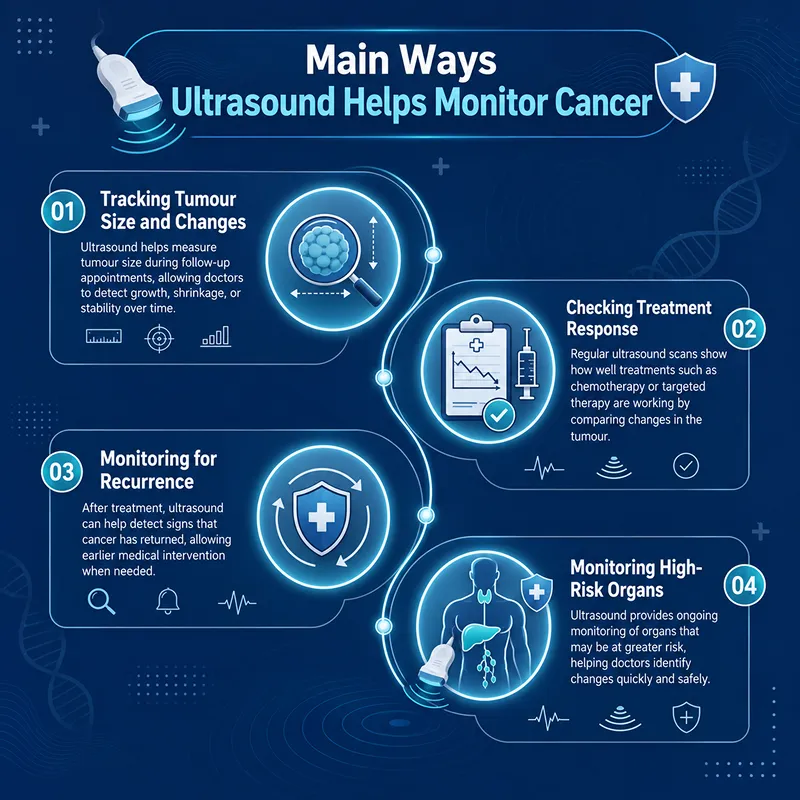
The main uses of ultrasound in cancer monitoring include the following:
1. Tracking Tumour Size and Changes
Ultrasound in cancer diagnosis can also support the monitoring of some tumours over time. Doctors can compare images from scans done at different times. This helps determine if the tumour is growing, shrinking or changing. Ultrasound can be used to monitor changes in areas that are not easy to examine using this imaging method. This includes the thyroid, breasts, liver and nearby lymph nodes.
2. Checking Treatment Response
Repeat scans can help doctors see how a tumour responds to treatment. They can show whether the tumour is getting smaller, staying the same size, or growing. Changes in blood flow can also give doctors useful information. These results help doctors decide whether the current treatment is working or needs to be changed.
3. Monitoring for Recurrence
Follow-up scans may help check for signs of cancer returning. It is useful in certain areas, such as the breast, thyroid gland and neck region. Ultrasound in cancer diagnosis tests can also help check the lymph nodes. Ultrasound scans continue to monitor the benign cells to ensure they don’t become malignant.
4. Monitoring High-Risk Organs
People with some long-term health risks may need regular ultrasound scans. For example, cirrhosis can cause long-term damage and scarring in the liver. Over time, this damage can increase the risk of abnormal cells developing and becoming cancerous. Regular scans can help doctors monitor the liver for new changes that may need further tests.
Ultrasound of the liver may be used to check people with cirrhosis for signs of liver cancer. It can help doctors spot changes early and arrange more tests if needed. Hernia diagnosis with ultrasound is another use of this scan. However, it is separate from cancer monitoring and is not a cancer test.
Case Study: How Ultrasound Detected Breast Cancer During Pregnancy
A 39 year old pregnant woman discovered a hard lump in her breast. Doctors initially suspected it was a milk filled cyst, which is common during pregnancy. However, an ultrasound scan revealed suspicious features that suggested breast cancer.
An ultrasound guided core biopsy confirmed invasive lobular carcinoma. The scan also identified abnormal lymph nodes, leading to further testing that confirmed the cancer had spread to nearby lymph nodes.
The patient was treated with surgery, chemotherapy and radiotherapy. This case highlights the important role of ultrasound in cancer diagnosis by detecting suspicious changes, guiding biopsies and supporting timely treatment, even during pregnancy.
Read the full case study from the Society of Radiographers.
Conclusion
Ultrasound plays an important role in cancer diagnosis and monitoring. It helps detect abnormal tissues, guide biopsies and monitor tumour changes throughout treatment. As it does not use ionising radiation, it is a safe imaging technique for diagnosis and follow-up care.
At Concise Medico, we provide advanced ultrasound imaging to support accurate cancer diagnosis and monitoring. Contact our team today to discuss your case and find the right imaging solution for your needs.