TABLE OF CONTENT
What happens when the brain doesn’t get the oxygen it needs? The brain is an organ that uses the largest amount of oxygen. Anoxic brain injury occurs when the brain stops receiving oxygen. It can result in the death of brain cells.
Such an injury can be hard to diagnose. In legal cases, it becomes even harder to explain it to the jury. That’s the role of an expert witness in cases involving injury to the brain.
Their job is simple to say, but hard to do:
Explain the most complex injury in the human body so everyone understands it.
Key Takeaways:
- Injuries to the brain are complex and life-changing.
- Brain injury claims need strong medical proof.
- Expert witnesses explain what others can’t.
- An anoxic injury expert witness is vital in oxygen-loss cases.
- A skilled lawyer protects the future.
What Is Brain Injury?
A brain trauma occurs when the brain is damaged by trauma, lack of oxygen, or disease. It affects memory, movement, behaviour, speech and more.
Types of brain trauma include:
- Traumatic Brain Injury (TBI) that occurs from physical impact.
- Acquired Brain Injury (ABI) that occurs due to illness or lack of oxygen.
- Anoxic Injury occurs due to the total loss of oxygen to the brain.
Why Brain Injury Is Called ‘The Invisible Injury’
Because:
- Scars don’t always show.
- Behaviour changes get misjudged.
- Intelligence may appear normal.
- Fatigue is misunderstood.
Expert witnesses make the invisible visible.
What Does A Brain Injury Expert Witness Do In UK Claims?
Symptoms of brain injuries can be very hard to detect. You need expert reports to detect such issues.
Moreover, without expert evidence, courts struggle to understand how the injury happened, how serious it is, and what prognosis or costs will follow.
Expert witnesses translate medical complexity into evidence that lawyers and judges can use.
Why Are Brain Injury Claims Hard To Prove?
Here’s the problem:
- The brain is complex.
- Symptoms vary from person to person.
- Damage doesn’t always show on scans.
- Effects can change over time.
Courts don’t work on feelings. They work with evidence.
That evidence comes from expert witnesses.
Who Is a Brain Trauma Expert Witness?
An expert witness in brain trauma is a medically qualified professional, such as:
- Neurologist.
- Neuropsychologist.
- Rehabilitation specialist.
These experts provide impartial opinions:
- Cause of the injury.
- Severity and prognosis.
- Functional impact on daily life.
- Care needs and future support.
- Whether negligence played a role in causing the injury.
These opinions are often delivered in detailed reports and sometimes in court testimony.
What Is the Role of an Expert Witness in Brain Injury Claims?
The role of an expert witness in brain trauma cases extends to:
- Reviewing medical records.
- Studying scans and test results.
- Assessing behaviour and ability.
- Writing detailed legal reports.
- Giving evidence in court.
Their words often decide:
- If a claim succeeds.
- How much compensation is awarded
That’s why choosing the right expert matters.
How An Expert Witness Report Is Prepared
An expert witness report tells the court about the extent of injury, the costs, and causes. Here is how it’s done:
Reviewing Medical Records
Medical records such as emergency rooms notes, ambulance records, test records and therapy notes are reviewed.The person’s prior medical history is also assessed.
Prognosis and Testing
The patient undergoes checkups to assess current physical state. An expert may perform a series of tests such as memory, cognitive function and language tests. The functional capacity of the patient is assessed. Finally brain scan tests like CT scan or MRI are performed to get the complete extent of injury.
Report Draft
An expert report has:
- Experts’ qualifications.
- Medical records.
- Sequence of events.
- Findings.
- Expert opinion and prognosis.
The expert witness gives impartial opinion based on their findings to the court.
Why Evidence Is Vital in Brain Injury Claims?
Expert evidence helps with:
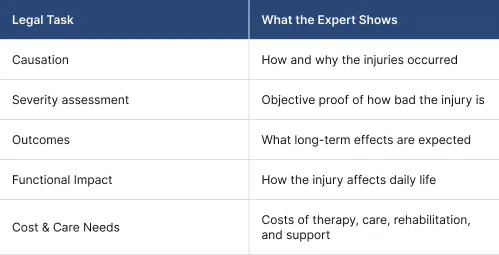
Without this evidence, your claim may fail even if the injury is clear.
What Is an Anoxic Injury Expert Witness?
This is a specialist expert witness focused on injuries caused by a complete lack of oxygen to the brain.
They typically have deep experience in:
- Neurology.
- Emergency medicine.
- Neurorehabilitation.
- Clinical neuropsychology.
Their role is to explain
- How long oxygen was lost?
- Which brain areas were affected?
- What permanent damage occurred?
- What level of care is required?
This information is provided to the courts in simple language. Their opinion is very important for the decision.
Legal Reality: Experts Can Be Held Accountable
Expert witnesses are not above the law. Under UK law, Criminal Procedure Rules 2020 Part 19 governs that expert witnesses must be impartial in their duty to the court.
This need was shown in Jones vs Kaney, in which an expert witness was sued for giving careless or misleading evidence.
You should be extra careful in choosing expert witnesses. If you don’t know where to start a good place to start is our guide on how expert witnesses are selected in the UK.
How Expert Evidence Impacts Compensation
Expert evidence can make or break a case. Here is how it impacts the compensation:
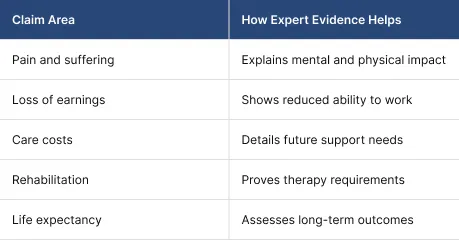
This is why claims involving brain damage depend on expert reports.
Common Symptoms Experts Look For
A brain trauma doesn’t look the same in everyone.
Experts often assess:
- Memory problems.
- Poor concentration.
- Mood changes.
- Aggression or withdrawal.
- Speech difficulties.
- Balance issues.
- Fatigue.
- Need for supervision.
They explain how these affect:
- School.
- Work.
- Relationships.
- Independence.
These details have a great impact on the outcome of the case.
Case Study: Anoxic Brain Injury Claim
The following example will help illustrate how a brain trauma claim plays out.
What Happened?
A patient suffered oxygen loss during medical treatment. This led to a anoxic injury with long-term effects.
Legal Action
Specialist solicitors instructed neurological expert witnesses.
Role of Expert Witness:
Expert witness answered:
- When did oxygen loss occur?
- What was the extent of damage to the brain?
- Why were the symptoms permanent?
- What lifelong care was needed?
Their input was what decided the outcome.
Outcome
The claim succeeded and secured funds for:
- Rehabilitation.
- Specialist care.
- Long-term support.
This demonstrates how expert evidence and legal strategy work together.
What Happens Without a Brain Injury Expert Witness?
Without expert evidence:
- Injuries are misunderstood.
- Symptoms are downplayed.
- Future needs are ignored.
- Compensation is reduced.
- Claims can fail entirely.
Courts need a clear explanation backed by evidence. This is why expert witnesses are a must to win negligence claims.
How To Choose The Right Brain Injury Expert Witness
Look for someone who:
- Specialises in injuries to the brain.
- Has court experience.
- Writes clear reports.
- Understands legal standards.
- Works with solicitors regularly.
The best experts don’t confuse.
They simplify.
Related: What Are the Roles and Responsibilities of an Expert Witness?
Why Courts Trust Expert Witnesses?
UK courts rely on expert witnesses because:
- Judges are not doctors.
- Brain injuries are invisible.
- Long-term impact is complex.
- Medical science matters.
Experts bridge the gap between medicine and law.
Tips for Winning Injury Claims
To maximise chances of success:
- Instruct an expert early in the case.
- Provide full medical records.
- Use a solicitor who knows the medical law.
- Ask for the prognosis and cost projections in reports.
Good expert evidence helps courts make fair decisions.
Conclusion
A brain injury can change a life in seconds. Proving its causes in court can take a lot of time. Courts need clear, trusted and well-explained evidence to understand:
- What happened?
- What does it mean?
- What support is needed long-term?
When the injury is complex, the science is deep and the stakes are high. Then clarity is everything. Concise Medico specialises in providing exactly that level of clarity. Their expert witnesses understand both the medical science and the legal standards required. Contact us to discuss medico-legal services today.
If you’re dealing with a brain injury and nothing makes sense yet, you don’t have to figure it out alone.
Clarity starts with the right expert evidence. Reach out for our expert witness services today and take the first step toward understanding what comes next.
FAQs
What happens when the brain doesn’t get the oxygen it needs? The brain is an organ that uses the largest amount of oxygen. Anoxic brain injury occurs when the brain stops receiving oxygen. It can result in the death of brain cells.
Such an injury can be hard to diagnose. In legal cases, it becomes even harder to explain it to the jury. That’s the role of an expert witness in cases involving injury to the brain.
Their job is simple to say, but hard to do:
Explain the most complex injury in the human body so everyone understands it.
Key Takeaways:
- Injuries to the brain are complex and life-changing.
- Brain injury claims need strong medical proof.
- Expert witnesses explain what others can’t.
- An anoxic injury expert witness is vital in oxygen-loss cases.
- A skilled lawyer protects the future.
What Is Brain Injury?
A brain trauma occurs when the brain is damaged by trauma, lack of oxygen, or disease. It affects memory, movement, behaviour, speech and more.
Types of brain trauma include:
- Traumatic Brain Injury (TBI) that occurs from physical impact.
- Acquired Brain Injury (ABI) that occurs due to illness or lack of oxygen.
- Anoxic Injury occurs due to the total loss of oxygen to the brain.
Why Brain Injury Is Called ‘The Invisible Injury’
Because:
- Scars don’t always show.
- Behaviour changes get misjudged.
- Intelligence may appear normal.
- Fatigue is misunderstood.
Expert witnesses make the invisible visible.
What Does A Brain Injury Expert Witness Do In UK Claims?
Symptoms of brain injuries can be very hard to detect. You need expert reports to detect such issues.
Moreover, without expert evidence, courts struggle to understand how the injury happened, how serious it is, and what prognosis or costs will follow.
Expert witnesses translate medical complexity into evidence that lawyers and judges can use.
Why Are Brain Injury Claims Hard To Prove?
Here’s the problem:
- The brain is complex.
- Symptoms vary from person to person.
- Damage doesn’t always show on scans.
- Effects can change over time.
Courts don’t work on feelings. They work with evidence.
That evidence comes from expert witnesses.
Who Is a Brain Trauma Expert Witness?
An expert witness in brain trauma is a medically qualified professional, such as:
- Neurologist.
- Neuropsychologist.
- Rehabilitation specialist.
These experts provide impartial opinions:
- Cause of the injury.
- Severity and prognosis.
- Functional impact on daily life.
- Care needs and future support.
- Whether negligence played a role in causing the injury.
These opinions are often delivered in detailed reports and sometimes in court testimony.
What Is the Role of an Expert Witness in Brain Injury Claims?
The role of an expert witness in brain trauma cases extends to:
- Reviewing medical records.
- Studying scans and test results.
- Assessing behaviour and ability.
- Writing detailed legal reports.
- Giving evidence in court.
Their words often decide:
- If a claim succeeds.
- How much compensation is awarded
That’s why choosing the right expert matters.
How An Expert Witness Report Is Prepared
An expert witness report tells the court about the extent of injury, the costs, and causes. Here is how it’s done:
Reviewing Medical Records
Medical records such as emergency rooms notes, ambulance records, test records and therapy notes are reviewed.The person’s prior medical history is also assessed.
Prognosis and Testing
The patient undergoes checkups to assess current physical state. An expert may perform a series of tests such as memory, cognitive function and language tests. The functional capacity of the patient is assessed. Finally brain scan tests like CT scan or MRI are performed to get the complete extent of injury.
Report Draft
An expert report has:
- Experts’ qualifications.
- Medical records.
- Sequence of events.
- Findings.
- Expert opinion and prognosis.
The expert witness gives impartial opinion based on their findings to the court.
Why Evidence Is Vital in Brain Injury Claims?
Expert evidence helps with:
Without this evidence, your claim may fail even if the injury is clear.
What Is an Anoxic Injury Expert Witness?
This is a specialist expert witness focused on injuries caused by a complete lack of oxygen to the brain.
They typically have deep experience in:
- Neurology.
- Emergency medicine.
- Neurorehabilitation.
- Clinical neuropsychology.
Their role is to explain
- How long oxygen was lost?
- Which brain areas were affected?
- What permanent damage occurred?
- What level of care is required?
This information is provided to the courts in simple language. Their opinion is very important for the decision.
Legal Reality: Experts Can Be Held Accountable
Expert witnesses are not above the law. Under UK law, Criminal Procedure Rules 2020 Part 19 governs that expert witnesses must be impartial in their duty to the court.
This need was shown in Jones vs Kaney, in which an expert witness was sued for giving careless or misleading evidence.
You should be extra careful in choosing expert witnesses. If you don’t know where to start a good place to start is our guide on how expert witnesses are selected in the UK.
How Expert Evidence Impacts Compensation
Expert evidence can make or break a case. Here is how it impacts the compensation:
This is why claims involving brain damage depend on expert reports.
Common Symptoms Experts Look For
A brain trauma doesn’t look the same in everyone.
Experts often assess:
- Memory problems.
- Poor concentration.
- Mood changes.
- Aggression or withdrawal.
- Speech difficulties.
- Balance issues.
- Fatigue.
- Need for supervision.
They explain how these affect:
- School.
- Work.
- Relationships.
- Independence.
These details have a great impact on the outcome of the case.
Case Study: Anoxic Brain Injury Claim
The following example will help illustrate how a brain trauma claim plays out.
What Happened?
A patient suffered oxygen loss during medical treatment. This led to a anoxic injury with long-term effects.
Legal Action
Specialist solicitors instructed neurological expert witnesses.
Role of Expert Witness:
Expert witness answered:
- When did oxygen loss occur?
- What was the extent of damage to the brain?
- Why were the symptoms permanent?
- What lifelong care was needed?
Their input was what decided the outcome.
Outcome
The claim succeeded and secured funds for:
- Rehabilitation.
- Specialist care.
- Long-term support.
This demonstrates how expert evidence and legal strategy work together.
What Happens Without a Brain Injury Expert Witness?
Without expert evidence:
- Injuries are misunderstood.
- Symptoms are downplayed.
- Future needs are ignored.
- Compensation is reduced.
- Claims can fail entirely.
Courts need a clear explanation backed by evidence. This is why expert witnesses are a must to win negligence claims.
How To Choose The Right Brain Injury Expert Witness
Look for someone who:
- Specialises in injuries to the brain.
- Has court experience.
- Writes clear reports.
- Understands legal standards.
- Works with solicitors regularly.
The best experts don’t confuse.
They simplify.
Related: What Are the Roles and Responsibilities of an Expert Witness?
Why Courts Trust Expert Witnesses?
UK courts rely on expert witnesses because:
- Judges are not doctors.
- Brain injuries are invisible.
- Long-term impact is complex.
- Medical science matters.
Experts bridge the gap between medicine and law.
Tips for Winning Injury Claims
To maximise chances of success:
- Instruct an expert early in the case.
- Provide full medical records.
- Use a solicitor who knows the medical law.
- Ask for the prognosis and cost projections in reports.
Good expert evidence helps courts make fair decisions.
Conclusion
A brain injury can change a life in seconds. Proving its causes in court can take a lot of time. Courts need clear, trusted and well-explained evidence to understand:
- What happened?
- What does it mean?
- What support is needed long-term?
When the injury is complex, the science is deep and the stakes are high. Then clarity is everything. Concise Medico specialises in providing exactly that level of clarity. Their expert witnesses understand both the medical science and the legal standards required. Contact us to discuss medico-legal services today.
If you’re dealing with a brain injury and nothing makes sense yet, you don’t have to figure it out alone.
Clarity starts with the right expert evidence. Reach out for our expert witness services today and take the first step toward understanding what comes next.