The Importance of Causation in Medical Negligence Cases

Published On: June 30th, 2026|Total Views: 1|Daily Views: 1|8.8 min read|1750 words|

TABLE OF CONTENT

The Importance of Causation in Medical Negligence Cases

Do you know that around 14,428 clinical negligence claims and incidents occurred in the UK in 2025? Negligence claims are very common in the UK. But, can a medical mistake itself result in compensation? No, not always. You can only get compensation if a medical expert’s mistake was the cause of your injury. That is because causation is crucial in these cases.

Causation means proving that the medical expert’s negligence caused you injury. This is an important requirement in every case. It ensures the injury happened due to causation in medical negligence. This is especially significant considering the large number of clinical negligence cases reviewed each year in the UK.

Key Takeaways

  • Causation in medical negligence is the link between a medical mistake and the harm suffered by a patient.
  • A claim can fail even if negligence occurred, if the harm was not caused by that negligence.
  • Courts often use the “but-for” test to decide whether the injury would have happened without the medical error.
  • Medical records and expert evidence play a key role in proving causation.
  • Pre-existing health issues and multiple causes can make causation harder to prove.
  • UK courts assess claims on the balance of probabilities, meaning harm must be more likely than not caused by the negligence.
  • Understanding causation helps patients see why some medical negligence claims succeed while others do not.

What Is Causation in Medical Negligence?

Causation in medical negligence cases means you have to prove that your injuries are caused by the negligence of a medical expert. Even if the medical mistake is accepted, you have to prove that the injury would not have happened ‘but for’ the negligence. This is a test of proof on the probabilities that it is ‘more likely’ than not the medical mistake caused the injury.

Key Point:

Causation is often the most disputed part of medical negligence claims.

What Is the Importance of Causation in Medical Negligence in the UK?

Causation in medical negligence in the UK is the legal bridge between the medical error and the damage caused to the patient. Even if the doctor’s care was below standard, the case will fail in court if no causation is proved.

In medical negligence causation cases, there are two frameworks to establish causation in the UK. One of them is factual causation, while the other is legal causation. For a successful claim, you have to satisfy both pillars of causation.

The difference between factual and legal causation in medical negligence is shown below:

1. Factual Causation (The ‘But For’ Test)

Causation in fact refers to the true cause of the injury. It asks the question, ‘What was the true cause of the injury?’ It focuses on the actions taken by the medical professional or any actions which were needed but not performed. In such a case, there will be an established cause of injury.

Once a cause is identified, the next step is for courts to check whether it is right to assign the legal blame.

2. Legal Causation (Material Contribution)

Legal causation checks fairness and risk. The question is whether the harm caused was a reasonable result of the mistake. If the harm that occurred was too far away or not what was expected, then the doctor cannot be held liable. This helps courts limit how far blame should go.
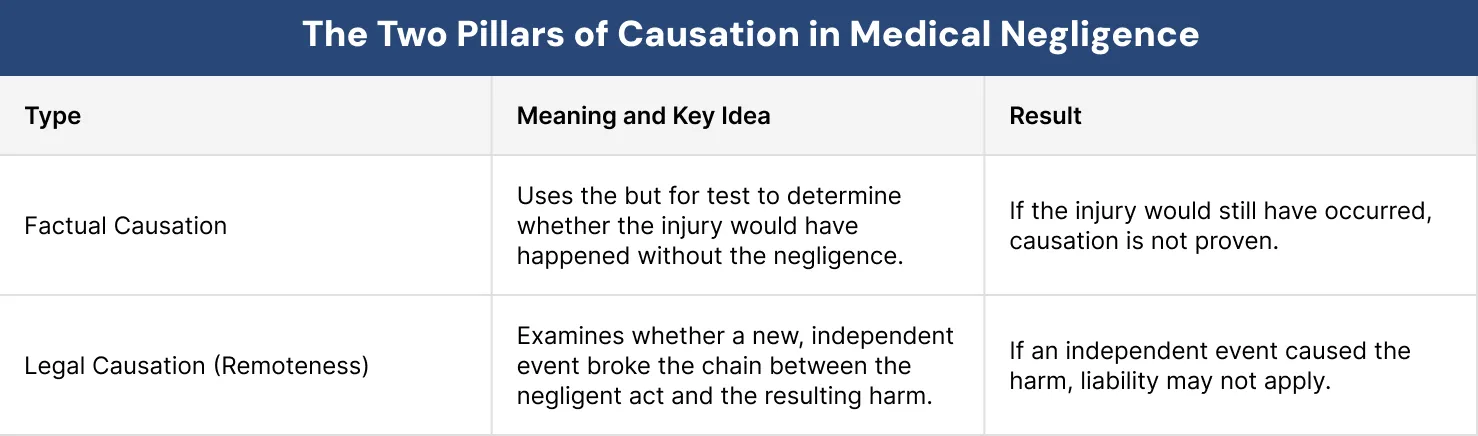
The Two Pillars of Causation in Medical Negligence

How Is Causation in Medical Negligence Proven Using the ‘But-For’ Test?

In many situations, courts rely on the ‘but for’ test to determine if negligence resulted in harm. It is one of the key methods of proving causation in medical negligence. The test involves analysing what would have been the outcome if the negligence did not happen.

The first thing to do is learn how to apply the test in real life situations.

1. Working of ‘But-For’ Test

The test asks one clear question: would the harm have occurred without the negligence?

  • If the answer is no, then there is a causal relationship.
  • If the answer is yes, then the case may be dismissed.

Such a test helps the court establish whether there is a link between the harm and the negligence.

Although the test seems easy, it may get complicated by different things that influence the health condition of a patient.

2. Challenges in Applying the Test

A test becomes difficult to apply due to many reasons such as:

  • A diagnosis was made late after many months.
  • A patient suffers from several diseases.
  • There were various factors that led to injuries.

These cases require the medical expert to determine the causation of injuries.

Examples of the But-For Test

What Makes Causation in Medical Negligence Cases So Complex in Practice?

The causation in medical negligence is complicated because it is not clear whether the error caused by the health care provider led to the patient’s injury. It could happen that the patient is already having some illness. This makes it hard to determine the cause of the injury. This is why the concept of causation has been challenged and carefully assessed by the court.

It might get difficult to prove the link in practice for several reasons:

1. Pre-existing Conditions

Many patients are sick before they receive treatment. It is important to separate the natural progression of the illness and the injury due to medical negligence.

2. Challenges with the “But For” Test

UK law needs proof that the injury would not have happened without negligence. If the results were to occur regardless of any negligence, the claim has less chance of succeeding.

3. Multiple Causes of Injury

Sometimes the causes are multiple. In such cases, it becomes hard to determine whether the negligence is the main cause or just one of many other contributing factors.

4. Conflicting Medical Evidence

Causation often depends on the opinions of medical experts. If these experts disagree, then the courts have to determine whose evidence is more reliable.

5. Loss of a Chance Cases

In other cases, where the problem is late diagnosis, the question becomes whether the patient has missed out on an opportunity to recover. The courts will then consider whether the loss is legally compensable.

So, these above are the reasons that make causation in medical negligence cases complex.

Key Point:

Causation in medical negligence is not automatically proven by showing a mistake. You must also prove that the mistake directly caused the injury, based on the balance of probabilities.

Case Study: Failure to Diagnose

Hotson v East Berkshire Area Health Authority [1988]

In this case, causation in UK law in a case of medical negligence is a very strong factor to be considered. Despite evidence of delay in treatment, the patient must prove the link between the delay and injuries that occurred. If this link is not proven, the claim will fail.

This is what happened in the case.

  • Case Facts

A 13-year-old boy got injuries to his hip after falling down. There was no diagnosis made for his injuries within five days of it happening. As a result, his injuries became worse, causing permanent damage to his hip.

This is when the court examined the actual cause of the injuries.

  • The Causation Issue

In this case, the court concluded that there was a 75% chance of the development of the disease even after receiving immediate treatment, which indicated that not enough blood vessels remained after the fall for the survival of the epiphysis. It means that the injury occurred before the delay at the hospital. This would imply that the damage had happened before the hospital delay.

The court held that in this particular case, the child needed to show that it was more likely than not (i.e., greater than 50%) that the hospital delay led to his damage.

Since he was unable to do so, the case was dismissed. The court further held that less than 50% of a ‘lost chance’ will not be enough for causation.

If there is more chance of the damage having been done before the mistake, causation does not exist.

The burden of proving causation rests on the claimant, who must show that the defendant’s breach caused the damage on the balance of probabilities.

Wilsher v Essex Area Health Authority [1988] AC 1074 

How Do Courts Decide Causation in Medical Negligence UK Cases?

In UK cases, causation is checked based on whether there is a greater chance that the medical negligence led to the injury. This is known as the balance of probabilities. Courts consider evidence to check if the damage was a common effect of the negligence.

To understand this better, first look at the standard of proof.

1. Standard of Proof in Medical Negligence

The legal standard used is ‘more likely than not.’ In other words, the chance that the harm is caused by negligence should be greater than 50%. If it falls below 50%, then the claim fails.

After that, all the evidence is evaluated to prove this point of the case.

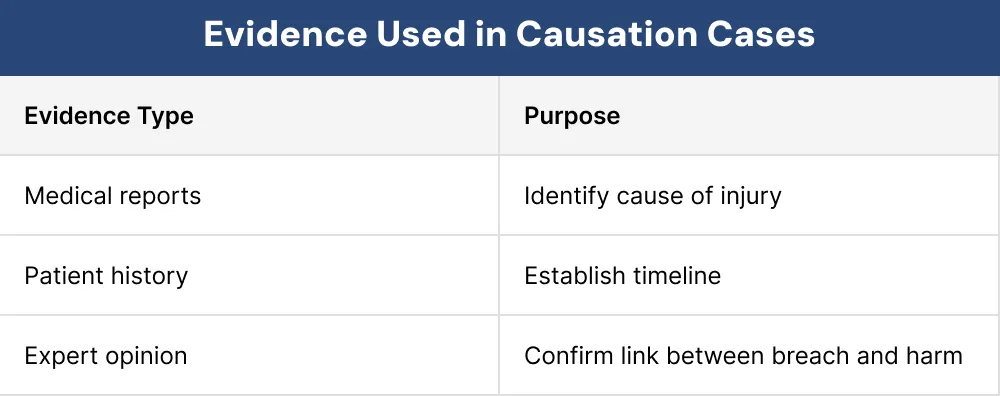
2. Evidence Used by the Courts

Courts rely on facts and evidence. Courts do not make assumptions regarding the cause of damage. Courts analyse facts and opinions from experts to determine what happened. Medical history will provide information regarding the treatment. The opinion of an expert will state the medical cause of damage.
Final Thoughts

Causation is necessary in court cases of medical negligence. This shows how the medical error led to an injury. Where causation cannot be proven, the lawsuit will fail even if there was negligence. In UK courts, the link must be proven that the mistake caused the injury.

This tends to be complicated. Several medical conditions may overlap or may result from other causes. So, detailed medical information and expert opinions become very important in such cases.

At Concise Medico, we help our clients to have a good understanding of their legal position in simple words. Contact us today if you want to discuss your case.

Not sure if a medical mistake led to your injury or made it worse?

Causation is often the hardest part of a claim to prove. We help you review your case with clear legal guidance and simple medical insight, so you understand your position easily. Reach out to us today if you think you may have a claim


Not sure if a medical mistake led to your injury or made it worse?

Causation is often the hardest part of a claim to prove. We help you review your case with clear legal guidance and simple medical insight, so you understand your position easily. Reach out to us today if you think you may have a claim

FAQs

What is causation in medical negligence in the UK?2026-06-30T06:14:48+00:00

In UK medical negligence law, causation is the legal requirement to prove that a healthcare provider’s negligent act or omission directly caused or significantly contributed to your injury, rather than the underlying illness itself. It is the critical link between the substandard care and the resulting damage.

Why is causation important in medical negligence claims?2026-06-30T06:15:14+00:00

Causation acts as the legal bridge connecting a healthcare provider’s negligent act to the actual harm a patient suffered. It is essential because, even if a medical error is obvious, a patient cannot recover compensation without proving that the mistake directly caused or worsened their injury.

What is the “but-for” test in medical negligence?2026-06-30T06:15:33+00:00

In medical negligence, the “but for” test establishes legal causation. It asks: “But for the healthcare professional’s negligence, would the patient’s injury or harm still have occurred?”. If the patient would have suffered the exact same outcome regardless of the medical mistake, the negligence did not legally cause the harm.

What is meant by break in the chain of causation?2026-06-30T06:16:11+00:00

A break in the chain of causation known legally as novus actus interveniens (a new intervening act) occurs when a new, independent, and unforeseeable event interrupts the sequence of events connecting a defendant’s initial wrongful action to the final harm or injury. If proven, this concept serves as a defense that can absolve the original wrongdoer of legal liability for the ultimate damage or consequence.

What evidence is needed to prove causation?2026-06-30T06:16:36+00:00

Proving causation generally requires showing that the cause happened before the effect and that there are no other reasonable explanations for the harm. In legal cases, especially medical negligence, this means proving both factual causation (usually through the “but-for” test) and legal causation. Evidence often includes expert witness reports, medical records, and other supporting documentation, and the standard of proof is the balance of probabilities, meaning it must be more likely than not that negligence caused the harm.

Share This Article!

The Importance of Causation in Medical Negligence Cases

Do you know that around 14,428 clinical negligence claims and incidents occurred in the UK in 2025? Negligence claims are very common in the UK. But, can a medical mistake itself result in compensation? No, not always. You can only get compensation if a medical expert’s mistake was the cause of your injury. That is because causation is crucial in these cases.

Causation means proving that the medical expert’s negligence caused you injury. This is an important requirement in every case. It ensures the injury happened due to causation in medical negligence. This is especially significant considering the large number of clinical negligence cases reviewed each year in the UK.

Key Takeaways

  • Causation in medical negligence is the link between a medical mistake and the harm suffered by a patient.
  • A claim can fail even if negligence occurred, if the harm was not caused by that negligence.
  • Courts often use the “but-for” test to decide whether the injury would have happened without the medical error.
  • Medical records and expert evidence play a key role in proving causation.
  • Pre-existing health issues and multiple causes can make causation harder to prove.
  • UK courts assess claims on the balance of probabilities, meaning harm must be more likely than not caused by the negligence.
  • Understanding causation helps patients see why some medical negligence claims succeed while others do not.

What Is Causation in Medical Negligence?

Causation in medical negligence cases means you have to prove that your injuries are caused by the negligence of a medical expert. Even if the medical mistake is accepted, you have to prove that the injury would not have happened ‘but for’ the negligence. This is a test of proof on the probabilities that it is ‘more likely’ than not the medical mistake caused the injury.

Key Point:

Causation is often the most disputed part of medical negligence claims.

What Is the Importance of Causation in Medical Negligence in the UK?

Causation in medical negligence in the UK is the legal bridge between the medical error and the damage caused to the patient. Even if the doctor’s care was below standard, the case will fail in court if no causation is proved.

In medical negligence causation cases, there are two frameworks to establish causation in the UK. One of them is factual causation, while the other is legal causation. For a successful claim, you have to satisfy both pillars of causation.

The difference between factual and legal causation in medical negligence is shown below:

1. Factual Causation (The ‘But For’ Test)

Causation in fact refers to the true cause of the injury. It asks the question, ‘What was the true cause of the injury?’ It focuses on the actions taken by the medical professional or any actions which were needed but not performed. In such a case, there will be an established cause of injury.

Once a cause is identified, the next step is for courts to check whether it is right to assign the legal blame.

2. Legal Causation (Material Contribution)

Legal causation checks fairness and risk. The question is whether the harm caused was a reasonable result of the mistake. If the harm that occurred was too far away or not what was expected, then the doctor cannot be held liable. This helps courts limit how far blame should go.

The Two Pillars of Causation in Medical Negligence

How Is Causation in Medical Negligence Proven Using the ‘But-For’ Test?

In many situations, courts rely on the ‘but for’ test to determine if negligence resulted in harm. It is one of the key methods of proving causation in medical negligence. The test involves analysing what would have been the outcome if the negligence did not happen.

The first thing to do is learn how to apply the test in real life situations.

1. Working of ‘But-For’ Test

The test asks one clear question: would the harm have occurred without the negligence?

  • If the answer is no, then there is a causal relationship.
  • If the answer is yes, then the case may be dismissed.

Such a test helps the court establish whether there is a link between the harm and the negligence.

Although the test seems easy, it may get complicated by different things that influence the health condition of a patient.

2. Challenges in Applying the Test

A test becomes difficult to apply due to many reasons such as:

  • A diagnosis was made late after many months.
  • A patient suffers from several diseases.
  • There were various factors that led to injuries.

These cases require the medical expert to determine the causation of injuries.

Examples of the But-For Test

What Makes Causation in Medical Negligence Cases So Complex in Practice?

The causation in medical negligence is complicated because it is not clear whether the error caused by the health care provider led to the patient’s injury. It could happen that the patient is already having some illness. This makes it hard to determine the cause of the injury. This is why the concept of causation has been challenged and carefully assessed by the court.

It might get difficult to prove the link in practice for several reasons:

1. Pre-existing Conditions

Many patients are sick before they receive treatment. It is important to separate the natural progression of the illness and the injury due to medical negligence.

2. Challenges with the “But For” Test

UK law needs proof that the injury would not have happened without negligence. If the results were to occur regardless of any negligence, the claim has less chance of succeeding.

3. Multiple Causes of Injury

Sometimes the causes are multiple. In such cases, it becomes hard to determine whether the negligence is the main cause or just one of many other contributing factors.

4. Conflicting Medical Evidence

Causation often depends on the opinions of medical experts. If these experts disagree, then the courts have to determine whose evidence is more reliable.

5. Loss of a Chance Cases

In other cases, where the problem is late diagnosis, the question becomes whether the patient has missed out on an opportunity to recover. The courts will then consider whether the loss is legally compensable.

So, these above are the reasons that make causation in medical negligence cases complex.

Key Point:

Causation in medical negligence is not automatically proven by showing a mistake. You must also prove that the mistake directly caused the injury, based on the balance of probabilities.

Case Study: Failure to Diagnose

Hotson v East Berkshire Area Health Authority [1988]

In this case, causation in UK law in a case of medical negligence is a very strong factor to be considered. Despite evidence of delay in treatment, the patient must prove the link between the delay and injuries that occurred. If this link is not proven, the claim will fail.

This is what happened in the case.

  • Case Facts

A 13-year-old boy got injuries to his hip after falling down. There was no diagnosis made for his injuries within five days of it happening. As a result, his injuries became worse, causing permanent damage to his hip.

This is when the court examined the actual cause of the injuries.

  • The Causation Issue

In this case, the court concluded that there was a 75% chance of the development of the disease even after receiving immediate treatment, which indicated that not enough blood vessels remained after the fall for the survival of the epiphysis. It means that the injury occurred before the delay at the hospital. This would imply that the damage had happened before the hospital delay.

The court held that in this particular case, the child needed to show that it was more likely than not (i.e., greater than 50%) that the hospital delay led to his damage.

Since he was unable to do so, the case was dismissed. The court further held that less than 50% of a ‘lost chance’ will not be enough for causation.

If there is more chance of the damage having been done before the mistake, causation does not exist.

The burden of proving causation rests on the claimant, who must show that the defendant’s breach caused the damage on the balance of probabilities.

Wilsher v Essex Area Health Authority [1988] AC 1074 

How Do Courts Decide Causation in Medical Negligence UK Cases?

In UK cases, causation is checked based on whether there is a greater chance that the medical negligence led to the injury. This is known as the balance of probabilities. Courts consider evidence to check if the damage was a common effect of the negligence.

To understand this better, first look at the standard of proof.

1. Standard of Proof in Medical Negligence

The legal standard used is ‘more likely than not.’ In other words, the chance that the harm is caused by negligence should be greater than 50%. If it falls below 50%, then the claim fails.

After that, all the evidence is evaluated to prove this point of the case.

2. Evidence Used by the Courts

Courts rely on facts and evidence. Courts do not make assumptions regarding the cause of damage. Courts analyse facts and opinions from experts to determine what happened. Medical history will provide information regarding the treatment. The opinion of an expert will state the medical cause of damage.

Final Thoughts

Causation is necessary in court cases of medical negligence. This shows how the medical error led to an injury. Where causation cannot be proven, the lawsuit will fail even if there was negligence. In UK courts, the link must be proven that the mistake caused the injury.

This tends to be complicated. Several medical conditions may overlap or may result from other causes. So, detailed medical information and expert opinions become very important in such cases.

At Concise Medico, we help our clients to have a good understanding of their legal position in simple words. Contact us today if you want to discuss your case.

Not sure if a medical mistake led to your injury or made it worse?

Causation is often the hardest part of a claim to prove. We help you review your case with clear legal guidance and simple medical insight, so you understand your position easily. Reach out to us today if you think you may have a claim
Not sure if a medical mistake led to your injury or made it worse?

Causation is often the hardest part of a claim to prove. We help you review your case with clear legal guidance and simple medical insight, so you understand your position easily. Reach out to us today if you think you may have a claim

FAQs

What is causation in medical negligence in the UK?2026-06-30T06:14:48+00:00

In UK medical negligence law, causation is the legal requirement to prove that a healthcare provider’s negligent act or omission directly caused or significantly contributed to your injury, rather than the underlying illness itself. It is the critical link between the substandard care and the resulting damage.

Why is causation important in medical negligence claims?2026-06-30T06:15:14+00:00

Causation acts as the legal bridge connecting a healthcare provider’s negligent act to the actual harm a patient suffered. It is essential because, even if a medical error is obvious, a patient cannot recover compensation without proving that the mistake directly caused or worsened their injury.

What is the “but-for” test in medical negligence?2026-06-30T06:15:33+00:00

In medical negligence, the “but for” test establishes legal causation. It asks: “But for the healthcare professional’s negligence, would the patient’s injury or harm still have occurred?”. If the patient would have suffered the exact same outcome regardless of the medical mistake, the negligence did not legally cause the harm.

What is meant by break in the chain of causation?2026-06-30T06:16:11+00:00

A break in the chain of causation known legally as novus actus interveniens (a new intervening act) occurs when a new, independent, and unforeseeable event interrupts the sequence of events connecting a defendant’s initial wrongful action to the final harm or injury. If proven, this concept serves as a defense that can absolve the original wrongdoer of legal liability for the ultimate damage or consequence.

What evidence is needed to prove causation?2026-06-30T06:16:36+00:00

Proving causation generally requires showing that the cause happened before the effect and that there are no other reasonable explanations for the harm. In legal cases, especially medical negligence, this means proving both factual causation (usually through the “but-for” test) and legal causation. Evidence often includes expert witness reports, medical records, and other supporting documentation, and the standard of proof is the balance of probabilities, meaning it must be more likely than not that negligence caused the harm.

Go to Top
