How Much Compensation for Cerebral Palsy Negligence Claims? UK Payout Guide 2026

Published On: June 10th, 2026|Total Views: 2|Daily Views: 2|12.2 min read|2445 words|

TABLE OF CONTENT

Taking care of a child with cerebral palsy can change and affect daily life in many ways. Parents may often have to deal with therapy sessions, money issues and also emotional stress.

If cerebral palsy happened due to poor medical care then families may be able to seek compensation. These cases are called cerebral palsy negligence claims and it can help to cover long-term support and treatment.

Recent research shows that one in every 400 children is affected by cerebral palsy. This means every year about 1,800 babies are diagnosed with cerebral palsy in the UK.

Key Takeaways

  • Cerebral palsy negligence claims may arise when a child’s condition is linked to avoidable medical mistakes during pregnancy, birth, or shortly after delivery.
  • Compensation is not fixed and depends on the severity of the condition, care needs, and long-term impact on daily life.
  • Claims usually include two parts:
    • General damages for pain, suffering, and loss of quality of life
    • Special damages for medical costs, care, equipment, and future support
  • Severe cases can result in high-value settlements, often reaching millions of pounds due to lifelong care requirements.
  • Every case is different, and expert medical evidence is needed to prove negligence and causation.
  • Families may receive interim payments to help cover urgent care and therapy costs while the claim is ongoing.
  • Legal time limits apply, but children usually have longer to bring a claim, often until three years after turning 18.
  • Specialist solicitors often handle these claims on a No Win No Fee basis, reducing financial risk for families.
  • The goal of compensation is to provide long-term financial security and support for the child’s future needs.

Understanding the Cerebral Palsy Negligence Claims

Cerebral palsy is a condition that affects movement, posture and also muscle control. It mostly happens when the brain is damaged before, during or after the child birth.

Some children have less symptoms and live quite easily. But others may need support and full-time care.

Cerebral palsy may be caused by certain cases of medical negligence such as when doctors fail to notice a lack of oxygen. It can also happen if doctors do not quickly treat infections of the mother or severe jaundice in the newborn.

Remember not every case is caused by medical mistakes. However, some cerebral palsy negligence claims come when doctors or staff fail to provide proper care.

What Is Cerebral Palsy?

The word “cerebral” relates to the brain. “Palsy” refers to weakness or difficulty with muscle movement.

Children who are affected with cerebral palsy may struggle with walking, balance or speech. The condition affects every child in different ways.

Some children may use mobility aids, while others may require 24 hours care from healthcare professionals. This depends on the severity of the condition.

Types of Cerebral Palsy

Doctors usually group cerebral palsy into different types, based on movement problems. Each type has different symptoms. Some children have only one type but others may experience more than one type at a time.
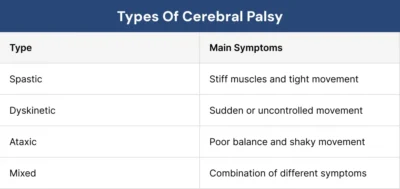
Symptoms can range from less weakness to severe mobility problems. This can often affect compensation levels in cerebral palsy negligence claims.

How Cerebral Palsy Affects Families?

Cerebral palsy can affect more than just physical movement. It can also affect learning, hearing and also daily life activities.

Parents often spend large amounts of time in treatment of their child. Many families also face emotional and financial pressure.

Some parents may reduce their working hours or stop working altogether. This loss of income may form part of cerebral palsy negligence claims.

Causes Behind Cerebral Palsy Negligence Claims

Cerebral palsy can happen due to many reasons. Some cases develop naturally and can not be prevented.

Other cases may come from medical mistakes. These are the situations where legal action may be possible.

Families often ask whether something went wrong during birth or shortly after birth. In this case medical records and expert reports can help answer this question.

Can Medical Negligence Cause Cerebral Palsy?

Yes, medical negligence can sometimes lead to cerebral palsy. This usually happens when a baby suffers from brain damage because of poor care.

A lack of oxygen to the brain is one of the most common causes. This can happen if warning signs are missed and not focused on it.

To succeed in cerebral palsy negligence claims you must show that the injury could have been avoided with proper treatment.

Common Medical Errors Linked to Cerebral Palsy

There are many situations where poor medical care may affect. Not every mistake leads to a claim but some failures can cause serious harm.

Common examples include:

  • Failure to monitor the baby’s heart rate
  • Delayed caesarean section
  • Failure to react to fetal distress
  • Incorrect use of forceps or vacuum delivery
  • Failure to provide oxygen after birth
  • Undiagnosed infections or jaundice

These issues often appear in cerebral palsy negligence.

Natural Causes vs Medical Negligence

Some children face cerebral palsy because of genetics, early brain problems or premature birth. These cases may not involve negligence.

Medical negligence means the care does not meet the safety standards. But this must be proven through evidence.

Who Can Make Cerebral Palsy Negligence Claims?

Parents often wonder whether they can make a claim on behalf of their child or not. In many cases, the answer is yes.

Claims can usually be made if medical negligence caused or contributed to the condition. In this case legal advice helps families to understand their options in a better way.

The process may feel overwhelming, but support of the professional can make things clearer and easy.

Legal Requirements for a Claim

There are key legal points that must be proven. These points apply to most medical negligence cases.

Missing one of these points may weaken your claim. Strong evidence is very important for the claim.

A successful claim usually needs proof of:

  • Duty of care
  • Breach of duty
  • Causation

These legal steps form the basis of cerebral palsy negligence claims.

Duty of Care and Breach

Medical professionals have a duty to take care of patients. This means they must provide treatment that meets proper medical standards and rules.

A breach happens when the treatment falls below from what is reasonably expected. This could involve delay or poor care.

For example, failing to monitor the oxygen levels during labour may be considered a breach.

Causation and Medical Evidence

Causation means proving that the medical mistake played a role in the injury. This is often the hardest part of the case.

In this case medical experts will review the records of hospitals and they also provide their opinions.

Without proper and right evidence, cerebral palsy negligence claims are difficult to prove.

How Compensation Is Calculated in Cerebral Palsy Negligence Claims?

Every claim is different from others. Compensation depends on the child’s needs and the impact of their future life.

Some children need limited support, while others require lifetime care. This is why compensation varies widely.

In this process legal experts work with the medical and care experts to understand the future needs.

Factors That Affect Compensation

During a claim courts look at many different areas. The aim is to ensure that long-term support is properly funded.

The severity of the condition is only one part of the calculation.

Important factors include:

  • Level of disability
  • Therapy and treatment costs
  • Care needs
  • Housing changes
  • Equipment costs
  • Loss of earnings
  • Impact on quality of life

These factors play a major role in cerebral palsy negligence claims.

Types of Compensation

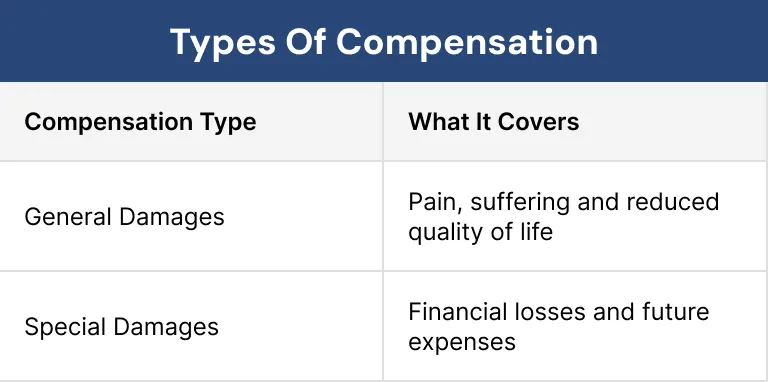
There are mainly two types of compensation in cerebral negligence claims including:

  • General damages
  • Special damages
Types of Compensation

Special damages in cerebral palsy negligence claims may include:

  • Therapy and medical treatment
  • Wheelchairs and mobility aids
  • Home adaptations
  • Vehicle changes
  • Care costs
  • Education support
  • Lost income for carers

Did you know?

Special damages are designed to ensure that children need the support throughout life.

Average Compensation in Cerebral Palsy Negligence Claims

One of the first questions most parents ask is how much compensation they may receive. The answer depends on the facts of the case and the child’s future needs.

There is no fixed amount for cerebral palsy negligence claims. It is based on the level of injury, care needs and financial losses.

Some cases involve moderate support needs, while others require lifetime care and also specialist treatment.

Read more: How Much Compensation Can You Claim for Surgical Negligence in the UK?

Typical Compensation Ranges

Compensation can range from thousands to many millions of pounds.
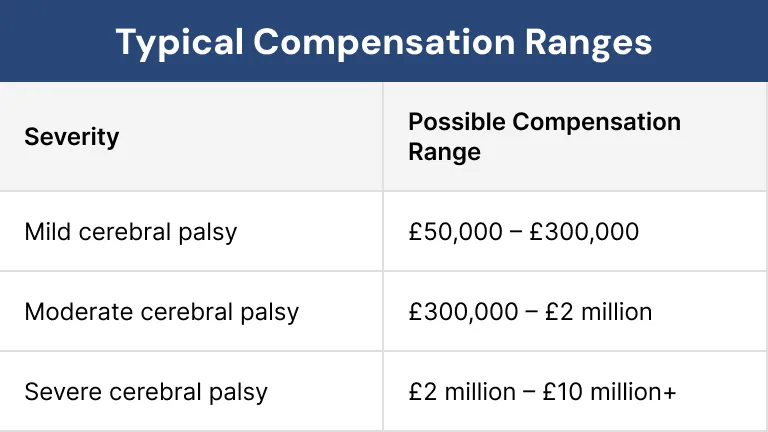
Typical Compensation Ranges

These figures show why cerebral palsy negligence claims are often considered high-value medical negligence cases.

Brain Injury and Compensation

Cerebral palsy often involves brain damage which is caused by lack of oxygen or birth injury. The level of brain injury affects the compensation.

Mild injuries may involve limited long-term impact. Severe injuries can affect mobility, speech and also eyesight.

Courts look closely at evidence when deciding the compensation for brain injuries.
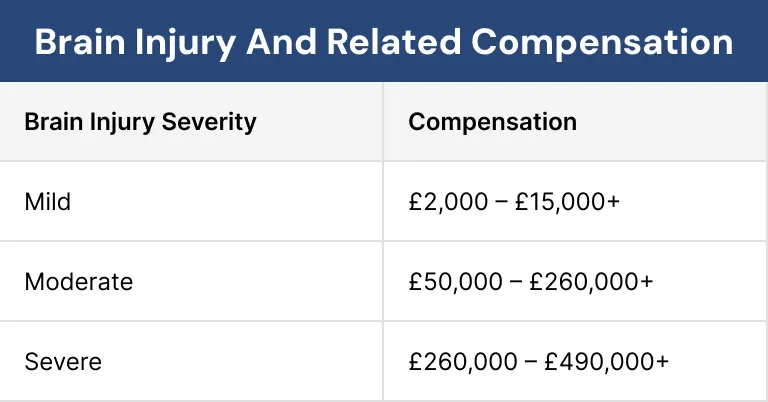
Brain Injury and Related Compensation

These figures may form only part of wider cerebral palsy negligence claims.

Compensation for Other Conditions

Some children with cerebral palsy can also suffer from conditions like epilepsy or seizures. These may affect their daily life and also increase the needs of care.

If these problems are found, the compensation amount may increase. In this case the impact on education is also considered.

Conditions often linked with cerebral palsy include:

  • Epilepsy
  • Speech problems
  • Hearing loss
  • Learning difficulties
  • Vision problems
  • Joint and posture issues

Did you know?

Additional conditions can increase both treatment costs and overall compensation.

Interim Payments in Cerebral Palsy Negligence Claims

Legal cases can take time to settle. In this case families may need help long before the payment of final compensation arrives.

Interim payments are early payments which are made while the case continues. It helps to provide practical support during the claim.

What Interim Payments Can Cover?

Early support can help in the treatment process of the child. Many families rely on interim payments to access the care sooner.

These payments can be used in many ways. Common uses include:

  • Therapy sessions
  • Home care support
  • Medical treatment
  • Mobility aids
  • Home changes
  • Specialist equipment

Interim payments often play an important role in cerebral palsy negligence claims.

Time Limits for Cerebral Palsy Negligence Claims

Legal claims must normally be started within certain time limits. Children follow different rules for the claim as compared to adults.

Time Limits for Children

A child usually can not manage a legal claim alone. Parents or guardians can act on their behalf. In many cases, the age of a child must be 21 to begin a claim. This is because the normal time limit starts at age 18.

Remember that families do not need to wait until adulthood. Claims can begin much earlier.

Litigation Friends and Mental Capacity

Parents often act as a litigation friend. This means they make decisions and also manage the case on the behalf of the child.

This role allows parents to protect the legal interests of the child. In this case courts supervise this process.

An adult child requires a litigation friend if they lack the mental capacity to handle a court case due to illness, injury or disability.

Did you know?

If the child lacks mental capacity as an adult, time limits may work differently.

Do You Need a Lawyer for Cerebral Palsy Negligence Claims?

Yes, you need a lawyer for cerebral palsy negligence claims. Because medical negligence cases are often more complex.

Many families choose a specialist lawyer because the process can feel difficult to handle without their support.

In this process a lawyer can manage legal work while families focus on care and treatment of the child.

What is the Role of a Lawyer?

The role of the lawyer is to investigate the case and collect all related evidence. They also speak with medical experts for additional evidence.

A lawyer may help with:

  • Medical records
  • Expert evidence
  • Settlement talks
  • Interim payment requests
  • Court paperwork

This support can help to make cerebral palsy negligence claims easier to manage.

What is a No Win No Fee Agreement?

Many lawyers offer No Win No Fee agreements. These are also called Conditional Fee Agreements.

Families usually do not pay the upfront legal fees. Payment is only paid when you get success in your case.This can help to reduce the financial risk and allows families to seek the advice more confidently.

How to Start Cerebral Palsy Negligence Claims?

In the beginning of the claim it may feel stressful at first. If you understand the process then it can make things less overwhelming.

Most claims follow similar stages. Each stage helps to build evidence and also add value to the case. The goal is to secure fair compensation for lifetime support.

Step-by-Step Claims Process

The process often starts with an initial consultation. A lawyer reviews the case and also explains the options.

After reviewing the case a lawyer gathered all the medical evidence. Expert opinions also help to support the case.

Stages for the claims includes:

  1. Initial legal advice
  2. Medical record review
  3. Expert evidence
  4. Letter of claim
  5. Settlement talks or court action
  6. Final compensation agreement

Most cerebral palsy negligence claims settle without a full trial.

How Long Do Claims Take?

There is no exact time for every case. However some settle within a few years, while others take longer.

Severe cases may require detailed medical assessments. Experts often need time to understand the care needs of the future.

Although the process can be lengthy, good planning helps to secure long-term support.

Case Study: Compensation for a Child with Cerebral Palsy

An 11-year-old boy in England received a £4 million compensation after a medical negligence claim against an NHS hospital. The child faces cerebral palsy as a result of a brain injury that occurred around the time of his birth.

The settlement was reached before the case proceeded to a full trial.

Conclusion

Cerebral palsy can have lifetime effects on a child and their family. Daily care, therapy and also financial pressures can feel stressful.

If poor medical treatment caused harm, cerebral palsy negligence claims may provide good support. In such a case compensation can help to cover the treatment, care and also future needs.

Every case is different from others, which is why advice from the legal specialist matters. Early guidance can help families to understand their legal rights and make good decisions. We at Concise Medico fully understand cerebral palsy negligence claims and are here to help you in this process.

We understand cerebral palsy claims, and we are ready to help you.

Don’t face the legal hurdles alone. Feel free to contact us today for expert opinions.

We understand cerebral palsy claims, and we are ready to help you.

Don’t face the legal hurdles alone. Feel free to contact us today for expert opinions.

FAQs

How much compensation can you get for cerebral palsy negligence claims?2026-06-10T06:21:39+00:00

Compensation varies depending on the severity of the condition and future care needs. Severe cases may exceed several million pounds. The final amount depends on medical evidence and financial losses.

Can parents make cerebral palsy negligence claims for their child?2026-06-10T06:23:04+00:00

Yes, parents can usually claim as a litigation friend. This allows them to act on the child’s behalf.
The court ensures the child’s interests remain protected.

What proof is needed for cerebral palsy negligence claims?2026-06-10T06:23:33+00:00

Medical records and expert reports are very important. Evidence must show negligence and causation.
Strong evidence helps support a successful claim.

How long do cerebral palsy negligence claims take?2026-06-10T06:24:03+00:00

Some claims settle in a few years, while complex cases take longer. Future care needs often affect timing.
Interim payments may help while the case continues.

Are cerebral palsy negligence claims available on a No Win No Fee basis?2026-06-10T06:24:31+00:00

Yes, many specialist solicitors offer No Win No Fee agreements. This means families often avoid upfront legal costs.
Terms may vary, so legal advice is important before proceeding.

Share This Article!

Taking care of a child with cerebral palsy can change and affect daily life in many ways. Parents may often have to deal with therapy sessions, money issues and also emotional stress.

If cerebral palsy happened due to poor medical care then families may be able to seek compensation. These cases are called cerebral palsy negligence claims and it can help to cover long-term support and treatment.

Recent research shows that one in every 400 children is affected by cerebral palsy. This means every year about 1,800 babies are diagnosed with cerebral palsy in the UK.

Key Takeaways

  • Cerebral palsy negligence claims may arise when a child’s condition is linked to avoidable medical mistakes during pregnancy, birth, or shortly after delivery.
  • Compensation is not fixed and depends on the severity of the condition, care needs, and long-term impact on daily life.
  • Claims usually include two parts:
    • General damages for pain, suffering, and loss of quality of life
    • Special damages for medical costs, care, equipment, and future support
  • Severe cases can result in high-value settlements, often reaching millions of pounds due to lifelong care requirements.
  • Every case is different, and expert medical evidence is needed to prove negligence and causation.
  • Families may receive interim payments to help cover urgent care and therapy costs while the claim is ongoing.
  • Legal time limits apply, but children usually have longer to bring a claim, often until three years after turning 18.
  • Specialist solicitors often handle these claims on a No Win No Fee basis, reducing financial risk for families.
  • The goal of compensation is to provide long-term financial security and support for the child’s future needs.

Understanding the Cerebral Palsy Negligence Claims

Cerebral palsy is a condition that affects movement, posture and also muscle control. It mostly happens when the brain is damaged before, during or after the child birth.

Some children have less symptoms and live quite easily. But others may need support and full-time care.

Cerebral palsy may be caused by certain cases of medical negligence such as when doctors fail to notice a lack of oxygen. It can also happen if doctors do not quickly treat infections of the mother or severe jaundice in the newborn.

Remember not every case is caused by medical mistakes. However, some cerebral palsy negligence claims come when doctors or staff fail to provide proper care.

What Is Cerebral Palsy?

The word “cerebral” relates to the brain. “Palsy” refers to weakness or difficulty with muscle movement.

Children who are affected with cerebral palsy may struggle with walking, balance or speech. The condition affects every child in different ways.

Some children may use mobility aids, while others may require 24 hours care from healthcare professionals. This depends on the severity of the condition.

Types of Cerebral Palsy

Doctors usually group cerebral palsy into different types, based on movement problems. Each type has different symptoms. Some children have only one type but others may experience more than one type at a time.

Symptoms can range from less weakness to severe mobility problems. This can often affect compensation levels in cerebral palsy negligence claims.

How Cerebral Palsy Affects Families?

Cerebral palsy can affect more than just physical movement. It can also affect learning, hearing and also daily life activities.

Parents often spend large amounts of time in treatment of their child. Many families also face emotional and financial pressure.

Some parents may reduce their working hours or stop working altogether. This loss of income may form part of cerebral palsy negligence claims.

Causes Behind Cerebral Palsy Negligence Claims

Cerebral palsy can happen due to many reasons. Some cases develop naturally and can not be prevented.

Other cases may come from medical mistakes. These are the situations where legal action may be possible.

Families often ask whether something went wrong during birth or shortly after birth. In this case medical records and expert reports can help answer this question.

Can Medical Negligence Cause Cerebral Palsy?

Yes, medical negligence can sometimes lead to cerebral palsy. This usually happens when a baby suffers from brain damage because of poor care.

A lack of oxygen to the brain is one of the most common causes. This can happen if warning signs are missed and not focused on it.

To succeed in cerebral palsy negligence claims you must show that the injury could have been avoided with proper treatment.

Common Medical Errors Linked to Cerebral Palsy

There are many situations where poor medical care may affect. Not every mistake leads to a claim but some failures can cause serious harm.

Common examples include:

  • Failure to monitor the baby’s heart rate
  • Delayed caesarean section
  • Failure to react to fetal distress
  • Incorrect use of forceps or vacuum delivery
  • Failure to provide oxygen after birth
  • Undiagnosed infections or jaundice

These issues often appear in cerebral palsy negligence.

Natural Causes vs Medical Negligence

Some children face cerebral palsy because of genetics, early brain problems or premature birth. These cases may not involve negligence.

Medical negligence means the care does not meet the safety standards. But this must be proven through evidence.

Who Can Make Cerebral Palsy Negligence Claims?

Parents often wonder whether they can make a claim on behalf of their child or not. In many cases, the answer is yes.

Claims can usually be made if medical negligence caused or contributed to the condition. In this case legal advice helps families to understand their options in a better way.

The process may feel overwhelming, but support of the professional can make things clearer and easy.

Legal Requirements for a Claim

There are key legal points that must be proven. These points apply to most medical negligence cases.

Missing one of these points may weaken your claim. Strong evidence is very important for the claim.

A successful claim usually needs proof of:

  • Duty of care
  • Breach of duty
  • Causation

These legal steps form the basis of cerebral palsy negligence claims.

Duty of Care and Breach

Medical professionals have a duty to take care of patients. This means they must provide treatment that meets proper medical standards and rules.

A breach happens when the treatment falls below from what is reasonably expected. This could involve delay or poor care.

For example, failing to monitor the oxygen levels during labour may be considered a breach.

Causation and Medical Evidence

Causation means proving that the medical mistake played a role in the injury. This is often the hardest part of the case.

In this case medical experts will review the records of hospitals and they also provide their opinions.

Without proper and right evidence, cerebral palsy negligence claims are difficult to prove.

How Compensation Is Calculated in Cerebral Palsy Negligence Claims?

Every claim is different from others. Compensation depends on the child’s needs and the impact of their future life.

Some children need limited support, while others require lifetime care. This is why compensation varies widely.

In this process legal experts work with the medical and care experts to understand the future needs.

Factors That Affect Compensation

During a claim courts look at many different areas. The aim is to ensure that long-term support is properly funded.

The severity of the condition is only one part of the calculation.

Important factors include:

  • Level of disability
  • Therapy and treatment costs
  • Care needs
  • Housing changes
  • Equipment costs
  • Loss of earnings
  • Impact on quality of life

These factors play a major role in cerebral palsy negligence claims.

Types of Compensation

There are mainly two types of compensation in cerebral negligence claims including:

  • General damages
  • Special damages
Types of Compensation

Special damages in cerebral palsy negligence claims may include:

  • Therapy and medical treatment
  • Wheelchairs and mobility aids
  • Home adaptations
  • Vehicle changes
  • Care costs
  • Education support
  • Lost income for carers

Did you know?

Special damages are designed to ensure that children need the support throughout life.

Average Compensation in Cerebral Palsy Negligence Claims

One of the first questions most parents ask is how much compensation they may receive. The answer depends on the facts of the case and the child’s future needs.

There is no fixed amount for cerebral palsy negligence claims. It is based on the level of injury, care needs and financial losses.

Some cases involve moderate support needs, while others require lifetime care and also specialist treatment.

Read more: How Much Compensation Can You Claim for Surgical Negligence in the UK?

Typical Compensation Ranges

Compensation can range from thousands to many millions of pounds.

Typical Compensation Ranges

These figures show why cerebral palsy negligence claims are often considered high-value medical negligence cases.

Brain Injury and Compensation

Cerebral palsy often involves brain damage which is caused by lack of oxygen or birth injury. The level of brain injury affects the compensation.

Mild injuries may involve limited long-term impact. Severe injuries can affect mobility, speech and also eyesight.

Courts look closely at evidence when deciding the compensation for brain injuries.

Brain Injury and Related Compensation

These figures may form only part of wider cerebral palsy negligence claims.

Compensation for Other Conditions

Some children with cerebral palsy can also suffer from conditions like epilepsy or seizures. These may affect their daily life and also increase the needs of care.

If these problems are found, the compensation amount may increase. In this case the impact on education is also considered.

Conditions often linked with cerebral palsy include:

  • Epilepsy
  • Speech problems
  • Hearing loss
  • Learning difficulties
  • Vision problems
  • Joint and posture issues

Did you know?

Additional conditions can increase both treatment costs and overall compensation.

Interim Payments in Cerebral Palsy Negligence Claims

Legal cases can take time to settle. In this case families may need help long before the payment of final compensation arrives.

Interim payments are early payments which are made while the case continues. It helps to provide practical support during the claim.

What Interim Payments Can Cover?

Early support can help in the treatment process of the child. Many families rely on interim payments to access the care sooner.

These payments can be used in many ways. Common uses include:

  • Therapy sessions
  • Home care support
  • Medical treatment
  • Mobility aids
  • Home changes
  • Specialist equipment

Interim payments often play an important role in cerebral palsy negligence claims.

Time Limits for Cerebral Palsy Negligence Claims

Legal claims must normally be started within certain time limits. Children follow different rules for the claim as compared to adults.

Time Limits for Children

A child usually can not manage a legal claim alone. Parents or guardians can act on their behalf. In many cases, the age of a child must be 21 to begin a claim. This is because the normal time limit starts at age 18.

Remember that families do not need to wait until adulthood. Claims can begin much earlier.

Litigation Friends and Mental Capacity

Parents often act as a litigation friend. This means they make decisions and also manage the case on the behalf of the child.

This role allows parents to protect the legal interests of the child. In this case courts supervise this process.

An adult child requires a litigation friend if they lack the mental capacity to handle a court case due to illness, injury or disability.

Did you know?

If the child lacks mental capacity as an adult, time limits may work differently.

Do You Need a Lawyer for Cerebral Palsy Negligence Claims?

Yes, you need a lawyer for cerebral palsy negligence claims. Because medical negligence cases are often more complex.

Many families choose a specialist lawyer because the process can feel difficult to handle without their support.

In this process a lawyer can manage legal work while families focus on care and treatment of the child.

What is the Role of a Lawyer?

The role of the lawyer is to investigate the case and collect all related evidence. They also speak with medical experts for additional evidence.

A lawyer may help with:

  • Medical records
  • Expert evidence
  • Settlement talks
  • Interim payment requests
  • Court paperwork

This support can help to make cerebral palsy negligence claims easier to manage.

What is a No Win No Fee Agreement?

Many lawyers offer No Win No Fee agreements. These are also called Conditional Fee Agreements.

Families usually do not pay the upfront legal fees. Payment is only paid when you get success in your case.This can help to reduce the financial risk and allows families to seek the advice more confidently.

How to Start Cerebral Palsy Negligence Claims?

In the beginning of the claim it may feel stressful at first. If you understand the process then it can make things less overwhelming.

Most claims follow similar stages. Each stage helps to build evidence and also add value to the case. The goal is to secure fair compensation for lifetime support.

Step-by-Step Claims Process

The process often starts with an initial consultation. A lawyer reviews the case and also explains the options.

After reviewing the case a lawyer gathered all the medical evidence. Expert opinions also help to support the case.

Stages for the claims includes:

  1. Initial legal advice
  2. Medical record review
  3. Expert evidence
  4. Letter of claim
  5. Settlement talks or court action
  6. Final compensation agreement

Most cerebral palsy negligence claims settle without a full trial.

How Long Do Claims Take?

There is no exact time for every case. However some settle within a few years, while others take longer.

Severe cases may require detailed medical assessments. Experts often need time to understand the care needs of the future.

Although the process can be lengthy, good planning helps to secure long-term support.

Case Study: Compensation for a Child with Cerebral Palsy

An 11-year-old boy in England received a £4 million compensation after a medical negligence claim against an NHS hospital. The child faces cerebral palsy as a result of a brain injury that occurred around the time of his birth.

The settlement was reached before the case proceeded to a full trial.

Conclusion

Cerebral palsy can have lifetime effects on a child and their family. Daily care, therapy and also financial pressures can feel stressful.

If poor medical treatment caused harm, cerebral palsy negligence claims may provide good support. In such a case compensation can help to cover the treatment, care and also future needs.

Every case is different from others, which is why advice from the legal specialist matters. Early guidance can help families to understand their legal rights and make good decisions. We at Concise Medico fully understand cerebral palsy negligence claims and are here to help you in this process.

We understand cerebral palsy claims, and we are ready to help you.

Don’t face the legal hurdles alone. Feel free to contact us today for expert opinions.

We understand cerebral palsy claims, and we are ready to help you.

Don’t face the legal hurdles alone. Feel free to contact us today for expert opinions.

FAQs

How much compensation can you get for cerebral palsy negligence claims?2026-06-10T06:21:39+00:00

Compensation varies depending on the severity of the condition and future care needs. Severe cases may exceed several million pounds. The final amount depends on medical evidence and financial losses.

Can parents make cerebral palsy negligence claims for their child?2026-06-10T06:23:04+00:00

Yes, parents can usually claim as a litigation friend. This allows them to act on the child’s behalf.
The court ensures the child’s interests remain protected.

What proof is needed for cerebral palsy negligence claims?2026-06-10T06:23:33+00:00

Medical records and expert reports are very important. Evidence must show negligence and causation.
Strong evidence helps support a successful claim.

How long do cerebral palsy negligence claims take?2026-06-10T06:24:03+00:00

Some claims settle in a few years, while complex cases take longer. Future care needs often affect timing.
Interim payments may help while the case continues.

Are cerebral palsy negligence claims available on a No Win No Fee basis?2026-06-10T06:24:31+00:00

Yes, many specialist solicitors offer No Win No Fee agreements. This means families often avoid upfront legal costs.
Terms may vary, so legal advice is important before proceeding.

Go to Top