TABLE OF CONTENT
A Guide on Making CICA Abuse Claims
Have you ever gone through physical, sexual, or emotional abuse? If you have, you could apply for compensation from the Criminal Injuries Compensation Authority, known as CICA. Every year, thousands of people turn to CICA for help. They handled over 40,000 compensation applications annually. That’s a lot of people looking for support after violent crimes, including different forms of abuse.
If you qualify, a CICA abuse claim can help you get compensation for things like physical, sexual, or domestic abuse. The scheme also covers other violent crimes. And if you’ve suffered psychological injuries, there’s a chance you can get compensation for that too, as long as you meet their criteria.
This guide explains who can make a CICA abuse claim, what types of abuse are covered, the eligibility requirements, and what to expect before starting your application.
Who Can Make a CICA Abuse Claim?
Not everyone can make CICA abuse claims. You must meet the rules of the Criminal Injuries Compensation Scheme.
You may be able to claim if:
- You were injured because of a violent crime.
- The abuse happened in England, Scotland or Wales.
- The incident was reported to the police.
- You meet the CICA time limit or qualify for an exception.
- You cooperate with the police and the CICA during your claim.
What Types of Abuse Can Be Claimed Through CICA?
The types of abuse that can be claimed through CICA include physical abuse, sexual abuse, child abuse, domestic abuse, modern slavery and human trafficking. To claim compensation through CICA, the abuse must have resulted from a violent crime covered by the CICA Scheme and meet the eligibility requirements.
The sections below explain the main types of abuse that may qualify.
1. Physical Abuse
Physical abuse happens when someone intentionally hurts another person. Examples include:
- Punching
- Kicking
- Burning
- Strangling
- Using a weapon
Physical abuse may cause the following:
- Broken bones
- Cuts
- Head injuries
- Long-term pain
- Emotional trauma
Many successful CICA abuse claims involve physical injuries supported by medical records and police reports.
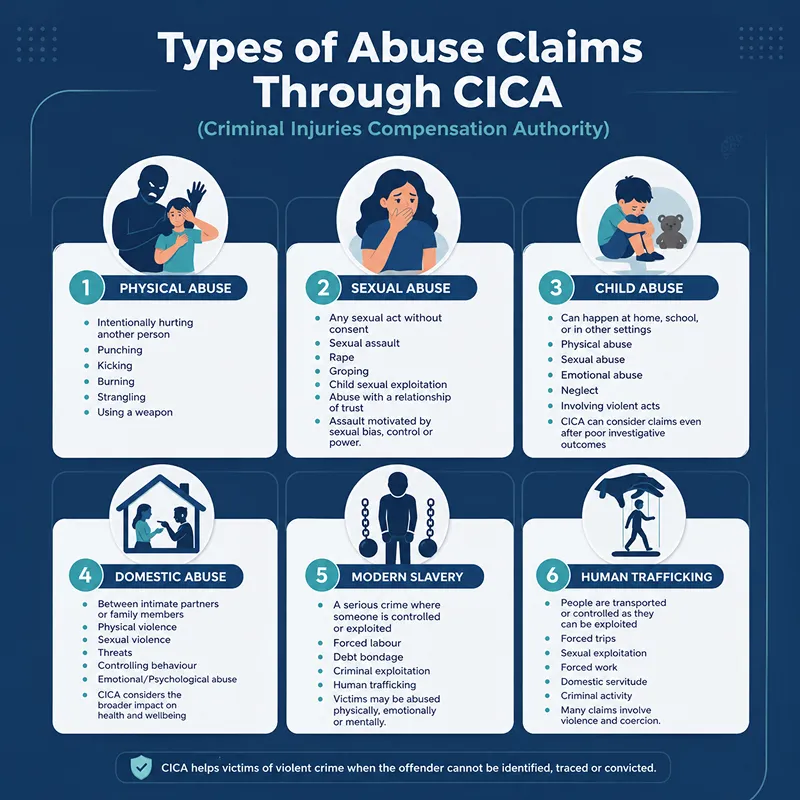
2. Sexual Abuse
Sexual abuse includes any sexual act without consent. This may include:
- Sexual assault
- Rape
- Grooming
- Child sexual exploitation
- Sexual abuse by a partner
Sexual abuse often causes emotional as well as physical harm. Some people also develop anxiety, depression or post-traumatic stress disorder (PTSD).
3. Child Abuse
Child abuse can happen at home, in school, in care or in other settings. It may include:
- Physical abuse
- Sexual abuse
- Emotional abuse
- Serious neglect involving violent acts
Many adults only feel able to report abuse years later. The CICA understands that this can happen and may consider claims outside the normal time limit where there are exceptional reasons.
4. Domestic Abuse
Domestic abuse involves abusive behaviour between family members, partners or former partners. It may involve:
- Physical violence
- Sexual violence
- Threats
- Controlling behaviour
- Coercive behaviour
Domestic abuse often continues over a long period. Survivors may feel frightened or unable to report the abuse to the police.
5. Modern Slavery
Modern slavery is a serious crime where someone is controlled or exploited. This may include:
- Forced labour
- Debt bondage
- Criminal exploitation
Victims of this type of abuse often face physical injuries and serious mental harm.
6. Human Trafficking
Human trafficking happens when people are moved or controlled so they can be exploited. Victims may be forced into:
- Sexual exploitation
- Forced work
- Domestic servitude
- Criminal activity
Many CICA abuse claims that involve trafficking rely on police and medical reports.
What Evidence Do You Need for a CICA Abuse Claim?
Good evidence can help you to improve the chances of a successful claim. The CICA looks at different types of details before making a decision. You do not always need every type of evidence, but the more reliable evidence you have, the stronger your claim may be.
Common evidence used in CICA abuse claims includes medical records, police reports and other official documents.
1. Medical Records
Medical records are one of the strongest forms of evidence in CICA abuse claims. These records may include:
- GP notes
- Hospital records
- Mental health records
- Counselling records
Medical records show:
- The injuries you suffered
- When the injuries happened
- The treatment you received
- How the abuse affected your health
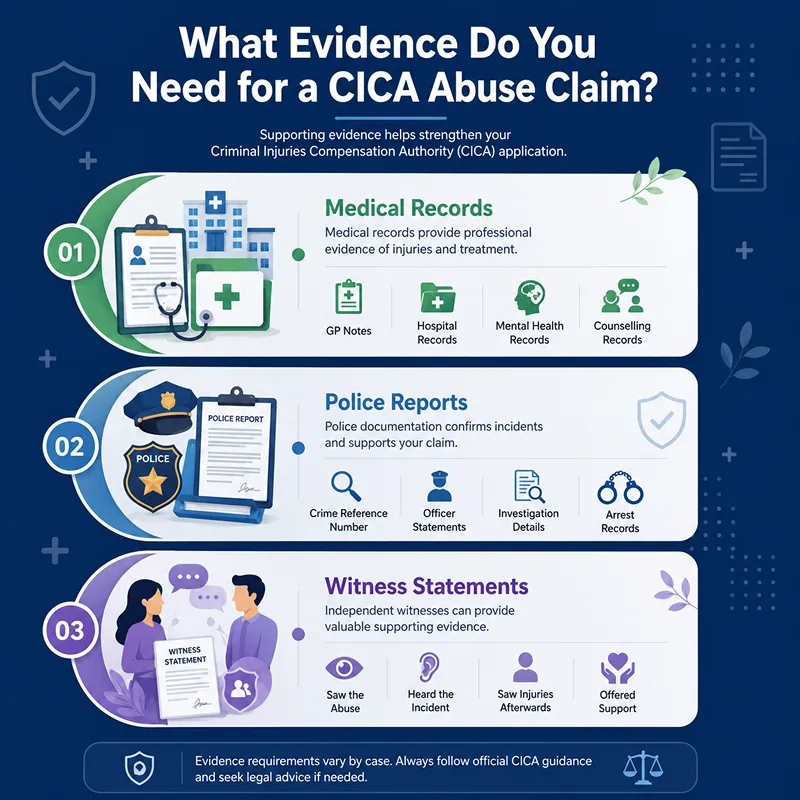
2. Police Reports
The CICA usually expects the abuse to have been reported to the police as soon as possible. Police reports may include:
- Crime reference numbers
- Officer statements
- Investigation details
- Arrest records
A criminal conviction is not always needed. The CICA can still consider your claim if there is enough evidence to show that a violent crime took place.
3. Witness Statements
Witness statements can help you support your claim. A witness may have:
- Seen the abuse
- Heard what happened
- Seen your injuries afterwards
- Supported you after the incident
Not every case has witnesses. The CICA understands this and will consider other available evidence.
How to Make a CICA Abuse Claim?
Starting a CICA abuse claim is usually a simple step-by-step process if you have the right details. Before applying, you must gather as much evidence as you can. Having your documents ready can make the process easier for you.
The basic steps are:
- Report the abuse to the police.
- Collect your evidence.
- Submit your application to the CICA.
- Respond to any requests for more information.
- Wait for the CICA’s decision.
During the assessment, the CICA may contact the police, your GP and hospitals and collect the details. They use those details to decide whether your claim meets the rules of the scheme or not.
Do I Have to Report Abuse to the Police for a CICA Claim?
Yes, you have to report the crime to the police because the CICA expects victims to report violent crime to the police as soon as it is possible. Reporting the crime to police helps the CICA:
- Confirm that the incident happened
- Check the police investigation report
- Review important evidence
Speaking up is the first step toward breaking the cycle of abuse.”
— Tarana Burke,
Is There a Time Limit for Making a CICA Abuse Claim?
Yes, the standard time limit for a CICA abuse claim is two years, which starts from the date of the incident. However, abuse cases are often different from other violent crime claims. The CICA may allow you a late application if:
- You were a child when it happened.
- Your mental health prevented you from applying sooner.
- Enough evidence is still available to assess the claim.
How Is CICA Compensation Calculated?
CICA uses the published scheme tariff to decide the actual compensation. The tariff has 25 levels, from Level 1 (£1,000) to Level 25 (£250,000).
Here are some examples from the current tariff:
- Ankle sprain causing disability for at least six weeks – Level 1 – £1,000
- Loss of a front tooth – Level 1 – £1,000
- Broken nose with a displaced fracture – Level 4 – £2,000
- Loss of several teeth requiring multiple dental implants – Level 6 – £3,500
- Severe psychological injury with long-term effects – Level 10 – £6,200
- Permanent disabling fracture, such as to the hip or knee – Level 12 – £11,000
- Permanent loss of sight in one eye – Level 17 – £33,000
- Loss of one arm or one leg – Level 18 to Level 22 – £33,000 to £82,000
- loss of eyesight (total blindness) – Level 23 – £110,000
- Quadriplegia (paralysis affecting all four limbs) – Level 25 – £250,000
How Much Compensation Could I Receive for an Abuse Claim?
There is no single amount paid in all CICA abuse claims. Every case is different from the others. Your compensation depends on several factors, including:
- The type of abuse.
- The injuries you suffered.
- Whether you have more than one injury.
- Medical evidence.
- Whether you qualify for any additional payments.
Here are some examples of compensation awards available under the CICA Scheme:
- Fractured jaw – £1,500
- Fractured skull – £1,000
- Loss of a front tooth – £1,000
- Serious facial scarring – £11,000
- Sexual assault involving touching over clothing – £1,000
- Loss of the sense of taste – £3,500
- Dislocated jaw – £3,500
- Loss of one ear – £11,000
- Very serious brain injury – £175,000
Can I Claim Loss of Earnings or Other Expenses Through CICA?
Yes, you can claim other expenses through CICA, but they are only available if you meet the rules of the scheme. Some common expense claims are the following:
1. Loss of Earnings
Some survivors cannot return to work because of the abuse they suffered. If your injuries stop you from performing daily tasks and affect your earnings, you may be able to claim for loss of earnings. In this case, the CICA has strict rules. You usually need to show that:
- Your injuries are serious.
- You cannot work because of those injuries.
- You meet the eligibility requirements under the Scheme.
2. Special Expenses
Some people have extra costs because of their long-term injuries. The CICA may consider paying certain necessary expenses if they meet the scheme rules.
Examples may include:
- Specialist equipment.
- Home adaptations.
- Personal care.
- Mobility aids.
Why Might CICA Reduce or Refuse My Compensation?
Not every application is successful. The CICA follows strict rules when it comes to deciding CICA abuse claims. Your claim may be reduced or refused if:
- You did not report to the police without a good reason.
- There is not enough evidence to support your claim.
- You do not cooperate with the CICA.
- You have certain unspent criminal convictions under the scheme rules.
This does not mean that every delayed or difficult case will fail. The CICA must look at the facts of each case before making a decision.
How Long Does a CICA Abuse Claim Take?
There is no fixed time for every claim. Some CICA abuse claims are decided within a few months, while others take much longer. The time depends on:
- How complex your case is.
- How quickly evidence is collected.
- Whether medical reports are needed or not.
- Whether the police investigation is complete or not.
- Whether the CICA needs more information or not.
Simple claims are usually completed within a few months compared to cases involving historic abuse or serious psychological injuries.
Can I Make a CICA Abuse Claim on a No Win No Fee Basis?
Yes, you can make a CICA abuse claim on a no-win, no-fee basis because some solicitors offer this agreement. This is usually called a Conditional Fee Agreement (CFA).
With a No Win No Fee agreement:
- You usually do not pay legal fees to your solicitor if your claim is not successful.
- If your claim succeeds, the solicitor may charge a fee from you, subject to the terms of the agreement and any legal limits that apply.
Remember that you always read the agreement carefully before signing it. Ask questions if you are unsure about success fees, any other costs and what happens if your claim is unsuccessful.
Choosing an experienced solicitor may help you understand the process and avoid common mistakes.
Case Study: Historic Child Sexual Abuse Survivor Awarded £252,514
A survivor of historic child sexual abuse successfully received £252,514 in compensation through the CICA.
The survivor had suffered repeated sexual abuse during her childhood at the hands of her father and other offenders. As a result of the abuse, she developed severe mental health conditions, including complex post-traumatic stress disorder (complex PTSD). She also required several admissions to the hospital under the Mental Health Act.
The Challenge
She faced significant long-term effects from the abuse, including:
- Severe psychological trauma.
- Multiple psychiatric admissions.
- Ongoing mental health treatment.
- Historic abuse that required extensive medical evidence.
To support her application, medical records and psychiatric evidence were collected and submitted to the CICA.
The Outcome
After reviewing the evidence, the CICA awarded her £252,514.
The award included:
- Compensation for the psychological injuries caused by the abuse.
- Loss of earnings.
- Other payments available under the Criminal Injuries Compensation Scheme, where the eligibility rules were met.
Conclusion
The CICA is an executive agency that gives financial support to you if you suffered injuries because of a violent crime. The CICA abuse claims scheme allows eligible survivors of physical or sexual abuse to seek compensation when the abuse meets the scheme’s requirements. Understanding who can claim, what evidence is needed and how compensation is assessed can help you to make informed decisions.
If you believe you qualify to make a claim, gather your evidence, report the crime to the police if you have not already done so and submit your application as soon as you can. Even if the abuse happened many years ago, you may still be able to make CICA abuse claims if exceptional circumstances apply. At Concise Medico, we provide high-quality medico-legal reports from experienced medical experts to support your CICA abuse claim.