TABLE OF CONTENT
Are you or a close one suffering from drug addiction and wondering how to quit this habit? People ruin their lives due to drug addiction.
Nearly 8.7% of people aged 16 to 59 have used a drug in England and Wales in the last year. After calculation, this becomes around 2.9 million people. A crime survey for England and Wales says that drugs are still used too much.
In the past, people thought that handling drugs was an easy thing. However, it can spoil your work, relationships and health over time.
Many drug addicted people want to get rid of drugs and live a normal life. But they don’t know how to do this and are confused about whom to trust.
It is not easy to quit this habit alone. Also, without a guiding hand, a person may relapse. Drug rehabilitation centres can help you get your normal life back. They also support both your body and mind. Drug rehab uses procedures with different steps to quit addiction.
You cannot recover from any disease or addiction in one day. You can positively transform yourself with the right guidance, support and patience.
Here’s what you will explore in this blog:
- Understand drug rehabilitation
- Grasp the working of drug rehabilitation
- Types of drug rehabilitation programmes
- The role of therapy and support
- How recovery helps in rebuilding life
- Know the details of drug rehabilitation cost
What Is Drug Rehabilitation?
With the help of drug rehabilitation, people can stop themselves from the habit of using drugs or alcohol. They can also live a healthy life with proper guidance. In this process, therapy, medical care and support are used. A person can live a normal life and stop using drugs with this.
Rehabilitation also supports people in handling the outcomes of addiction. These may include financial troubles, health issues, stress and broken relationships.
The person also needs to build a stable and healthy life. It takes a lot of time to recover but it’s not impossible. There is hope that you can return to a normal life with the help of these centres.
Many people think drug rehab is only for serious problems. Therefore, you must know the facts and myths about rehab to get full advantages.
Why Drug Rehabilitation Matters?
The consequences of addiction are greater than those of any bad habit. It gradually changes how the brain works. Drug use changes brain chemicals, such as dopamine. As a result of drug use, a person’s feelings become linked to pleasure and reward.
Ultimately, if a person stops using drugs, these changes can linger in the brain.
When suitable help is not available, people often relapse. Many people with addiction face past trauma and stress. You may have seen such people struggling with mental health problems or facing pressure from society.
Drug rehabilitation provides people with guidance and support.
It is so helpful for people to stop using drugs and build a safe and healthy life.
Main Types of Drug Rehabilitation
Drug rehabilitation works in a different way for every drug addicted person. Different rehab programmes are built to fit different needs. The type of programme depends on a person’s lifestyle, wellbeing and how serious their addiction is.
Each type of drug rehab gives different levels of routine, care and support. Therefore, before you visit these centres, it is important to understand them. I have described the main types of rehabilitation programmes below:
1. Outpatient Drug Rehabilitation
In outpatient drug rehabilitation, patients can recover through medicines and enjoy living in their homes. This is because they do not need to leave their home. Patients have to choose a set of sessions at a treatment centre or clinic. These treatments can include counselling, therapy and medical care.
This type is best for people who are suffering from moderate addiction. The outpatient option is best for people who cannot leave home or are worried about their family. However, only the patients with strong willpower can get more benefits from it because relapse can happen at any time.
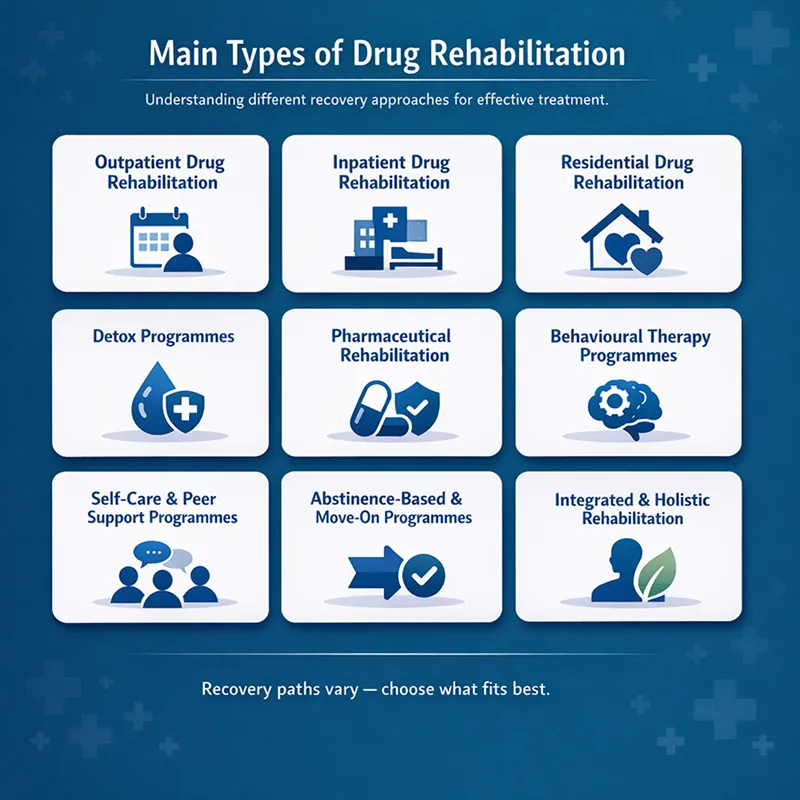
2. Inpatient Drug Rehabilitation
Patients can get proper care day and night in inpatient drug rehab by staying at the centre. This safe and organised space supports patients in focusing fully on getting better.
The treatments given in such centres are usually daily healthy routines, detox and therapy. Patients receive proper care day and night.
Inpatient programmes work well for severe addiction. They help people who repeatedly relapse into drug use. They block access to illegal substances and remove outside stress.
3. Residential Drug Rehabilitation
Residential rehab is a process where inpatient care is provided for a long time. People can rebuild their lives in a safe and healthy environment. These programmes mainly focus on treatment and teaching daily life skills to patients.
A good example of this rehab is the Jatis Project. In this project, each person gets a support worker to make a plan for their personal recovery. Residents learn beneficial skills like making daily routines, managing money and keeping a home.
Mental health support, teamwork and counselling are important parts of it. This also includes community activities and personal growth. With the help of residential rehab, people can live on their own and stay in better health for a long time.
You can consider Gloucester House in Swindon as an example of residential rehab in the UK. It has been helping affected people for 65 years.
This centre runs a 12‑step residential programme. Many people have recovered and now live healthy lives.
4. Detox Programmes
In drug rehabilitation, detoxification is done in the initial phase. In this process, drugs are taken out of the body without harming it. However, other processes are also needed to achieve lasting results.
After detox, the risk of relapse is high without therapy and support.
5. Pharmaceutical Rehabilitation
Some people get relief from medication as part of treatment. You can quit opioid or alcohol addiction with this in a better way.
Here, the level of cravings is reduced with medicines like methadone or buprenorphine. They also help prevent relapse. Other medicines are also available for recovery from alcohol or nicotine use.
Medicine and therapy work best when combined. This combination helps address both the physical and psychological aspects of addiction.
6. Behavioural Therapy Programmes
Most rehab plans use behavioural therapy as the most important part. They help change harmful thoughts and habits. Let us understand the three main types of behavioural therapy:
Cognitive Behavioural Therapy or CBT
With the help of CBT, patients detect triggers and can handle cravings.
Family Therapy and Motivational Interviewing
This therapy guides people to spot the factors that can lead them to relapse. Patients also learn ways to handle and cope with strong drug or alcohol cravings.
Mindfulness and Emotional Control Techniques
With the help of this therapy, patients feel relaxed from stress and calm their minds. It makes it easier to think before acting. This therapy helps eliminate impulsive actions performed without thinking. These sudden, careless acts could lead to problems.
7. Self-Care and Peer Support Programmes
Peer support is a main part of recovery. Groups like Narcotics Anonymous help people talk to each other face-to-face. SMART Recovery also connects people with the same objective.
People connect in such meet-ups and feel supported and encouraged. It gives a safe space to talk, share progress and stay motivated. Peer support helps reduce loneliness and supports responsible living.
8. Abstinence-Based and Move-On Programmes
Some programmes are made to help people live clean and independently for a long time. Often, they follow the starting phases of treatment.
With the right support, people develop stable lifestyles and learn essential life skills. It also helps them transition to independent living.
Peer-run centres provide ongoing support to help people continue their recovery. They perform this by sharing experiences and providing support.
9. Integrated and Holistic Rehabilitation
Today’s rehab focuses on the whole person, not just the addiction. It provides treatment for the body, mind and life together. When a patient also has mental health issues, this approach is best.
Holistic rehab supports long-term recovery. It also enables people to build balanced and stable lives.
How Does Drug Rehabilitation Work?
Drug rehabilitation is a planned process that helps people stop drug addiction. It provides treatment for both the body and mind to support recovery. Drug treatment is not the same for all affected people. It is made to fit each person’s life situation, needs and health.
Most programmes provide support, medical care and therapy. They help people stop using drugs and ultimately maintain their health. Let us learn how drug rehabilitation works and what cares it provides, as explained below:
Step 1. Patient’s Assessment
The first step is to check the person’s situation. Professionals will ask about drug use, health and daily life. They may also carry out tests to detect any risks. After a complete assessment, a personalised plan is made for the individual.
A support worker is assigned to help and guide them. The plan is checked and changed when needed.
Step 2. Detoxification
Detoxification is a process in which people can take out drugs or alcohol from their bodies harmlessly. This step benefits the body but does not provide full recovery on its own. Therapy is also required with this.
Step 3. Therapy
To recover from drugs, therapy plays an important role. Patients can know about their actions, thoughts and feelings with the help of therapy. This way, they can control cravings and avoid triggers.
To build confidence, therapies like CBT, motivational interviewing and family therapy help a lot. When someone gets them, a noticeable change occurs in their behaviour.
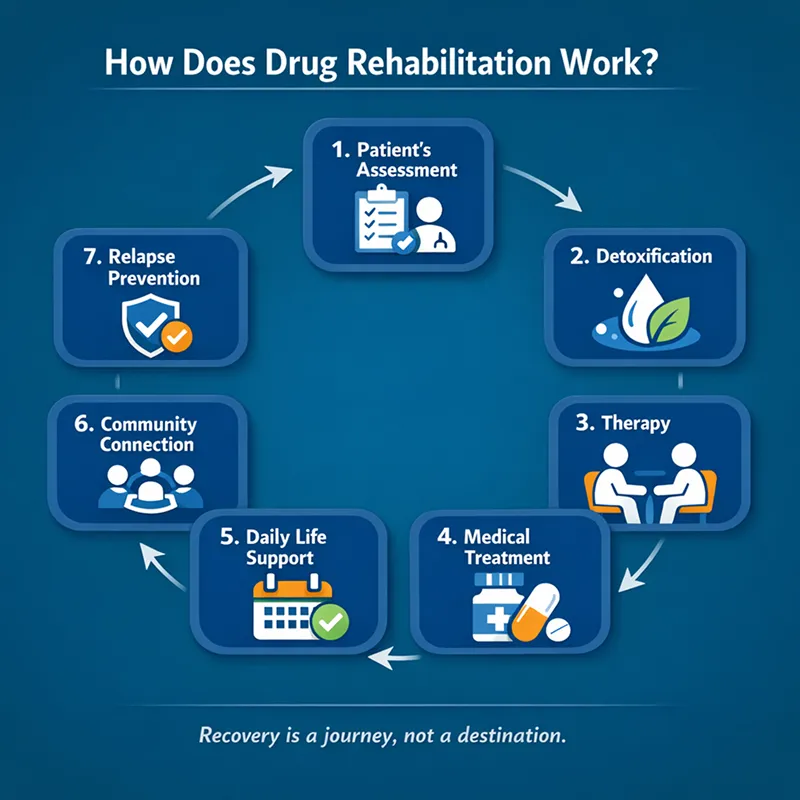
Step 4. Medical Treatment
Sometimes medication is used to aid recovery. To lower cravings in people with opioid dependence, methadone or buprenorphine is used.
Other medications also work well in recovery from alcohol or nicotine use. Therapy and medical treatment, when combined, helps a lot.
Step 5. Daily Life Support
Rehab also helps people manage everyday life. Support can help with work, money and keeping a home. Mental well-being, relationships and overall health are also supported. Many residential programmes are available, such as The Jatis Project CIC, which provides support with daily life.
Step 6. Community Connection
Peer support can make people connect with each others who have had the same experiences. Narcotics Anonymous, SMART Recovery and many other groups are available for this purpose. This is best for patients who feel lonliness.
Step 7. Relapse Prevention
The recovery process continues even after formal treatment ends. Patients learn to identify triggers, manage stress and make positive choices.
Recovery is maintained if ongoing support, check-ups and support groups function effectively. Many patients need at least three months of treatment. Extra support improves results further.
Handling relapse to ensure long-term recovery is an important thing to consider. This applies to both physical injuries and drug addiction.
What Is the Drug Rehabilitation Cost?
Drug rehabilitation costs can vary a lot. It depends on the place, the type of treatment and care needed. Some people can access free rehabilitation through health services or charitable organisations.
These services can be found at local treatment centres and through therapy programmes. They may also offer counselling and support from health workers, usually without any fees. But to get the facility, you may have to wait for a long time.
Private rehabilitation usually involves fees. The cost of these services depends on the programme type, such as residential or outpatient. The price is also according to the facilities, the treatment and how much time it takes.
Residential programmes are more expensive due to the offer of 24-hour treatment, housing, food, therapy and daily support. Most programmes typically run for one month and fees increase if a person wishes to stay longer.
Detoxification and medication raise the cost of the service. This is because methadone or buprenorphine is used to handle drug cravings.
The cost can increase according to the type of therapy and mental health support availability. Rehabilitation is very helpful in lowering health risks and can also lower legal problems and the risk of job loss.
The support of rehab makes people able to stay sober and build long-term stability. Also, people stay sober and balanced for a long time. Without proper support, the risk of relapse increases, which can cause serious problems ahead.
Recovery is not just about quitting drugs, it’s about building a new life, step by step. – Dr. Sarah Mitchell, Addiction Specialist
Case Study of Ben’s Journey: From Addiction to a New Life
Ben fought addiction for a long time. He tried to recover and visited treatment centres often, but most of the time, he became addicted again.
In 2015, he started joining a supported housing programme for recovery. At that time, many serious challenges came his way because of his past actions.
When he first began recovery, he stayed in prison. He entirely spent time living with his support team. When he was living in prison, Ben remained clean to prove that he wanted to change himself.
After 18 months had passed, he went back to supported housing. At that time, he worked with his support workers to make a long-lasting recovery plan. Ben thought that recovery was more than quitting drugs. This was also like building a new life for him.
He started working on his body and mind and began boxing to build discipline in his life. To create a powerful support network, he also joined Narcotics Anonymous.
Key Takeaway
A patient at any stage of addiction can recover with proper guidance. Rehabilitation is not just about quitting a drug habit. It is more than this. You achieve the skill of building a full and balanced life.
Final Remarks
Drug rehabilitation does not mean you will get a quick fix. It takes effort, support and a lot of time to recover. It is a path that provides real hope and lasting change.
With support and guidance, people can quit drugs. These centres teach them to live a healthy life and develop skills.
First, get complete information about the cost of drug rehabilitation. It makes it easier to take the initial step towards a healthy and normal life.
Concise Medico understands that recovering from drug addiction can be difficult. You can travel this difficult journey with our help and we will always support you at every step.
It is very essential to give support to the people who you knows.
Let us hear from you today and take the initial step.
FAQs
Are you or a close one suffering from drug addiction and wondering how to quit this habit? People ruin their lives due to drug addiction.
Nearly 8.7% of people aged 16 to 59 have used a drug in England and Wales in the last year. After calculation, this becomes around 2.9 million people. A crime survey for England and Wales says that drugs are still used too much.
In the past, people thought that handling drugs was an easy thing. However, it can spoil your work, relationships and health over time.
Many drug addicted people want to get rid of drugs and live a normal life. But they don’t know how to do this and are confused about whom to trust.
It is not easy to quit this habit alone. Also, without a guiding hand, a person may relapse. Drug rehabilitation centres can help you get your normal life back. They also support both your body and mind. Drug rehab uses procedures with different steps to quit addiction.
You cannot recover from any disease or addiction in one day. You can positively transform yourself with the right guidance, support and patience.
Here’s what you will explore in this blog:
- Understand drug rehabilitation
- Grasp the working of drug rehabilitation
- Types of drug rehabilitation programmes
- The role of therapy and support
- How recovery helps in rebuilding life
- Know the details of drug rehabilitation cost
What Is Drug Rehabilitation?
With the help of drug rehabilitation, people can stop themselves from the habit of using drugs or alcohol. They can also live a healthy life with proper guidance. In this process, therapy, medical care and support are used. A person can live a normal life and stop using drugs with this.
Rehabilitation also supports people in handling the outcomes of addiction. These may include financial troubles, health issues, stress and broken relationships.
The person also needs to build a stable and healthy life. It takes a lot of time to recover but it’s not impossible. There is hope that you can return to a normal life with the help of these centres.
Many people think drug rehab is only for serious problems. Therefore, you must know the facts and myths about rehab to get full advantages.
Why Drug Rehabilitation Matters?
The consequences of addiction are greater than those of any bad habit. It gradually changes how the brain works. Drug use changes brain chemicals, such as dopamine. As a result of drug use, a person’s feelings become linked to pleasure and reward.
Ultimately, if a person stops using drugs, these changes can linger in the brain.
When suitable help is not available, people often relapse. Many people with addiction face past trauma and stress. You may have seen such people struggling with mental health problems or facing pressure from society.
Drug rehabilitation provides people with guidance and support.
It is so helpful for people to stop using drugs and build a safe and healthy life.
Main Types of Drug Rehabilitation
Drug rehabilitation works in a different way for every drug addicted person. Different rehab programmes are built to fit different needs. The type of programme depends on a person’s lifestyle, wellbeing and how serious their addiction is.
Each type of drug rehab gives different levels of routine, care and support. Therefore, before you visit these centres, it is important to understand them. I have described the main types of rehabilitation programmes below:
1. Outpatient Drug Rehabilitation
In outpatient drug rehabilitation, patients can recover through medicines and enjoy living in their homes. This is because they do not need to leave their home. Patients have to choose a set of sessions at a treatment centre or clinic. These treatments can include counselling, therapy and medical care.
This type is best for people who are suffering from moderate addiction. The outpatient option is best for people who cannot leave home or are worried about their family. However, only the patients with strong willpower can get more benefits from it because relapse can happen at any time.
2. Inpatient Drug Rehabilitation
Patients can get proper care day and night in inpatient drug rehab by staying at the centre. This safe and organised space supports patients in focusing fully on getting better.
The treatments given in such centres are usually daily healthy routines, detox and therapy. Patients receive proper care day and night.
Inpatient programmes work well for severe addiction. They help people who repeatedly relapse into drug use. They block access to illegal substances and remove outside stress.
3. Residential Drug Rehabilitation
Residential rehab is a process where inpatient care is provided for a long time. People can rebuild their lives in a safe and healthy environment. These programmes mainly focus on treatment and teaching daily life skills to patients.
A good example of this rehab is the Jatis Project. In this project, each person gets a support worker to make a plan for their personal recovery. Residents learn beneficial skills like making daily routines, managing money and keeping a home.
Mental health support, teamwork and counselling are important parts of it. This also includes community activities and personal growth. With the help of residential rehab, people can live on their own and stay in better health for a long time.
You can consider Gloucester House in Swindon as an example of residential rehab in the UK. It has been helping affected people for 65 years.
This centre runs a 12‑step residential programme. Many people have recovered and now live healthy lives.
4. Detox Programmes
In drug rehabilitation, detoxification is done in the initial phase. In this process, drugs are taken out of the body without harming it. However, other processes are also needed to achieve lasting results.
After detox, the risk of relapse is high without therapy and support.
5. Pharmaceutical Rehabilitation
Some people get relief from medication as part of treatment. You can quit opioid or alcohol addiction with this in a better way.
Here, the level of cravings is reduced with medicines like methadone or buprenorphine. They also help prevent relapse. Other medicines are also available for recovery from alcohol or nicotine use.
Medicine and therapy work best when combined. This combination helps address both the physical and psychological aspects of addiction.
6. Behavioural Therapy Programmes
Most rehab plans use behavioural therapy as the most important part. They help change harmful thoughts and habits. Let us understand the three main types of behavioural therapy:
Cognitive Behavioural Therapy or CBT
With the help of CBT, patients detect triggers and can handle cravings.
Family Therapy and Motivational Interviewing
This therapy guides people to spot the factors that can lead them to relapse. Patients also learn ways to handle and cope with strong drug or alcohol cravings.
Mindfulness and Emotional Control Techniques
With the help of this therapy, patients feel relaxed from stress and calm their minds. It makes it easier to think before acting. This therapy helps eliminate impulsive actions performed without thinking. These sudden, careless acts could lead to problems.
7. Self-Care and Peer Support Programmes
Peer support is a main part of recovery. Groups like Narcotics Anonymous help people talk to each other face-to-face. SMART Recovery also connects people with the same objective.
People connect in such meet-ups and feel supported and encouraged. It gives a safe space to talk, share progress and stay motivated. Peer support helps reduce loneliness and supports responsible living.
8. Abstinence-Based and Move-On Programmes
Some programmes are made to help people live clean and independently for a long time. Often, they follow the starting phases of treatment.
With the right support, people develop stable lifestyles and learn essential life skills. It also helps them transition to independent living.
Peer-run centres provide ongoing support to help people continue their recovery. They perform this by sharing experiences and providing support.
9. Integrated and Holistic Rehabilitation
Today’s rehab focuses on the whole person, not just the addiction. It provides treatment for the body, mind and life together. When a patient also has mental health issues, this approach is best.
Holistic rehab supports long-term recovery. It also enables people to build balanced and stable lives.
How Does Drug Rehabilitation Work?
Drug rehabilitation is a planned process that helps people stop drug addiction. It provides treatment for both the body and mind to support recovery. Drug treatment is not the same for all affected people. It is made to fit each person’s life situation, needs and health.
Most programmes provide support, medical care and therapy. They help people stop using drugs and ultimately maintain their health. Let us learn how drug rehabilitation works and what cares it provides, as explained below:
Step 1. Patient’s Assessment
The first step is to check the person’s situation. Professionals will ask about drug use, health and daily life. They may also carry out tests to detect any risks. After a complete assessment, a personalised plan is made for the individual.
A support worker is assigned to help and guide them. The plan is checked and changed when needed.
Step 2. Detoxification
Detoxification is a process in which people can take out drugs or alcohol from their bodies harmlessly. This step benefits the body but does not provide full recovery on its own. Therapy is also required with this.
Step 3. Therapy
To recover from drugs, therapy plays an important role. Patients can know about their actions, thoughts and feelings with the help of therapy. This way, they can control cravings and avoid triggers.
To build confidence, therapies like CBT, motivational interviewing and family therapy help a lot. When someone gets them, a noticeable change occurs in their behaviour.
Step 4. Medical Treatment
Sometimes medication is used to aid recovery. To lower cravings in people with opioid dependence, methadone or buprenorphine is used.
Other medications also work well in recovery from alcohol or nicotine use. Therapy and medical treatment, when combined, helps a lot.
Step 5. Daily Life Support
Rehab also helps people manage everyday life. Support can help with work, money and keeping a home. Mental well-being, relationships and overall health are also supported. Many residential programmes are available, such as The Jatis Project CIC, which provides support with daily life.
Step 6. Community Connection
Peer support can make people connect with each others who have had the same experiences. Narcotics Anonymous, SMART Recovery and many other groups are available for this purpose. This is best for patients who feel lonliness.
Step 7. Relapse Prevention
The recovery process continues even after formal treatment ends. Patients learn to identify triggers, manage stress and make positive choices.
Recovery is maintained if ongoing support, check-ups and support groups function effectively. Many patients need at least three months of treatment. Extra support improves results further.
Handling relapse to ensure long-term recovery is an important thing to consider. This applies to both physical injuries and drug addiction.
What Is the Drug Rehabilitation Cost?
Drug rehabilitation costs can vary a lot. It depends on the place, the type of treatment and care needed. Some people can access free rehabilitation through health services or charitable organisations.
These services can be found at local treatment centres and through therapy programmes. They may also offer counselling and support from health workers, usually without any fees. But to get the facility, you may have to wait for a long time.
Private rehabilitation usually involves fees. The cost of these services depends on the programme type, such as residential or outpatient. The price is also according to the facilities, the treatment and how much time it takes.
Residential programmes are more expensive due to the offer of 24-hour treatment, housing, food, therapy and daily support. Most programmes typically run for one month and fees increase if a person wishes to stay longer.
Detoxification and medication raise the cost of the service. This is because methadone or buprenorphine is used to handle drug cravings.
The cost can increase according to the type of therapy and mental health support availability. Rehabilitation is very helpful in lowering health risks and can also lower legal problems and the risk of job loss.
The support of rehab makes people able to stay sober and build long-term stability. Also, people stay sober and balanced for a long time. Without proper support, the risk of relapse increases, which can cause serious problems ahead.
Recovery is not just about quitting drugs, it’s about building a new life, step by step. – Dr. Sarah Mitchell, Addiction Specialist
Case Study of Ben’s Journey: From Addiction to a New Life
Ben fought addiction for a long time. He tried to recover and visited treatment centres often, but most of the time, he became addicted again.
In 2015, he started joining a supported housing programme for recovery. At that time, many serious challenges came his way because of his past actions.
When he first began recovery, he stayed in prison. He entirely spent time living with his support team. When he was living in prison, Ben remained clean to prove that he wanted to change himself.
After 18 months had passed, he went back to supported housing. At that time, he worked with his support workers to make a long-lasting recovery plan. Ben thought that recovery was more than quitting drugs. This was also like building a new life for him.
He started working on his body and mind and began boxing to build discipline in his life. To create a powerful support network, he also joined Narcotics Anonymous.
Key Takeaway
A patient at any stage of addiction can recover with proper guidance. Rehabilitation is not just about quitting a drug habit. It is more than this. You achieve the skill of building a full and balanced life.
Final Remarks
Drug rehabilitation does not mean you will get a quick fix. It takes effort, support and a lot of time to recover. It is a path that provides real hope and lasting change.
With support and guidance, people can quit drugs. These centres teach them to live a healthy life and develop skills.
First, get complete information about the cost of drug rehabilitation. It makes it easier to take the initial step towards a healthy and normal life.
Concise Medico understands that recovering from drug addiction can be difficult. You can travel this difficult journey with our help and we will always support you at every step.
It is very essential to give support to the people who you knows.
Let us hear from you today and take the initial step.