When Is a Psychiatric Expert Witness Needed in Civil Litigation?

Published On: June 29th, 2026|Total Views: 1|Daily Views: 1|17.6 min read|3515 words|

TABLE OF CONTENT

When Is a Psychiatric Expert Witness Needed in Civil Litigation?

Have you ever wondered how courts prove that a person has suffered psychological harm? Assessing a hidden injury is never simple, whether it happens after a severe accident or due to stress at a job. It can also happen during a bitter legal dispute.

An expert witness for litigation cases is required to clarify complex mental health matters to the court.

A psychiatric expert witness for litigation cases is a doctor who knows everything about mental health. They also give unbiased advice to the court about how a person is mentally affected. Besides this, they explain how it is related to the case.

These types of cases are growing more common as society begins to talk more about mental health. Courts are often directed to look at anxiety, emotional suffering, trauma, workplace stress and persistent mental problems. These concerns are complex, so judges and lawyers cannot always deal with them on their own.

For example, there are more than 1,500 psychiatrists in the UK who are ranked on expert panels. They can provide unbiased, competent evidence for civil and other legal cases. They look for diagnoses, causes and how the illness affects daily life. They also analyse what might be expected in the future and how the illness affects daily life.

However, mental health disorders are not always easy to diagnose or evaluate. As a result of this, courts need an expert to find the true cause of the harm. On the other hand, a psychiatric expert witness for litigation cases can lay out clearly what is going on. They also help the court comprehend the case properly.

This expert evidence is usually very crucial in mental health litigation. It can rule out who is at fault, how much compensation is required and the outcome of the case.

In this blog, you will learn when a psychiatric expert witness for litigation cases is essential and what they do. You will also understand how their evidence helps in civil litigation cases.

Key Takeaways

  • An expert witness for litigation cases provides independent medical evidence to help courts understand complex psychiatric issues and reach fair decisions
  • In civil litigation, expert psychiatric evidence is often used to assess diagnosis, causation, prognosis, and the impact of mental health conditions
  • Mental health litigation frequently depends on expert opinion to determine whether psychological harm is linked to a specific incident or dispute
  • A psychiatric expert witness must remain impartial, comply with CPR Part 35, and place their duty to the court above the interests of either party
  • Cases involving a mental health patient charged for litigation often require specialist assessment to evaluate mental health history, capacity, and functional impact
  • A UK mental health legal case may require expert evidence to assess psychiatric injury, future risks, treatment needs, and potential compensation

What Is the Role of an Expert Witness for Litigation Cases?

Let’s look at the true role of a psychiatric expert witness before we see when a court needs to call one in. Rather than arguing like a lawyer, an expert’s duty is to explain specialist facts clearly.

1. Independent Medical Opinion

An expert witness for litigation cases is a skilled person who provides an independent view to assist the court. In mental health claims, this qualified person is usually a psychiatrist.

The expert may look over medical records, talk with the person and look into the history of symptoms. They also compose a written report. The report may address a diagnosis, cause, healing, future risks and daily life effects.

2. Help for the Court

The expert does not rule out the case. Instead, the judge or court performs that. The expert only provides medical advice so the court can make a wiser decision.

Learn more: How expert witnesses strengthen legal cases

The expert’s duty is to help the court on matters within his expertise. This duty overrides any obligation to the person from whom he has received instructions or by whom he is paid.

Mr Justice Cresswell, Judge of the High Court of England and Wales

Why Is an Expert Witness for Litigation Cases Important?

Mental health conditions are usually not seen. A person may seem to be normal but still feel fear, despair, panic or deep stress within.

Understanding Psychiatric Evidence

In civil litigation, the court may want to figure out whether a person has a valid mental health condition. It may also need to confirm if that situation was created by the event in the claim.

An expert can clarify whether signs indicate a known condition or a normal stress reaction. This is vital because not every tragic or stressful event leads to a psychiatric injury.

Fair Legal Decisions

Expert evidence assists in helping the court prevent unfair assumptions. It also helps both parties learn about the strength of the claim. This is especially useful in mental health litigation, where signs can be personal, complex and hard to assess.

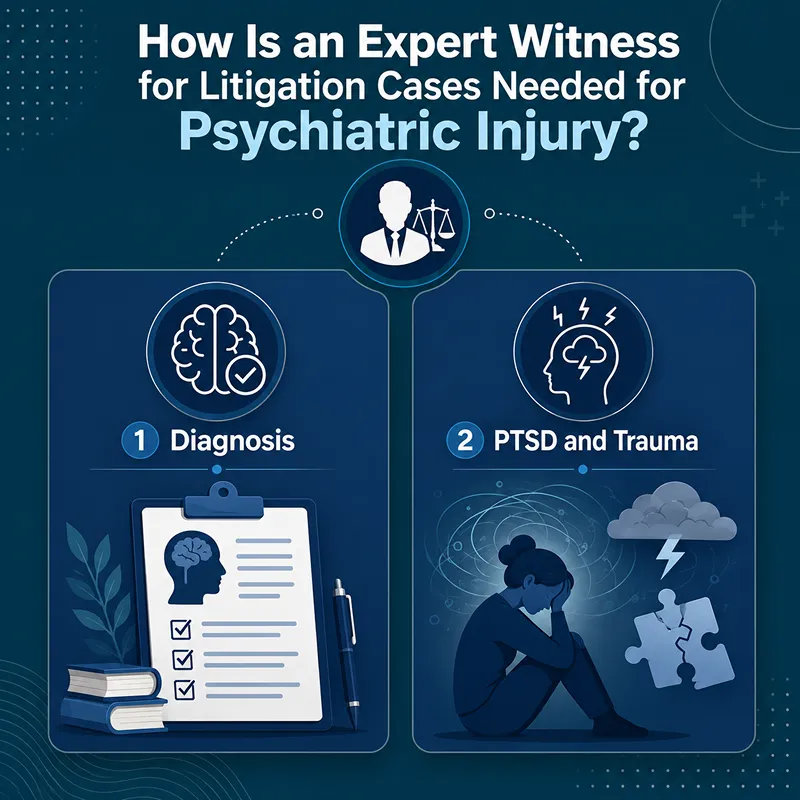
How Is an Expert Witness for Litigation Cases Needed for Psychiatric Injury?

A psychiatric injury involves more than merely feeling distressed. It means a known mental health problem that impacts the person’s life.

1. Diagnosis

An expert witness for litigation cases is usually required when someone claims a mental health condition after an event. This may consist of depression, anxiety, post traumatic stress disorder (PTSD), adjustment disorder or other psychological conditions.

The expert looks at symptoms, medical records, treatment history and the person’s existing mental state. This helps verify whether there is a real mental health condition or not.

2. PTSD and Trauma

Trauma cases may lead to nightmares, memories, panic, fear, poor sleep or not going to certain places. These symptoms need detailed review.

A psychiatric expert witness for litigation cases can explain whether the symptoms match PTSD or a different mental health condition. The expert can also lay out how severe the condition is.
How Is an Expert Witness for Litigation Cases Needed for Psychiatric Injury

When Does an Expert Witness for Litigation Cases Assess Causation?

Causation is the process of finding out what led to the mental health problem. This is often one of the most significant concerns in a legal claim.

Incident Link

The expert looks at whether a certain incident caused the condition, made it more serious or had only a minor effect.

The event may be a road accident, office bullying, medical error, physical abuse or another serious experience. The expert examines the timing, symptoms, documents and life events.

Other Causes

The expert also inspects to see if something else may have led to the symptoms. This could be due to family stress, money concerns, illness, past trauma or previous mental health issues.

All this information provides the court with a detailed picture.

Why It Matters!

In psychiatric claims, proving that an incident caused a mental health condition is often one of the most disputed issues. A clear expert opinion on causation can significantly influence liability, compensation, and the overall outcome of the case.

When Is an Expert Witness for Litigation Cases Needed for Pre-Existing Conditions?

Many people have suffered from mental health problems before a claim takes place. That does not mean the claim is false but it only means the expert must look closely at what changed.

Baseline Mental Health

The expert reviews older medical records to learn about the person’s mental health before the incident.

This helps indicate whether the person was healthy, partly recovered, still in treatment or already having trouble.

New Injury or Worsening

The expert then chooses whether the current problem is new or whether an old problem became more serious.

This is important because compensation may rely on how much the incident changed the person’s health.

When Does an Expert Witness for Litigation Cases Assess Functional Impact?

Only a diagnosis is not enough. The court also needs to understand how the condition relates to real life.

Work and Daily Life

An expert witness for litigation cases may review work, study, sleep, family life, social life, travel and personal care.

For example, due to anxiety, people may not go outside their homes. Depression may lessen your energy and focus and PTSD may make someone avoid areas that are linked to trauma.

Practical Limits

The expert breaks down these complex mental health problems into simple terms. This helps the court comprehend what the person can and cannot do.

These factors can affect decisions about lost earnings, support needs and medical care expenses.

When Is an Expert Witness for Litigation Cases Needed to Evaluate Prognosis?

Prognosis refers to the expected future outcome. The court may need to know if the person will recover or keep suffering.

Recovery Outlook

The expert looks at the person’s symptoms, care, support, background history and progress. They may explain whether full recovery, partial healing or lasting symptoms are likely to occur.

Treatment and Relapse Risk

The expert may also specify upcoming treatment needs. This can include therapy, medication, ongoing care or support at job duties.

The expert may also review the likelihood of relapse. This is important when the court looks at future damages.

When Does an Expert Witness for Litigation Cases Assess Mental Capacity?

Sometimes the issue is not injury. Instead, the problem can be that the court needs to know whether a person can make decisions.

Ability to Make Decisions

An expert may assess whether someone can grasp information, weigh choices and clearly convey a decision.

This may take place in settling disputes, care decisions, money matters, wills or legal participation.

Clinical Assessment

The expert looks at brain function, thinking, mood, insight and the impact of any mental illness. The aim is to decide whether the person can make a certain decision at a specific time.

When Is an Expert Witness for Litigation Cases Needed in Workplace Disputes?

Workplace disputes can consist of stress, bullying, prejudice, unfair treatment or too much workload. These cases usually need detailed mental health evidence.

1. Workplace Stress

An expert witness for litigation cases can review whether workplace events triggered or worsened a condition.

The expert may inspect illness records, job files, grievance papers, medical notes and treatment records.

2. Employment Tribunal Relevance

In mental health litigation, expert evidence may help clarify how workplace events impacted the person. The document also shows if the person can return to their job or if they need special changes at work.

3. Equality Act Issues

Some mental health disorders may be considered as a disability under the Equality Act 2010. Expert evidence can help explain how long the condition has existed, how critical it is, and how it impacts daily activities.

This can also help the court figure out whether workplace alterations were needed.

How Is an Expert Witness for Litigation Cases Instructed?

The instruction process should be clear from the beginning. This helps the expert answer the correct questions.

1. Solicitor Instructions

A solicitor generally provides a letter of instruction. This explains the scenario, the legal questions and the issues the expert must deal with.

The expert may be asked about diagnosis, root cause, medical care, work ability, future risks,

and healing.

2. Records Review

The expert reviews medical records, treatment notes, employment records, accident findings and other valuable documents.

This helps the expert form a careful opinion that relies on evidence, not guesswork.

3. Psychiatric Assessment

The expert may then arrange to meet the patient for an assessment. They ask about symptoms, history, daily life, medical care, work and future matters.

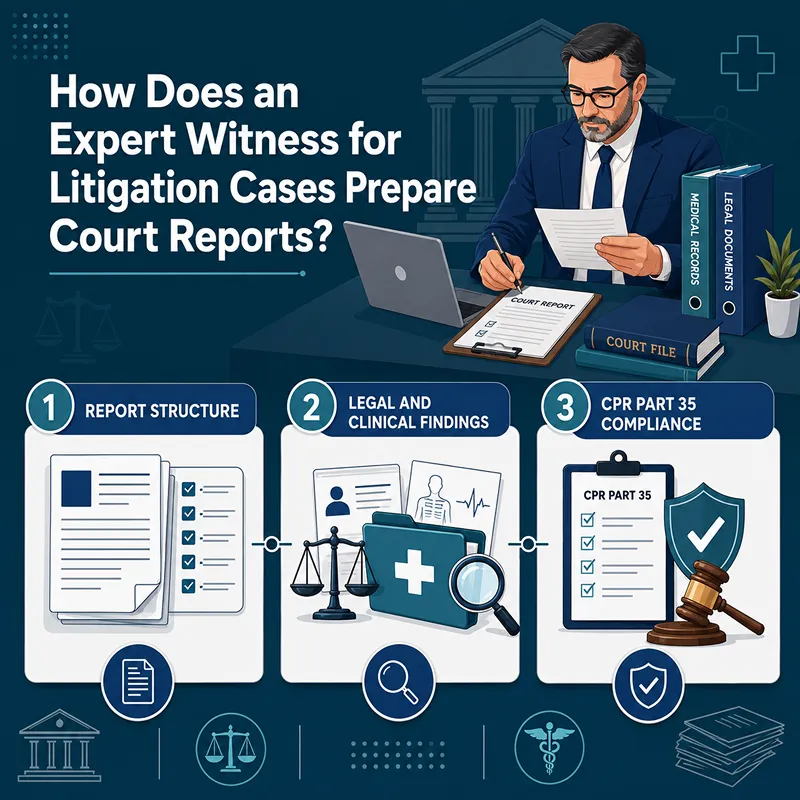
How Does an Expert Witness for Litigation Cases Prepare Court Reports?

A good report should be clear, balanced and easy for the court to follow.

Report Structure

An expert witness for litigation cases usually explains what records were reviewed, what questions were asked and what assessment took place.

The report then covers background, diagnosis, causation, functional impact, treatment, recovery and future risk.

Legal and Clinical Findings

The expert must explain their opinion and the reasons behind it.

A strong report does not only state conclusions. It also shows how the expert reached those conclusions.

CPR Part 35 Compliance

In England and Wales, expert reports must follow CPR Part 35. These rules require experts to be independent, clear and honest.

The expert must help the court, not act as a supporter for one side.
Why Must an Expert Witness for Litigation Cases Remain Independent?

Independence is one of the most important parts of expert evidence.

Duty to the Court

An expert witness for litigation cases has a duty to the court. This duty is more important than the obligation to the person who pays for the report.

The expert must give the same honest opinion even if it does not help the instructing party.

Neutral Opinion

A good expert considers all sides. They look at other possible causes, missing records and limits in the evidence.

This makes the report more trusted.

Key Point!

An expert witness does not work for the claimant or the defendant. Their primary duty is to the court, and their opinion must remain independent, objective, and based solely on the available evidence.

What Legal Standards Apply to Expert Witness for Litigation Cases?

Expert evidence must meet proper legal standards. This protects the court from weak or biased opinions.

CPR Duties

The report should explain facts, assumptions, methods and conclusions.They should also answer the legal questions clearly and avoid making claims outside their skill area.

Transparency

If the evidence is limited, the expert should say so. However, if there is more than one possible explanation, they should explain that too.

This honesty makes the evidence stronger.

When Is Expert Evidence Admissible in Civil Litigation?

Not every judgement is useful in court. Expert evidence must be accurate and reliable.

Relevance

The evidence must help the court respond to an important question. For example, it may help explain diagnosis, causation, work capability or future treatment needs.

Reliability

The opinion should be based on proper records, review and accepted medical knowledge.

This is why clear strategies and fair reasoning matter.

What Is the Role of Single Joint Experts?

Sometimes both sides use one common expert instead of separate experts. This can make the case a lot easier.

Shared Expert

A single joint expert is directed by both parties. The expert answers agreed questions and provides one neutral report.

This can lower a cost and avoid too many conflicting opinions.

Balanced Evidence

The expert must keep matters fair to both sides. Their role is to help the court comprehend the medical facts.

What Are the Risks for Expert Witness Evidence?

Expert evidence can be challenged. This is why the report must be careful and well reasoned.

Cross Examination

An expert may be asked questions in court about their opinion, records and method.

If the report is unclear or weak, it may lose value.

Credibility

Credibility depends on clear thinking, fair analysis and honest limits.

A strong expert explains both the helpful evidence and the weaker points.

How Are DSM-5 and ICD-11 Used?

Psychiatric diagnosis should not be based on guesswork. Experts use accepted systems to guide diagnosis.

Diagnostic Frameworks

DSM-5 and ICD-11 describe recognised mental health conditions. They help experts decide whether symptoms match a known disorder.

Standard Assessment

These systems make diagnosis more consistent. They also help the court see that the opinion is based on accepted medical standards.

How Is Compensation Measured?

The total compensation is not fixed by the expert. However, the court may benefit from their evidence.

Injury Severity

For legal cases, an expert witness can describe the severity of the condition, its duration and its impact on life.

The court can determine the degree of harm due to this.

Loss of Earnings

If symptoms affect work, the expert may confirm whether the person can return to jobs or work fewer hours. They may also ask for support.

This can be helpful with claims for missing earnings.

Treatment Costs

The expert may also describe future treatment options, drugs or care needs. This can help the court figure out a health and financial impact.

When Is Risk Assessment Essential?

Some cases need a thorough review of possible future risk. This is common when symptoms may return back or get more severe.

Future Risks

The expert may evaluate relapse, worsening signs or ongoing mental health problems. They may also consider stress, medical care availability and support systems.

Extended Stability

Risk assessment helps the court assess whether the person is stable or still at risk.

This can be important in claims related to serious and long term issues.

What Is the Difference Between a Fact Witness and an Expert Witness?

This difference is minor but important. Both can provide evidence, but they do different duties.

Fact Witness

A fact witness explains what they personally saw, heard or observed. For example, a co-worker may describe changes in someone’s attitude after an incident.

Expert Witness

An expert witness for litigation cases gives a professional opinion. They explain medical significance, diagnosis, cause and future impact.

They do not just talk about events. They explain what the evidence refers to.

Psychiatrist vs. Psychologist: Who Does the Court Need?

Both can assist in legal cases, but their roles are not identical.

Medical Expertise

A psychiatrist is a medical specialist. They can diagnose mental illness, prescribe medication and advise on medical treatment.

A psychologist usually focuses on behaviour, therapy, screenings and emotional patterns.

Legal Cases

A psychiatric expert witness may be chosen when the court needs medical diagnosis, medication review, causation or a lasting prognosis.

A psychologist may be beneficial for therapy issues, testing or detailed psychological health.

How Does Case Law Influence Expert Evidence?

Earlier legal decisions can change how expert evidence is taken into account. Courts will expect expert reports to be concise, equitable and helpful.

Court Expectations

Courts usually look for expert evidence that addresses the actual concerns in the case.

The expert should not exaggerate their judgement or ignore information that do not support it.

Takeaways from Previous Cases

Previous cases suggest that faulty methods, ambiguous reasoning or bias can harm qualified evidence.

A thorough and balanced report is more prone to help the court.

Case Study: Stress at Work

Mr Easton was employed at B&Q. He got very tense at work and it made him mentally unhealthy. Therefore, he went to court to request for money.

The court took a look at an important 2002 law known as Hatton. However, in Mr Easton’s case, the court stated that his stress was not clearly caused by job duties.

He was competent at his job and had some assistance. He never complained in a way that reflected severe stress. Other people in the same line of work were fine, so his claim was dismissed. The court specified £17,500 as an example of what he might have received.

What the Court Said

Two regulations from Hatton:

  1. If there are multiple causes for sickness, the employer only is responsible for the part they caused
  2. The court looks at any existing medical problems and whether the person might have got worse anyway

What if a person is already tense at home and a small workplace problem makes them sick? Courts determine if the work was a big enough reason.

Workplace Stress in Numbers

This includes:

Key Takeaway

If work clearly causes mental strain, the employer may have to raise wages. However, if work is only a minor part of the stress, the payment may be lower or none at all.

Final Thoughts

Mental health evidence can have a significant effect on a legal claim. However, it must be presented clearly and fairly.

An expert witness for litigation cases helps the court understand the diagnosis, causation, pre-existing conditions, daily impact and prognosis. They also help the court to know capacity, risk and treatment needs.

This support is most crucial when symptoms are serious, disputed or difficult to measure. In civil litigation, expert evidence lets the court make choices based on medical facts, not beliefs.

Effective expert evidence also promotes fair findings in mental health litigation. It helps all parties understand what was done, how much injury was caused and what support may be needed in the future.

Concise Medico understands the value of providing reliable and clear mental health evidence in legal cases. Contact us today to find out how we can assist with your case.

Struggling to determine whether you need an expert witness for litigation cases?

Our team helps clients secure clear, independent psychiatric expert evidence for complex legal matters.
We have helped with a wide range of civil litigation and mental health cases, providing reliable expert support and court-ready reports.
Reach us today to discuss your case and find the right expert guidance.
Struggling to determine whether you need an expert witness for litigation cases?

Our team helps clients secure clear, independent psychiatric expert evidence for complex legal matters.
We have helped with a wide range of civil litigation and mental health cases, providing reliable expert support and court-ready reports.
Reach us today to discuss your case and find the right expert guidance.
FAQs

Can a mental health patient charged for litigation be assessed by a psychiatric expert witness?2026-06-25T06:02:11+00:00

A mental health patient charged for litigation may require an independent psychiatric assessment to evaluate their mental health condition, decision-making capacity, diagnosis, prognosis, and the impact of any psychiatric symptoms on the legal issues being considered.

What can a psychiatric expert contribute to a UK mental health legal case?2026-06-25T06:02:49+00:00

In a UK mental health legal case, a psychiatric expert witness can provide independent evidence on diagnosis, causation, treatment needs, functional impact, and future prognosis. Their opinion helps courts and tribunals make informed decisions based on clinical evidence.

Who qualifies as an expert witness?2026-06-25T06:03:30+00:00

An expert witness is qualified through their specialised knowledge, professional experience, training, education, and recognised expertise in a particular field. In legal proceedings, they must be able to provide independent and objective opinions that assist the court in understanding complex issues beyond the knowledge of an ordinary person.

What disqualifies an expert witness?2026-06-25T06:04:10+00:00

An expert witness may be disqualified if they lack relevant expertise, fail to remain independent, have an undisclosed conflict of interest, use unreliable methods, or provide opinions outside their area of competence. Courts may also reject evidence that does not comply with procedural rules such as CPR Part 35.

What are the disadvantages of expert witnesses?2026-06-25T06:04:38+00:00

Expert witnesses can increase the cost and length of legal proceedings, and opposing parties may challenge their opinions through cross-examination. If an expert appears biased, lacks clear reasoning, or uses weak evidence, their credibility may be questioned, potentially reducing the value of their testimony.

Share This Article!

When Is a Psychiatric Expert Witness Needed in Civil Litigation?

Have you ever wondered how courts prove that a person has suffered psychological harm? Assessing a hidden injury is never simple, whether it happens after a severe accident or due to stress at a job. It can also happen during a bitter legal dispute.

An expert witness for litigation cases is required to clarify complex mental health matters to the court.

A psychiatric expert witness for litigation cases is a doctor who knows everything about mental health. They also give unbiased advice to the court about how a person is mentally affected. Besides this, they explain how it is related to the case.

These types of cases are growing more common as society begins to talk more about mental health. Courts are often directed to look at anxiety, emotional suffering, trauma, workplace stress and persistent mental problems. These concerns are complex, so judges and lawyers cannot always deal with them on their own.

For example, there are more than 1,500 psychiatrists in the UK who are ranked on expert panels. They can provide unbiased, competent evidence for civil and other legal cases. They look for diagnoses, causes and how the illness affects daily life. They also analyse what might be expected in the future and how the illness affects daily life.

However, mental health disorders are not always easy to diagnose or evaluate. As a result of this, courts need an expert to find the true cause of the harm. On the other hand, a psychiatric expert witness for litigation cases can lay out clearly what is going on. They also help the court comprehend the case properly.

This expert evidence is usually very crucial in mental health litigation. It can rule out who is at fault, how much compensation is required and the outcome of the case.

In this blog, you will learn when a psychiatric expert witness for litigation cases is essential and what they do. You will also understand how their evidence helps in civil litigation cases.

Key Takeaways

  • An expert witness for litigation cases provides independent medical evidence to help courts understand complex psychiatric issues and reach fair decisions
  • In civil litigation, expert psychiatric evidence is often used to assess diagnosis, causation, prognosis, and the impact of mental health conditions
  • Mental health litigation frequently depends on expert opinion to determine whether psychological harm is linked to a specific incident or dispute
  • A psychiatric expert witness must remain impartial, comply with CPR Part 35, and place their duty to the court above the interests of either party
  • Cases involving a mental health patient charged for litigation often require specialist assessment to evaluate mental health history, capacity, and functional impact
  • A UK mental health legal case may require expert evidence to assess psychiatric injury, future risks, treatment needs, and potential compensation

What Is the Role of an Expert Witness for Litigation Cases?

Let’s look at the true role of a psychiatric expert witness before we see when a court needs to call one in. Rather than arguing like a lawyer, an expert’s duty is to explain specialist facts clearly.

1. Independent Medical Opinion

An expert witness for litigation cases is a skilled person who provides an independent view to assist the court. In mental health claims, this qualified person is usually a psychiatrist.

The expert may look over medical records, talk with the person and look into the history of symptoms. They also compose a written report. The report may address a diagnosis, cause, healing, future risks and daily life effects.

2. Help for the Court

The expert does not rule out the case. Instead, the judge or court performs that. The expert only provides medical advice so the court can make a wiser decision.

Learn more: How expert witnesses strengthen legal cases

The expert’s duty is to help the court on matters within his expertise. This duty overrides any obligation to the person from whom he has received instructions or by whom he is paid.

Mr Justice Cresswell, Judge of the High Court of England and Wales

Why Is an Expert Witness for Litigation Cases Important?

Mental health conditions are usually not seen. A person may seem to be normal but still feel fear, despair, panic or deep stress within.

Understanding Psychiatric Evidence

In civil litigation, the court may want to figure out whether a person has a valid mental health condition. It may also need to confirm if that situation was created by the event in the claim.

An expert can clarify whether signs indicate a known condition or a normal stress reaction. This is vital because not every tragic or stressful event leads to a psychiatric injury.

Fair Legal Decisions

Expert evidence assists in helping the court prevent unfair assumptions. It also helps both parties learn about the strength of the claim. This is especially useful in mental health litigation, where signs can be personal, complex and hard to assess.

How Is an Expert Witness for Litigation Cases Needed for Psychiatric Injury?

A psychiatric injury involves more than merely feeling distressed. It means a known mental health problem that impacts the person’s life.

1. Diagnosis

An expert witness for litigation cases is usually required when someone claims a mental health condition after an event. This may consist of depression, anxiety, post traumatic stress disorder (PTSD), adjustment disorder or other psychological conditions.

The expert looks at symptoms, medical records, treatment history and the person’s existing mental state. This helps verify whether there is a real mental health condition or not.

2. PTSD and Trauma

Trauma cases may lead to nightmares, memories, panic, fear, poor sleep or not going to certain places. These symptoms need detailed review.

A psychiatric expert witness for litigation cases can explain whether the symptoms match PTSD or a different mental health condition. The expert can also lay out how severe the condition is.

How Is an Expert Witness for Litigation Cases Needed for Psychiatric Injury

When Does an Expert Witness for Litigation Cases Assess Causation?

Causation is the process of finding out what led to the mental health problem. This is often one of the most significant concerns in a legal claim.

Incident Link

The expert looks at whether a certain incident caused the condition, made it more serious or had only a minor effect.

The event may be a road accident, office bullying, medical error, physical abuse or another serious experience. The expert examines the timing, symptoms, documents and life events.

Other Causes

The expert also inspects to see if something else may have led to the symptoms. This could be due to family stress, money concerns, illness, past trauma or previous mental health issues.

All this information provides the court with a detailed picture.

Why It Matters!

In psychiatric claims, proving that an incident caused a mental health condition is often one of the most disputed issues. A clear expert opinion on causation can significantly influence liability, compensation, and the overall outcome of the case.

When Is an Expert Witness for Litigation Cases Needed for Pre-Existing Conditions?

Many people have suffered from mental health problems before a claim takes place. That does not mean the claim is false but it only means the expert must look closely at what changed.

Baseline Mental Health

The expert reviews older medical records to learn about the person’s mental health before the incident.

This helps indicate whether the person was healthy, partly recovered, still in treatment or already having trouble.

New Injury or Worsening

The expert then chooses whether the current problem is new or whether an old problem became more serious.

This is important because compensation may rely on how much the incident changed the person’s health.

When Does an Expert Witness for Litigation Cases Assess Functional Impact?

Only a diagnosis is not enough. The court also needs to understand how the condition relates to real life.

Work and Daily Life

An expert witness for litigation cases may review work, study, sleep, family life, social life, travel and personal care.

For example, due to anxiety, people may not go outside their homes. Depression may lessen your energy and focus and PTSD may make someone avoid areas that are linked to trauma.

Practical Limits

The expert breaks down these complex mental health problems into simple terms. This helps the court comprehend what the person can and cannot do.

These factors can affect decisions about lost earnings, support needs and medical care expenses.

When Is an Expert Witness for Litigation Cases Needed to Evaluate Prognosis?

Prognosis refers to the expected future outcome. The court may need to know if the person will recover or keep suffering.

Recovery Outlook

The expert looks at the person’s symptoms, care, support, background history and progress. They may explain whether full recovery, partial healing or lasting symptoms are likely to occur.

Treatment and Relapse Risk

The expert may also specify upcoming treatment needs. This can include therapy, medication, ongoing care or support at job duties.

The expert may also review the likelihood of relapse. This is important when the court looks at future damages.

When Does an Expert Witness for Litigation Cases Assess Mental Capacity?

Sometimes the issue is not injury. Instead, the problem can be that the court needs to know whether a person can make decisions.

Ability to Make Decisions

An expert may assess whether someone can grasp information, weigh choices and clearly convey a decision.

This may take place in settling disputes, care decisions, money matters, wills or legal participation.

Clinical Assessment

The expert looks at brain function, thinking, mood, insight and the impact of any mental illness. The aim is to decide whether the person can make a certain decision at a specific time.

When Is an Expert Witness for Litigation Cases Needed in Workplace Disputes?

Workplace disputes can consist of stress, bullying, prejudice, unfair treatment or too much workload. These cases usually need detailed mental health evidence.

1. Workplace Stress

An expert witness for litigation cases can review whether workplace events triggered or worsened a condition.

The expert may inspect illness records, job files, grievance papers, medical notes and treatment records.

2. Employment Tribunal Relevance

In mental health litigation, expert evidence may help clarify how workplace events impacted the person. The document also shows if the person can return to their job or if they need special changes at work.

3. Equality Act Issues

Some mental health disorders may be considered as a disability under the Equality Act 2010. Expert evidence can help explain how long the condition has existed, how critical it is, and how it impacts daily activities.

This can also help the court figure out whether workplace alterations were needed.

How Is an Expert Witness for Litigation Cases Instructed?

The instruction process should be clear from the beginning. This helps the expert answer the correct questions.

1. Solicitor Instructions

A solicitor generally provides a letter of instruction. This explains the scenario, the legal questions and the issues the expert must deal with.

The expert may be asked about diagnosis, root cause, medical care, work ability, future risks,

and healing.

2. Records Review

The expert reviews medical records, treatment notes, employment records, accident findings and other valuable documents.

This helps the expert form a careful opinion that relies on evidence, not guesswork.

3. Psychiatric Assessment

The expert may then arrange to meet the patient for an assessment. They ask about symptoms, history, daily life, medical care, work and future matters.

How Does an Expert Witness for Litigation Cases Prepare Court Reports?

A good report should be clear, balanced and easy for the court to follow.

Report Structure

An expert witness for litigation cases usually explains what records were reviewed, what questions were asked and what assessment took place.

The report then covers background, diagnosis, causation, functional impact, treatment, recovery and future risk.

Legal and Clinical Findings

The expert must explain their opinion and the reasons behind it.

A strong report does not only state conclusions. It also shows how the expert reached those conclusions.

CPR Part 35 Compliance

In England and Wales, expert reports must follow CPR Part 35. These rules require experts to be independent, clear and honest.

The expert must help the court, not act as a supporter for one side.

Why Must an Expert Witness for Litigation Cases Remain Independent?

Independence is one of the most important parts of expert evidence.

Duty to the Court

An expert witness for litigation cases has a duty to the court. This duty is more important than the obligation to the person who pays for the report.

The expert must give the same honest opinion even if it does not help the instructing party.

Neutral Opinion

A good expert considers all sides. They look at other possible causes, missing records and limits in the evidence.

This makes the report more trusted.

Key Point!

An expert witness does not work for the claimant or the defendant. Their primary duty is to the court, and their opinion must remain independent, objective, and based solely on the available evidence.

What Legal Standards Apply to Expert Witness for Litigation Cases?

Expert evidence must meet proper legal standards. This protects the court from weak or biased opinions.

CPR Duties

The report should explain facts, assumptions, methods and conclusions.They should also answer the legal questions clearly and avoid making claims outside their skill area.

Transparency

If the evidence is limited, the expert should say so. However, if there is more than one possible explanation, they should explain that too.

This honesty makes the evidence stronger.

When Is Expert Evidence Admissible in Civil Litigation?

Not every judgement is useful in court. Expert evidence must be accurate and reliable.

Relevance

The evidence must help the court respond to an important question. For example, it may help explain diagnosis, causation, work capability or future treatment needs.

Reliability

The opinion should be based on proper records, review and accepted medical knowledge.

This is why clear strategies and fair reasoning matter.

What Is the Role of Single Joint Experts?

Sometimes both sides use one common expert instead of separate experts. This can make the case a lot easier.

Shared Expert

A single joint expert is directed by both parties. The expert answers agreed questions and provides one neutral report.

This can lower a cost and avoid too many conflicting opinions.

Balanced Evidence

The expert must keep matters fair to both sides. Their role is to help the court comprehend the medical facts.

What Are the Risks for Expert Witness Evidence?

Expert evidence can be challenged. This is why the report must be careful and well reasoned.

Cross Examination

An expert may be asked questions in court about their opinion, records and method.

If the report is unclear or weak, it may lose value.

Credibility

Credibility depends on clear thinking, fair analysis and honest limits.

A strong expert explains both the helpful evidence and the weaker points.

How Are DSM-5 and ICD-11 Used?

Psychiatric diagnosis should not be based on guesswork. Experts use accepted systems to guide diagnosis.

Diagnostic Frameworks

DSM-5 and ICD-11 describe recognised mental health conditions. They help experts decide whether symptoms match a known disorder.

Standard Assessment

These systems make diagnosis more consistent. They also help the court see that the opinion is based on accepted medical standards.

How Is Compensation Measured?

The total compensation is not fixed by the expert. However, the court may benefit from their evidence.

Injury Severity

For legal cases, an expert witness can describe the severity of the condition, its duration and its impact on life.

The court can determine the degree of harm due to this.

Loss of Earnings

If symptoms affect work, the expert may confirm whether the person can return to jobs or work fewer hours. They may also ask for support.

This can be helpful with claims for missing earnings.

Treatment Costs

The expert may also describe future treatment options, drugs or care needs. This can help the court figure out a health and financial impact.

When Is Risk Assessment Essential?

Some cases need a thorough review of possible future risk. This is common when symptoms may return back or get more severe.

Future Risks

The expert may evaluate relapse, worsening signs or ongoing mental health problems. They may also consider stress, medical care availability and support systems.

Extended Stability

Risk assessment helps the court assess whether the person is stable or still at risk.

This can be important in claims related to serious and long term issues.

What Is the Difference Between a Fact Witness and an Expert Witness?

This difference is minor but important. Both can provide evidence, but they do different duties.

Fact Witness

A fact witness explains what they personally saw, heard or observed. For example, a co-worker may describe changes in someone’s attitude after an incident.

Expert Witness

An expert witness for litigation cases gives a professional opinion. They explain medical significance, diagnosis, cause and future impact.

They do not just talk about events. They explain what the evidence refers to.

Psychiatrist vs. Psychologist: Who Does the Court Need?

Both can assist in legal cases, but their roles are not identical.

Medical Expertise

A psychiatrist is a medical specialist. They can diagnose mental illness, prescribe medication and advise on medical treatment.

A psychologist usually focuses on behaviour, therapy, screenings and emotional patterns.

Legal Cases

A psychiatric expert witness may be chosen when the court needs medical diagnosis, medication review, causation or a lasting prognosis.

A psychologist may be beneficial for therapy issues, testing or detailed psychological health.

How Does Case Law Influence Expert Evidence?

Earlier legal decisions can change how expert evidence is taken into account. Courts will expect expert reports to be concise, equitable and helpful.

Court Expectations

Courts usually look for expert evidence that addresses the actual concerns in the case.

The expert should not exaggerate their judgement or ignore information that do not support it.

Takeaways from Previous Cases

Previous cases suggest that faulty methods, ambiguous reasoning or bias can harm qualified evidence.

A thorough and balanced report is more prone to help the court.

Case Study: Stress at Work

Mr Easton was employed at B&Q. He got very tense at work and it made him mentally unhealthy. Therefore, he went to court to request for money.

The court took a look at an important 2002 law known as Hatton. However, in Mr Easton’s case, the court stated that his stress was not clearly caused by job duties.

He was competent at his job and had some assistance. He never complained in a way that reflected severe stress. Other people in the same line of work were fine, so his claim was dismissed. The court specified £17,500 as an example of what he might have received.

What the Court Said

Two regulations from Hatton:

  1. If there are multiple causes for sickness, the employer only is responsible for the part they caused
  2. The court looks at any existing medical problems and whether the person might have got worse anyway

What if a person is already tense at home and a small workplace problem makes them sick? Courts determine if the work was a big enough reason.

Workplace Stress in Numbers

This includes:

Key Takeaway

If work clearly causes mental strain, the employer may have to raise wages. However, if work is only a minor part of the stress, the payment may be lower or none at all.

Final Thoughts

Mental health evidence can have a significant effect on a legal claim. However, it must be presented clearly and fairly.

An expert witness for litigation cases helps the court understand the diagnosis, causation, pre-existing conditions, daily impact and prognosis. They also help the court to know capacity, risk and treatment needs.

This support is most crucial when symptoms are serious, disputed or difficult to measure. In civil litigation, expert evidence lets the court make choices based on medical facts, not beliefs.

Effective expert evidence also promotes fair findings in mental health litigation. It helps all parties understand what was done, how much injury was caused and what support may be needed in the future.

Concise Medico understands the value of providing reliable and clear mental health evidence in legal cases. Contact us today to find out how we can assist with your case.

Struggling to determine whether you need an expert witness for litigation cases?

Our team helps clients secure clear, independent psychiatric expert evidence for complex legal matters.
We have helped with a wide range of civil litigation and mental health cases, providing reliable expert support and court-ready reports.
Reach us today to discuss your case and find the right expert guidance.
Struggling to determine whether you need an expert witness for litigation cases?

Our team helps clients secure clear, independent psychiatric expert evidence for complex legal matters.
We have helped with a wide range of civil litigation and mental health cases, providing reliable expert support and court-ready reports.
Reach us today to discuss your case and find the right expert guidance.

FAQs

Can a mental health patient charged for litigation be assessed by a psychiatric expert witness?2026-06-25T06:02:11+00:00

A mental health patient charged for litigation may require an independent psychiatric assessment to evaluate their mental health condition, decision-making capacity, diagnosis, prognosis, and the impact of any psychiatric symptoms on the legal issues being considered.

What can a psychiatric expert contribute to a UK mental health legal case?2026-06-25T06:02:49+00:00

In a UK mental health legal case, a psychiatric expert witness can provide independent evidence on diagnosis, causation, treatment needs, functional impact, and future prognosis. Their opinion helps courts and tribunals make informed decisions based on clinical evidence.

Who qualifies as an expert witness?2026-06-25T06:03:30+00:00

An expert witness is qualified through their specialised knowledge, professional experience, training, education, and recognised expertise in a particular field. In legal proceedings, they must be able to provide independent and objective opinions that assist the court in understanding complex issues beyond the knowledge of an ordinary person.

What disqualifies an expert witness?2026-06-25T06:04:10+00:00

An expert witness may be disqualified if they lack relevant expertise, fail to remain independent, have an undisclosed conflict of interest, use unreliable methods, or provide opinions outside their area of competence. Courts may also reject evidence that does not comply with procedural rules such as CPR Part 35.

What are the disadvantages of expert witnesses?2026-06-25T06:04:38+00:00

Expert witnesses can increase the cost and length of legal proceedings, and opposing parties may challenge their opinions through cross-examination. If an expert appears biased, lacks clear reasoning, or uses weak evidence, their credibility may be questioned, potentially reducing the value of their testimony.

Go to Top
